A Deepness in the Sky
Read via NetGalley and the publisher, Tor. This is a reprint so you might be able to get earlier printings, or this one is out in October 2023.

Where do I even begin?
I have never read a Vernor Vinge story before. According to Jo Walton’s introduction to this one, this and The Fire in the Deep are basically the culmination of his lifetime’s work.
Reading this (admittedly quite long) novel is like reading a trilogy that’s been refined down to just one volume. There is SO MUCH GOING ON – and it all works, and it draws you inexorably on. It’s not particular frenetic in pace – I didn’t feel like I was reeling from one explosion to another – but it’s relentless. It’s like an avalanche.
Partly this is because although the story takes place over decades, there are several well-placed time jumps. I think this is part of where the ‘trilogy refined to one book’ feeling comes from. There’s nothing extraneous. There are moments of people just being people – being in relationship, having families, relaxing – but they don’t feel like padding. It’s all adding together to make these characters intensely real.
There are three strands. Two are human: the Qeng Ho, a loosely connected and enormous group of people whose aim is trade; they travel between planets to sell whatever is needed, and call people on planets Customers – not in a taking-advantage kind of way, but in a ‘this is what we do’ way. Then there’s the people known as Emergents, and I wondered about this name for a long time… before I discovered it was because their society is the Emergency, named for a particularly dramatic time in their political history which has had cascading effects on their political and social structures (to become far more authoritarian than the Qeng Ho countenance) and honestly the name tells you a lot about them. These two groups of humans end up working together – much to the dismay and distrust of both sides – as they go to explore an astronomical anomaly. The third strand is the aliens who live on the planet around that astronomical anomaly, who are not bipeds and whose planetary and biological experience has led them to develop in some very different ways from humans… and yet, they are intelligent, and Vinge suggests convergent evolution in a lot of scientific and technological ways.
As I said, there is A LOT in this novel. Love and betrayal and family and war and technology… and then Jo Walton’s foreword tells me that if I read The Fire in the Deep it may completely change the way I understand this novel? I’m a bit sad that it took me until now to read this, AND YET reading it at this age was actually excellent.
I’m so glad Tor is reprinting this and I hope it gets a lot of love.
The Far Reaches: an anthology
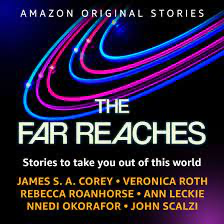
Read courtesy of NetGalley. It’s out now.
Honestly you just look at this list of authors and you can’t help but be impressed, right? I don’t love the Behemoth but this is a pretty amazing anthology.
James SA Corey gives a non-Expanse short story where the goal is humanity populating the galaxy. Which isn’t necessarily a goal I can subscribe to, but the method proposed here is an ingenious one. Clearly the distances are too great to send actual humans; generation ships are deeply problematic. So instead, Corey invents “slow light” that (don’t ask questions) allows for duplication of… stuff. So you can scan people and things and beam it out into the void – and ta dah! Humans colonising worlds that may or may not actually support them. Unsurprisingly, there’s not a lot of focus on the science; instead, this is all about the people. Because it’s the same people going to each of the maybe-settlements, and they can communicate with each other – albeit only at the speed of light. I loved this a lot.
I’ve never read anything by Veronica Roth! But I was fairly impressed by “Void”, which takes a completely different spin from the Corey: while it’s not quite a generation ship, the Redundancy moves people between our solar system and that of Centauri – so the crew lives on ship time, speeding along, while history goes on around them. Again, this is not a story of war or empire or politics of any sort; it’s human relationships and failings and friendships. It’s nicely done, and is exactly the sort of story that works well in the short format.
Ann Leckie, though! A new Ann Leckie story is always to be celebrated! And this is a super weird one from her. Humanity is not at the centre; instead it’s an alien whose planet has been discovered and settled by humans. This particular alien has the uncommon ability to look to the future, and organise its people to make its plans reality – partly inspired by the humans, and partly through its own intuition. So it’s a story of bootstrapping, and of individual genius and shortcomings, as well as the functions of society. It’s enthralling.
Then Rebecca Roanhorse, whom I have also never read. And “Falling Bodies” is heartbreaking. Ira, newly arrived at the space station Long Reach (which is, I’m sure, unintentionally hilarious to the Australian reader), is hoping for a fresh start. He’s human but hasn’t grown up with a human family; he’s got a new name and identity to live on this station, rather than spending however many years in prison; and he’s not sure how to fit in, and whether it will all last. The fitting in bit won’t be unfamiliar to anyone who’s gone away to uni, or moved towns in general; Ira’s particular circumstances just make it that much harder. Set more against a political background than most of the other stories, this one is still intensely personal.
And THEN there’s Nnedi Okorafor’s “Just Out of Jupiter’s Reach”. Seven people in all the world are chosen not at random or for skills but because of their genetics – the fact they happen to match with a genetically bio-engineered creature/machine, in partnership with which they must go exploring the solar system. As with the other stories, the main character, Tornado, isn’t anyone special – she says so herself – and so it’s a story of solitude and companionship, resilience or not… it’s beautifully written, and it’s hopeful and heartbreaking, and I loved it.
Finally, John Scalzi’s “Slow Time between the Stars” is another non-human story. In this case, the narrator is an AI: a ship, for want of a better word, launched by humans, containing the “Alexandria Module” – a repository of all human knowledge – and the task of finding a human-habitable planet and then creating those humans and whatever they required to survive. But of course, sentient beings often end up with their own intentions and goals, and so here. It’s a story of becoming, more than anything – learning about self, and figuring out what to do with it.
The unifying theme here is that these are individual stories. For all the title is “Far Reaches”, these stories are intensely personal. They’re not even really ABOUT exploration or anything else on the grand side of things. They’re about people, and much more about internal discovery and knowledge than external. These stories are fantastic.
Small Fires: An Epic in the Kitchen, by Rebecca May Johnson
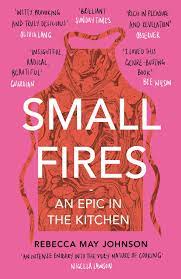
I read this via NetGalley, thanks to the publisher Pushkin Press.
This book is incredible and thought-provoking and I loved it enormously.
I sort of want to say this is a book that is “ostensibly” about cooking… except that it IS about cooking, there’s nothing ostensible about it. But it also uses cooking as a metaphor for many things, and looks at recipes and in-kitchen behaviour both for themselves and as metaphors, and reflects on the author’s life in general as well as her relationship with food and the preparation thereof.
I love reading about food and cooking and, although I feel a little guilty about it, I also love reading about how people feel about food. (The guilt comes because I feel like a voyeur.) This book does that for me, as well as touching on other things I hadn’t realised I would love in connection with a discussion of cooking. Such as…
Johnson has a PhD looking at a German translation of The Odyssey, and I had never before considered how you could make connections between that text and the myriad ways that cooking and food (not to mention gender – although I had thought about that a bit) are used in western society. The way that how we talk/feel about translation can also connect to the way we talk/feel about cooking was absorbing. And then there’s all the other theoretical stuff, like the psychoanalyst who thinks that cooking from a recipe is a sign that the cook lacks creativity… which made me, and Johnson, rage.
This book is at times prickly, at times confronting; Johnson reflects on large chunks of her life so sometimes she is bewildered and struggling while other times doing quite well. There were a LOT of times I responded on a very emotional level with what Johnson was saying: I cook for those I love; I struggle to think about making food for just myself; I have struggled with what my love of cooking says about me in terms of feminism (thank you, third wave feminism, for teaching me about the issues of second-wave feminism).
This is a powerful book. About cooking, yes, and the place of the recipe – and my goodness, Johnson’s exploration of what a single recipe can be, what it does, what it means: all of these things are glorious. It’s also an exploration of life, although I hesitate to call it a memoir and it’s certainly not autobiography. Many people come into Johnson’s life through the book, as she cooks for them and reflects on their relationships, but there’s not a lot of names – there’s a sustained reflection on the idea of ‘YOU’ as the one cooked for, and what body YOU represents changes over time, and exactly who they are and their relationship to Johnson is irrelevant for the purpose of the book. I liked this, too, even though the biography-reader in me kept expecting to understand the various relationships. But it’s not necessary for the book.
This is a book that I may need to own, in paper.

 Randomly Yours, Alex