The Mortons

Back in the mists of time, when Justine Larbalestier’s Liar first came out, we on Galactic Suburbia invented the Spoilerific episode just to talk about it in all its glory.
The Mortons isn’t as tricksy as Liar was. It is, however, a book to talk about, chew on, examine the bones of… and those metaphors get really uncomfortable when applied to this book.
The sprawling Morton family are not a family that ordinary people will have heard of. But if you have money, or power – or your family might one day have those things – you may well hear from them. They can help. They can get things done, smooth paths, remove obstacles. And all you have to do is sign a blank piece of paper.
The Mortons aren’t just killers, although that’s a significant part of their brand, if you like – just take a look at that cover. They also work in other ways to make the correct outcome occur; torture, accounting, social manipulation, and so on. They have been doing this for generations, because their children are taught – pretty much from infancy – how to Be A Morton. And sometimes they adopt children, too.
If you’ve Seanan McGuire’s InCrytpid series: imagine if the Price family were actually like the Covenant. And now make them the actual Covenant.
Jessica Morton is the prodigy of her generation. She is nearing the end of her schooling at Helshire College – along with her Morton cousins, the offspring of the other three legacy crime families, and a large number of children from wealthy ‘ordinary’ families… some of whom will end up being incorporated by the Mortons. She is eager to be blooded, and be acknowledged as an adult Morton. Fer first kill isn’t quite what she expected, though; and then her summer internship isn’t either. And then things escalate, and… well. Life can’t be the same again. Probably.

This is the author photo at the front of the book. When I first saw it, I thought it was Larbalestier and Westerfeld having a fun photo shoot. And it is. And then you get to a certain point in the book and you realise that they’re cosplaying, and it’s still a fun photo shoot but also just a little uncomfortable.
This novel is vicious. The characters aren’t spending their time asking whether killing is evil; the only questions are around motive. If you’re very squeamish, you’ll probably want to avoid it; there are a couple of bits that were a bit gruesome. Having said that: I read this very quickly. It was un-put-down-able. The writing itself is a delight: evocative, smartly paced, leavened with a touch of humour. The characters are really where it’s at. Jessica is an intriguing character to sit in the head of. She is completely committed to her family, and the family legacy. She has experienced trauma, and uses it to feed her desire to be excellent. Even when she is tasked with doing terrible things – things she actually doesn’t want to do – the family comes first. I had no idea where the authors could possibly be going with the story for a long time. When a change does occur, it blindsided me – it’s such a good twist – and of course it didn’t just stay as one thing, either. No, I am not going to put more spoilers here, this is a book where you do not want to know more than the minimum before going in.
The short version is that this is a brilliant book and I hope a lot of people read it. The main characters are in the late teens but I really hope it doesn’t get classified as ‘young adult’ – I might give it to a mature late-teen reader, but no younger than that. I would not recommend it, as noted, for those who are very squeamish (no shade!), or if you’re not prepared to read about children and adolescents happily considering (and undertaking) murder.
LOTR: Book 3
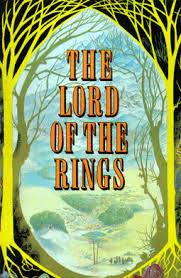
Finally I am back to this! Here’s a link to Book 2 (and thence to Book 1).
And now we get the split: the Fellowship has broken: Frodo and Sam have gone East; Merry and Pippin have been nicked by Orcs; Aragorn, Gimli, and Legolas choose to follow along after. Boromir is dead. And for this entire book we have only those second two sets; for a while, we have no knowledge of Frodo and Sam and the Ring, just like their friends. Which is really quite a remarkable choice, when you think about it: in theory this story is meant to be all about the Ring, isn’t it? But we go 170-odd pages with no knowledge of its whereabouts!
Other thoughts:
- I still really enjoy following Aragorn et al as they track the Orcs and hobbits. There’s something delightful to me in the description of the land, and of the chase.
- My attitude is now very coloured by the film-version of the Rohirrim – and especially their theme – but I do find them a magnificent, romantic, people. Dreadfully violent and arrogant, of course, but nonetheless. Tolkien captures their bravery and their pride, as well as the sense that the time for those attitudes might be coming to an end.
- Everything about Fangorn Forest, and Fangorn himself, delights me. The way Tom Bombadil’s forest is a foreshadowing of this one delights me; that much of the forest is untouched by other people delights me; Fangorn’s stoicism that can also be kindled to action delights me.
- I cannot imagine how it must have been for the first readers to have Gandalf back; I do not recall my own reaction. The metaphors-made-real of purifying by fire and ordeal are resonant and powerful, and I still find it awe-some.
- I’m sure readers who come to this from having seen the films must be very surprised by the swiftness of the Helm’s Deep battle. I do love that section in the film, don’t get me wrong; but I also like that it’s actually just another part of the action, and then the key folks go off to Isengard.
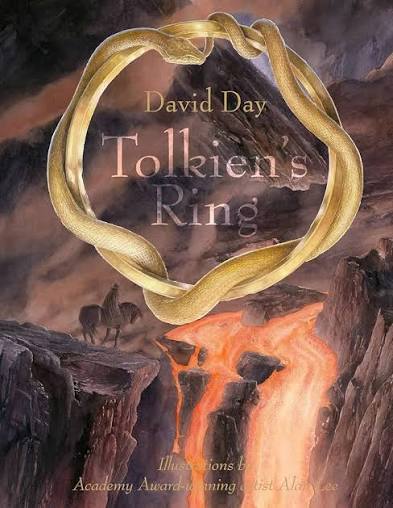
- At some point in high school, I won a book prize (okay, I won a lot of book prizes; but this is the only specific one I remember). The librarian knew me fairly well (unsurprisingly), and she chose the prizes, so I was given David Day’s Tolkien’s Ring – a beautiful hardcover version. It might have been the first time I read anything vaguely academic (it’s not academic) about Anglo-Saxon people, and about the Norse. Most importantly, that book introduced me to the idea that there are two moments in LOTR where Tolkien is chastising Macbeth, and the first one occurs at Helm’s Deep when the Huorns arrive and deal with the Orcs. That is how one should have Birnam Wood come to Dunsinane, Mr Shakespeare.
The last couple of times I’ve watched these films, I’ve often skipped through the Frodo and Sam sections. They’ve become the least interesting parts for me. Partly it’s the lack of action, and also the lack of colour; partly it’s that I find them so earnest and (genuinely) pathetic – I find them too hard to watch. But now there’s 150 or so pages of nothing but Frodo and Sam and Sméagol/ Gollum.
The Fist of Memory

Read c/ NetGalley and the publisher. It’s out in October.
There’s a Trevor Noah skit about how aliens never land anywhere near Africa, in Hollywood movies. Literature, of course, puts that to the lie, especially with Afro- and Africanfuturism over the last couple decades. Nonetheless, it sprang to mind while reading this excellent novel, because it’s set entirely in Africa – in Nigeria and South Africa, mostly – except for the bits that are set off-planet, that is.
Talabi uses multiple narrators to tell this story of memory, power, family and history. The first is The Irunmole – a name I had to look up, because my knowledge of mythology originating in Africa is woeful; I only did so when I was about halfway through and I’m glad I did that, so I’m not going to spoil it; feel free to do so for yourself. But here, The Irunmole starts off out at the Kuiper Belt, and they are focused on Earth. So yes, that’s a bit intimidating, but also there’s no sense of threat. We come back to the Irunmole just occasionally. Next is Tope: a killer for hire (that’s not a spoiler, she tells you she’s good at killing in the first line), she lives in Nigeria. Her story is told in the first person, so we’re right inside her head for her first chapter as she focuses on her target – and then deals with the aftermath. She has a painful backstory – and a painful present, too, as we slowly discover. Then there’s Itumeleng, an astrophysicist living in South Africa and a disappointment to his family; his story is told in the third person. I think Itu is my favourite character; his struggles to understand things outside of his worldview are highly believable. The story largely revolves around these two. Additionally, there’s Ahanna – also a killer, but these days hellbent on revenge, and pretty unpleasant as a result. His story is one that I was less interested in, ultimately, as the story progressed. And getting just a few chapters is Ufuoma, aide to the president of Nigeria – an intriguing character, with unexpected motivations; I would have enjoyed more from her perspective.
The overarching story is that humans register the approach of the Irunmole, and the Powers That Be respond as they think fit. But the truth is that this takes up far less of the novel than I had expected – while it’s always in Itu’s mind, it barely registers for the others until quite late in the story, because it’s kept quiet. So really this is a story of a near-future Nigeria (mostly; Itu goes to Nigeria relatively early on); and it’s fantastic. This is a world where most people have AI implants, which are trained on the individual – ask it for the time, or for basic info about something, or have it question whether you’re making sensible decisions. It’s a world of self-driving cars (mostly), and various other impressive technological features… but also one where corruption, and poverty, and other human vicissitudes are very present – why else would someone like Tope still get work? But that’s not to ignore that humanity’s other aspects – the love, the collegiality, the desire to do and be better – are also, of course also present.
I don’t know Nigeria, so I can’t speak to how well Talabi sites the novel geographically – he’s Nigerian, so one assumes he knows what he’s writing. Same goes for the way he portrays Nigerian society, and the use of language; several speakers use pidgin, and there’s a fair amount of slang too, all of which makes sense in context and adds to the sense of place. Additionally it’s worth noting the use of “juju” – just a few mentions, but at key moments – this is a word that I’ve only come into contact with as meaning ‘magic’, basically. Is the reference here meant to be ‘magic’ in a Western fantasy understanding? Is it science that’s not explained? It’s unclear – and I think that’s actually the point. Differentiating is unnecessary, and even unhelpful.
I was a little… surprised, maybe, by the ending. It wasn’t what I expected; I’m maybe a little disappointed, but also intrigued. Basically I have to keep thinking about it, which in itself isn’t a terrible result.
Overall though his is a really great novel, and one I enjoyed a lot.
The Missing Thread
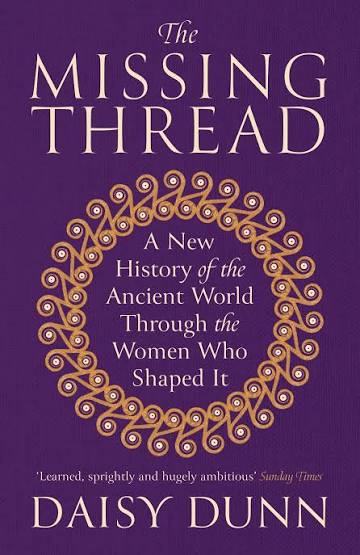
A New History of the Ancient World Through the Women Who Shaped It.
I am so conflicted about this book.
The theory: absolutely up my alley. Writing women back into the (hi)story they were always a part of? Of course that’s a good idea!
And yet… I can’t help but feel this book isn’t quite the right way to do it.
Some of the good things first:
It is great to have women like Atossa and others who get one line as a wife or a mother brought to the forefront. Discussing Fulvia and Octavia a lot when discussing Marc Antony and Octavian? Brilliant! Not to mention Olympias when you’re discussing Phillip and Alexander of Macedon. There’s a nice amount about women like Sappho, too, so it’s not just all fighting – and the book opens with what we might be able to understand about Minoan culture, which probably had important roles for women, so that’s also excellent.
And yet. I have reservations.
One issue is that it’s still trying to tell exactly the same story of battles and political intrigue, just with women in it. Sometimes the women feel shoehorned in – this is a story the author wants to tell, and has to fit in the women to justify the story. So that’s frustrating. Partly this is a result of my own expectations: I was hoping for some new stories, making “history” not just about battles.
A large part of my problem is that the author doesn’t make much attempt to differentiate hearsay, calumny, and verifiable stories. There’s occasionally a gesture at that – “oh, these words were used to make the woman / man associated with the woman look bad” – but it’s usually after the story has been presented as legit. And sometimes the stories are just presented as fact: Cleopatra in the rug to sneak into Caesar’s room, for example. So in some instances, the worst stories about women’s roles are blithely repeated.
And then there’s the fact that this is presented as a history “of the ancient world.” Which, to me, suggests “of the world.” The occasional reference to China – with no context at all – does not make a global history. This is a history “of the Classical world” with very occasional reference to things in “the Near East” and about three sentences about China. Which would be fine if the book had made it obvious that’s what it was doing.
So. Yes. I am disappointed. As someone with knowledge of most of the general stuff discussed in the book, I could contextualise what was being presented and it did indeed give me info about women’s actions I hadn’t come across before. But I would not give this to someone with no prior knowledge.
Beyond the Graves Waits Mist and Sea
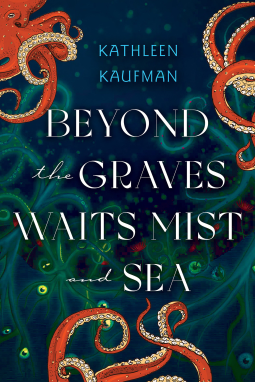
Read courtesy of NetGalley. It’s out in September.
The short version is I liked the ideas behind this quite a lot, but I found the execution lacking.
The positives:
Sometimes I like a chosen one story. There’s something a bit cosy, a bit comforting, about reading a book where the main character is really special. I know it’s not for everyone, and that’s ok! So, here, Harper is a marine biologist and she’s looking for some evidence that will help show her PhD idea is real and viable rather than just a crackpot theory. So she ends up on the remote and mysterious Bell Island to do the research. She’s been a loner all of her life; her parents died when she was 13 and she’s been emotionally closed since then. Her mother was a Bell Island native, but Harper’s never been there. She’s also had weird dreams for her whole life. So yes, it’s pretty obvious there is Something Special about Harper.
Some of Kaufman’s description is pretty great. It’s a windlashed island – there’s a lot of scope for it.
The less positive:
I have some big complaints, and some smaller one.
First, it’s too long. Harper’s dreams – especially early on – and her internal agonies get repetitive.
Second, some bits are simply unbelievable. I’m not talking the existence of huldafolk or an octopus who communicates with humans; I mean someone with both a 17-century diary (which she can read with ease) AND a historical account in front of her, and she CHOOSES to go back and forth between them rather than reading one in entirety. With no explanation like ‘she’s looking for context’.
Third… I just got bored. It was very obvious very early on what some of the twists would be – which isn’t necessarily a problem, but when the book treats the reveal as a surprise, it is a problem. Harper is meant to be looking for evidence of a mysterious octopus, but there is a remarkable LACK of octopus. Also a lack of science, but that’s because of the epic storms the island faces, and that’s fine in the context of the geography.
And a small issue in the context of the story, but rather large theologically: pretty sure no one prays to “Christ the Father.” Because, uh, that’s kinda the point of Christ – that’s he’s not the Father…
Overall, I was disappointed.
As You Wake, Break the Shell
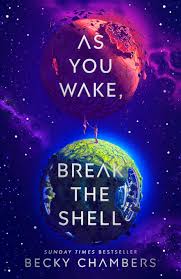
I read this courtesy of the publisher and NetGalley. It’s out in October (sorry).
A more complete review of this will appear in Locus eventually, but: it’s brilliant.
I read Long Way to a Small, Angry Planet when it first came out, I think, and I bounced off it hard. Why? I do not remember. Not a jot. Probably I was in the wrong frame of mind – at least, I can only assume so; after reading this I wonder if actually I was too much in a ‘big space adventures’ mode.
Chambers does some clever narrative things across this novel. Firstly, the chapter sequencing: it starts with Chapter 1… but then all of a sudden you’re in Chapter 764, and no you didn’t skip a lot of pages. So there’s two parallel timeframes. Which means one of the big character questions is resolved very quickly, which means that you can get on with looking at the other questions: how do the characters get from here to there? What changed?
It would be easy to read this mostly as an almost domestic novel, focused on two people and their experiences; there are even recipes! But the reality is that Chambers is doing some really cool political stuff here. The reality of the initial planet’s colonisation, the way the two societies structure themselves, how difference is viewed… yeh, there’s a lot going on.
It’s really good.
Object Lessons: Laboratory
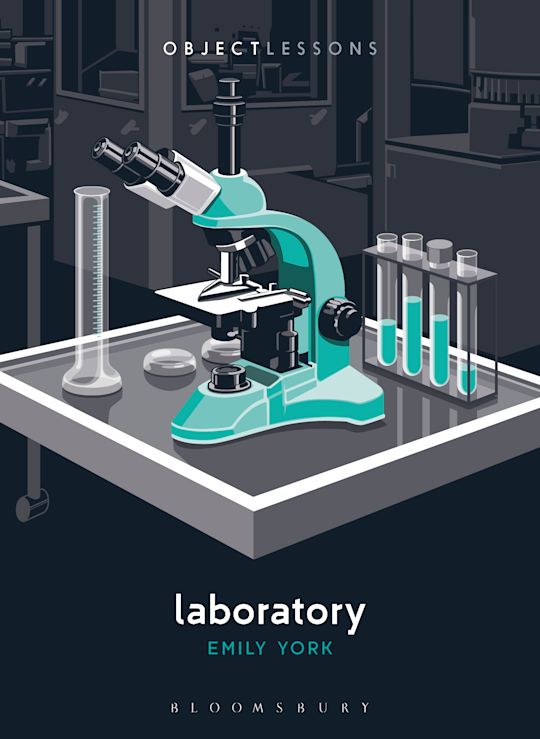
I read this courtesy of NetGalley and the publisher, Bloomsbury Academic. It’s out in September.
I have said this before and I say it again: I love the Object Lesson series. Sometimes the Object in question seems relatively simple – a skateboard! – but sometimes it’s a bit more abstract: like The Laboratory. (One of those words where you can hear an Aussie / Brit vs US accent difference.)
As is so often the case, York uses her own experience – of sort of working in a lab, and sort of not; being science-adjacent – to illuminate all sorts of interesting aspects of the lab, and along the way varying reactions to science as a discipline. She looks at labs in science fiction – in film, in particular, since that informs so much of what non-scientists think of as “a lab” (ask me how I feel about the lab in Fringe).
I enjoyed the expansive view of “the lab” that York brought in this book, and how passionate she clearly is about communicating the realities of scientific research to a broad audience – that it’s piecemeal, that it involves many, many contributors, that it’s usually safe! She has a good section on the development of scientific rigour, and laws around things like animal experimentation – and, of course, given it’s Now, touches on some of the issues around Covid and its genesis.
This is a really great intro to the idea of “the lab” for the non-scientist, but I suspect it might also be a nice thought-provoker for those who work in science to think about how the rest of the world views their work, and their world.
Bodies of Magic
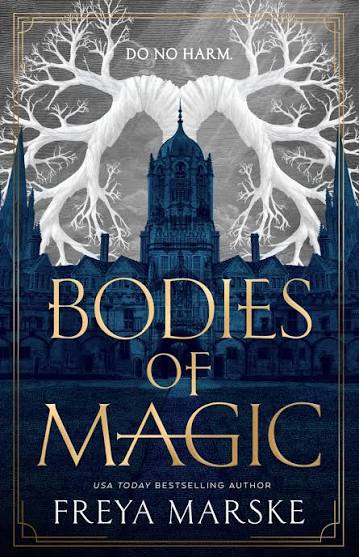
I read this in ARC. It’s out in September. (And it’s worth waiting for.)
A proper review of this is forthcoming in Locus, but the TL;DR is I loved it. I’ve loved everything of Marske’s I’ve read so far, so that’s not a huge surprise – but this is quite different from her other books in some ways. Some similarities, though, too.
Set in secondary world, where some people are born with magical ability and that’s no real big deal. You get tested, you see whether you might have a gift. If you live in Sieuxerr, though, you might have the ability to be a healer – in which case you have no choice but to be a healer. And after five years of study you undertake five days of exams with four other students – not of your choosing – before you graduate. And then you have to go off and be a healer, either in whatever place paid for your training (because of course it costs), or at home if your family is rich enough to have paid upfront.
Sounds familiar, really, doesn’t it.
The book focuses on five students in those final days. All of the characters are beautifully developed. They all have their struggles, and their achievements.
Did I mention there’s a death? There’s a death. Finish your medical exams AND figure out whether the death is a murder or not! No drama! So there’s investigatory shenanigans; there’s falling in love, arguing with family, making your place in the world, defying expectations, etc etc. It’s a lot of fun. I did get about 4/5 through and have to go stare at a wall, For Reasons.
This is such a great book.
Eat Like a Sardinian
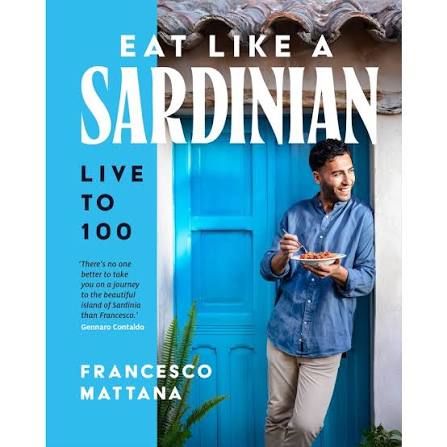
I was sent this book by the publisher, Allen & Unwin, at no cost. It’s out now, RRP $45.
On the one hand, this book has really excellent recipes.
On the other hand, I deeply object to the whole ‘live to 100’ vibe, given probable realities about so-called blue zones.
On the third hand, you can look past that (I do), and it’s a fine book.
As you would expect, this is a beautifully produced book (although to my sadness, there’s no ribbon bookmark; I do love a ribbon in a cookbook). The photography is great, it’s mostly about the food rather than the cook, there are some adorable handdrawn (they look like embroidery!) images scattered throughout, and the recipes themselves are laid out well. No complaints at all about the presentation.
There’s a good range of recipes – the book is structured like a traditional Sardinian meal, Mattana says: Aperitivo and Antipasti; Pane and Pasta; Primi; Secondi; Contorni and Verdure; La Dolce Vita. Within the chapters, there are harder and easier recipes. I would note that this is not a book for a beginning baker: the recipe for (the delicious) sultana and saffron bread asks you to judge ‘if the bread looks ready to bake’ with no suggestion for what that looks like, for example. And in the Culurgiones recipe there’s no indication of when the ravioli is cooked / how long to cook for.
Recipes I have made:
- Pizzette Sfoglia – puff pastry pizzas. So simple! Quite tasty, although I do think the filling (tomato passata, oregano, capers) could have been tastier.
- Su Pani Arrubiu – sultana and saffron bread. Also with orange zest. Absolutely delicious. And he recommends a long, overnight, proving, which I think was really good. Mine wasn’t as good as it could have been – I’m blaming winter – but 100% would make again.
- Tallutzas con noci e ricotta – I made this with bought orecchiette; the combination of ricotta and walnuts and nutmeg was an absolute delight.
- Culurgiones – potato stuffed ravioli. Yes, I made ravioli. Was it worth it? Look, I’m not sure. They were very tasty and I made quite a lot so a bunch went into the freezer. Are they better than very generic supermarket ravioli? Oh yes. Did they take a long time? Also yes.
- Li Puligioni – ricotta ravioli – no, I did not learn my lesson. Yes, pasta stuffed with ricotta and orange and lemon zest is very tasty.
- Spizzulus con cardoncelli e salsiccia – pasta with sausage and mushroom sauce. Had to make a sub here as my local supermarket doesn’t have dried porcini (!), so I used fresh mushrooms instead. It will have tasted a bit different, therefore, but overall this was absolutely excellent. And getting the butcher to de-case the sausage first was also brilliant.
- Panada – Sardinian pie. Further to ‘not learning my lesson,’ yes I made the shortcrust pastry for this pie. The pie has a really interesting structure: basically you’re cooking a really dry stew inside a pastry shell. You’re putting raw meat and uncooked potato inside and it comes out… perfectly cooked. Also a lot of work, but did feed two of us for three dinners.
- Bombas – meatballs. I love meatballs. These are fine but nothing out of the ordinary.
- Involtini di carne con verza. Never again will I stuff cabbage rolls. Maybe using ordinary cabbage rather than Savoy was a mistake – I don’t know, I don’t know cabbage.
- Torta di mele – apple cake. It was fine! I was lazy and didn’t do the apple slices on top, which meant it wasn’t as apple-y as it should have been, so that’s all on me.
There are more recipes I’m looking forward to making, so this one will be staying on rotation.
The Hunger of Those Who Built It
Read courtesy of the publisher, Stelliform Press. It’s out in September; you can preorder it now.
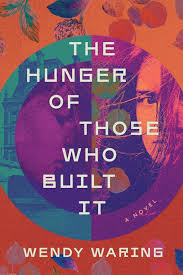
Wendy Waring does an intriguing narrative thing in this novel. The first 60 or so pages alternate between Lou, who has managed to infiltrate The Oxbow – an exclusive and exclusionary colony, basically, set up in the middle of a crumbling Paris – and Diane, Lou’s aunt, Green architect/designer and largely responsible for The Oxbow.
Then all of a sudden we get a timeshift: back 16 years, before The Oxbow exists. Diane is offered a job in Paris, creating vertical farms and helping to green part of the city, at the same time growing food for the inhabitants. It’s a world where in theory, at least, technology is greening, and so some aspects of early-21st-century urban life can change – massive highways, for instance. But, as Diane slowly learns, there are still privileged groups seeking to keep all the good stuff to themselves.
Basically, the majority of the novel is following Diane as she learns how her dream gets turned into the gated community of The Oxbow.
So on one level, it’s a story of a woman watching her dreams get manipulated and changed away from her vision. And it’s powerful for that: how hopeful intentions can be subverted, how good plans can be made to go astray, and so on. How corporations can destroy individual hopes. And, as well, there are some intriguing ideas for how cities might indeed change – for good; this is being advertised as solarpunk, after all.
The novel is not only about ambition and technology and urban infrastructure, and the big picture, though. It’s also focused squarely on the smaller picture: Diane wants to go to Paris because she is seeking reconnection with her sister, from whom she has been estranged for many years. There are many reasons for their separation; some familial, others political and philosophical. None of them have easy solutions, and Diane is frequently conflicted about her own as well as her sister’s attitudes. What I liked about Waring’s story is how very real it feels. Siblings are exactly those people who know how best to get under your skin, and who are also (often, not always) the people you want to be drawn back to.
I have one quibble with the story: an event in Diane’s history turns out to be very different from how she understood it, which has serious ramifications, many of which are part of the point of the story. But one consequence, about the dating of other events, doesn’t seem ever to be addressed, which is unfortunately something I really struggled to reconcile.
However! All up, I very much enjoyed this novel. It’s well written – I devoured it – and Waring balances the macro, urban issues with the micro, personal issues beautifully. They each feel as important as the other.
As a debut, I am deeply impressed, and hope that we can expect more of the same in future from Waring.

 Randomly Yours, Alex