The Brilliant Boy, Gideon Haigh
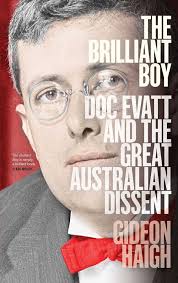
Doc Evatt and the Great Australian Dissent
Ok. So. Firstly, this is not the book I thought it was going to be. Partly that’s on me – I didn’t read the blurb carefully. So that’s a lesson. It’s also on the person who recommended it to me, because he led me to believe it was a proper – that is, complete – biography of Doc Evatt. And it’s not.
So, actually, possibly firstly: did you know that Gideon Haigh wrote full-on proper history, and not just cricket?? Me neither, until I was recommended this book.
Maybe this is first: until last year, I really didn’t read modern biographies, and I certainly didn’t read modern Australian biographies, let alone modern Australian political biographies. And now I’ve read two, arguably three, and I am having a minor (very, very minor) identity crisis.
All of that out of the way:
I know of Doc Evatt for having been instrumental in setting up the Universal Declaration of Human Rights, doing other important work at the UN, and then being shuffled off and ignored by the Labor Party and Australian politics more broadly. I had absolutely no idea about his early life, how he got into politics, or what he was like as a human – except that he’s generally regarded as “brilliant and/but mad.” This book is almost entirely about Evatt’s early life, focused on his career as a lawyer and then as an exceptionally young High Court judge.
Do I care much about the law, the legal profession, or even much about how the Constitution is interpreted? No I really do not. Were there bits – large chunks excerpted from lawyers’ speeches, and bits from judgements – where my eyes glazed over? What do you think. Did I nonetheless find this a fascinating biography? I am almost embarrassed to admit that I really did. And that’s partly because Haigh is a really great writer, and partly because of the actual point of the book. Yes, it’s about Evatt. But it’s also about the idea that someone should be recompensed for the suffering they experience – not just physical injury – when someone has done them wrong.
The book opens not with Evatt, but with the death of a young boy – “the brilliant boy” – a child of Polish Jewish migrants who drowned in water collected in a hole in a road thanks to roadworks, in the early 1930s. The council hadn’t put up much in the way of protection. The mother suffered enormously from what was then termed “nervous shock” in the months and years after his body was found. And that was the focus of many court cases. Were the council liable for the mother’s suffering?
Warning: there’s a lot of callous and misogynist language in the judgements handed down.
I did, indeed, learn a lot about Evatt. I have much greater respect for his intellect and achievements – as well as some appreciation for why he was and is regarded as a bit mad. There have been two full biographies written of the man, but they’re both quite old and I don’t feel like I can go read them now. Along with all of that, I also learned a great deal about the development of how pain and suffering are viewed in the law, and – knowing that our current system is very, very far from perfect – feel very thankful that I live now, rather than a century ago.
Notes from a Regicide, Issac Fellman
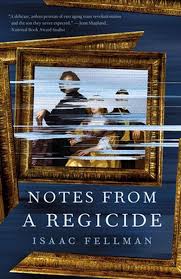
This is a complicated and complex, beautiful, fierce, glorious novel. There are so many things going on. The short version is: if you want a beautifully written novel involving a political story (I mean, look at the title), trans stories, a love of art, dealing with families, and a hint of science fiction – just read this. Don’t bother reading this review, just go find it.
If you need some convincing, well:
I feel like the only way I can talk about this book is to identify some of the strands, but also begin by saying all of the strands work together perfectly.
In part this is a son editing and presenting his father’s memoirs, particularly from when the father was in prison. The son, Griffon, includes notes at the start of those chapters – just a little William Goldman-esque, noting that he’s done some pruning. Those sections are where most of the politics are. The father, Etoine, lived for many years in Stephensport, an island that has completely turned its back on the wider world, ruled by a prince chosen by electors – who otherwise sleep in “the stone yard” and for whom citizens pray. Etoine is an artist, and gets drawn into revolutionary activity mostly against his will. It’s here Etoine meets fellow artist Zaffre (which really is a beautiful colour); she is a much more willing revolutionary. As someone who taught kids about revolutions for many years – well, the political bits here ring true, in the most devastating and fierce and poignant ways.
It’s also a memoir of Griffon, finding his family with Etoine and Zaffre, and also finding himself: he is trans, and it’s only on meeting Etoine and Zaffre that the possibility of living as himself starts to seem feasible. As an adult, looking back on his adolescence, Griffon is both harsh on his younger self for being self-centred and arrogant, and also forgiving for not knowing any better. It feels right.
So there is a lot about family here – having one, ignoring them, the frustrations and embarrassments and comfort, the impossibility of ever knowing people fully and the joy of being known and loved despite that. All of that alongside the politics.
And then there’s the art. Etoine and Zaffre are artists: for both of them, although in different ways, art is at the core of their identity. Fellman captures the obsession and drive of some artists, not romanticising the despair but also not ignoring the difficulties; for both, art is about life and life is about art – and it’s inextricably connected to politics, too.
I haven’t finished yet. There’s also mental illness – Etoine is an alcoholic, Zaffre has schizophrenia (maybe; her diagnosis is unclear), which they manage to varying degrees across their lives, to different effect on themselves and those around them. Again, not romanticised, but it also doesn’t make either of them a villain – and nor is it necessary to their art. It just is.
And, finally, this is a science fiction novel. Honestly it would be easy to ignore that part. It’s not quite blink-and-you’ll-miss-it, but it’s not far off. It is completely necessary to the world of the story, but it’s also not at the heart of the narrative. It’s supremely well done. I feel like there will be a lot of people who go into this expecting A Science Fiction Novel who may be disappointed by the way it uses the genre; that would be sad, but I would get it. I also think there will be a lot of readers who would love this book – for all the reasons listed above – who will avoid it because it’s called science fiction. That, my friends, would be a great tragedy. But if the foregoing words don’t convince you of that, there’s not much I can say.
Really. Just read it.
This is yet another book I have read by Ian Mond, and – intriguingly – he’s never steered me wrong. I’m not going to say we always agree, because there’s a lot he reads that I never will, but the circles of our reading Venn diagram do have some overlap.
Speculative Orientalism, by Sang-Keun Yoo
I read this courtesy of the publisher, Bloomsbury, who sent me the ebook. It’s out now.
It’s been a while since I read a book doing such serious literary analysis. And I don’t remember the last time I read one looking at such a range of science fiction authors, so that aspect alone was really awesome.
I believe that this book came from Yoo’s PhD thesis, and having read a few theses – and read a few books that have come out of theses – I can say that overall Yoo has done a good job translating what is necessary for a very specialised academic audience into what works for a slightly more general audience. There are a still a few bits – in particular, some repetitions – that I think are hold-overs from the thesis; they weren’t bad, as such, just not quite what I would expect from a book written first and foremost as a book.
I should note, though, that this is not a read-in-one-sitting, easy-going book. It requires you to actively pay attention, and think seriously about the words and ideas, because the ideas about ‘orientalism’ and Yoo’s points about how English and, in particular, American authors have used and changed orientalism, particularly as part of the New Wave – these aren’t entirely straightforward, and you want to follow the changes over time closely.
So, if you’re up for a serious read, this will suit you well!
I’ve been reading science fiction for a long time, but I am a child of the 80s, which means that “new wave” fiction was already ageing when I first became aware of it – and honestly I would still struggle to point out the real differences between pre-new wave, new wave, and post-new wave. Maybe I’m just not analytical enough? Whatever the case, one of the initial things that actually really worked for me was Yoo’s general introduction to what the new wave authors were doing, and why this was important, and what it looked like in both the UK and the USA. So that was one very useful result!
The meat of the book is looking at the – well, I hesitate to use ‘progression’ or ‘development,’ for their implications of positive change over time. I think Yoo does make a claim for progression, eventually, but it’s still a somewhat fraught term.
Let’s stick with ‘change.’ So, Yoo opens with looking at how William S Burroughs (whose work I have never read!) uses orientalism in his work: that is, references to “Asian” ideas, places, or things, whether that’s a generic “Asian” or a specific ethnicity like Chinese. Uh, spoiler? It reads as super racist. (Who am I kidding, it is super racist.) So that’s… fun.
The really serious analysis comes with next three chapters: Philip K. Dick (do I get kicked out of the club if I say I didn’t enjoy the few stories I’ve read); Samuel Delany (I’ve read a few! I refuse to read Dhalgren, though, on the grounds of too darned long), and Ursula K. Le Guin (I have read most). With these authors, Yoo traces the various influences on their writing – personal experiences, personal belief systems, and so on – and how this plays out across their fiction, and what this suggests about attitudes towards “Asian” ideas, in particular religiously and politically. Unsurprisingly, Le Guin’s use of Taoism is noted as the most nuanced and thoughtful use of those ideas, and as developing across her long career. I was also very interested to read about the African-American and Asian connections that were apparently being discussed in the 1960s, about which I knew nothing.
Overall? This is not a book for a casual reader. It is a book for someone who likes thinking about meaty issues, and who already has at least some familiarity with some of the works being discussed. I’m very pleased that I got to read it.
Yet She Lives, by Lisa Hannett
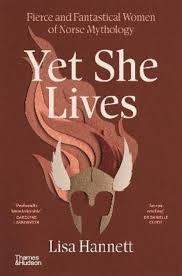
As we all know, the women of mythology tend to be poorly served – both in their original source material, and in subsequent historical examination. (Perhaps I exaggerate… but really? Not that much.)
In this excellent book, Lisa Hannett looks at the women of Norse mythology. She does so in a way that is very particular to her expertise – as an historian and a writer of speculative fiction: she retells the stories of the women and also puts the myths into their historical context – both the context of what life was like for women when the myths were probably initially told and then written down (which are not at all the same time), and how the original audience likely received the stories. This level of historical explanation has the potential to come off rather dry, but Hannett presents it in an engaging, readable style: there are references to pop culture, and her own travels to Iceland and Scandinavia; she uses precise language but in such a way that it never becomes jargon. She puts herself into the book – this isn’t some clinical academic pretending that her own experiences have no impact on the way she approaches her material. And she also looks at the enduring legacy of many of the characters – from the Marvel Cinematic Universe to Wagner’s Ring Cycle, via other iterations of Freyja, the Norns, and Valkryies. Hannett covers a lot in just over 250 pages.
There were some characters in here I had not previously come across, and others I had not experienced at this level of detail. I certainly hadn’t fully appreciated the role of the Norns, nor of Freyja as the goddess of sex, love, and death. Obviously not all female characters in Norse mythology can be covered in such a book as this. Instead, Hannett has chosen specific characters – some are those she clearly is particularly intrigued by, others chosen for what they reveal about particular aspects of Norse society. All together, they provide a sometimes challenging, always intriguing insight into the myths and their audiences.
This is a companion book to Hannett’s Viking Women, which looked at the (maybe, mostly) historical women of the Viking sagas. It is also, unsurprisingly, brilliant. You should definitely read both of them.
What the Bones Know
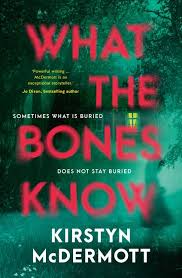
I am a wuss. I do not enjoy being frightened. As a consequence, I rarely read books that are explicitly marketed as horror, and don’t particularly love books that have horror elements.
Of course, there are exceptions to this rule; sometimes I have read a book without realising it had horror elements and I’ve really enjoyed it! But I am wary.
All of this is to say, I haven’t read much of Kirstyn’s work, despite her being a friend.
However. I should start a “books I read in one sitting” tag in Goodreads. This book would go on that shelf. Because, yes, I did. I started it in the afternoon, read through dinner, and finished it before bed. Note: I did not read this while alone in the house. Because I am not that silly.
There are three sets of horror / disturbing elements playing in this novel. One: it’s set in 2020, and it starts in Melbourne. The main character then goes back to her family farm, so she’s not in the city for the entire period of the world’s longest sets of lockdown, but nevertheless: the panic buying and the lack of certainty and… yes. Well. If you were there, you know. Kirstyn captures it beautifully. It all felt very real – the not knowing in March, the waiting for the Premier Dan pressers… no, I didn’t quite have flashbacks, but I could visualise it all very easily.
Two: Jude, the main character, goes back to the farm because she fears her mother’s mind is wandering. Hands up those of us in that situation or about to be? Yeh. I don’t like it. Again, Kirstyn writes it perfectly: the snapping in and out of focus, the tightrope-walking of whether to challenge a sentence here or there, the fear of whether she’s a danger or herself or others. Being bewildered at suddenly being the responsible one.
Three: there’s a ghost. Maybe? The gradual revelation of what’s going on with that is truly masterful. And I won’t say any more about that because it’s the unravelling that makes it worthwhile. Trust me, though, it is worthwhile.
Oh, there’s also a recently ex-husband who’s a complete arse, so that’s like point 3.5.
What the Bones Know has a tiny cast of characters, all of them excruciatingly well-observed – and being so tightly bound to just a few people (particularly when it’s daughter, mother, grandmother) really adds to a sense of claustrophobia – despite it being set on a farm. It has a spectacularly Australian tone (tits on a bull!) – and if you’ve driven around Myrtleford, in Victoria, you will instantly recognise the area. And, as witnessed by my need to read the damned thing so quickly, it’s very compelling.
Just read it.
She Who Tastes, Knows
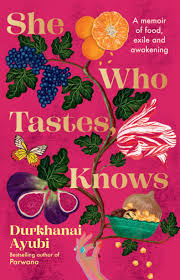
I received this courtesy of the publisher. It’s out now.
I am very ambivalent about this memoir.
On the one hand, there are some parts I enjoyed a great deal. The history overview of Afghanistan’s place in history – central to several empires over centuries, key to the Silk Road, and then the later shitshow of the 19th, 20th, and 21st centuries – was very well done and gives a good sense of the country’s deep and important place in the world. And then the discussion of its botanical richness – that was incredible. I know about the importance of not having monocultures and the extreme risk the world faces regarding a loss of diversity; I had no idea that for a whole bunch of colliding reasons, Afghanistan is home to an astonishing range of wheat varieties and fruit varieties and so on. That was fascinating.
I also appreciated the author’s discussion of her own life as a very young refugee, moving to Australia and growing up right around the time most Australians first learned about Afghanistan for all the wrong reasons. Her graciousness in conceding why ‘ordinary’ Australians didn’t know better than what we were fed by the media and politicians is humbling, while also infuriating that such an attitude was even needed. Attached to this are two very different discussions: one, Ayubi’s discussion about the importance of keeping her culture alive within a broader Australian culture – particularly through food, unsurprisingly; and two, a broader critique of the way white Western cultures have bad-mouthed refugees and all of the implications of that.
Most of the content was engaging, and was the reason I kept reading.
However… much of the book is written in a style that really doesn’t work for me. I find it overly flowery, to the point where I struggled to grasp the author’s point because the language obscured it. As a sample:
“I sat quietly amid my grandmothers and ancestors. Till this point, I’d never felt such a depth of my own story. Through a life of exile that was shaped most by absence, my relationship to food had kept me tethered just enough – weaving into my body and consciousness the hints I would need to stay aligned as I undertook the necessary remakings of myself, to gradually bridge me here. I was within a verdant and layered sense of fullness that had ripened through time, each cycle of growth feeding on the decomposition of the last.”
I’m quite sure this style appeals to a lot of people, and I think that’s great. I hope the book finds its way to their hands! But 220-odd pages of this was too much for me. Which was a shame, because I really wanted to enjoy it more.


