Women’s History Month series


Links to interviews (and transcripts) with Melbourne women who protested against the Vietnam War and the National Service Act.
(list continues below)
Continue reading →Stargate SG1, s4
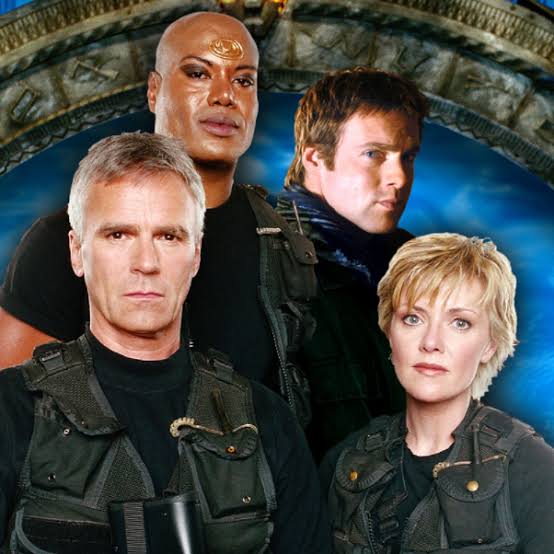
We left season 3 with Jack, Sam and Teal’c having just destroyed Thor’s ship to try and destroy the Replicators, but did our heroes get off via stargate?? We know at least one of the replicators survived… and we start the fourth season in a Russian submarine hearing weird things. More importantly Daniel has had a time to get a sleek haircut, around dealing with the consequences of not staying in bed after his appendicitis. And Teal’c has a WEIRD BLONDE SUPER-SOUL PATCH BEARD THING? (Which fortunately only lasts less than half the season.) And I think Sam has had a haircut too – well, it’s longer, and more curly. (And she gets a cute little pixie a bit later in the season, too, which really works for her.)
ANYWAY. We also learn that the most advanced Asgard ship is The O’Neill. THAT is hilarious – and the only thing funnier is that Sam tells them to use it as a bait and blow it up.

The episode with the Eurodans (which WordPress just autocorrected to European, which is… appropriate) is one of my least favourite episodes: the grotesque nature of Alar and his people is so insidious, and Jack is so easily swayed – until his buddy Teal’c is a problem – that I find it really hard to watch. BUT the immediate next episode is where the team gets magic strength armbands and that, too, is hilarious. As is Jack and Daniel’s competition for Anise’s attention. Anise/Freya’s outfits get outrageous across this season. I mean… And, of course, this brings us to the episode that sparked one million fan fics, because both Jack and Sam have to admit their feelings for one another. OOOOH. And it’s followed by the other episode that spawned a million fics, with Jack and Teal’c going all groundhog day. This is probably the episode I rewatched the most, back in the day. It’s just so funny (mostly). (There are, I think, a number of Daniel/Jack moments in this season that must also have launched a million fanfics, but I’m not as good at seeing those.)
Last season I commented there were no significant cameos, but then we get Deanna Troi! Marina Sirtis! With a Russian accent! Because of course the Russians found the stargate and got it open. This episode aired in 2000, which makes the maybe-friendly maybe-enemy storyline with Russia really quite fascinating. Meanwhile, there’s some other BSG alum – Alessandro Juliani, a Cylon (Matthew Bennett), and the fabulous Lorena Gale is briefly an archivist. And Steven Williams, whom I recognise from many shows, got to play a general. And holy shit General Michael E. Ryan who was an actual Chief of Staff of the US Air Force plays the Chief of Staff of the US Air Force. What. Even.
With such a long-running arc in terms of villainy – and the fact that the Goa’uld are a society, rather than just being Blofeld – I increasingly appreciate that the show occasionally pays attention to them as such. So you get the discovery that the Goa’uld originally took Unas as hosts, and then in this season the discovery of the probably Goa’uld home world – not to mention the history of the Tok’ra, plus the arguments between System Lords. Let’s be honest, SG1 is sometimes a very silly show, but there really are some deeply fascinating and thoughtful ideas throughout it.
The somewhat shocking threatened change in this season is Gen Hammond apparently getting shot of sending people off to die, which brings in Gen Bauer, who immediately splits up SG1 so he’s clearly a knob. And it leads to Jack making a deal with Maybourne, which I kinda love – he’s so spectacularly paranoid – but also talking to Senator Kinsey, which I could always do without. Although Hammond immediately comes back when his grandkids are not being threatened, it does subliminally signal that not all of these characters will last forever…
Given my comments on season 3, there’s remarkably little about children in this season. Shan’auc regards her symbiont, with whom she’s been communicating, as her child; Jack mentions his son once. And then you get the episode “2010” which sees Earth stealthily taken over by an apparently beneficent alien race that actually sterilises the population – which we learn because Sam is married but not to Jack, and trying for children. And then there’s the episode with young Loran, who’s somehow been surviving in the Goa’uld pleasure-palace by himself for ?years. Then, 2/3 through the season, we flip back to the Harcesis arc: the team meets Shifu, who gives Daniel information that would help against the Goa’uld and then an insight into what it might do if Daniel were to use it… and so Shifu goes on his way and Daniel acknowledges he needs to change. But still: not so many children.
There is, though, a bit more focus on Earth politics than previously. The Tok’ra and the US president meet, to come up with an accord; the Americans do some coordination with the Russians (and Maybourne, that arse, was already playing with them).
On a structural level: there’s a new credit roll. I dunno, does that mean they didn’t want to focus on a particular person on the cast anymore? Are they preparing for someone leaving? It’s a curious choice, anyway – having a faux-Egyptian sarcophagus (Osiris?) as the entire opening? – given that the Goa’uld had slowly seemed to be moving away from being the focus of the show. I’m also fascinated by the fact that the opening scene – the prologue, before the credits – doesn’t seem to be a uniform length. Have I actually timed their lengths? Of course not. But they feel like they vary. And I don’t usually pay attention to the directors with tv shows – it’s just not a focus for me – but I did notice that Michael Shanks directed an episode, which is cool.
DVD extras:
Mostly a bit dull and I didn’t bother watching, TBH, and the set up (Hammond and Frasier ‘talking to the screen’) is a bit cringey. However the one I did watch taught me that the Antarctic episode was shot with real ice and snow, and Sam’s falls down the “glacier” were real; and Daniel’s appendicitis was because Shanks had actually had appendicitis so they had to figure out what to do.
Stats:
- Sam gets a raw deal for being female: 0 (I’m keeping this in just so I can hold the show accountable)
- Someone falls madly in love Sam: 1 (we don’t see the falling in love, but she is married in the future…)
- Sam reciprocates: (as above… we assume it’s a love-match…)
- Jack gets seduced: 0.5 (because he manages to resist Freya)
- Daniel gets seduced: 0 (it’s a close run things with Sarah but then she turns into Osiris)
- Sam gets seduced: 0
- Teal’c gets seduced: 1 (mutual seduction, hello Shan’auc / goodbye Shan’auc)
- The team brings dangerous stuff back to Earth: 0 ( a fascinating change – they’re learning not to bring things back through??)
- Something timey-wimey happens: 2
- Daniel apparently gets killed: 1
- Jack apparently gets killed: 1
- Sam apparently gets killed: 1
- Teal’c apparently gets killed: 1
- Jack gets replaced / mindwiped: 1.5 (the androids are back! briefly, mostly to Teach Jack A Lesson, I think)
- Sam gets replaced/ mindwiped: 2.5
- Daniel gets replaced / mindwiped: 1.5
- Teal’c gets replaced / mindwiped: 1.5
- Everybody else at the SGC gets replaced: 0
- Sam and Jack have A Moment: 6 (sometimes they’re really brief but I see them)
- Maybourne gets thwarted: 1
- Extra special episodes where it’s not Maybourne’s fault / he actually helps: 1
- Specific human cultures represented:
- NONE! This is an improvement!
- Goa’uld encountered:
- Tanith, you arsehole
- Osiris (and Isis, I guess, although only as a dead parasite)
- Heru’ur (RIP)
- A newly sybaritic Apophis (will you not DIE?!
- Chronos (RIP)
Ode to the Half-Broken
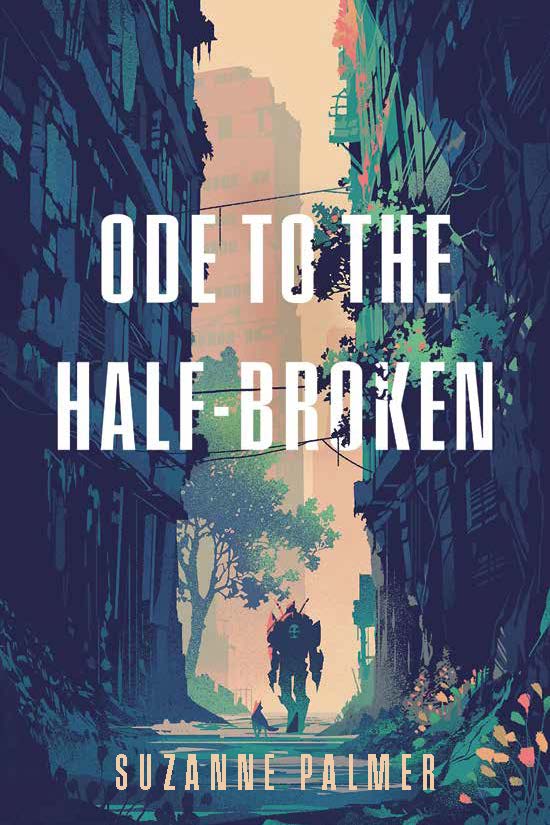
Several people have been raving about this for a few months, and I finally got around to reading it. (As with the Isabel J Kim, I am not late to reading this – it only came out in May! They were early.) If you are even vaguely interested in sentient robots, post-collapse of the existing world, getting-a-ragtag-team-together stories, with a healthy dollop of snark, you just want to stop reading this now and go read the book.
The (deliberately, consciously) unnamed narrator wakes up having lost 36 hours, in a bathtub, with their leg missing. They’re a robot so that’s not life-threatening – the electromagnets in the tub are a bigger problem – but they’re still human-shaped, so it’s going to present a locomotive issue. Once they finally get out of the tub – there’s a talking dog involved, it’s not as twee as it sounds, not least because the dog would be angry at having the word applied to them – our narrator’s mission is straightforward: find whichever bastard stole their leg and retrieve it. Which of course necessitates figuring out some stopgap (heh) for the missing leg, which means talking to a lot more folks than they’ve talked to in about two decades, and leaving their home which ditto.
This is the getting-the-team-together aspect, because of course some of the folks they meet over time end up joining in, for reasons of their own. Our narrator’s quest ends up being much more than they bargained for (of course). Their world has a lot of robots, of varying sizes, abilities, intelligence levels, and attitudes towards both other robots and humans. There are humans, but it’s a lot fewer than there are now.
That’s only half the narrative, though. The other half is set some indeterminate time in the past – that is, it starts in 2037, but we don’t know when the leg-stealing occurs. In this past, Dr Milton has figured out how to create mindchips, which will enable sentience to form – as has happened with our robot narrator. Milton is interested in the science but not the business, which is bad because it means other people who have taken over the business in ways that he did not expect or desire. This part of the narrative covers several years, and gives a glimpse into how things got to where they are in the “now” of the rest of the book.
There are some obvious parallels to be drawn between this robot and Murderbot, which I’m sure other folks have drawn. Both wish to have nothing to do with gender; both have issues with names. Both would prefer to just be left alone – this narrator has been working on entomology for decades rather than watching soap operas, but really, that’s basically Desperate Ant-wives. Both end up interacting with humans in ways they would rather not; most of the time I think Palmer’s character is less anti-social than Murderbot, but I’m ambivalent about that. This is not to say that they’re the same, of course! But both Palmer and Wells are riffing on a long genealogy of robots/AIs and the variety of ways they might interact with humans, and other robots, if you don’t choose the Skynet option.
Again, the short version is that I enjoyed this enormously. I liked the writing itself, I was intrigued by the characters, some of the villains were excellent villains and others were suitably ambivalent and complex. Our main narrator totally won my heart, and the revelations about their history were beautifully presented, drip-fed at a rate that didn’t make me bored or anxious. 100% will read again.
Sublimation, Isabel J Kim
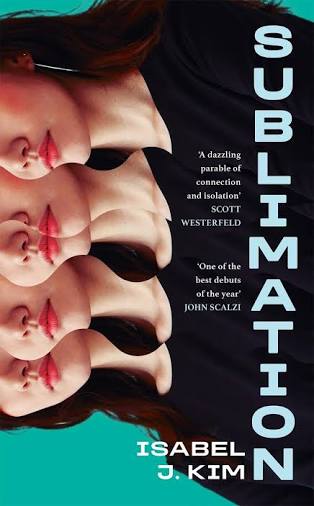
I feel like I’m late to this party, because so many people I know have been talking about it, but it’s actually only a 2026 book! So I am not late, they’re just early.
This book is brilliant and if you’re up for a world that’s just off from ours – in a very significant way and yet still the world is recognisably ours – you would do worse than just go out on a limb and read this. But if you need to know more…
This is a world where crossing a border might give rise to an “instance” of yourself. Not sure if you do want to go home from that holiday? Not sure if you want to take that overseas posting? Being forced out of your home by natural or human forces? Any of these might create an instance. Who is a real, live, human being, with all of your memories and traits up to that moment. They are you. But they stay, while you go – or they go, and you stay.
I’m sure you can imagine some of the large-scale problems, as well as the small-scale. For migration, as well as for families.
Soyoung instanced when she was a young girl; she lives in Korea, while her instance, who goes by Rose, lives in America – with the instance of Soyoung’s mother. Yujin instances when he leaves Korea for study leave in the US; they also live in those two countries.
Here’s the thing I didn’t mention: if instances meet, and touch, they will generally reintegrate. Again, you can probably imagine the large- and small-scale problems. What if one instance wants to reintegrate, and the other doesn’t? Reintegrating gives the person both sets of memories – imagine living like that!
And now, imagine the techbros rubbing their hands at the opportunities this affords: what about something to guarantee forced reintegration can’t happen? What about… well, there are all sorts of possibilities if instancing could somehow be managed.
Sublimation isn’t about the technological stuff, exactly, but it does run through the whole book: Yujin’s instance, YJ, works for the company who made MERGEBREAK (bracelets that should stop reintegration). And the whole question of reintegrating or not is at the core of the novel, so external efforts to affect that are pretty important.
This is a book about migration, of course: about choosing to migrate, about the consequences of doing so, and what it means to leave somewhere. And it’s about identity – how could it not be: what does it mean if you’re torn between choices? How can you reconcile with yourself?
I haven’t even mentioned the structure of the novel. First thing: large swathes of it are written in the second person. Bold choice! It means you (heh) switching between a Soyoung, Rose, Yujin and YJ – you say, you do, you think – and it makes the whole experience remarkably visceral. And when you (heh) suddenly flip to reading in the third person, it’s quite discombobulating. Which is really clever. Second thing: there’s a lot of asides about literature across the novel. There are references to a Korean fairytale, a Korean song, The Odyssey, and the Book of Genesis. The last two are what I know best, but they all suggest the same thing: in a world where instancing has always happened, how does that change literature? What if Odysseus instanced when he left Ithaca – what does that say about him? And what if – this one is the most challenging, IMO – the act of creating the world (and everything in it) was one absolutely epic example of instancing?
Some thoughts about the very end below the cut, but look – this book is just great, you should read it.
Continue reading →Frankenstein Rex
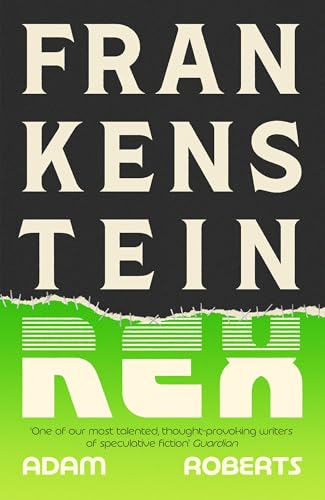
First off: if you’re reading this while the blurb still talks about immortality and seeking an heir, that blurb is WRONG. I won’t speculate about how that happened – not my business – but it’s very, very wrong. That is not what this book is about at all.
To head off any other jokes: it’s also not about a dinosaur. It is indeed a play on Shelley’s Frankenstein, and specifically the creature – and yes there’s a whole bit about the name choice.
So what is it about, then? Well, Frankenstein (the creature) has been king of the world for many, many decades. Since not long after Napoleon popped up, in fact, and it’s now just our time. Frankenstein does seem to be immortal; he’s not ageing or changing, and assassination attempts in the past have failed. Of course, that doesn’t stop other people from trying.
Frankenstein rules as a benevolent (ish) dictator. All land belongs to him – with just a couple of carve-outs, like Jerusalem and Mecca – and he leases it back; but he has strict expectations about energy efficiency etc. The lingua franca is French (heh). National sentiment is forbidden, and regarded as irrelevant by the powers that be. Decade on decade, Frankenstein swings between more liberal and more tyrannical. Someone is arrested for planning to assassinate the king… and the novel goes from there.
It’s very important I let you know that the opening chapter has some quite gruesome torture. I had to skim a couple of paragraphs after I realised what was going on. There’s nothing like it for the rest of the book, so it’s a shocking opener but not indicative of the novel as a whole.
As well as being a novel about trying to understand a would-be assassin, this is quite blatantly a book about politics. If there is literally a monster in charge, how do and should humans act? (Yes, of course there is discussion to be had about whether the creature is a monster, and you’ll note that I don’t use ‘monster’ to describe him.) Sometimes there is something darkly appealing about having one person in charge forever and ever! Change is hard and sometimes painful! … and there will always be collaborators, who are either all-in on the regime or out for whatever they can get; and there will be people who are just muddling along and putting up with it because what else are you going to do; and there will be some few who are defiant and maybe reckless and endanger both themselves and others because they think there’s a better way. Where does righteousness lie? What is appropriate? I know what I think; and Roberts manages to be a lot more nuanced than many other writers would achieve (which does not surprise me, because… well. It’s Adam Roberts. Man knows how to be complicated).
I do have thoughts about the ending; spoilers below the cut.
Continue reading →Rakesfall
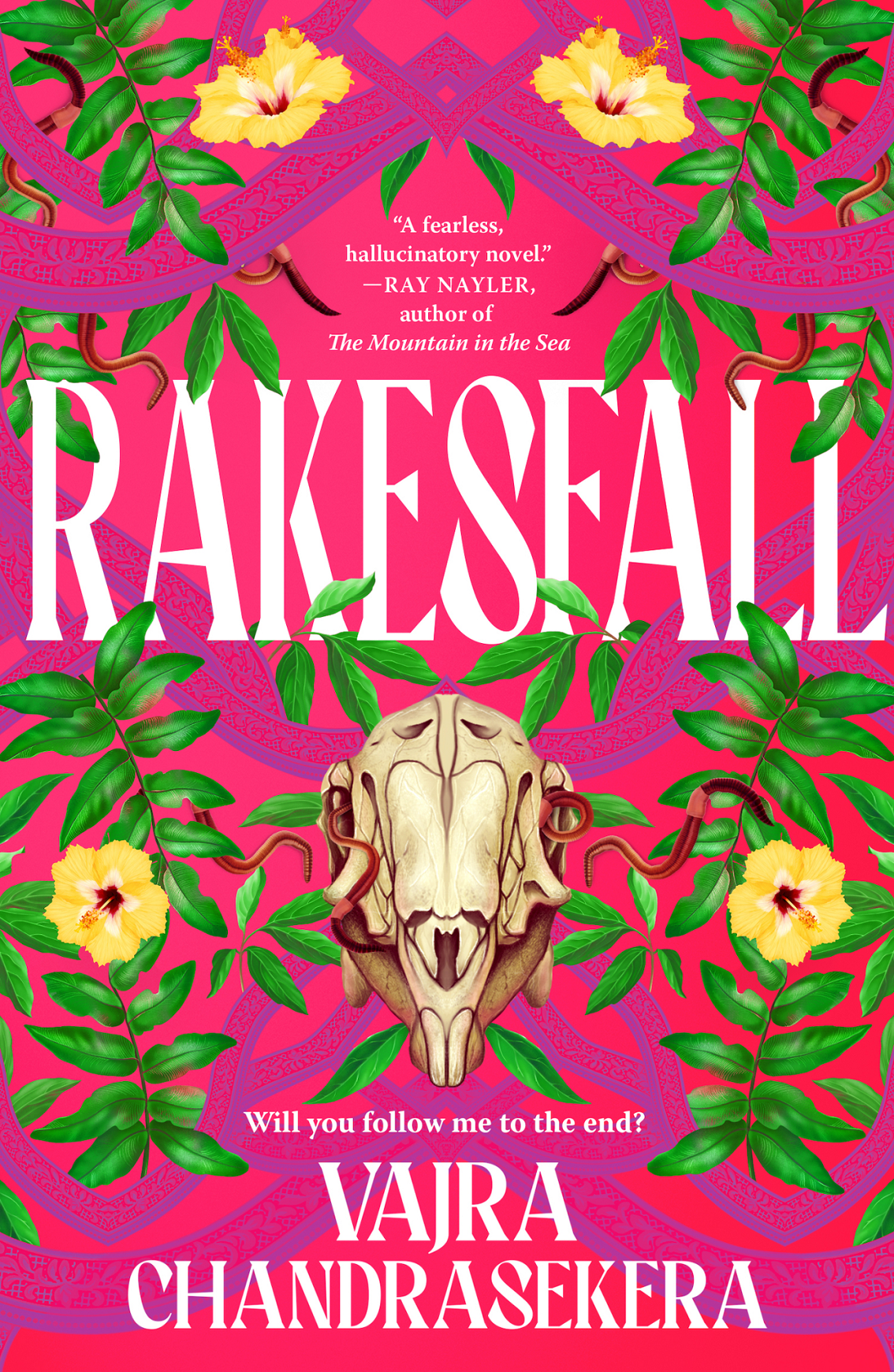
I just.
What.
Why have I read so many not-straightforward books recently?
Why do I read books where I’m really not sure that I’m smart enough to understand them?
Well, in this case it’s because so many people talked about this book that I got incredible FOMO and decided to finally take the plunge, even though I knew – from all that talking – that it was going to make my head spin.
And it did. Mostly in a “I think this is enjoyable?” kind of way, but… yeh. Spinning.
I could try to outline the story, but that would be something of a fool’s errand. There’s versions of worlds, or perhaps dimensions? Some characters maybe keep recurring across centuries. There are things hidden from mortal ken, and probably none of the worlds are our world, and things happened in the past that echo through to the future. You should definitely read Ian Mond’s review of it in Locus, because he does a better job of summing it up than I could.
So why bother writing this review? Really I just wanted to note, out loud as it were, how impressed I was while also flailing a bit to understand what was going on. Even through that flailing, I was drawn on, because the writing is just that good. And I felt hope that, even if I didn’t completely understand everything by the end, I’d at least have some sense of… completion, or resolution, or something. And I did. Not entirely completion, but certainly as though events and characters made some sort of sense, even if there were still gaps.
It really is excellent. Hard, and excellent. I can’t quite imagine where Chandrasekera will go next – anywhere, I guess.
What A Fish Looks Like
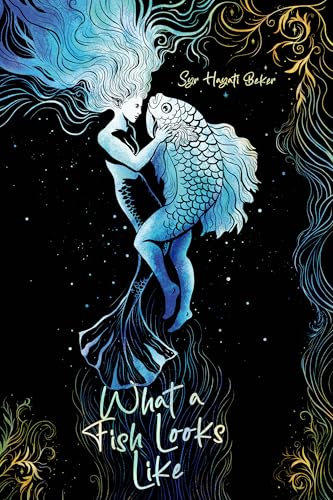
I’ve liked everything I’ve seen out of Stelliform Press; they focus on fiction that centres climate change and how it affects the planet and people. Often hopeful, like solarpunk, but not in a blinkered, rosy-glasses way.
The overarching story here is that a spaceship is soon to take off, and some tickets have come available for folks who didn’t expect it. The question of whether to take one or not is driving wedges between people. In particular, between Seb and Jay. So the story is sort of about that. But it’s about more than that: it’s about community, and how a changed world can be understood, and how and why we tell stories – to understand what’s going on and to shape what’s going on.
Rather than being a straightforward narrative, Beker presents a montage of myths and fairy stories, along with ephemera like party invitations and graffiti. The stories are found in a book Seb has left for Jay. They remake old stories to be more appropriate for the changed world: Beauty and the Beast becomes What a Fish Looks Like; The Little Mermaid becomes Playlist 4Merx in Times of Sea Levels Rising.
Characters come in and out – mentioned in ephemera and then in a story, times looping in and out, so it’s sometimes a tease trying to figure out who is known to be where. It’s incredibly clever and I can only assume Beker must have created one of those enormous pin boards with string to keep it all together (literally or metaphorically).
I’m late to this party but I can see why folks were talking about it last year. The structure works really well – done with thoughtfulness, the inclusion of ephemera adds enormous depth to a world, and the design works beautifully here. I like Beker’s ambivalence about the state of the world: maybe leaving will be the right decision! Maybe staying and trying to make things better on this planet is the right decision! … maybe both are right, for different people. And I liked, too, the hints at community building and support. I’m increasingly being drawn to that sort of fiction.
The Silver Book
So what happened is that I found out about the Tadeusz Bradecki Prize. It values works that combine fiction and nonfiction and generally do interesting things. That’s how I found out about The Book of Records and it’s how I found The Silver Book. This is even less like the works that I usually read. I have no regrets.
Nicholas is a young English artist, running away from a suffocating and difficult England. In Venice, he meets Danilo Donati. It’s the 1970s, and Donati works in cinema, with both Fellini and Pasolini – preferably on costuming, sometimes also on sets. Fellini is making Casanova; Pasolini is making Salo.
Politically, it’s a tremendously difficult time for Italy: fascists and their collaborators from under Mussolini are still around, times are hard economically, and so on. Socially, being homosexual is somewhat accepted within the arty world – certainly at least some people don’t go to any lengths to hide their preferences – but in the wider world… well. It’s the 1970s. And personally, both Fellini and Pasolini are not exactly easy to work with; and Nicholas and Donati have their own personal demons to deal with.
Nicholas is invented, representing young men who have sought adventure and love and difference – and who have fled difficulty. The other main characters, like Donati, are or were all real. Some of the events are real: the challenges of creating both films, what Fellini and Pasolini were like both artistically and politically, the general atmosphere in Rome and Venice. Laing draws all of these together to create a truly superb novel that’s important on a personal level, as well as on the political.
Salo was made in the 1970s; it was about late fascism in Italy, as well as about its own time. The Silver Book is set in the 1970s… and it’s absolutely about our own time as well. It’s not always an easy read; some dreadful things happen, although mostly off-page. It is, though, magnificent.
The End of Everything, M John Harrison
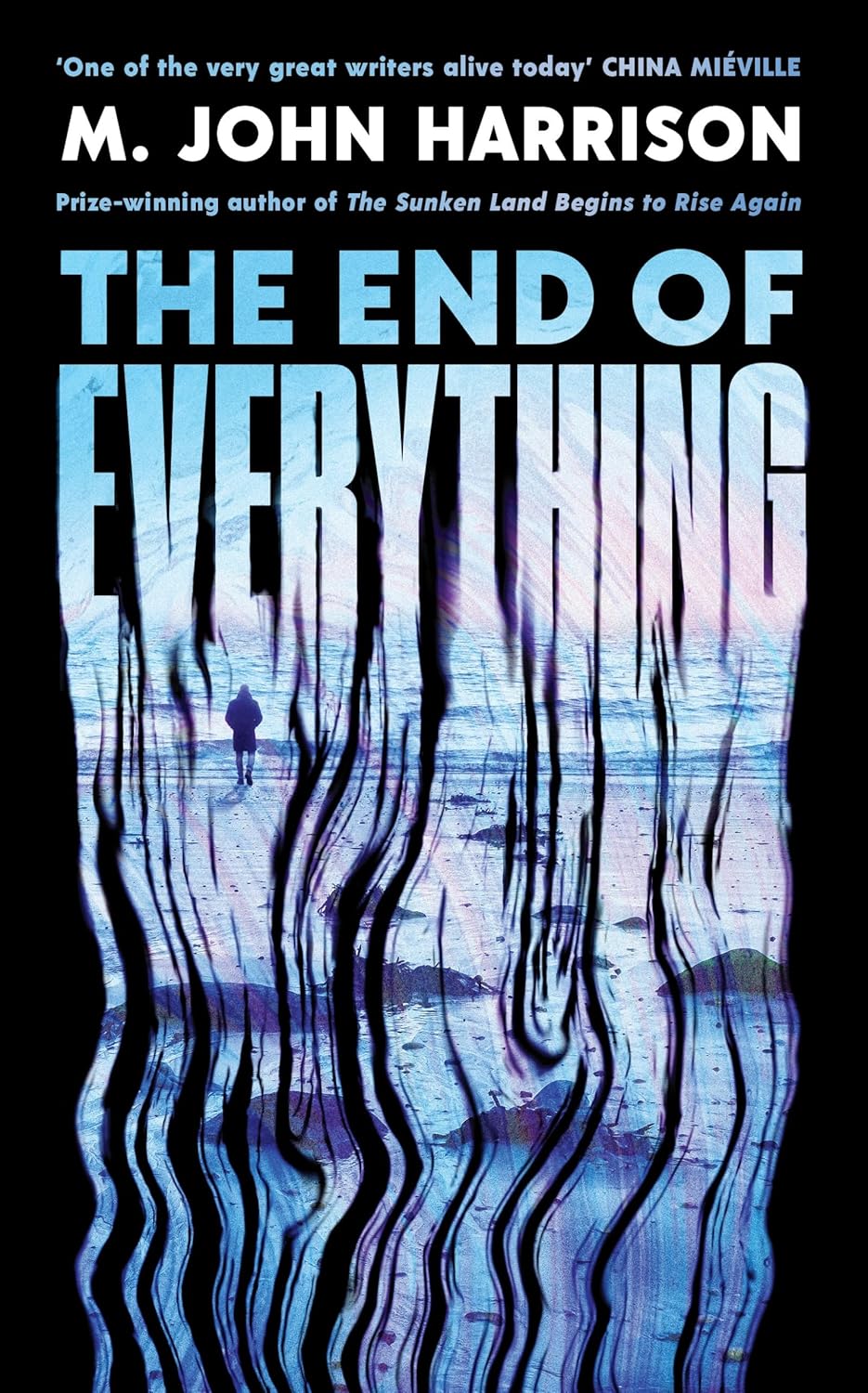
This is a very difficult book for me to even consider reviewing.
How to talk about the plot? Well, it’s sort of post-apocalyptic – certainly there was a crisis some years ago, involving an alien arrival (… ish) and folks are figuring out how to live in the aftermath. Phillip is a beachcomber, and an object he finds one day becomes more than he bargained for. For a while we follow Phillip, and then we follow his aunt. They occasionally act, but more often things happen to them and they react – or don’t – and then the it’s the end of the book.
Are Phillip and Marnie “main characters”? Not really; certainly no one would be accusing them of having main character energy. I wouldn’t even comment on whether they’re likely; I didn’t get to know them well enough for that.
There’s not that much detail, but post-crisis British society was the aspect I found most fascinating. I’m sure that for people who live there, there are all sorts of resonances with their post-Brexit and -Covid world. Even from the outside I could see some of the points that Harrison is poking. The people who are resolutely unaware that anything has changed; the people living like everything has changed; the utter weirdness of towns that have been abandoned for no apparent reason.
This is not the style of book I tend to read for pleasure. It reminded me a lot of Jeff VanderMeer’s Annihilation for that reason; prose that isn’t straightforward, almost certainly references that went over my head, and a narrative that left me with more questions than anything else. Annihilation is definitely weirder, and I think more oblique, but anyone looking for “a story” in The End of Everything is looking in the wrong place. I don’t think that’s why anyone would read it – and if you were misinformed about the sort of book you were reading, you’d either give up in disgust or hate-read to the end (don’t ever do that, it’s not healthy). I certainly don’t regret reading this, but also I’m not going looking for more in the same vein. It’s just not my scene.
Stargate SG1, season 3
… we jump straight back to Hathor threatening SG1 – did I mention Daniel’s non-floofy haircut? it’s so odd (but the bandana/cap is a much better option) – and the entirety of the SGC is mustered to go get our kids back.
More importantly, Carter gets promoted to Major! Hooray! And then Jack totally steals the award show by being beamed aboard an Asgard ship, what a diva. Still, it gives us Thor, and that the Asgards will negotiate with the System Lords on behalf of the Earthlings. And that negotiation will happen on Earth what could possibly go wrong. And we get ~foreshadowing~ of a “far worse enemy” in the Asgard’s home galaxy.
We see Sam being able to access Goa’uld tech thanks to the aftereffects of Jolinar’s presence, and we get another!alt!Sam, this time coming through the mirror, complete with a picture of her and Jack getting married. Which is honestly all very uncomfortable. (However, alt!Teal’c and alt!Apophis both have little goatees, and I know enough Star Trek that this made me very happy.) Then we get Martouf back again, needing Jolinar’s memories. I just don’t like Martouf, and there’s no good reason for it.
The range of cultures represented continues to expand – Nirrti from the Hindu pantheon (I have thoughts about using a living religion…); Yu from Chinese mythology (?); Aztec deities represented on a planet that seems to be entirely inhabited by very white people and has no connection to anything we know about Aztec culture. A medieval European Christian village! Guess it was only a matter of time before they tried it – but of course an American show couldn’t make Jesus a Goa’uld… and the Canon is an appropriately cartoonishly evil churchman. And then later we visit Sokar’s planet – Hell, basically – and O’Neill makes a comment about it being a “dry heat” – is that an Aliens 2 reference??
Despite the visit to Hell, this season’s most distressing episode is the one where Daniel is thought to have schizophrenia and treated appallingly. Michael Shanks really gets to shine in the episode, and it’s awful.
Furthermore, one part of Daniel’s story – his search for Sha’re – comes to an end, with Sha’re’s death at the hands of Teal’c. Once again Michael Shanks gets a chance to do some particularly poignant acting. And then he discovers that Amaunet & Apophis’ child is the Harcesis – a human born with knowledge of the Goa’uld. Thus begins a new quest – and consequently Daniel meets Oma Dasala, which is also the beginning of his rather epic story arc. (I’m having anticipatory grief.) This really is Daniel’s season.
Importantly, this season has some really fantastic Jack/Daniel interactions.
People I haven’t mentioned much: I really like Dr Janet Fraiser, and I’m so pleased that she appears more in this season – she even gets to go off-world! And he doesn’t appear often, but I also really enjoy Major Davis. Plus: there haven’t been many guest stars, or people who went on to become well-known, but Aaron Douglas (Chief Tyrol, of Battlestar Galactica) turned up as a Jafar for about 10 seconds in this episode, before dying. (Also the crystal skull, Indiana Jones should be ashamed for stealing it.)
I am realising that parenting is a significant thread running through this show. Apophis wants to make a human child who will become his new host; the Sam/Jacob Carter dynamic; Jack’s dead son (used against him again in this season) and his relationship with Skaara – who is finally freed! – and there’s a strong suggestion that Jack leaves Laira pregnant; Teal’c and Rya’c; the clone son from the Reetou, Merrin and other Urrone children of the Orban (do I remember ever being a little teary from an SG1 episode? No I do not. I think I’m getting old). The man looking for his child in Seth’s cult. Aris Boch lies about having a child to get sympathy; the Jafar practising to be an SG unit are basically children. And, of course, Cassandra. Looking forward, the question of children – relating to parents, how they develop – continues to be massive, especially in the last two seasons.
On a broader level there’s another incredibly significant through-line, too, about SG1 interfering with the way things are done, usually to what is perceived as the benefit of the newly-visited population (not quite always in the short term, but mostly in the long term). Of course, it wouldn’t be much of a show – or rather, it would be a very different show – if there weren’t this overtone of, frankly, colonialism. And of course, they don’t call it colonialism, and the SGC folks don’t want to actually live in those places. But they do want to trade for useful things, and they do feel more comfortable if everyone goes along with their same morality and processes. At least we do occasionally get folks like the Nox – and more obnoxiously, the Tollan – who refuse to give the SGC any tech because they’re too inferior. So that’s some balance.
And the season ends with replicators… (I have so many thoughts about replicators v Goa’uld insofar as enemies go).
You know what else season 3 brings? DVD extras.
Character featurettes:
- Capt (now Major) Carter: apparently it was important to have a beautiful woman! Bah. I did enjoy hearing her reflections on Richard Dean Anderson, and how odd it is to act before a blue screen; her description of Sam as the midpoint between Jack and Daniel is nicely observed.
- Teal’c’s feature is a sweet piece about Chris Judge’s acting career, and his enjoyment of the role.
- General Hammond: got his start as MacGyver’s boss’s double, and now plays O’Neill’s boss! That’s so cool!
- Daniel Jackson: Michael Shanks comes across as adorable. His comment about how the regular cast react when new directors come on board and then freak out at how huge a production it is? Hilarious.
Other bits:
- In the “Producing Stargate” featurette – which I assume was made for the DVD, so maybe a couple years after it aired in 1999? – Brad Wright, co-creator, suggests “at least ten seasons” for the show. Awww.
- Costuming! Interesting to hear Christina McQuarrie talking about how she’s certainly not aiming for any sort of cultural verisimilitude, and that she’s combined elements of various cultures. But she’s often only given seven days to costume an episode, so… that’s a whole thing from tv 25 years ago! They costumed hundreds of people for the pilot, and while other episodes have fewer it’s still a lot.
Stats:
- Sam gets a raw deal for being female: 0 (… does this mean the show is actually treating Sam properly??)
- Someone falls madly in love Sam: 1 (blergh, Narim – get over it)
- Sam reciprocates: 0 (you go girl)
- Jack gets seduced: 1 (well, it was a mutual seduction with Laira)
- Daniel gets seduced: 1 (
at least she’s not evil(hahaha she’s amnesiac Linnea) but it’s literally immediately after Sha’re dies soooo that’s rude) - Sam gets seduced: 0
- Teal’c gets seduced: 0
- The team brings dangerous stuff back to Earth: 2 (once wasn’t SG1’s fault)
- Something timey-wimey happens: 1 (plus one alt-timeline)
- Daniel apparently gets killed: 0 (but also that time Daniel went out of phase; turns out I love shows where actors have to not respond to someone who’s meant to be invisible)
- Jack apparently gets killed: 0 (briefly out of phase)
- Sam apparently gets killed: 0 (briefly out of phase)
- Teal’c apparently gets killed: 1
- Jack gets replaced / becomes an alien avatar: 1.5 (half because the Goa’uld binding didn’t take)
- Sam gets replaced: 0
- Daniel gets replaced: 1
- Teal’c gets replaced: 0
- Everybody else at the SGC gets replaced: 1
- Sam and Jack have A Moment: 2 (sometimes they’re really brief but I see them) (Jack and alt!Sam doesn’t count)
- Maybourne gets thwarted: 1 (serious lack of Maybourne in this season)
- Extra special episodes where it’s not Maybourne’s fault / he actually helps: 0.5 (because there was one episode where he was MEANT to help but instead he was an ARSE and only helped EVENTUALLY; at least he gave Carter the credit)
- Specific human cultures represented:
- Medieval European Christians?!
- Keb is vaguely Buddhist? the flutes, the architecture… the monk’s robes, speaking vaguely in koans… this one also makes me uncomfortable
- Goa’uld encountered:
- Hathor (RIP)
- Seth (distressingly, but appropriately, hot; RIP)
- Chronos
- Yu (we haven’t had many non-vaguely-Western deities, I guess this is a good thing?)
- Nirrti (again) (I had missed she’s meant to be a Hindu goddess… so yeh, another one from a living religion, not cool)
- Amaunet (RIP)
- Bynarr
- Sokar
- Reincarnated!Apophis
- did everyone forget Sokar had a sarcophagus? I had!
- he just won’t die
- I love the way he tells Teal’c “It is I, your god, Apophis” as if Teal’c could have forgotten his name
- Klorel
- Zipacna
Echolands: A Journey in Search of Boudica
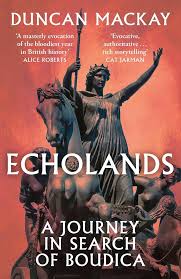
I love a really good travel book. (Do I know what I mean by that? Not really. But apparently, from recent experience, it often includes at least a little bit of history.)
I also love good history books; and Roman/British/women centric is definitely up there as a favourite.
Echolands is fantastic.
An English archaeologist decides to visit all the can-actually-be-identified Boudica-associated sites. And discusses Tactius, Dio, and the archaeology (what’s been found + the history of the finding – is there a word for historiography but it’s archaeology?) along the way. Plus adds some appropriate personal aspects – both about the travelling (some by foot, some by bicycle, some by car, some by train), his career, and occasionally his family. Plus some reflections on the modern physical landscape, and what Boudica means today.
It’s 300 pages long, and it’s extremely readable.
There are many aspects I found fascinating, but one that really stood out is his experimentation with caligae – the hobnailed “sandals” Roman soldiers wore, often – yes – with socks. His conclusion? Incredibly comfortable and sensible for long treks – especially on gravel and other such surfaces, not on tarmac and other such formed surfaces where the nails get little grip. Having heard just a little bit about things like trench foot, just the fact of airflow makes a lot of sense!
Mostly I was enchanted by the way he visits places like the castle at Colchester, and then also places that look completely unremarkable (weird little lakes created by peat mining in WW2), talks about why those spots were so important in the Boudica story, and presents the history of archaeological discovery in the area.
You don’t need to have any Roman or Iron Age British history knowledge to appreciate this.


