Eat Like a Sardinian
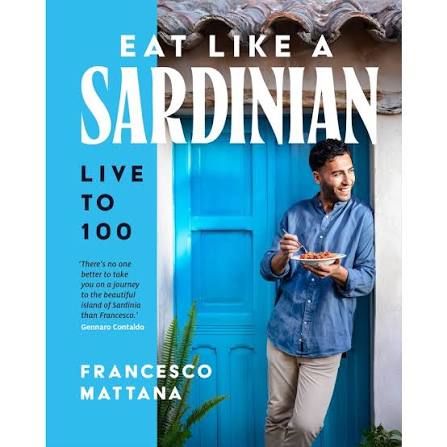
I was sent this book by the publisher, Allen & Unwin, at no cost. It’s out now, RRP $45.
On the one hand, this book has really excellent recipes.
On the other hand, I deeply object to the whole ‘live to 100’ vibe, given probable realities about so-called blue zones.
On the third hand, you can look past that (I do), and it’s a fine book.
As you would expect, this is a beautifully produced book (although to my sadness, there’s no ribbon bookmark; I do love a ribbon in a cookbook). The photography is great, it’s mostly about the food rather than the cook, there are some adorable handdrawn (they look like embroidery!) images scattered throughout, and the recipes themselves are laid out well. No complaints at all about the presentation.
There’s a good range of recipes – the book is structured like a traditional Sardinian meal, Mattana says: Aperitivo and Antipasti; Pane and Pasta; Primi; Secondi; Contorni and Verdure; La Dolce Vita. Within the chapters, there are harder and easier recipes. I would note that this is not a book for a beginning baker: the recipe for (the delicious) sultana and saffron bread asks you to judge ‘if the bread looks ready to bake’ with no suggestion for what that looks like, for example. And in the Culurgiones recipe there’s no indication of when the ravioli is cooked / how long to cook for.
Recipes I have made:
- Pizzette Sfoglia – puff pastry pizzas. So simple! Quite tasty, although I do think the filling (tomato passata, oregano, capers) could have been tastier.
- Su Pani Arrubiu – sultana and saffron bread. Also with orange zest. Absolutely delicious. And he recommends a long, overnight, proving, which I think was really good. Mine wasn’t as good as it could have been – I’m blaming winter – but 100% would make again.
- Tallutzas con noci e ricotta – I made this with bought orecchiette; the combination of ricotta and walnuts and nutmeg was an absolute delight.
- Culurgiones – potato stuffed ravioli. Yes, I made ravioli. Was it worth it? Look, I’m not sure. They were very tasty and I made quite a lot so a bunch went into the freezer. Are they better than very generic supermarket ravioli? Oh yes. Did they take a long time? Also yes.
- Li Puligioni – ricotta ravioli – no, I did not learn my lesson. Yes, pasta stuffed with ricotta and orange and lemon zest is very tasty.
- Spizzulus con cardoncelli e salsiccia – pasta with sausage and mushroom sauce. Had to make a sub here as my local supermarket doesn’t have dried porcini (!), so I used fresh mushrooms instead. It will have tasted a bit different, therefore, but overall this was absolutely excellent. And getting the butcher to de-case the sausage first was also brilliant.
- Panada – Sardinian pie. Further to ‘not learning my lesson,’ yes I made the shortcrust pastry for this pie. The pie has a really interesting structure: basically you’re cooking a really dry stew inside a pastry shell. You’re putting raw meat and uncooked potato inside and it comes out… perfectly cooked. Also a lot of work, but did feed two of us for three dinners.
- Bombas – meatballs. I love meatballs. These are fine but nothing out of the ordinary.
- Involtini di carne con verza. Never again will I stuff cabbage rolls. Maybe using ordinary cabbage rather than Savoy was a mistake – I don’t know, I don’t know cabbage.
- Torta di mele – apple cake. It was fine! I was lazy and didn’t do the apple slices on top, which meant it wasn’t as apple-y as it should have been, so that’s all on me.
There are more recipes I’m looking forward to making, so this one will be staying on rotation.
The Hunger of Those Who Built It
Read courtesy of the publisher, Stelliform Press. It’s out in September; you can preorder it now.
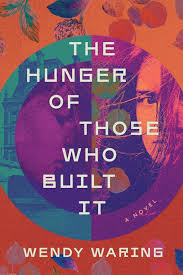
Wendy Waring does an intriguing narrative thing in this novel. The first 60 or so pages alternate between Lou, who has managed to infiltrate The Oxbow – an exclusive and exclusionary colony, basically, set up in the middle of a crumbling Paris – and Diane, Lou’s aunt, Green architect/designer and largely responsible for The Oxbow.
Then all of a sudden we get a timeshift: back 16 years, before The Oxbow exists. Diane is offered a job in Paris, creating vertical farms and helping to green part of the city, at the same time growing food for the inhabitants. It’s a world where in theory, at least, technology is greening, and so some aspects of early-21st-century urban life can change – massive highways, for instance. But, as Diane slowly learns, there are still privileged groups seeking to keep all the good stuff to themselves.
Basically, the majority of the novel is following Diane as she learns how her dream gets turned into the gated community of The Oxbow.
So on one level, it’s a story of a woman watching her dreams get manipulated and changed away from her vision. And it’s powerful for that: how hopeful intentions can be subverted, how good plans can be made to go astray, and so on. How corporations can destroy individual hopes. And, as well, there are some intriguing ideas for how cities might indeed change – for good; this is being advertised as solarpunk, after all.
The novel is not only about ambition and technology and urban infrastructure, and the big picture, though. It’s also focused squarely on the smaller picture: Diane wants to go to Paris because she is seeking reconnection with her sister, from whom she has been estranged for many years. There are many reasons for their separation; some familial, others political and philosophical. None of them have easy solutions, and Diane is frequently conflicted about her own as well as her sister’s attitudes. What I liked about Waring’s story is how very real it feels. Siblings are exactly those people who know how best to get under your skin, and who are also (often, not always) the people you want to be drawn back to.
I have one quibble with the story: an event in Diane’s history turns out to be very different from how she understood it, which has serious ramifications, many of which are part of the point of the story. But one consequence, about the dating of other events, doesn’t seem ever to be addressed, which is unfortunately something I really struggled to reconcile.
However! All up, I very much enjoyed this novel. It’s well written – I devoured it – and Waring balances the macro, urban issues with the micro, personal issues beautifully. They each feel as important as the other.
As a debut, I am deeply impressed, and hope that we can expect more of the same in future from Waring.
Department of the Vanishing
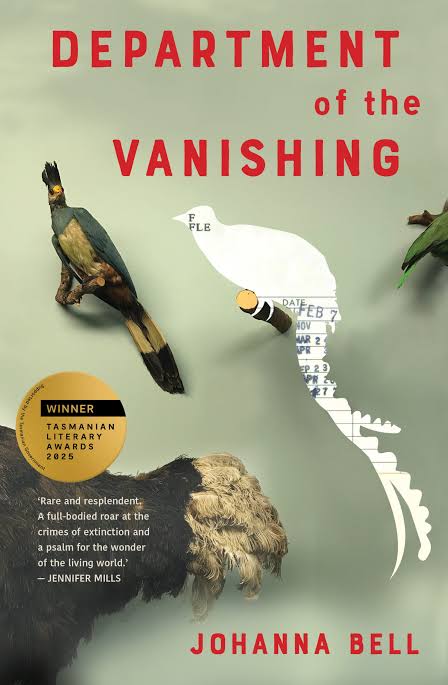
This is another book I read because of Ian Mond. If you’re interested, here’s the publisher, Transit Lounge.
Poetry is very much not my vibe. I have always worried that I just don’t get it and so almost feel I shouldn’t be allowed to read it, and certainly not comment on it. Is this ridiculous? Of course it is. Well, mostly. Am I actually afraid of some beret-wearing, cigarillo-smoking, pretentious white man tut-tutting me?
Well. A little bit. Yes.
Anyway, I’m going to comment on this book despite my fears. And it is poetry – almost all of the text is set out as couplets, with almost no punctuation. Sometimes the story is hard to follow as a result, when it’s not clear how the clauses fit together. Which is, I presume, part of the point. A lot of the time, it’s completely clear, and a delight to read.
This is not, though, just a poetic novel. It’s also playing with the idea of found footage.
Almost every poetic page has a library stamp on it: RESTRICTED, or an accession stamp, or the link. In between poetry pages, there are collages of newspaper headlines; excerpts from the narrator’s police interviews; photographs and stills from video; pages where birds sounds are turned into text; transcriptions of the narrator’s mother’s maybe-dementia ramblings; and many lists.
Some of the found footage includes excerpts from other books, and friends, I dogeared a page because I didn’t have a bookmark handy when I got to the bit about Shifting Baseline Syndrome: “a gradual change in the accepted norms for the condition of the natural environment due to a lack of experience, memory, and/or knowledge of its past condition. (Soga & Gaston, 2018).
Ava lives in a too-near-future Australia, in 2029. She works for the Department of the Vanishing, archiving references to birds that are, or are nearly, extinct. (There’s a moment where she’s allocated the pelican: where to start? With Stormboy, of course – and my mid-40s-heart gave a great big heave.) She is also caring for her ailing mother, grieving her long-lost father, and seeking connection through a series of flings. Plus, of course, all the heartache that comes with her work.
It’s almost eye-rollingly trite to call this novel is a wake-up call, but of course that’s what it is. The idea that I would no longer hear kookaburras or magpies or the various teeny little tweety-birds I hear on the regular is horrifying. Is there something I can personally do? Probably not. Maybe I should send a copy of this book to some politicians.
It’s a splendid piece of art and I hope it gets more attention.
Platform Decay, Martha Wells
I read Platform Decay! Of course! And of course I liked it! Although… it’s a bit different from what I was expecting.
What was I expecting? I think I was expecting more pew-pew space adventures with ART, to be honest. It’s where System Collapse appeared to be leading, after all.
Instead, we get a story that’s focused on very few characters – none of whom we’ve had much, if any, interaction with in the past (Murderbot excepted, obviously) – on a new and potentially hostile space ring. There is a tie back to the previous two stories; there always is, because the Corporates are small-minded, vindictive, petty, bullies who can’t let anyone get away with anything if they can possibly do something to them.
TL;DR there is a good amount of action, there is an excellent amount of banter and snark, we get to experience quite a different space habitat, and Three is still around. I won’t be sad to come back to this one as part of my maybe-it’s-annual re-read of the series.
A few more thoughts:
Murderbot: continues to be an absolute delight to follow. I wouldn’t keep reading if I didn’t find its style immensely enjoyable. I like that we can see real change in the way it thinks about humans, more along the lines of ‘weary acceptance’ but in reality it’s a little bit more… well… emotional than that. Although it wouldn’t appreciate me using the word. I also continue to take great joy in its competence. I am a sucker for competence. Also, it’s actively learning about its organic side and taking steps to look after itself, and following other people’s suggestions (sometimes). How healthy is that??
Slight spoiler:
Continue reading →Julian: Rome’s Last Pagan Emperor
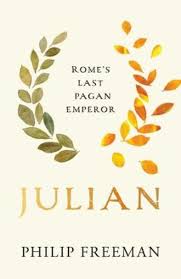
My knowledge of Roman history goes: not great to okay for the Republican period; not bad for the Julio-Claudians; verrrry sketchy and potted post the Year of Four Emperors, right up to… like, the fall of Constantinople. There are bits and persons in there I know about! But it’s not connected up.
Anyway then I learned there was a newish (2023) biography of Julian, and I was excited.
Julian “the Apostate” is one of those fascinating characters who pop up in Roman (and other) history: they don’t last long but they have an outsized legacy because of a key thing or moment. In Julian’s case, it’s that he is the nephew of Constantine – our man who moved the Roman Empire’s capital to the city he modestly named for himself, and also paved the way for Christianity to become the dominant religion in said empire. Was Constantine a “real” Christian? What do you even mean by that? Not relevant, for the purposes of this biography (and, uh, completely impossible to answer anyway). What IS important is that after Constantine, the empire was basically expecting a Christian emperor. And so when Julian comes along and goes PSYCH! I’ve been pretending for a decade or so!, there are a lot of people who are Unimpressed.
This is a short biography: we’re talking 133 pages, and they’re not huge pages either. So there’s not super detailed info about every day of Julian’s life. What Freeman does present, though, is an excellent overview of the main stages of Julian’s life: upbringing in Asia Minor after his now-emperor cousin kills the rest of their family (… yeah…), then raised to Caesar (sub-emperor) and sent to fight in Gaul – with no military experience! but apparently sometimes reading about a thing does make you good at it! Then back towards Constantinople, expecting to fight the cousin, who conveniently (fr) dies on the way, leaving Julian uncontested as Augustus. At which point he begins to try bringing back pagan ways, and eventually oppressing Christians.
And then he heads off to Persia. Apparently he paid more attention to Alexander than to, like, pretty much everyone else. It doesn’t go well.
Freeman’s writing is immensely readable. I don’t think you need to have much knowledge of Roman history to understand what Julian is doing; Freeman presents enough background that the various issues – like the place of Christians in society by this point – is easy to grasp. He doesn’t go into the weeds about what the Senate and others are doing at this point, or even what’s happening in the rest of the empire; this is a very focused, narrow biography, and it works for that reason.
Left-Wing Ladies
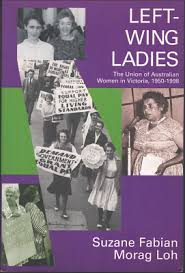
I received this book as a gift for speaking at a meeting quite some months ago, and I’ve only just got around to reading it – not from lack of interest, but just… you know. Life.
So! It’s quite short, at only 177 pages, and it’s very readable. There are a lot of acronyms, so it’s a good thing there’s a list of them at the start of the book. It probably helps to have a bit of knowledge about Australian, and particularly Victorian, history from 1950-2000, but honestly it wouldn’t matter if you knew nothing. It’s based on a lot of archival research – someone has clearly been very conscientious at keeping minutes, pamphlets, letters etc – and some oral history interviews as well.
I knew a very small amount about the Union of Australian Women before diving into this: that they existed, in the first place, which is probably more than most people my age. I had come across them in my anti-Vietnam War research, as there were several women in both Save Our Sons and UAW, and they kept getting discussed in passing with regard to other actions around peace and women’s stuff. What I did not know was the extraordinary breadth of issues that the UAW took on, nor anything about their internal politics.
For me, the most interesting aspect is what the women in the UWA worked towards. They started out as an explicitly working-class organisation, and saw themselves as more aligned with unions than anyone else; there’s a really interesting discussion about being concerned with wages not keeping up with price hikes, rather than being concerned with salaries, which I think is a difference that doesn’t get discussed so much these days. When you add that concern for class difference to the fact that in Victoria, in particular, the UWA had Aboriginal members and worked to support ideas like land rights – well before that was popular – and that they printed their information in languages other than English and worked to support migrant women workers: I rather think these women – many of whom would not have described themselves as feminist! – were expressing intersectional feminism decades before it was being discussed in those terms. Which is not to say they were always on the cutting edge of women’s issues; the book points out how members reacted to discussions of prostitutes as workers, for instance, and the early reluctance of UWA to support ease of abortion access. On both topics, though, the UWA did come around to supporting women broadly.
One of the things I can’t get over is that so many of the things they were agitating for from the 1950s on are still relevant today. Pay equity (although at least that’s now legislated…). Accessible childcare. The problem of the price of goods rising faster than wages. Aboriginal rights. Environmental issues. Safety for women and children. And their number one issue, across five decades: peace.
The internal political situation is an important aspect, if not quite as gripping. As with so many organisations like this, there was much external discussion about whether they were merely a front for the Communist Party. And it’s true that many early members were members of both, and that the CPA contributed to the UWA and may have had a hand in guiding it. They were also associated with international socialist organisations for several decades, and the Australian issues brought about by the Sino-Soviet split showed themselves in the UWA too. But it’s clear that the UWA was never just a Communist organisation.
The Victorian branch of the UWA was the last one in existence. It has basically folded now: in 2021 they announced that their remaining funds would be used to fund activities for “the leadership, training and rights of Aboriginal and Torres Strait Islander women, girls, non-binary and gender diverse young people.” I can’t help but be a bit sad that I will never experience the UWA, although I have met some women who were themselves members.
The Raven Scholar
I read this because it’s in the Hugo Awards packet. When I got to the end, my main thought was “ah crap, another book that makes ranking my vote hard.”
Actually that’s a lie. On two fronts.
1. I had already thought that at about the 1/3 mark.
2. I also thought “eeeeee I need the second book NOW.”
Set in an empire where basically everyone pledges to one god of eight gods – who are all (in theory) revered for their different functions; and where the imperial title changes at the latest every generation – via a series of trials. This is really intriguing world. Yes it’s monarchy yet again, but this idea that the crown cannot be inherited and that the choice of who will be next is via not just physical tests but social, emotional, and intellectual tests – well, that’s nicely novel, and also makes up a substantial portion of the novel itself.
The story opens with a young woman whose father was condemned, when she was very young, as a traitor. It’s an excellent way to set up some of the problems with the system as it exists, highlight some of the inequities, and also demonstrate that Hodgson has an excellent storytelling knack. Because the novel is not about that girl, it’s about someone completely different – the titular scholar.
Talking too much more about the narrative gets into “I enjoyed discovering the twists and turns and don’t want to take that away from other readers” – I knew nothing about this book, going in, except that a) it was in the Hugo packet and b) Renay of Intergalactic Mixtape is always pleased when there’s a new review of. So if you’re keen on a clever take on fantasy, intriguing worldbuilding, morally problematic characters, truly superb twists (I thought I had figured one out but nope golly I was wrong) and a little bit of emotional devastation, this is for you.
A few slightly spoiler-y comments below the fold.
Continue reading →Glasses (Object Lessons)
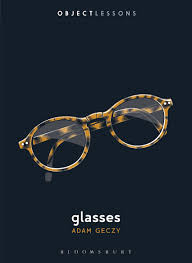
I read this courtesy of the publisher, Bloomsbury Academic, and NetGalley. It’s out in July.
Firstly, I know this is an ARC but I really hope that the publishers deal with the editing issues. Eyes described as “shouldering blue”? There are a few points with very silly typos, and a couple of sections where sentences have clearly been rewritten but the original not removed.
Overall I enjoyed this book, if not quite as much as others in the series. The history of lenses used to either improve eyesight or shade the eyes from bright light is genuinely fascinating – I had no idea about the use of emeralds and green-tinted glass by Venetian nobles, nor the use of visors by artists. I was a little perturbed by the discussion of how kids with glasses are viewed: not the repeating of stereotypes so much as that it didn’t feel like there was enough reminder of the fact that these ARE stereotypes. There’s also a weird tendency across the book to suggest that in some cases the assumption of genius in the glasses-wearer is born out by some individuals, which feels like making assumptions about cause and effect – and individuals don’t make stereotypes real – etc etc. There’s also a discussion about the aesthetics of facial shape and what glasses work with what shape, which also honestly just felt weird, when there was no “or you just pick the glasses you like!”
I liked that the book included exploration of sunglasses and their use by celebrities – and also what wearing corrective glasses does for celebrities, and that this included extended discussion of Clark Kent. The section on sunglasses included mention of blind people like Stevie Wonder and Ray Charles, which was great – but the omission of Roy Orbison felt egregious, given how his use of sunglasses was counter to basically every example provided in the book.
All up, an interesting overview, but not as insightful or engaging as others.
A Bite-Sized History of Italy
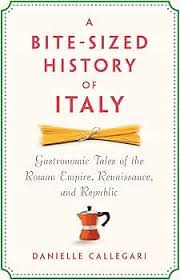
Read courtesy of NetGalley and the publisher. It’s out at the start of June.
This book was an absolute delight.
The ‘bite-sized’ is an important part of the title, and the point is reiterated in the introduction: Callegari isn’t claiming this as a definitive look at Italian food, Italian culture, Italian identity, or their connections. What it is is a starting point, a set of vignettes (appetisers?) pointing to important moments and aspects of food and culture and identity, which are starting points for a deeper investigation – if you want to. If you just want an overview, that’s what this is!
Starting from Roman history and coming through to today, touching on many geographical areas and many Significant Italian Foods, Callegari touches on how certain things became ‘Italian” – tomatoes are not even European, let alone originally Italian! – as well as what it means for certain foods to exist in very specific regions. And beyond that, she touches on what it even means to be “Italian,” how that has changed / is changing, how food has influenced it, and also how talking about food (looking at you, Dante) has been a factor in this.
Not only is this a really great overview of a lot of interesting topics, it’s incredibly engaging. Chapters are short – like I said: appetisers – but they usually don’t feel too superficial because Callegari is very clear about the purpose of the book.
If you’re interested in food history but not looking for an encyclopaedia, this is an excellent starting point on Italy. Also: what a brilliant bibliography.
Lords of the Salt Road
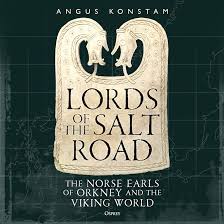
I read this courtesy of the publisher, Osprey, and NetGalley. It’s out at the start of June.
Overall I enjoyed this book very much. I have a couple of caveats, which I’ll get to, but in general it has expanded my understanding of the role “the Norse” played in the history of the British Isles, as well as what it meant to be Norse / a Viking.
I came to this book with some knowledge already of “the Viking Age” – and I use those quote marks advisedly, since it’s a term that many historians aren’t happy about and is anyway incredibly vague (after all, what is “viking”?). Still, this is my context: I have a decent understanding of British history between when the Romans nicked off and the Normans stomped in; I have slightly less, but still some, knowledge of what was going on with that area now called Scandinavia. Would this book be as accessible to someone with zero knowledge of those things? It’s hard to say. Perhaps not, not least because one of the very difficult things is all of the Hara/olds, and there are a couple of other names that pop up repeatedly too; it’s hard to keep track of who’s who, even if you have a basic grasp of who should be when.
So, the book: a history of the Earls of Orkney (who also had control of the Shetlands, for most of their existence, as well as parts of northern Scotland for a fair chunk of time). It uses as its base a Norse saga about the earls, along with some other bits and pieces. Konstam makes a good argument for seeing the earls as a really important part of understanding the history of both Scotland, and Britain more broadly, and Norway in particular. It has been very easy for a very long time to insist on a French/maybe also Spanish tilt to British history, but the truth is that the Norse played much more of a role than just occasionally burning some monasteries down. And this book goes a ways to showing how that was true. I learned a great deal that I had no idea about, and some things I did already know got a lot more context.
Now, the caveats.
- The treatment of women. There’s one woman in particle, Ragnhild the daughter of Queen Gunnhild, whose role in various terrible events is taken with basically no hesitation straight from the sagas – that she was responsible for the deaths of “four notable men”, was evil, nearly destroyed the earldom, blah blah. I honestly can’t believe that this got past the editors: that there was no discussion about “maybe something else was going on here?”
- The first irked me. The second is actually more of a problem: there are a couple of things that I know for sure are actually errors. Harald Hardrada is described as having founded the Varangian Guard – nope. And a couple of the earls had to do with Macbethad ac Findleach – Macbeth. Konstam says that “Shakespeare followed the right historical script” in terms of murdering Duncan; again, nope, it seems to have been in battle. Both of these things do trouble me as to the veracity of other parts.
- Linked to the above: there’s not quite as much external verification of the Orkney saga as I might hope. The author brings in points from other sagas, and I get that there’s not many other sources, but the book also doesn’t caveat a lot of the ideas quite as much as I might have liked.
- Finally, a stylistic choice that drove me spare. Most of the Earls and other significant men have nicknames, like Harald Hardrada and Magnus Barelegs. Throughout the book, Konstam writes this as Harald ‘Hardrada’. And I can’t help but read these as ironic quote marks, as if the author is having a little joke or something. I’m sure that’s not true, but it did make for a frustrating reading experience.
Do I regret reading the book? Not in the slightest. It’s definitely made my knowledge of the late 800s-1200s in northern Scotland and Norway much more expansive. It’s not perfect, but that’s why multiple books should be written about similar topics.

 Randomly Yours, Alex