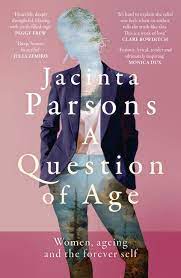
Not the sort of book I would gravitate towards; but I heard Parsons speak at the Clunes Booktown festival this year, on a panel about ageing – which was interesting itself – and I decided it would be worth reading.
This is in no sense a self-help book, as Parsons says in the very first sentence. It’s part-memoir, in that it includes a lot about Parsons’ reflections on her own life and experiences – growing up, living as a white, disabled, woman, conversations she’s had with women about the idea of age and ageing; partly it’s philosophical reflections on the whole concept of ageing, particularly for women; and it also bring together research about what age means in medical and social contexts, the consequences of being seen as ‘old’, what menopause is and means, and many of the other issues around ageing. I should note here that it’s not just ‘life after 50’ (or 60, or 70); there’s also exploration of the experience of little girls growing up, the changes from adolescence into adulthood, and then into ‘middle age’ and ‘being older’.
It’s a book that’s likely to make many readers feel pretty angry. Not at what Parsons is suggesting (in my view), but the facts that she lays bare. About the way that girls are treated as they mature; about the way ‘old’ women are treated; at the way ‘old’ bodies are viewed, and everything around those moments. It made me realise how privileged I have been, in either not particularly experiencing (or not noticing) a lot of the sexualisation that women experience, and in not having a career that’s geared in any way around my appearance. I had a discussion recently with someone who mentioned that they didn’t feel like they were allowed to let their hair go grey, as I am – that their appearance was too important in their (corporate) work, and grey wouldn’t fit the image. I felt so, so sad that that’s what the world is enforcing. (I have always delighted in my grey streaks; it’s only partly because I am too lazy to bother with colouring it.)
Parsons is at pains to discuss what her identity means in the context of ageing – being white, and being disabled, being cis; she strives to include the experiences of queer, trans, and especially Indigenous Australian women throughout. It’s not even 300 pages in length so clearly it’s not the definitive book on the topic: a book with the same origin written by an Indigenous woman, or a collective, is going to turn out very different. Parsons is making no claim to be all-encompassing and I liked that. This is a deeply personal book, while also including a lot of science and stats and other women’s voices.
In many ways this feels like the start of a conversation. To use a meta book analogy, this isn’t the prologue – we’ve been having these conversations and there’s been research done in some important areas – but it’s around chapter 1 or 2. There’s still so much more to explore, and to examine, around ideas of ageing. And individuals need to be having these conversations, too – older women with younger, as well as peers.
Very glad I picked this up.

 Randomly Yours, Alex