Herc – a novel
Read courtesy of NetGalley. It’s out at the end of August.

I am bored by Hercules as a hero. But as a character in other people’s lives – as a messy, complicated, often unheroic, flawed, and realistic person – I am THERE.
The man named Heracles by his parents (who then changes his name to Hercules (which is a cute way of getting around the Greek/Roman thing) because reasons) never speaks to the reader in Herc. Instead, it’s all the people around him who tell his – and their own – story, from birth to death: father, brother, sister, nephew, cousins; wives; lovers (male and female); cousins; others met along the way. This variety showcases the different ways that people interact with the man. Some love him, while others hate him. Some continually forgive his flaws, while others are unable to.
Hercules rarely comes across well. He is strong – but he has little idea how to mitigate that strength around ordinary people, and even seems unaware of what he’s capable of. He is aware of the terrible crimes he has committed – killing his music teacher as a child, murdering his first wife, Megara, and all their children, amongst other things – and accepts that there needs to be consequences… and yet. And yet he is still seen as a hero, by those outside of his immediate circle, and indeed often by himself. And yet he seems to largely get away with being terrible. And the book does not forgive him for that.
This story dives deep into the consequences of Hercules’ actions for those around him and it is pointed, it is complex, and it is deeply thoughtful. I would read more in this style any day of the week.
This All Come Back Now – anthology
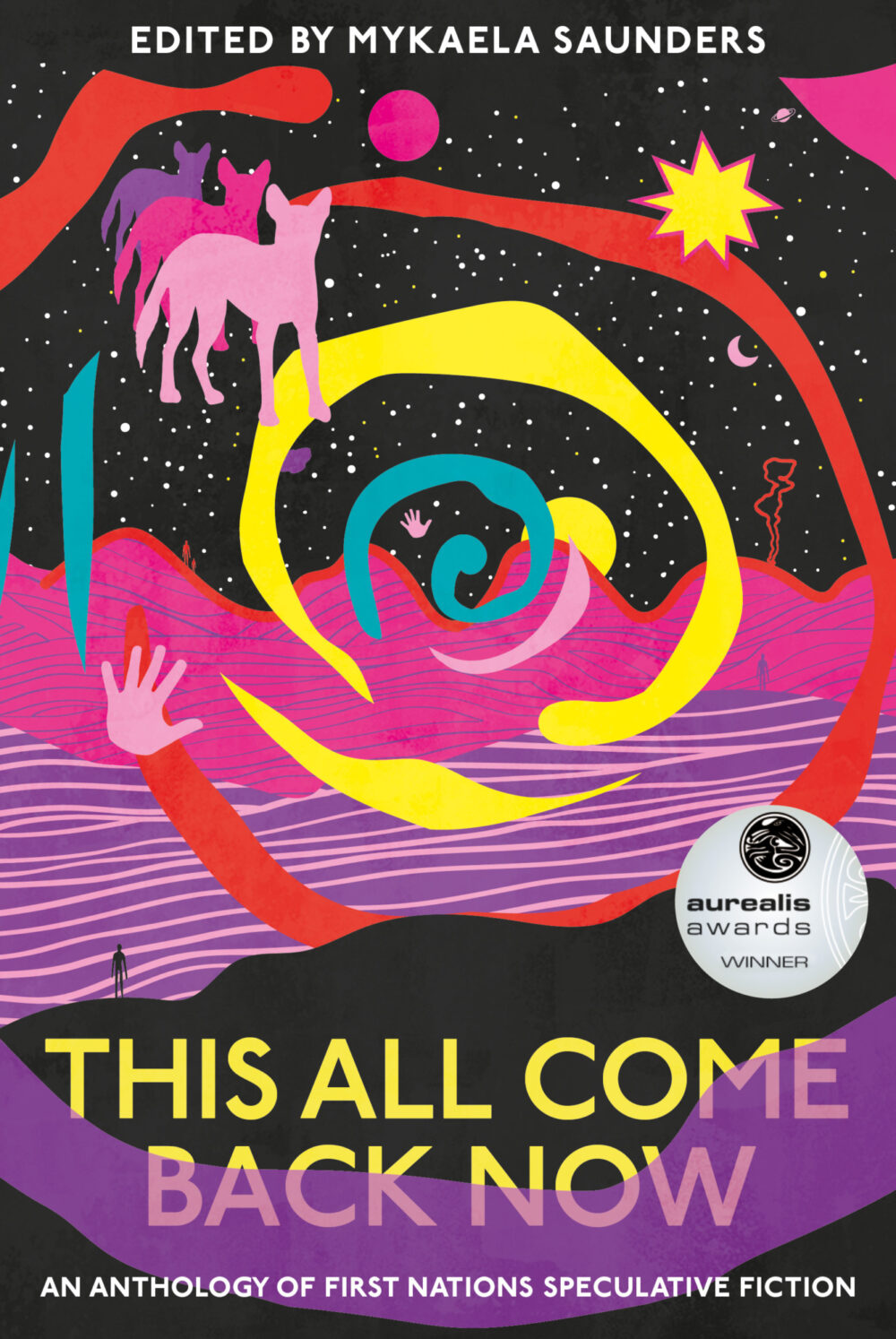
This came out last year, and I only found out about it this year… oops; not sure how I missed it (especially given its Aurealis Award!). Available from UQP.
The first all-Indigenous Australian speculative fiction anthology! Exciting that it exists; disappointing that it took until 2022 for it to exist. Oh, Australia.
First, how glorious is that cover? It’s so vibrant and exciting.
The editor, Saunders, gives a really interesting intro to the anthology. I go back and forth on whether I read intros to anthologies; sometimes they seem like placeholders, and sometimes they give a wonderful insight into the process. This is the latter (although I did skip the last few pages, where Saunders discussed the stories themselves; I don’t like reading that until after I’ve read the stories myself. YMMV). The comparison of an anthology with a mixtape has given me all sorts of things to think about. There’s also a brief discussion of First Nations’ speculative fiction – that it exists despite what a cursory overview of the Australian scene might tell you – as well as that insight into the creative process. This is one introduction that was definitely worth reading.
The stories themselves are hugely varied; this is not a themed anthology, like Space Raccoons, but instead is tied together by the identity of the authors. That means there’s experimental narratives and straightforward linear ones; recognisably gothic, science fiction, and fantasy stories; and other stories that refuse to fit neatly into categories. As with all such anthologies, I didn’t love every story; I have limited tolerance for surrealism, as a rule – it just doesn’t work for me, but I know it does for others. Some of these stories, though, will sit with me for a long time. Karen Wyld’s “Clatter Tongue,” John Morrissey’s “Five Minutes,” Ellen van Neerven’s “Water,” just as examples – they’re profound and glorious.
I love that this anthology exists. I’m torn between hoping there can be more books like this – because featuring Indigenous perspectives and writing in a concentrated way is awesome, showcasing the variety of stories and voices – and hoping that the authors featured here will also be published in other anthologies, and magazines, and have their novels published, as well. Maybe that’s not a binary. Maybe we can have both. That would be nice.
Divinity 36, Gail Carriger
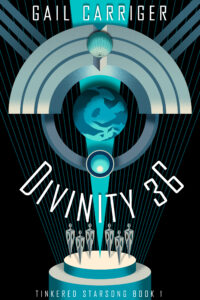
Sooo I missed this when it first came out – but it turns out I’m not too far behind the times as I read this first one (in a day…), went to look for the second one, and turns out it came out the next day (which is today, as I write). And the third comes out in October, so actually I’m doing just fine.
If you just want to buy it, or read what Carriger has to say: https://gailcarriger.com/books/d36/
So there’s many different aliens, pretty much all interacting companionably. One particular species, the Dyesi, search the galaxy for sentients who can sing or dance and then put them through rigourous training and bring them together as pantheons, because at that point those artists are gods. Yes, it’s a bit “The Voice” – or, more accurately, “Idol” where the prize is to ACTUALLY be an idol. And their performances get broadcast across the galaxy, and people literally identify as worshippers and send in votives and so on.
The focus of this series is a refugee who has a lot of trouble with ordinary emotional interactions thanks to childhood trauma. Brought together with new people and compelled to live and work with them, this is inherently a story about found family and in that it is simply lovely. There’s also, of course, music and art, and – amusingly – food and cooking.
This is a very cosy story, as should be no surprise to readers of Carriger’s work: that is, there is real and important trauma in various backgrounds but (so far) little immediate or overwhelming danger to our heroes; there’s a lot of focus on friendship and figuring out how all of that works, with a sense that obstacles can and will be overcome (not in a cheesy way). It’s a generally upbeat, inclusive, humorous, joyful story – and honestly who doesn’t need that in their lives sometimes? If you haven’t read any Carriger but you loved Legends and Lattes, I suspect this will work for you.
Desolation Road, by Ian McDonald

This book should not work.
The first few chapters are “and then this person arrived in this place that has no right to exist”. Sometimes the person or family group have some explanation about who they are or why they’re travelling; sometimes their background is incredibly vague. There are hints and vague hand-wavings at what might be coming in the future because of a particular character, and then it takes a hundred pages for anything like that to happen. There are possibly-magical occurrences, there are references that make it sound like you’ve missed the first two books in the trilogy (Our Lady of Tharsis…) and it takes FOREVER until there is something resembling a narrative.
This book absolutely works. And I don’t know why.
Well, I do: it’s because McDonald is an astonishing storyteller, and all of those things that seem wrong just become utterly intriguing and compelling. Someone who manages to make a time machine because a green person pops up at their camp as they travel across the desert? OK. Triplets who may or may not be clones; twins who split the rational and the mystical between them; someone who has an uncanny way with machines… yep, fine. I’ll read it. People are adults at 10 years old? Oh right, it’s Mars, and the Martian year is 2/3 longer again than an Earth year. So yes, actually, that’s fine.
Imagine writing this, and selling this, as one of your first books.

 Randomly Yours, Alex