Ares Express, by Ian McDonald

When I read Desolation Road I had no idea that I was reading a companion novel to Ares Express. Happily, it doesn’t matter what order you read them in – there’s no spoilers, and only one character in common… who is fairly central to the plot of both, but in ways that work separately for each novel.
Every time I read a new McDonald novel I’m reminded of just how awesome a creator he is. Here, the focus is a young woman born to a train family – they drive trains around Mars, and everything about the family is focused on the train. It’s a weird mix of a society, because it’s clearly technologically advanced – or at least, there are aspects of that, since they’re living on a terraformed planet and they have various tech things that don’t exist for us. At the same time, though, there are archaic aspects to the human side, including, sometimes, arranged marriage. Such is the future looming for Sweetness Octave Glorious-Honeybun Asiim 12th, and she is not having it. And so begins an adventure across Mars that will eventually have enormous repercussions.
The way McDonald gradually reveals his vision of this future world is masterful. There’s enough, early on, to understand the basics of society… and then slowly, slowly, enough of the history of the place is revealed that the reader’s vision is broadened. It’s looking through a keyhole vs eventually looking through a door. But not stepping through that door – there are still lots of tantalising bits that aren’t fully explained, which just makes it all the richer.
Sweetness is a great focal character: young, impetuous, smart, unafraid of challenges and usually willing to admit when she needs help. I would have been happy with an entire novel focused on her. But McDonald adds Grandmother Taal, and I love her to bits. Old ladies being feisty, taking up the slack when the younger generation is being a bit useless, fearless and clever and willing to meddle: she’s everything I love.
One of the great things about writing a middle-future novel where there’s been some loss of tech for whatever reason is that, despite being over 20 years old now, it still gets to feel vital and believable and not at all outdated. Ares Express is magnificent.
Tomorrow’s Parties (anthology)
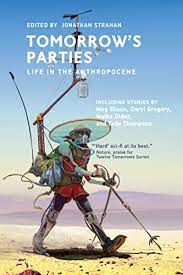
I really have to be in a particular frame of mind to read anthologies, which is why I read several in a row recently – including this one. It’s not that I thought I wouldn’t enjoy them – they’re Strahan anthologies, I’ve never not enjoyed one. It’s just a particular reading experience.
Anyway! Now I have read this awesome anthology and it was as stunning as I expected. As the subtitle suggests, the loose theme is “life in the Anthropocene”, and the authors largely took a similar-ish attitude towards what that means; there’s a lot of climate change-related stories, as is appropriate, and / but all of the authors took quite different approaches to what that might mean.
Every single one of these stories is amazing. I’m intrigued that Strahan chose to open the anthology with a conversation between James Bradley and Kim Stanley Robinson – it’s the sort of thing that I tend to expect at the end of the anthology – and maybe that’s part of the reason for it to be up front: to encourage readers to actually read it. It also sets up the climate change issues that are so front and centre through the rest of the book; the title is “It’s Science over Capitalism: Kim Stanley Robinson and the Imperative of Hope,” which itself speaks volumes.
The ten stories in this anthology are all exceptional.
Meg Elison, “Drone Pirates of Silicon Valley”: the future of online shopping and delivery, yes, but also rich vs poor, and the future of capitalism.
Tade Thompson, “Down and Out in Exile Park”: how communities might live differently, and how that challenges the status quo.
Daryl Gregory, “Once Upon a Future in the West”: multiple perspectives, and quite creepy at times. So many issues – the (negative) future of telehealth appointments, autonomous vehicles, bushfires…
Greg Egan, “Crisis Actors”: a very disturbing story that explores some of the consequences of living in a “post-truth society”. I always adore Egan’s short work.
Sarah Gailey, “When the Tide Rises”: another story that confronts capitalism head-on, bringing back the idea of the ‘company town’ as well as poking at the idea of companies making money from finally doing good for the planet. Brilliant.
Justina Robson, “I give you the moon”: one of my favourites, and not just because it’s one of the most hopeful of the stories. This is post-climate crisis, when humans have figured out how to live in more balance with the rest of the world (her vision is marvellous). Rather than focusing on how we get there, this story is about family dynamics, and ambition. It’s gentle and wonderful.
Chen Qiufan (trans. Emily Jin), “Do you have the Fungi sing?”: the consequences of a hyper-connected world, what happens if an area doesn’t want to participate – and possible alternatives.
Malka Older, “Legion”: completely and utterly different from all of the others, this is the story that’s going to stay with me the longest. Chilling, confronting, challenging… I had to stop reading when I finished this story and take a breath. It takes place over a short period of time – maybe an hour? – in the prep for, and during, an interview on a talk show. The host, Brayse, is interviewing a woman representing Legion, a group who have just won a Nobel Peace Prize. The reader is in Brayse’s head, which starts off as a reasonable experience and then gets… less so. Legion, as the name suggests, are not just one or a small group; they are everywhere, always watching through wearable cameras, and able to call out – or respond to – what they see: micro- and macro-aggressions, and all the ways in which some people are made to feel less comfortable right up to actual harm. Older nails the unfolding of this story perfectly.
Saad Z. Hossain, “The Ferryman”: another incisive take on the consequences of late-stage capitalism, this time how people will respond to death when, for the ‘haves’, death doesn’t need to exist.
James Bradley, “After the Storm”: being a child growing up in the ravages of climate change is likely to suck; at the same time, children do tend to be resilient and make their way within the world that they know. Bradley focuses on teenagers and their experiences – rather than the adults who know how things have changed – and captures the cruelty as well as the love of adolescents beautifully.
All in all, an excellent addition to the literature around ‘what next’.
Someone in Time (anthology)
I am late to the party… however, not SO late, because this just won the British Fantasy Award! Which it absolutely deserves.
I’m sure there are some readers who would avoid this because “they don’t read romance” (hi, I used to be one of those). The reality though is that you do; there’s almost no story – written or visual – that doesn’t include romance somewhere in its plot. What I have learned about myself is that I rarely enjoy what I think of as “straight romance” – that is, stories where the romance is the be-all of the plot; they just don’t work for me, as a rule. What I love, though, is when the romance is absolutely integral to the story and there’s a really fascinating plot around it. Every single one of these stories does that.
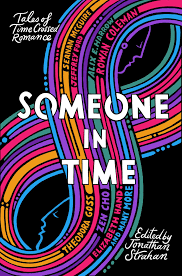
As the name suggests, this is set of stories involving romance and some sort of time travel. It’s a rich vein to mine, and every single one of these stories is completely different. Sometimes the time travelling is deliberate, sometimes not; sometimes the ending is happy, other times not; some are straight, some are queer; some pay little real heed to potentially disrupting the historical status quo; some have easy time travel while others do so accidentally; sometimes the time travel happens to save the world, and sometimes it’s about saving a single person. Sarah Gailey, Rowan Coleman, Margo Lanagan, Carrie Vaughn and Ellen Klages (a reprint) wrote my favourite stories.
And then there’s Catherynne M Valente’s piece. I did love every single story in this anthology; Valente’s story is breathtakingly different in its approach to both structure – eschewing linearity – and theme: the romance is between a human woman and the embodied space/time continuum. Hence the lack of linearity. It’s a poignant romance and sometimes painful romance; it also confronts the bitterness of dreams lost, the confusion of family relationships, the beauty of everyday life, and the ways in which even ordinary people don’t really live life in a straight line, given the ways our memories work (Proust, madeleines, etc). This is a story that will stay with me for a long, long time.

 Randomly Yours, Alex