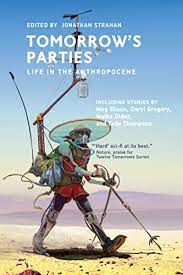
I really have to be in a particular frame of mind to read anthologies, which is why I read several in a row recently – including this one. It’s not that I thought I wouldn’t enjoy them – they’re Strahan anthologies, I’ve never not enjoyed one. It’s just a particular reading experience.
Anyway! Now I have read this awesome anthology and it was as stunning as I expected. As the subtitle suggests, the loose theme is “life in the Anthropocene”, and the authors largely took a similar-ish attitude towards what that means; there’s a lot of climate change-related stories, as is appropriate, and / but all of the authors took quite different approaches to what that might mean.
Every single one of these stories is amazing. I’m intrigued that Strahan chose to open the anthology with a conversation between James Bradley and Kim Stanley Robinson – it’s the sort of thing that I tend to expect at the end of the anthology – and maybe that’s part of the reason for it to be up front: to encourage readers to actually read it. It also sets up the climate change issues that are so front and centre through the rest of the book; the title is “It’s Science over Capitalism: Kim Stanley Robinson and the Imperative of Hope,” which itself speaks volumes.
The ten stories in this anthology are all exceptional.
Meg Elison, “Drone Pirates of Silicon Valley”: the future of online shopping and delivery, yes, but also rich vs poor, and the future of capitalism.
Tade Thompson, “Down and Out in Exile Park”: how communities might live differently, and how that challenges the status quo.
Daryl Gregory, “Once Upon a Future in the West”: multiple perspectives, and quite creepy at times. So many issues – the (negative) future of telehealth appointments, autonomous vehicles, bushfires…
Greg Egan, “Crisis Actors”: a very disturbing story that explores some of the consequences of living in a “post-truth society”. I always adore Egan’s short work.
Sarah Gailey, “When the Tide Rises”: another story that confronts capitalism head-on, bringing back the idea of the ‘company town’ as well as poking at the idea of companies making money from finally doing good for the planet. Brilliant.
Justina Robson, “I give you the moon”: one of my favourites, and not just because it’s one of the most hopeful of the stories. This is post-climate crisis, when humans have figured out how to live in more balance with the rest of the world (her vision is marvellous). Rather than focusing on how we get there, this story is about family dynamics, and ambition. It’s gentle and wonderful.
Chen Qiufan (trans. Emily Jin), “Do you have the Fungi sing?”: the consequences of a hyper-connected world, what happens if an area doesn’t want to participate – and possible alternatives.
Malka Older, “Legion”: completely and utterly different from all of the others, this is the story that’s going to stay with me the longest. Chilling, confronting, challenging… I had to stop reading when I finished this story and take a breath. It takes place over a short period of time – maybe an hour? – in the prep for, and during, an interview on a talk show. The host, Brayse, is interviewing a woman representing Legion, a group who have just won a Nobel Peace Prize. The reader is in Brayse’s head, which starts off as a reasonable experience and then gets… less so. Legion, as the name suggests, are not just one or a small group; they are everywhere, always watching through wearable cameras, and able to call out – or respond to – what they see: micro- and macro-aggressions, and all the ways in which some people are made to feel less comfortable right up to actual harm. Older nails the unfolding of this story perfectly.
Saad Z. Hossain, “The Ferryman”: another incisive take on the consequences of late-stage capitalism, this time how people will respond to death when, for the ‘haves’, death doesn’t need to exist.
James Bradley, “After the Storm”: being a child growing up in the ravages of climate change is likely to suck; at the same time, children do tend to be resilient and make their way within the world that they know. Bradley focuses on teenagers and their experiences – rather than the adults who know how things have changed – and captures the cruelty as well as the love of adolescents beautifully.
All in all, an excellent addition to the literature around ‘what next’.

 Randomly Yours, Alex