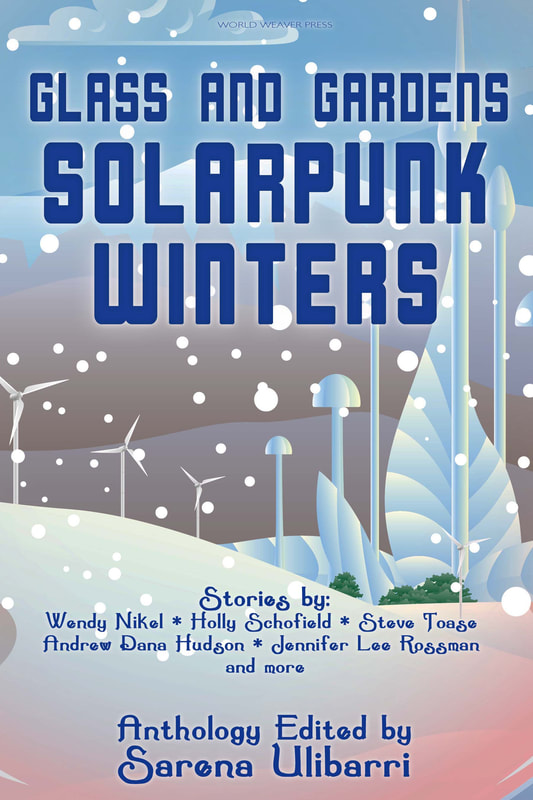
I’ve only recently come across the idea of ‘solarpunk’ – basically a hopeful take on humans living in a post-climate change world, as far as I can tell. I guess this is what ‘hopepunk’ also aims to be? maybe solarpunk is a bit more about the actual mechanics… I don’t know, I’m not going to claim the ability to set genre boundaries. ANYWAY, World Weaver Press has done a bunch of solarpunk anthologies, and a couple of them were on special the other day so I got them.
The first one I read was this, Glass and Gardens. Turns out I was in the right zone for some hopeful SF. As with all anthologies, I didn’t love every story – but also, there were no stories that left me wondering what the editor was thinking. They all fit the overall theme – how to be hopeful when winters have got more extreme or, in a couple of cases, the world has warmed so much that winter no longer happens, with equally disastrous consequences for the environment. It is heavily North American-focused, but honestly as an Australian this is just something I pretty much take for granted.
One thing I particularly liked was that while all of the stories were focused on humans, and what they are doing to live with/ mitigate/ work around climate change, there’s also a focus on how the climatic changes have affected the rest of the species on the planet. It’s s refreshing change and something that seems to be a trope within solarpunk from what I can tell – an acknowledgement that humans aren’t alone on the planet. So there’s Jennifer Lee Rossman’s “Oil and Ivory”, about narwhals and whether they’ll be able to travel underneath pack ice in the Arctic; bears and several other animals in “Set the Ice Free,” from Shel Graves; and several stories that have cities encouraging a lot more greenery and what could be called extreme eco-living compared to today.
An aspect that connects to the idea of hope is the prominence of art in these stories. Your dire post-apocalyptic world has no room for art and beauty. But Sandra Ulbrich Almazan has characters making clothes in a variety of ways in “A Shawl for Janice;” “On the Contrary, Yes” from Catherine F King is entirely focused on art and making art across multiple genres; Andrew Dana Hudson imagines ice-architecture as its own art form in “Black Ice City.”
This is a great anthology, and I look forward to reading more solarpunk.

 Randomly Yours, Alex