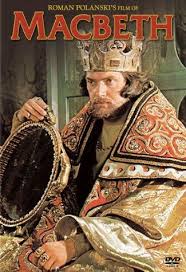
I have loved the play ever since I encountered it. I have seen many versions since then – several on stage (a memorable one at Melbourne Uni, performed in the round, with costuming to make it classic leathers-n-chains punk gangs), and several on film. Now I embark on an endeavour to watch as many versions I can find…
It’s a lot about Lady Macbeth – she is so active and yet she’s not allowed to be powerful without being punished. I’m also fascinated by the way it portrays power. And then the text around it is fascinating too: the utter misuse of history that it represents (yo, English propaganda!); the way that aspects of Lord of the Rings (the Huorns going to the Hornburg/Ents going to Isengard, and the Witch King being killed by a hobbit and a woman) are apparently speaking to Tolkien’s annoyance with the play (the forest coming to Dunsinane; no man of woman born…) – and its many appearances in popular culture.
So: here go.
1971: Polanski / Finch.
The 1971 Polanski Macbeth is my ur-text for the play. We watched it in Year 11 English, and it has coloured my view of the play irrevocably. (This was 1995 and of course I had no idea of anything about Roman Polanski at the time.) Francesca Annis is what I most remember – even more than Jon Finch – because her Lady M was so fierce and then so completely undone.
The weird sisters:
- First appearance;
- Maiden/mother/crone styling.
- Entirely physical – no sense that they are magical
- The maiden flashes her genitals!
- Second appearance:
- A cave full of naked women, all contributing to the cauldron.
- Macbeth drinks their concoction and then has weird hallucinations. – it’s not clear whether they have done magic or just given him really trippy drugs.
Macbeth:
- You really don’t get a sense that Macbeth is very impressive at the start: we don’t see him fighting, just immediately confused by witches.
- He’s conflicted right from the start – even in front of his men. Distracted, rather than decisive.
- Malcolm and Macbeth suspicious of each other from the start.
- His haircut is doing him no favours.
- After the coronation, when he’s dealing with the murderers, is when Macbeth starts to show some determination (being bloody, bold, and resolute…).
- His behaviour is verging on manic.
- Macbeth dreams of Banquo and Fleance killing him, after he sends the murderers for them.
- By the time he’s told that the English and Malcolm are coming, he’s becoming cruel and rash.
Lady Macbeth:
- In the first shot, we marvel at the HAIR. And the CLEAN DRESS.
- She is excited to see Macbeth – and he to see her: they are shown to be in love.
- She suggests murder – to Macbeth’s complete surprise.
- Uses tears to manipulate Macbeth into assassination.
- She has a potion to hand already that will drug Duncan’s servants.
- She is already freaked out while Macbeth is doing the deed. And she never recovers the composure she had at the start.
- Lady Macbeth falls asleep doing embroidery – first sign that she does anything so ladylike. And she has her first hallucination of bloody palms: her behaviour is very distracted.
- Re-reading the first letter: hair in disarray, can’t read for tears.
- We do not see her fall, but hear the cry of the nurse at finding her.
“Unsex me here”:
- Mostly spoken while on the parapet, watching Duncan coming in: hair blowing, wearing a lovely dress.
- Words are thought, not spoken.
- Speech is shorter than the written version, and split in half.
“Is this a dagger”:
- Ominous music
- Actual hallucinated knife, with added sparkly lights
- Macbeth follows it to Duncan
- Macbeth is strung out the whole time
“Out, damned spot”:
- Performed nude, in her sitting room / boudoir, at night. (Long hair is a good costume.)
- Emotive.
- I like it.
“Tomorrow and tomorrow and tomorrow”:
- Walking down the stairs to see Lady M’s broken body (which is shown).
- Tight focus on Macbeth for most of it, at first light.
- I like it.
Violence:
- GRUESOME
- Execution of the original Thane of Cawdor: brutal.
- shows beheaded Duncan servants
- The slaughter of the Macduff household is brutal (rape and dismemberment).
- The Macbeth/Macduff duel is very 1970s choreographed.
- Macduff’s stabbing of Macbeth in the back is almost an accident, as Macbeth stumbles.
- Macduff cuts Macbeth’s head off and we see it go tumbling down the wall.
- The head then ends up on a pike for everyone to cheer about.
Setting:
- medieval; dirty.
- violent – killing the defeated soldier on the beach.
- generally well lit.
- Inverness Castle is actually Lindisfarne Castle; Dunsinane is Bamburgh Castle.
Dialogue:
- Easy to understand
Other things:
- Third Murderer is Ross, one of the thanes! Who then has the murderers themselves killed!
- Ross is also Macduff’s wife’s cousin, and visits her immediately before the castle is slaughtered. Unclear whether he’s done that deliberately.
- And then intercepts messages to be the one to deliver them to Macbeth.
- AND THEN he is the one to go to Malcolm in England…
- Malcolm’s haircut also does him no favours.
- There’s no scene with Malcolm testing Macduff to see if he’s a good person.
- The English soldiers with Malcolm absolutely informed Monty Python’s Holy Grail.
- The last scene has Malcolm’s brother Donalbain, at the spot where Macbeth first saw the weird sisters, and they are singing, and he goes to investigate…

 Randomly Yours, Alex
[…] Via YouTube: The Royal Shakespeare Company in Trevor Nunn’s Production of. A 1979 filming of an RSC production. (First post in this series.) […]