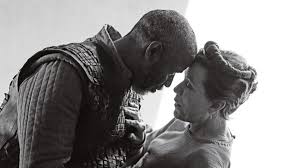
Via Apple.
The cast is wonderful, the filming is fabulous, and I love it very much. This might be my favourite Macbeth.
The weird sisters:
- First appearance:
- The first speech is just narration to a black screen… until suddenly it’s a cloudy sky, with three birds circling, and then it’s NOT the sky but sandy ground.
- Brief interlude to Duncan hearing about the battle, and then back to the witches…
- Except it’s not a trio: it’s one woman, a contortionist with an amazing voice and honestly she’s the most terrifying witch I’ve seen yet.
- She seems to be on the battlefield, and she squawks like a crow – the symbolism is glorious.
- And when she speaks to Macbeth, she’s in front of a pool of water – with two versions of her reflected. And her voice is echoed to sound like more than one person…
- And then her two reflections leave the pool and come to stand next to her!
- Second appearance:
- Three figures in the ceiling, looking down at Macbeth – he hasn’t had to go looking for them.
- There are multiple voices, but only one face.
- “Double, double” is put here, as a way of calling the witch’s master. All ingredients thrown into a pool of water that’s in the castle.
- The emphasis on “no more” was some ominous foreshadowing.
Macbeth:
- First appearance: walking out of the sun, into our view: that’s a symbol. In appropriately worn medieval-ish battle dress
- Second appearance: There’s love for Lady Macbeth, but it’s more restrained than in some other versions. Possibly because they’re much older?
- I think this is my favourite version of the “he’s here in double trust” speech. Washington isn’t a coward, he’s being rational and thinking it all through.
- I like Washington’s thoughtfulness as Macbeth. I do think it’s about age; he would be much less convincing as an impetuous, ambitious man. Which is not to say that he is emotionless: his anger at the idea that Fleance might be the reason he has soiled his soul is real.
- Macbeth seeing Banquo, post-death, is preceded by a crow flapping down the hall… and then when he is fighting Banquo, it turns out to be a crow. Like the crow the witches appeared to turn into at the start….
- Unravelling terribly as the English army approaches.
- He’s so tired by the time the English arrive. And resigned to fate. The way he hears that Macduff was untimely rip’d… again, I think it’s age.
Lady Macbeth:
- First appearance: Long pale dress walking down a long, bright corridor. Hair is a crown.
- Her use of fainting is beautifully timed.
- As queen: she is now in a dark dress, beautifully embroidered. Hair still up in a crown, with an actual crown added to it.
- After the Banquo hallucination, she gives Macbeth a cup of wine and adds a drop of… something… and then the next thing we know, it’s “Tomorrow” and Macbeth wakes up and sees the witches. So… playing into Lady M as a witch herself…
- And then when she comes in to him, her hair is in a rough plait and very messy.
- We actually see her once more, briefly, just before the army arrives – and Ross sees her too, and approaches her… menacingly…
“Unsex me here”:
- Burns the letter from Macbeth.
- Speech is broken in half – back to Duncan for investing Macbeth as Cawdor.
- The second half comes while she is sitting, and then lying, on her bed, which is very different from speaking it from the ramparts!
- In part spoken while looking directly at the camera, but much while looking to the side.
“Is this a dagger”:
- Worried, but not overwrought.
- There is a dagger – sort of – it’s a pale glimmer in front of a dark door, at the end of a long corridor, so it’s hard to determine what it is given the black and white of the film.
- … and then it turns out to be the door handle and that’s my favourite version EVER of this hallucination.
“Out, damned spot”:
- The scene starts with Lady Macbeth standing outside, magnificently silhouetted against the sky.
- Hair is loose, and a bit wild. Night gown is pale and long, with long sleeves – much looser than her other dresses.
- McDormand is glorious. I love Francesa Annis and always will, but McDormand might be my favourite.
“Tomorrow and tomorrow and tomorrow”
- Lady Macbeth at the bottom of stairs, Macbeth walking down towards her.
- He’s so tired. And so generally overwhelmed that he almost has no space for sadness.
Violence:
- The killing of Duncan is very intimate, but the violence isn’t extreme.
- The murder of Banquo is a bit vicious but not overdone.
- The killing of the Macduff household is suggested to be vicious, but again not really shown.
- Another sign that Coen was influenced by Polanski: Macbeth’s head goes flying.
Setting:
- The battlefield is sandy, or dusty – there’s no detail about what the land is actually like, and certainly not where it is. This is Anywhere.
- The castle is amazing. The ceilings are ludicrously high, very few doors, lots of stairs – lots of right angles.
- More focus on the sky than I’ve noticed before, in particular clouds or mist; the covering of the sun is done to great effect. And rain during the banquet! Marvellous.
- The final fight takes place on castle ramparts, which are apparently so high that they’re in the clouds.
Dialogue:
- Very easy to understand.
- A variety of accents, but I don’t find it distracting.
Other things:
- The black and white filming is marvellous, the use of shadows beautifully used.
- Washington’s dark skin and dark clothing is beautifully contrasted with McDormand’s pale skin and equally pale clothing, at the start.
- The cast of this film is glorious. I mean, Brendan Gleeson as Duncan? But Harry Melling as Malcolm: I’m sorry, kid, you are always going to be Dursley.
- This Ross is terrifying, and on top of that I can’t quite figure out his costume. It’s basically a dress: is it meant to be like a monk’s habit, or is he meant to be vaguely feminine? Different from the other thanes, anyway, particularly those who wear battle dress.
- Ross meets an old man and they have a confusing conversation… but it’s the woman who played the witch(es), with a beard. So that’s portentous.
- And again, Ross is the third murderer, following Polanski.
- And then he’s the one to take the knowledge of Macduff’s family to the man.
- Ross is definitely implicated in Lady Macbeth’s death.
- And he brings the crown and Macbeth’s head to Malcolm.
- And THEN at the end, Ross goes to collect Fleance from the “old man” – the witch – and they ride away, down a hill – and rather than come back up the hill, there’s an explosion of crows… that is one weird ending.

 Randomly Yours, Alex