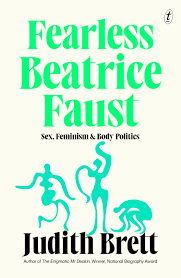
I very rarely read biographies of modern people. Faust only died in 2019, so that’s VERY modern by my standards. But I’ve been interested in how people approach modern biographies, for a project, and so this one was recommended. Having enjoyed Brett’s “From Compulsory Voting to Democracy Sausage,” I was fairly sure I’d enjoy her style, so this seemed like a good option.
Turns out, Faust was an amazing woman. Would I always have agreed with her? Oh no. Would I probably have found her abrasive to work with on a committee? Oh yes. Would I nonetheless have loved to be a neighbour, occasionally going over for coffee and hanging out? For sure.
Faust had a difficult upbringing: her mother dies from childbirth complications, her father is distant, her eventual stepmother unpleasant, and Faust herself is a sickly child (and continues to have multiple chronic conditions for most of her life, which are an enormously complicating factor for her). Yet she is clearly highly intelligent; she gets into Mac.Rob, the select-entry Melbourne girls’ school, and then Melbourne University to do an honours degree in Arts, and eventually an MA. Over her lifetime she writes many tens of thousands of words, and basically becomes a public intellectual – but not an academic, mostly because of misogyny.
Faust was extremely open about her life: her sexuality and sexual experiences, her abortions, her accidental addiction to benzos – all were fuel for public talks, articles, government submissions, and the many letters she wrote to friends.
She was also the founder of the Women’s Electoral Lobby, a key member of the Abortion Law Reform League, and various other women-focused campaigns. Her relationship with “women’s lib” and some aspects of feminism were fraught – she’s just that bit older than many of the agitators of the early 70s – and she definitely had some views that 1970s feminists had a problem with. In particular, some of the ways she talked about pronography, and – even more problematically – her apparent defence of some paedophiles were very troubling. Brett goes into these topics in great depth, sympathetic to Faust in that she tries to understand her views as well as possible, and present them fairly, but not so sympathetic that Faust gets a pass when she is saying unwholesome things.
Brett’s overall style is intriguing. She was approached by Faust’s friends, after she died, saying that she would be a good subject – and Brett said yes for many reasons, including the personal connection (living in Melbourne, some of the same haunts). Brett is not absent from the text, and I appreciated this aspect a lot. That’s not to say that Brett makes it all about her. I mean that Brett will mention when Faust’s reasoning is ambiguous, or when she got something wrong; and in dealing with some really hard topics – like her views on paedophilia – Brett wrestles with why Faust may have thought the way she did, and also calls her out for views that are pretty clearly inappropriate by today’s standards. Brett insightfully considers the question of whether Faust would be considered a TERF today, because she believed that biology was a significant part of a person’s identity; she concludes that it would be easy to say yes, but that Faust’s view is more nuanced than many TERFs, so perhaps not (Faust also didn’t seem to have a problem with a trans woman she spent some time with).
Beatrice Faust absolutely deserved to have a biography written about her. I’m glad Judith Brett was able to do so.

 Randomly Yours, Alex