The Everlasting, by Alix E. Harrow
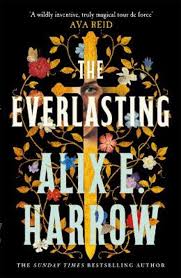
I keep not reading books by Alix E. Harrow as soon as I should, but at least this time I didn’t leave it a couple of years. Which means really I’m fairly up to date, right?
TL;DR this book is simply superb and if you have any interest in knights and adventure and time travel and stories that do very clever things with stories, this needs to be at the top of your To Be Read pile.
My thoughts on this magnificent novel are split into two bits: thoughts for readers with extensive (some might say tragic) Arthuriana knowledge, and thoughts for everyone else.
For everyone else: truly this is a beautiful novel of love and determination and the power of story. It can and should be read as a romping adventure story across time, with its share of heartbreak and despair but also a great deal of hope and bloody-minded teeth-gritting stubbornness. It can and should also be read as a dissection of the uses to which Story and History can be put, at a personal and a national level, which has a significant element of caution as well as its own element of hope. This is also a novel with fantastically well-developed characters: Sir Una, the knight whose image is used Kitchener-ly for Dominion wars (and I was also put in mind of Emily Blunt’s character in Edge of Tomorrow), whose devotion to her queen a thousand years ago is literally the stuff of legends. Owen Mallory, a nearly-failed historian with an alcoholic deserter father, struggling with his own demons, unexpectedly flung into Una’s story. The queen herself, Owen’s academic supervisor, the murderous horse – there’s not a misstep throughout.
… for the Arthuriana tragic, there’s even more going on here. The historian is Owen Mallory. Dominion is playing on the idea of England; the Arthur story is (or perhaps was) after all England’s national myth, in many ways, as Una’s is. There’s a wonderful interplay between Owen and his academic mentor about the Everlasting stories as a palimpsest, and stories being changed to fit a national moment, and irritation at audiences who think the later stories are the authentic ones – all of which applies to Arthuriana, in amusing and sometimes heated ways. There’s the idea of a knight being undying, the reference to a grail, most of the other knights’ names are plays on names from the various cycles – there are so many moments at which I just flailed at Harrow’s cleverness.
I adored this novel. And I read it just a few weeks after reading Tasha Suri’s The Isle in the Silver Sea; these ideas about stories and nations, their use and abuse, are clearly floating around in the zeitgeist. But I hasted to add that having read one does not detract from reading the other – the opposite is true: reading both (maybe not one after the other) is more like… some clever analogy with structures supporting one another. I’m sure you get the idea.

 Randomly Yours, Alex