She Who Tastes, Knows
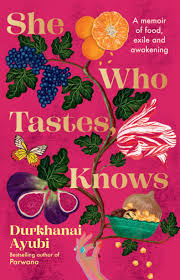
I received this courtesy of the publisher. It’s out now.
I am very ambivalent about this memoir.
On the one hand, there are some parts I enjoyed a great deal. The history overview of Afghanistan’s place in history – central to several empires over centuries, key to the Silk Road, and then the later shitshow of the 19th, 20th, and 21st centuries – was very well done and gives a good sense of the country’s deep and important place in the world. And then the discussion of its botanical richness – that was incredible. I know about the importance of not having monocultures and the extreme risk the world faces regarding a loss of diversity; I had no idea that for a whole bunch of colliding reasons, Afghanistan is home to an astonishing range of wheat varieties and fruit varieties and so on. That was fascinating.
I also appreciated the author’s discussion of her own life as a very young refugee, moving to Australia and growing up right around the time most Australians first learned about Afghanistan for all the wrong reasons. Her graciousness in conceding why ‘ordinary’ Australians didn’t know better than what we were fed by the media and politicians is humbling, while also infuriating that such an attitude was even needed. Attached to this are two very different discussions: one, Ayubi’s discussion about the importance of keeping her culture alive within a broader Australian culture – particularly through food, unsurprisingly; and two, a broader critique of the way white Western cultures have bad-mouthed refugees and all of the implications of that.
Most of the content was engaging, and was the reason I kept reading.
However… much of the book is written in a style that really doesn’t work for me. I find it overly flowery, to the point where I struggled to grasp the author’s point because the language obscured it. As a sample:
“I sat quietly amid my grandmothers and ancestors. Till this point, I’d never felt such a depth of my own story. Through a life of exile that was shaped most by absence, my relationship to food had kept me tethered just enough – weaving into my body and consciousness the hints I would need to stay aligned as I undertook the necessary remakings of myself, to gradually bridge me here. I was within a verdant and layered sense of fullness that had ripened through time, each cycle of growth feeding on the decomposition of the last.”
I’m quite sure this style appeals to a lot of people, and I think that’s great. I hope the book finds its way to their hands! But 220-odd pages of this was too much for me. Which was a shame, because I really wanted to enjoy it more.

 Randomly Yours, Alex