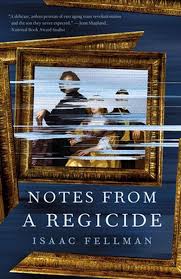
This is a complicated and complex, beautiful, fierce, glorious novel. There are so many things going on. The short version is: if you want a beautifully written novel involving a political story (I mean, look at the title), trans stories, a love of art, dealing with families, and a hint of science fiction – just read this. Don’t bother reading this review, just go find it.
If you need some convincing, well:
I feel like the only way I can talk about this book is to identify some of the strands, but also begin by saying all of the strands work together perfectly.
In part this is a son editing and presenting his father’s memoirs, particularly from when the father was in prison. The son, Griffon, includes notes at the start of those chapters – just a little William Goldman-esque, noting that he’s done some pruning. Those sections are where most of the politics are. The father, Etoine, lived for many years in Stephensport, an island that has completely turned its back on the wider world, ruled by a prince chosen by electors – who otherwise sleep in “the stone yard” and for whom citizens pray. Etoine is an artist, and gets drawn into revolutionary activity mostly against his will. It’s here Etoine meets fellow artist Zaffre (which really is a beautiful colour); she is a much more willing revolutionary. As someone who taught kids about revolutions for many years – well, the political bits here ring true, in the most devastating and fierce and poignant ways.
It’s also a memoir of Griffon, finding his family with Etoine and Zaffre, and also finding himself: he is trans, and it’s only on meeting Etoine and Zaffre that the possibility of living as himself starts to seem feasible. As an adult, looking back on his adolescence, Griffon is both harsh on his younger self for being self-centred and arrogant, and also forgiving for not knowing any better. It feels right.
So there is a lot about family here – having one, ignoring them, the frustrations and embarrassments and comfort, the impossibility of ever knowing people fully and the joy of being known and loved despite that. All of that alongside the politics.
And then there’s the art. Etoine and Zaffre are artists: for both of them, although in different ways, art is at the core of their identity. Fellman captures the obsession and drive of some artists, not romanticising the despair but also not ignoring the difficulties; for both, art is about life and life is about art – and it’s inextricably connected to politics, too.
I haven’t finished yet. There’s also mental illness – Etoine is an alcoholic, Zaffre has schizophrenia (maybe; her diagnosis is unclear), which they manage to varying degrees across their lives, to different effect on themselves and those around them. Again, not romanticised, but it also doesn’t make either of them a villain – and nor is it necessary to their art. It just is.
And, finally, this is a science fiction novel. Honestly it would be easy to ignore that part. It’s not quite blink-and-you’ll-miss-it, but it’s not far off. It is completely necessary to the world of the story, but it’s also not at the heart of the narrative. It’s supremely well done. I feel like there will be a lot of people who go into this expecting A Science Fiction Novel who may be disappointed by the way it uses the genre; that would be sad, but I would get it. I also think there will be a lot of readers who would love this book – for all the reasons listed above – who will avoid it because it’s called science fiction. That, my friends, would be a great tragedy. But if the foregoing words don’t convince you of that, there’s not much I can say.
Really. Just read it.
This is yet another book I have read by Ian Mond, and – intriguingly – he’s never steered me wrong. I’m not going to say we always agree, because there’s a lot he reads that I never will, but the circles of our reading Venn diagram do have some overlap.

 Randomly Yours, Alex