No more Blake’s
In case anyone other than Tansy and Terri care, I’ve decided to give the rest of Blake’s 7 a miss. The new Travis really doesn’t do it for me, and I was finding it all a bit slow going. I have read the Wikipedia entry for the series overview (sorry Tansy), and I’m impressed by some of the later ideas the writers introduced and how ambiguous they appear to have kept the tone of the show. It’s not quite enough to get me to watch it, though.
Galactic Suburbia 46 – bemusedly belated

Howie needs a Hat
This was meant to post last week!! I don’t know how it got stuck in drafts!!
In which we celebrate the World Fantasy Awards, take on the Kickstarter phenomenon and why people like to support authors/artists directly, Alex is betrayed by Isobelle Carmody, Alisa still can’t finish Tansy’s novel, and we indulge in a feedback frenzy. You can download us from Galactic Suburbia or get us from iTunes.
News
Realms of Fantasy sinks for the third time
Graham Joyce calls BFS Extraordinary General meeting December 9th –
Authors kickstarting their own projects:
Matt Forbeck – 12 novels in 12 months.
Laura Anne Gilman’s novella
CE Murphy’s novella
(mentions also of self publishing projects of Tracy & Laura Hickman, and Liz Williams)
Catherynne Valente’s Omikuji project looking for subscribers in order to keep the project going.
And Tobias Buckell talks about how just because you’re self publishing doesn’t mean you have to be a …
What Culture Have we Consumed?
Alisa: Power and Majesty by Tansy Rayner Roberts, The Courier’s New Bicycle by Kim Westwood
Alex: the Stone Key and The Sending, Isobelle Carmody; I Shall Wear Midnight, Terry Pratchett; end of Life on Mars S2; This is Not a Game, Walter Jon Williams; Distress, Greg Egan
Tansy: Ally Condie, Matched; Lisa Goldstein, The Uncertain Places; Gail Simone, Secret Six: Six Degrees of Devastation; Geek Tragedy, Nev Fountain
Feedback: well overdue!
Please send feedback to us at galacticsuburbia@gmail.com, follow us on Twitter at @galacticsuburbs, check out Galactic Suburbia Podcast on Facebook and don’t forget to leave a review on iTunes if you love us!
New monster
… not too scary for a one year old, right? Right? 
This is not a blog post
(Well, of course it is; but every chapter is entitled “This is not a…” and the trick is to figure out whether that’s the truth, or a lie, or a clue, or all three.)

This is not science fiction.
Well, it might have been when it was published – in 2008 – but I’m fairly sure that the requisite technology actually exists in the real world, now, to make everything (except maybe for the twist, but I’m not sure) actually work.
Dagmar Shaw’s job is writing ARGs – massively multi-player games where players access information etc on the web, but sometimes partake in real-world and real-time events, too. It’s all about puzzle-solving and cross-referencing with other players to figure out what the next clue is and how the game’s story is going to unfold. When things go wrong for Dagmar, she finds herself tapping into this Group Mind, and the possibilities inherent in having several tens of thousands of people – bored people with access to the wonders of the internet – willing to work for you are demonstrated.
It’s not the sort of game I can imagine myself being involved in, but I absolutely understand the appeal. One of the neat narrative tricks Williams uses is including message forum threads, so that the players’ points of view become part of the narrative; they’re nice little vignettes. I know that there have been some attempts, usually connected with marketing (which this is too), to have real-world/web crossovers, but I understand they’ve not always been that successful. Williams suggests one way of making it successful: better writing, and better narrative.
I like Dagmar. I read the sequel to this (Deep State) first, which is something that I almost never do, and while the idea of this sort of game is intriguing and I wanted to see how it started, it was Dagmar that was the clincher. It’s not that she is that unique or anything, she’s just an engaging and absorbing character. Which is really nice.
Overall this is a highly entertaining, fast-paced, well-detailed and appropriately twisty story. It’s probably not the sort of book to read twice, because of the twists and turns, but I thoroughly enjoyed it.
The Sending: Obernewtyn book 6
This review contains spoilers for the previous five books.
It’s important to say at the outset that this is not the book I thought it was.
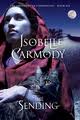
This is not the final book of the Obernewtyn Chronicles.
I knew that Carmody had wanted to split the last book in half, to properly tell Elspeth’s story; I thought that meant books 5 and 6. No. It meant books 6 and 7 – number 7 being The Red Queen, due out next year. I realised that this book could not be the final one with around 100 pages (of 750) to go. Having just inhaled the other five in preparation for a grand finale, it’s fair to say that I was a little peeved when I came to that realisation. I will try not to let this frustration colour my review….
Let’s recap where we left Elspeth and the Misfits in 2008, with the last book (The Stone Key). Dragon, heir to the Red Queen, is missing, as is Miryum the coercer-knight with the body of her would-be suitor Straaka.The farseeker Matthew is still a slave in the Red Lands. The rebels have destroyed the Council and set up a democracy in its place, with many of them being elected in their cities; the Misfits are slowly, slowly being accepted by society. The Herder Faction has been routed from Herder Isle (sorry, Norseland) thanks to Elspeth. Elspeth has broken Ariel’s hold over Rushton, so there’s no more agonising over he loves me/he loves me not. Sador is basically friends with the Land, and they’ve agreed to send ships to the Red Land to help stop Salamander and the slave trade. Anything else? Maruman is as cranky as ever and oh, Elspeth is only a little closer to having all the necessary keys for stopping a second holocaust from happening.
Elspeth’s quest as Seeker has dominated the plot of the last couple of books; her attempts to find the keys and signs Cassandra left behind have been the motivating force behind most of her actions. Either that, or instructions from the futuretellers, which themselves generally move her quest forward too. The pattern seems set to continue here, with Elsepth having raced home at the end of book 5 on instructions from the oldOnes. Then, for the first half of the book, she finds that she must hurry up and wait as Seeker, while fulfilling her function as Guildmistress and master of Obernewtyn in Rushton’s absence. Important things are happening around her: politically, there are moves to ensure Obernewtyn’s place in the Land is confirmed; people come and go, unexpectedly or not; relationships are formed and changed and, in some cases, severed. But the Seeker’s quest seems a bit stalled, because although the ships are getting ready to go to the Red Lands, where Elspeth and futuretellers have seen Elspeth and Dragon together, Elspeth does not have all of the necessary keys to stop Sentinel from awakening. Plus, Dragon is still missing. Which is a problem.
The first half is light on big action scenes. Some of the most interesting action continues to happen in Elspeth’s dreams, where she learns yet more about the Beforetimers, Cassandra and Hannah (although I was disappointed to see that the publishers have altered the formatting, such that the dreams are no longer in smaller type; this was a marvellous way of making such an experience obviously different from the waking world). That’s not to say that I didn’t enjoy the first half, because Carmody is by and large a skilful writer who makes it very easy to convince one’s self to ‘just read one more chapter’ (although her love scenes are a bit perfunctory). And as I mentioned, there are important things happening – it’s just that most of them in the personal arena, which the Obernewtyn Chronicles really focus on the most. While there have been major battles and a revolution in the preceding books, Carmody has shown herself to be far more interested in people: how they react to falling in love, losing a loved one, meeting foreigners, having prejudices challenged, or running a small community. Or, indeed, being told that you are the only hope for the world in the face of a second holocaust (no pressure). I do think that this volume could have been trimmed down, because there was a lot of repetition of Elspeth bemoaning her fate and going over and over the things she has learnt and still must find out. I understand that that’s probably quite realistic – humans, as Maruman is fond of saying, do constantly gnaw at things, usually unhelpfully. It just got a little boring.
The second half changes things, although I can’t explain how or why without spoiling things terribly. Just take my word for it. There’s a bit more action, a few revelations and a couple of resolutions, as well as a whole new raft of problems to deal with. Unsurprisingly. There is some character development, although Elspeth’s development as a human has stalled somewhat. She doesn’t seem to change much any more, especially in comparison with the first three books. Perhaps that’s an unfair comparison, given she was in her late teens then and there were major upheavals in her life to force change – but I certainly didn’t stop changing when I got to my twenties. Perhaps this too is a result of her quest having not quite stalled, but certainly slowed down.
I have been and remain determined to see Elspeth’s quest to the end, but it would be harder to continue reading if the world’s history were not so enthralling. It’s a post-nuclear holocaust world, and I love that, unlike a book such as John Wyndham’s Chrysalids, mind powers are not a result of mutation caused by that holocaust. Carmody keeps revealing more and more of the Beforetime, the end of which is some time – possibly centuries – into our own future. (It’s depressing to think that there might still be a need for a balance of terror at that point.) The hints that Carmody gives about cryogenics, and gene storage, and computers, are really cleverly done. I seriously hope there is resolution of Cassandra’s story, and Hannah’s, as well as Elspeth’s, in Red Queen. The world itself – or at least ‘the Land’, where Elspeth lives – is perhaps a little hampered by having initially been developed by Carmody as a teen; I don’t find it that rich or compelling. The lands of Sador and the Red Lands, introduced later in the series, are certainly more foreign and interesting. (I presume I am not the only one who spends half their time trying to figure out where in our world these places correspond to.)
This is not a stand-alone book, so do not pick it up if you’re curious about Carmody’s work. If you have been on this journey with Elspeth for a while now and are desperate to see just how Carmody is going to tie all of those threads together, then of course you have to read it… but, I would suggest, wait for the last book to be published.
Ashling
Spoilers for the first two Obernewtyn books.
 Ashling. The point at which Carmody’s editor said, let’s make it big! Sigh. 520-odd pages is large. Still, she is a page turner, so it didn’t take me that long to plough through it a second time.
The book opens with a halfblooded gypsy about to be burned at the stake by a Herder, which is nicely dramatic and also introduces the gypsies themselves, who have only been vaguely alluded to in the previous books. Here, beginning with Elspeth’s rescue of the gypsy woman (oh come on, that’s not a spoiler; as if she could ride past and let it happen!), gypsies and their place in the Land play a large, and intriguing, part. And so does Dragon, the mysterious child discovered in the Beforetime ruins who turned out to be an immensely powerful coercer.
The narrative continues to follow Elspeth and her somewhat torturous groping after her destiny as presented to her by the Agyllian birds, as well as the Misfits of Obernewtyn striving towards acceptance, or at least not open hatred, in the Land. For Elspeth this means travelling away from Obernewtyn for much of the book, meeting new people – gypsies and foreigners amongst them – and experiencing a wide variety of responses to herself and the things she has to say. For the Misfits it means confronting the unTalented rebels also present in the Land, and whether the Talented have a place with them or not.
The word ashling refers to a sort of dream, and dreams play a prominent role here, especially when Elspeth discovers the dreamtrails. This is a really interesting aspect of the world Carmody has created for her Talents, although not many can access them or understand how they work.
This is a third book in what has turned out to be a six-book series, and to some extent it suffers from classic middle book syndrome. It doesn’t really start anything, and it certainly doesn’t bring any real resolution (except in one matter). It definitely doesn’t stand alone, not least because there’s not much effort to explain Obernewtyn and the Misfits, because much more infodump would have made me very impatient. What it does do well, though, is character development. Elspeth is of course the focus – she’s telling the story, after all, and apparently the fate of the world actually does rest on her. But other characters do become more well-rounded. Dragon, the foundling who is gradually being civilised; Matthew, the impetuous and romantic farseeker, has a big role to play; Kella, the healer, whose feelings and attitudes are perhaps the most complex of the lot. And then there’s Brydda, the rebel, who plays Big Bluff Larrikin but whom Carmody rescues from buffoon by giving him gentleness and wisdom as well.
It’s not a perfect book; it’s definitely a bit slow going in some parts, and could have done with some better editing. Still, enjoyable.
Thief of Lives will steal your time
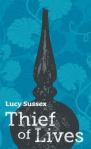
This is the delightfully-packaged third book in the Twelve Planets series, from Twelfth Planet Press. I should mention that I am friends with the editor/publisher, Alisa Krasnostein, and a passing acquaintance of the author, Lucy Sussex. But don’t worry; I would have no trouble saying I didn’t like it much, if that were the case…
The first story is, for me, the blazing outstanding story of the four. Called “Alchemy,” it is set in Babylon, a city as evocative, perhaps, as it is foreign. We are presented with a story told from two perspectives. The first is that of Tapputi, a perfumer from a long line of such. She is a mother, a widow, and a skilled artisan. She has also attracted the attention of Azubel, a spirit whose point of view we also read. Azubel has knowledge of the past and the possible paths of the future, with a particular passion for and understanding of what we would call chemistry. The stories of these two, over a long span of time (by human standards) has many strands, weaving in examinations of knowledge and the dangers thereof; juggling career and family; tradition and innovation and the pitfalls of each; and that essential conundrum, discerning good from evil when the world is grey, not black and white. Tapputi is finely, delicately drawn, the balance of concerns inherent being in being a widowed mother and artisan nicely indicated. She is both practical and romantic and, perhaps most wondrously, is actually based on a woman known to historians because her name and trade are recorded in cuneiform from the second millennium BC. This is a story that mixes fantasy and history in a glorious blend, and is one of my favourite stories for the year.
The second story in the collection is Krasnostein showing her readers that the Twelve Planets series is not going to follow the path set by the first two sets (Nightsiders and Love and Romanpunk), because it neither follows “Alchemy” (sigh) nor falls into SF/fantasy. “The Fountain of Justice” was first published for the Ned Kelly Awards, given in Australia to crime authors, and is indeed a story of crime and policing set in Melbourne, Sussex’s home city. It wasn’t really my sort of thing – crime never really has been. We get the story predominantly from the point of view of Meg, a solicitor who works mainly for the Children’s Court, and with the juveniles accused there. It’s a convoluted story questioning issues of justice and truth, asking I think whether our legal system delivers justice and even whether it can/should. It is clever, but it didn’t ultimately work for me.
Thirdly, “The Subject of O” is again completely different, and perhaps on the face of it far simpler than the preceding two – although it would be a mistake to actually believe that. Petra, a probably twenty-something university student, is the focus, as a stupid comment from an acquaintance sends her memory over the past few weeks and months in which she has been thinking about, and learning about, women and orgasms. On one level it is quite a funny story about students and their conversations, and plays into the common theme that university students are all rather busy with sex and drugs. But the reality is that underneath is a genuine questioning of why discussion of women’s sexuality and experience of sex is more often than not hidden, or spoken of only hazily, or left to blokes leering and imagining them as God’s gift to womankind. It’s frank and honest, refreshingly spiked with wry humour. But don’t read it on public transport if you are the blushing type.
Finally, the collection is rounded out by the eponymous story, “Thief of Lives,” which itself contains a book of the same name (confused yet?). This is the most complicated story of the set, although fortunately almost everything is clarified by the end, making hindsight a wonderful thing. It’s set in Bristol, and told from the first person by someone who is not what they at first appear to be, and whose intentions in Bristol are far from straightforward. It’s impossible for me to give a good idea of the narrative, really, without spoiling it. Let me say that it toys with ideas like a cat with string: why (as the blurb puts it) do writers think that other people’s lives are fair game? How do writers get their ideas? Can writers and their writing have a concrete impact on those around them, especially when drawing on them for inspiration? It’s a little bit labyrinthine, which is echoed somewhat in the maze-like qualities of Bristol itself for our protagonist. It’s very, very clever, and the main character herself is a little bit hypnotic.
Also, isn’t it a totally lovely cover?
Galactic Suburbia 45
 In which Alex and Tansy wax lyrical about Joss Whedon’s Much Ado About Nothing (despite knowing next to nothing about it), welcome the new Apex overlord Lynne Thomas, celebrate the twin dawns of All Hallows Read and Nanowrimo, and embark upon an epic marathon of Culture Consumed. You can stream us at Galactic Suburbia or get us from iTunes.
News
Joss Whedon makes Much Ado About Nothing in secret
at first we knew next to nothing
then we knew something
and every new bit of something brings squeeage!
Harry Potter DVDs to disappear from the shelves after Christmas (and Tansy’s still not over the whole Disney revelation)
Lynne Thomas’ first issue of Apex comes out next week featuring an article by Tansy on The Australian Dark Weird.
As the new editor, Lynne talks about what she wants from authors at Outer Alliance
The lack of (paid) women reviewers (in the lit scene) continues to dismay and fascinate us in equal measure.
All Hallows Read is upon us
And if you’re going to gift a scary book to someone, why not make it Australian?
Nanowrimo is imminent!
What Culture Have we Consumed?
Tansy: Zoo City by Lauren Beukes
Alex: Life on Mars S2
Tansy: Bumped by Megan McCafferty
Alex: Obernewtyn, The Farseekers, and Ashling, by Isobelle Carmody
Tansy: Debris by Jo Anderton
Alex: God’s War, Kameron Hurley
Tansy: Marvel’s Ultimate Universe: Ultimate Spiderman, Ultimate X-Men, The Ultimates
Alex: Shadow Unit
Tansy: Big Finish and Mary Shelley: Mary’s Story (for 99p) & The Silver Turk.
Please send feedback to us at galacticsuburbia@gmail.com, follow us on Twitter at @galacticsuburbs, check out Galactic Suburbia Podcast on Facebook and don’t forget to leave a review on iTunes if you love us!
Eyes like Stars
 The premise: a theatre set in NoParticularTime, inhabited by every character of every play, who come on stage to perform when their scene is announced. Also inhabited by appropriate backstage personnel, and Beatrice Shakespeare Smith, an inappropriate foundling who loves the theatre (her home) with a passion and who is followed around by the Midsummer Night’s Dream fairies, who are as crude and rambunctious and loyal and awesome as (William) Shakespeare would have wanted. Also, two love interests. With this sort of set-up it would have been hard for me not to be completely in love. Happily, Mantchev does not disappoint.
Beatrice – sorry, Bertie – is a wonderful heroine, defiant and strong-willed, fiercely loyal and amusingly devious. She causes all sorts of mischief in and around the theatre – enough that eventually, she might have to leave, unless she can prove herself. This is a coming of age story, with Bertie discovering her gifts and talents and likes and dislikes, as well as dealing with how other people react to her and act on their own. She faces loss – new and old – and disappointment, confusion (especially about love) and revelation, and the glory of strong and true friendship. Basically, it’s all the good and bittersweet bits of the classic coming of age, in a marvellous and enchanting package.
I loved the Theatre Illuminata. I love the way the scene changes work, I love the irascible backstage types and their petty feuds. I was delighted by how Mantchev took mostly Shakespeare’s characters and used them on stage but also imagined them as people outside of their scenes (much like Rosencrantz and Guildenstern does, without the loopy philosophising and dialogue…). The characters from Hamlet were especially amusing, playing on and reflecting so many of the tensions that can easily be imagined from the play itself, and that might arise from the people playing those characters day in, day out. It’s just really clever. And then there’s the fairies: Cobweb, Mustardseed, Moth, and Peaseblossom. Pulling hair, mooning important people, eating all the cake… it’s all in a day’s work, really, and there better be cake after, too. Oh, and Ariel. I am not a huge fan of The Tempest, but I’ve read and seen it; I loved Dan Simmons’ play on Caliban in Ilium and Olympos… but I’ll never be able to see Ariel in the same light again. (Huh; this connects with Obernewtyn, by Isobelle Carmody, which I’ve also just read. Interesting.)
How much did I love this book? I’ve just ordered books 2 and 3. I HAVE to know what happens.
Slight spoiler: One thing bugged me. She’s all hung up about her mother, and wanting to find her mother, but she doesn’t seem worried about her father until right near the end. This is a girl who’s grown up around Shakespeare, where half the time it’s the mother who is missing, but the father is present. Surely, when she knows neither, she should be curious about both? Also, growing up around those stories, shouldn’t she be wanting to know the romantic story of how they met?
The Farseekers
 Well, it’s better than Obernewtyn, for sure.
*Spoilers for Obernewtyn, the first book*
Continuing my re-read of the Obernewtyn chronicles, I devoured most of this one in a night. Interestingly, it’s set some time after Obernewtyn ends, and therefore we don’t get most of the fight against Alexi and Madame Vega, nor Rushton’s work at being made legal owner of the place. Possibly because Elspeth is out of it for a while thanks to the burns to her legs? Anyway, we open here rather abruptly to discover that Rushton is in charge, and the Misfits have formed themselves rather (too) neatly into Guilds according to their mind powers. This was one thing that bugged me about the book – they all seemed to have come into their powers rather quickly, and easily, whereas I had the impression from the first book that many of them were uncomfortable and certainly not that good at using them because of the fear of being discovered. Perhaps Carmody imagines that once released from that fear, most young people would flourish in experimentation… and when I put it like that, perhaps she is not far wrong.
Anyway, the bulk of Farseekers is not actually set at Obernewtyn, but in the lowlands, as Elspeth and some others set out on a joint mission to find a library and a strong Talent they’ve sensed. Of course, things do not go easily, and they encounter most of the villains foreshadowed in Obernewtyn – Council, Herders, and the Druid himself – in various ways and with various consequences that I shan’t spoil. It is a more convincing narrative than the first book; while there are still happy coincidences and useful chance-meetings, well, that’s really the stock in trade of a fantasy, in some ways; and here it’s done more smoothly and with less jarring “oh hai, yr conveniently who i need” moments.
Characters are more interesting and well developed in this second novel, too. Elspeth is a bit more complicated and nuanced, conflicted between the desire for safety and an impatience with staying put. The characters she goes travelling with show hints of personality and individuality; the most developed and interesting are the animals, and particularly the arrogant stallion Gahltha. He’s way cool. Rushton continues to be gruff and remote but still appealing (to me, anyway!). The new people our Misfits meet on their travels are probably the most interesting characters aside from Elspeth, and although one of them gets a bit preachy and info-dumpy that’s hardly his fault, and I liked him for his rash-yet-considered ways.
Finally, the world is built up just that bit more in this novel, mostly thanks to the travels of our heroes. We learn more about the current society – which is complex enough to be not all bad, but simple enough that the reader knows (well, this one did) that they really wouldn’t want to live there. There’s more about the Beforetimes, too, and I seem to remember that it took me until this book to be absolutely sure that Carmody was envisioning this as OUR world after some sort of human-caused apocalypse. Which is a bit embarrassing frankly. Anyway – more Beforetimes things, and stories too. This sort of idea isn’t unique, but I like how Carmody runs with it.


