The Everlasting, by Alix E. Harrow
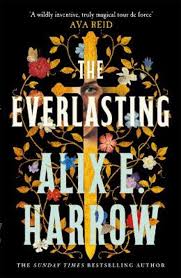
I keep not reading books by Alix E. Harrow as soon as I should, but at least this time I didn’t leave it a couple of years. Which means really I’m fairly up to date, right?
TL;DR this book is simply superb and if you have any interest in knights and adventure and time travel and stories that do very clever things with stories, this needs to be at the top of your To Be Read pile.
My thoughts on this magnificent novel are split into two bits: thoughts for readers with extensive (some might say tragic) Arthuriana knowledge, and thoughts for everyone else.
For everyone else: truly this is a beautiful novel of love and determination and the power of story. It can and should be read as a romping adventure story across time, with its share of heartbreak and despair but also a great deal of hope and bloody-minded teeth-gritting stubbornness. It can and should also be read as a dissection of the uses to which Story and History can be put, at a personal and a national level, which has a significant element of caution as well as its own element of hope. This is also a novel with fantastically well-developed characters: Sir Una, the knight whose image is used Kitchener-ly for Dominion wars (and I was also put in mind of Emily Blunt’s character in Edge of Tomorrow), whose devotion to her queen a thousand years ago is literally the stuff of legends. Owen Mallory, a nearly-failed historian with an alcoholic deserter father, struggling with his own demons, unexpectedly flung into Una’s story. The queen herself, Owen’s academic supervisor, the murderous horse – there’s not a misstep throughout.
… for the Arthuriana tragic, there’s even more going on here. The historian is Owen Mallory. Dominion is playing on the idea of England; the Arthur story is (or perhaps was) after all England’s national myth, in many ways, as Una’s is. There’s a wonderful interplay between Owen and his academic mentor about the Everlasting stories as a palimpsest, and stories being changed to fit a national moment, and irritation at audiences who think the later stories are the authentic ones – all of which applies to Arthuriana, in amusing and sometimes heated ways. There’s the idea of a knight being undying, the reference to a grail, most of the other knights’ names are plays on names from the various cycles – there are so many moments at which I just flailed at Harrow’s cleverness.
I adored this novel. And I read it just a few weeks after reading Tasha Suri’s The Isle in the Silver Sea; these ideas about stories and nations, their use and abuse, are clearly floating around in the zeitgeist. But I hasted to add that having read one does not detract from reading the other – the opposite is true: reading both (maybe not one after the other) is more like… some clever analogy with structures supporting one another. I’m sure you get the idea.
Starling House, by Alix E Harrow
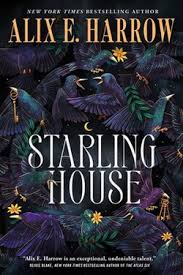
I think I avoided this when it first came out because it was called horror – or perhaps it was called ‘gothic’ and my brain generally translates that to ‘horror’ and as a rule, I avoid horror unless I know precisely what I’m getting; I do not enjoy being scared. However, it was turned face-out at the library when I went to pick up one book, and I decided to give it a go partly because it’s Harrow, and I have liked her other work, and partly because I’m beginning to suspect that much ‘gothic’ work is actually work that I do like. Nuance! It’s a good thing.
So anyway yeah I read this really quickly and it’s brilliant.
In terms of genre: I would not personally call it horror. For me, there was no moment when I was afraid: worried for the characters, yes, because they were likely to make truly stupid decisions; but no literary equivalents of jump-scares. So that’s an interesting discovery for me.
More importantly, the novel: it’s wonderful.
The writing is a delight – so easy to read, so lovely and lyrical, so evocative.
The characters are compelling – and, like I said, showing tendencies towards stupid decisions, although often for good – “good” – reasons.
The story – well. We have two points of view: one is Opal, in first person, and the other is third-person and focused on Arthur. Small-town USA, not a great place to grow up if you don’t really fit in, and Opal really doesn’t. She’s been looking after her brother since their mother died some years ago, working a crappy job and occasionally stealing as well. And she’s having dreams about a house. Through unlikely circumstance, she becomes the housekeeper at Starling House – a house that no one else ever visits, that even kids don’t approach on dares, so basically your classic threatening gothic house; Opal even references Boo Radley for its lone inhabitant. As you can probably imagine, things rather quickly go… well. Sideways? Weird, anyway.
The House is utterly central to the whole book – it’s where things happen, it’s what outsiders are obsessed with, it’s determined everything about Arthur’s life. Perhaps this is one of the key aspects of being a gothic story. And it’s a wonderfully developed house, too.
Harrow has done a wonderful thing here. She notes in her introduction that this is a story about staying, rather than leaving, and that made me really think about leaving and staying as tropes and what they tell us about how to approach the world.
I loved it. I should just trust Alix E. Harrow to write amazing stories.
The Once and Future Witches, Alix E Harrow
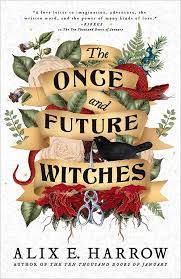
IN THEORY, this book should be right up my alley. Agitating for women’s suffrage! in an alt world where witchcraft is real! but banned! and you Alexandra Pope and the Sisters Grimm! And I’d already read and loved Ten Thousand Doors of January.
… but when I started it, pretty soon after it came out, I bounced right off. It was something about the jagged relationship between the sisters, I think (I have a sister. We’re fine, and always have been). I stopped after about 50 pages. But I didn’t give it away, because I really wanted to go back to it.
This year I want to get through my physical TBR, and so I went back to this. And this time, I did not bounce off (I had also been assured that the sisters’ relationships were more complex and became slightly less jagged than they are at first). And it is, absolutely, a gem of a book. I loved it. I loved all of the relationships, and the worldbuilding, and the gradual reveal of everything that’s going on, and the slight left twist from our world. The use of children’s rhymes and the reclaiming of “old wives’ tales”, the terrible cost and value of love, and everything else, frankly.
Simply wonderful.

 Randomly Yours, Alex