Menial: Skilled Labor in SF
Reviewing an anthology is always a bit more difficult than reviewing a novel. So is rating it. Does one poor story deserve to bring down the entire anthology? Should I mention every single story?
 I gave this anthology a 5-star rating on Goodreads. I did not do this because every single story blew me away; they didn’t, although I don’t remember any story that I loathed, which is impressive in its own right. Partly I was predisposed to being impressed by the anthology because of the theme: the menial. That is, no heirs-misplaced-at-birth, no admirals or planetary governors or princesses starring here; instead, it’s the miners, the sewerage workers, the grunts who feature. Not to say that the stories don’t feature action or adventure – they do – but largely it’s action that happens in the course of everyday work, and often because of accidents: the sorts of things that you’d really rather didn’t happen. The anthology points out the dignity in the menial tasks, as well as acknowledging the sheer back-breaking work that’s likely to still be necessary in the future; it points out the importance of the menial while remembering the danger. And even though the menial workers shine in the stories, it’s clear that for most of them, this isn’t going to lead to a huge change in fortunes. It’s part of a day’s work, or it’s not but it’s not enough to propel them out of drudgery – or indeed it’s something that leads to them getting fired and the consequent uncertainty of unemployment.
This anthology shows that good SF can be escapist in letting the reader escape from their own immediate situation, but can simultaneously speak to the reader who is unlikely to be a spaceship pilot or lead an army, but may well have a dead-end job that they hate. It can provide ways to imagine a different world but also reassure and comfort that even people in crappy jobs can actually have interesting lives, and do interesting things – something much SF ignores.
This anthology imagines a range of possible futures. They’re mostly fairly far future, and involve space travel of some sort; some have humanity spread far and wide, others are a bit more restricted. Because of its focus on the working class, there is less emphasis on the political or military than one often finds in SF, because really, when you’re scraping to get food on the table who has time to worry about the expansion of the empire? Many of these stories are united in their focus on the nitty-gritty details, those details that make up the everyday. Some of them are very familiar, some are familiar but in foreign contexts, whilst others are utterly alien. And the best stories make this work in clever and occasionally utterly bemusing ways.
I was initially dubious about the possibility of making an entire anthology based on the concept of skilled labour; not because I thought the concept was boring but because I wasn’t sure how there could be enough variety within that to keep having different stories. This is because I am not an author. There is, of course, infinite variety in the stories you can tell from the menial perspective – because there’s an infinite variety of stories to tell about humanity.
You can get Menial from Fishpond.
Crowd funding
1. Twelfth Planet Press is running a Pozible campaign to get a new anthology off the ground. Edited by Alisa Krasnostein (one of the voices of Galactic Suburbia; the other one, Tansy, is already writing her story…) and Julia Rios, this is a really awesome anthology: the idea is that (to quote them):
The main characters in Kaleidoscope stories will be part of the QUILTBAG, neuro-diverse, disabled, from non-Western cultures, people of color, or in some other way not the typical straight, white, cis-gendered, able-bodied characters we see all over the place.
Please consider contributing if you can – and either way, spread the word! I’m tardy in posting this, so there’s just 12 days to go (closes 31 October), and they’re not quite halfway yet. Halfway to what? $12000 will allow them to pay pro-rates AND publish the book AND do all the other rewards stuff. That’s not a lot for a whole lot of brilliant. If you need more convincing, they’ve already got three names to the anthology: Ken Liu (!!!), Sofia Samatar, and Jim C Hines. Magnificent.
2. A Kickstarter that I backed ages ago is now live! Mothership: Tales from Afrofuturism and Beyond (that link takes you to Fishpond) is an anthology that does just what it says; wrenches the future from overly white, American hands and puts it into more ethnically diverse ones. My copy came with a mixtape, and when George Clinton’s dulcet tones announced “ah-good evening” as the first track… well, I admit that I squealed a little with joy. Watch this space for a review!
Tiptree Award Anthology #2
 For those just joining us, James Tiptree Jr was a magnificent SF writer whose work Robert Silverberg once described as “ineluctably masculine.” Which is amusing because she was actually Alice B Sheldon. Anyway, in 1991 some people decided there should be an award named for a woman, and that it should be given to works that “explore and expand gender”. So, to be quirky, they named it for Sheldon/Tiptree. And the award has been going since then, and there are now a number of anthologies that reflect it: excerpts from novels, complete short stories, but also other work that reflects the issues that the award desires to highlight. Which is awesome.
Debbie Notkin’s introduction does a marvellous job of discussing the very first award and how it was decided on, as well as – most interestingly – pointing out that each jury has been forced to decide all over again what it means to “explore and expand gender.” Which is good to be reminded of, because there are definitely stories in the anthology whose inclusion I was a little confused by. And this, Notkin says, is totally fine.
In honour of Tiptree/Sheldon, the anthology opens with a short essay from Julie Phillips, the biographer of Tiptree/Sheldon (which I reviewed here, and as I write I am listening to The Writer and the Critic discuss it), about talking and talking too much which is completely fascinating (and somewhat connected to the current furore over Hilary Mantel’s words about the media representation of royalty?). It’s matched with a letter from Sheldon herself, to the psychologist Rudolf Arnheim, talking about identity and science fiction and science and friendship, which is such a nice touch. And then the anthology jumps straight into Raphael Carter’s “Congenital Agenesis of Gender Ideation by KN Sirsi and Sandra Botkin,” which can only be read by itself, must be read in a single sitting, and may then require that you sit staring at a wall for a few minutes. Because it is mind blowing. It’s written as a thoroughly researched scientific article, where two scientists from different backgrounds come to a startling discovery about how gender is perceived and what that means for identity and… that doesn’t really explain it at all. It’s very accessible as well as challenging and I can absolutely understand why it won.
L Timmel Duchamp’s collection Love’s Body, Dancing in Time was shortlisted in 2004, and from it this anthology includes “The Gift.” For all that it’s set in a distant future where the narrator is a travel writer who discusses other planets rather than other countries, there’s something rather medieval in its suggestion that there is more to an understanding of gender than a basic dichotomy. And I don’t mean ‘medieval’ in a pejorative sense, but in the sense that some medieval thinkers seemed to be groping towards a similar sense – and for similar reasons as suggested here. That aside, one of my favourite parts of this story is the description of the meal composed around the ideas of Matrix Aesthetics. And made me wish that something similar could possibly exist, that combined visual, aural, and taste sensations all designed to complement one another.
The next two parts of the anthology are again from 2004, this time excerpts from the winning novels. The Tiptree Award is an interesting one in that it seems to me one of the few really big-name awards that considers all work for one award (shorts and novels), and which is not afraid of having a tie (which has happened a few times). Firstly here, Joe Haldemann’s Camouflage – the first four chapters and “and two from a little further along,” according to the reading notes. I HAVE to read this novel. It’s utterly gripping, right from the start: an alien comes to earth millennia ago, and is capable of changing its outward appearance to be… whatever it likes. Imagine the consequences of that on ideas of gender and identity. This is complemented by an excerpt from Johanna Sinisalo’s Troll: A Love Story, which I imagine I will also get around to reading. Translated from the Finnish, it does indeed involve a troll, as well as (again according to the reading notes) mail-order bride slavery and Finnish folklore and homoerotic imagery. In this excerpt, the narrator’s night has started badly, with a failed date, and gets worse when she finds a bunch of boys attacking an animal. Things get weirder after that.
“Looking for Clues” is Nalo Hopkinson’s guest of Honour speech from WisCon (the convention where the Tiptree is announced) in 2002. As a woman of colour, as she explains in her speech, finding people “like her” was one of the aims of her extensive early reading – because there weren’t that many. She takes a winding road through various media and her experiences to look at the different sorts of role models (and not) available through her childhood and teenaged years, as well as making pointed remarks about people who insist on remaining ignorant about the issues. It would have been a brilliant speech to hear in person.
Eileen Gunn’s collection Stable Strategies is another one that got shortlisted in 2004, and as a representative this anthology chose “Nirvana High,” co-written with Leslie What. This is one of the inclusions that I simply do not get. It’s a clever story and it says interesting things about difference, and about growing up as ‘different’, but I don’t see that it says things about gender that connect it to the Tiptree. But I’m sure Notkin would say “and?”
From 1996 comes Jonathan Lethem’s “Five F***s” (sorry, I would like to keep this profanity free!). It’s a series of six vignettes, and in all of them there is a woman whose life appears to be different each time she has sex with a particular man. Indeed, it’s not just her life, but the world around her; in this sense it reminds me a bit of Lathe of Heaven. The lover does not appear in every story; in all but the first, there is a different man – Pupkiss, a policeman (mostly). So there are elements of the procedural to some of the sections, but not really. It’s one of those stories, as you may be able to guess, that is particularly hard to explain. It should just be read.
Carol Emshwiller’s “All of Us Can Almost…” is another story in the I don’t entirely get it pile. Shortlisted in 2004, it’s about desire and lying and determination, and while I think it’s a very good story and fascinating in what it says about interactions between people and expectations, I don’t entirely see that the gender aspects – which I can see – are an interesting enough or explored enough aspect to get it shortlisted. Again, refer to Notkin’s advice.

Gwyneth Jones is rapidly becoming one of my favourite authors, so I was pleased to see an entry from her here. Rather than a piece of fiction, it’s a paper she gave called “The Brains of Female Hyena Twins: On the Future of Gender,” presented at the Academic Fantastic Fiction Network conference in 1994. In it, she ranges far and wide over scientific papers that discuss aspects of gender and biological sex in animals (those hyenas, peacocks, lizards and fish…), as well as gender and sex in humans and their malleability, as well as some frightening aspects of the battle of the sexes. It’s erudite and occasionally witty (insofar as such a topic ought to be), and outright challenging to biological determinists.
The penultimate place belongs to Ursula le Guin, for Another Story, or A Fisherman of the Inland Sea which I have read before but fell in love with all over again, reading it here. The planet of O is such a richly realised place – their marriage customs so breathtakingly original – and they’re not even the centre of the story, which is I think mostly about scientific research and its impact on individuals, as well as the impact of family, and the choices that we make… It’s wonderful.
Finally, Jaye Lawrence’s “Kissing Frogs” is described as “a pleasing after-dinner mint of a story” by the reading notes, and I think that’s about right. It’s a retelling of the fairy story, of course; it’s amusing and sweet and I can’t go into any details because the point of it is the little twists Lawrence weaves in. A highly enjoyable way to complete the anthology, anyway.
What this anthology does, and I presume what it set out to do, is give a broad overview of the point of the Tiptree Award – showcasing works that various juries have thought worth honouring, as well as including work that must help to inform the juries, and authors, and readers about the ideas of gender that the award wants to recognise. It succeeds in this aim, and no doubt in a secondary aim as well – of publicising those names whose work has been recognised, so that they get more recognition, and more people are challenged and inspired by their words.
You can get this anthology from Fishpond.
Galactic Suburbia 71
 In which Tansy & Alex talk sexism, steampunk, Samuel Delaney and tiny baby Avengers fighting tiny baby X-Men. Also, feedback from listeners! You can get us from iTunes or at Galactic Suburbia.
News
Pornokitsch on the Mammoth Best New Horror introduction
Twelfth Planet Press announces Best YA SF anthology – Alisa & Tehani reading for this in 2013 and we hope it doesn’t break them.
The Fantasy Pin-Up Calendar Thing
The Calendar itself
Tansy’s post – when fantasy art embarrasses us all
Skepchick asks us to Please Stop Making Calendars
NK Jemisin on her involvement in the project
Sexism in the Skeptic Community – what happened after she spoke out
What Culture Have we Consumed?
Alex: Edge of Infinity, ed. Jonathan Strahan; Babel-17, Samuel Delaney; The Contrary Gardener by Christopher Rowe in Eclipse Online
Tansy: Wilful Impropriety, Ekaterina Sedia (ed); Hawkeye #1-3, Matt Fraction, David Aja; “A-Babies Vs. X-Babies” one-shot written by Skottie Young with art by Guruhiru
FEEDBACK
Suzy McKee Charnas story at SnackReads
Please send feedback to us at galacticsuburbia@gmail.com, follow us on Twitter at @galacticsuburbs, check out Galactic Suburbia Podcast on Facebook and don’t forget to leave a review on iTunes if you love us!
On the Edge of Infinity
Edge of Infinity is not especially concerned about Earth, but it cares deeply about humanity. It’s not blindly optimistic, but neither is it depressingly morbid. It cares about the little things and the big, it’s got romance and death, and lots and lots of adventure, set within our solar system but not on Earth. Also, space ships.
Pat Cadigan opens the anthology and immediately throws the reader into the position of deciding whether they can hack the displacement. “Nine decs into her second hitch, Fry hit a berg in the Main ring and broke her leg.” This, accompanied by the story’s title – “The Girl-Thing Who Went Out for Sushi” – is a very clear sign that Here Be Science Fiction; the sort of science fiction that requires the reader to do a bit of work, while trusting in the author that these things really will make sense. And, of course, they do; Cadigan is a marvellous writer who mixes the very weird with the quite familiar, and gently leads the reader to understanding where she’s going with her story. The unfamiliar language is used partly to warn the reader that this is not a situation they can just take for granted, but also because it’s entirely appropriate that language would change out there around the moons of Jupiter – perhaps especially, as in this case, when those living in an alien-to-humanity environment have themselves changed from the human standard, at least morphologically. Cadigan also makes some interesting points about how being “two-steppers” has impacted on humanity’s ways of thinking, especially with regard to binary decision making. At heart, this story is about choice: an individual’s freedom to make choices about their body and their livelihood and where they live. Just suggested in the background is also a broader discussion about political choice, too, with shades of James SA Corey’s Leviathan Wakes and Caliban’s War, about the place of Jupiter in the solar system. It’s a fitting opening to the anthology, flagging as it does many of the issues that resonate across the set.
Elizabeth Bear’s”The Deeps of the Sky,” which comes next, is the only story that focusses on aliens. Here again though the focus is on choice; Stormchases and his skiff have been out mining a storm for trace elements such as iron when a curious object appears in the sky, and he has to decide what to do about it. The plot is thus quite straightforward, but it’s the world building that makes this story an interesting one. As mentioned, it focusses on an alien society – probably living in Jupiter – and aside from the alien biology, the aspect Bear gives most attention is that of reproduction. Who gets to reproduce and with whom, and at what cost (…literally) is absorbing Stormchases, and therefore the narrative. And it is indeed different enough to cast a rather fascinating light on humanity’s own tendencies in those realms.
Bringing the anthology back closer to home (… again, literally) is James SA Corey’s “Drive”, a story that unfolds along two different temporal tracks: in one, Solomon has just taken off from Mars in his souped-up space craft; the other follows Solomon from his first encounter with Caitlin and their subsequent relationship. Like Cadigan, Corey envisages a solar system that is as uneasy with differentials in political power as it is with access to, and production of, resources. This provides much more of the narrative tension for Corey than it did for Cadigan; Earth’s attitude to Mars has an immediate impact on Solomon and his life. I’m excited to see stories like this one, despite its melancholy tone, because it puts the idea of colonising Mars squarely back into the realm of the possible, at least from an SF perspective. There’s no suggestion that it will be easy – quite the contrary – but at least humanity is there, reaching beyond our own troposphere. Somehow the idea of being out on Europa or Titan isn’t quite the same, even though the colonisation of Mars is generally a prerequisite of that further expansion.
Sandra McDonald and Stephen D Covey deliver “The Road to NPS,” similar to “Drive” in that it focusses on the issue of transportation – bringing to mind Samuel Delaney’s Nova, and the suggestion that once a civilisation expand beyond the solar system, transportation becomes the most important issue. For Rahiti, this presents a challenge he cannot leave alone – despite the threat, and very real danger, inherent in doing so. Rahiti is one of few antagonists of this anthology that I did not particularly connect to. I think this is partly because his motivation seemed to be entirely commercial – which isn’t necessarily a bad thing, it simply did not work for me. And he just didn’t seem like that nice a guy, overall.
The first AIs turn up in John Barnes’ “Swift as a Dream and Fleeting as a Sigh,” where, intriguingly, AIs are therapists. For humans. Which is about the most unlikely role I’ve ever read them in. This is one of the most complex stories of the anthology, narratively speaking. The “I” is the AI, and the narrative follows multiple threads. First, and appearing sporadically throughout, is the narrator’s own musings on its own capabilities – specifically the difference in subjective time that it and its human interlocutors experience. It draws a comparison for one of the humans: that “the ratio of [its] cycles of information processing per second to theirs is about the same as theirs to an oak.” In response to which, very sensibly, the human (eventually) asks what an oak would think about… which doesn’t seem to be the point, but perhaps from the AI’s point it is. Anyway, the story is a fascinating glimpse into what that sort of processing power might do (brain the size of a planet, and so on). The rest of the narrative involves the AI musing on its interactions with two humans it has counselled. Laura and Tyward see the AI for different reasons – Laura because of Ty, Ty because of an ant (a mechanical one). Their relationship, shown through the AI’s interactions with them as individuals, is poignant and realistic, even though I think the conclusion is a bit of a stretch. Finally, I’d like to point out how hard it was to write this without referring to the AI as ‘he’. I think this was because its character came across so strongly, and as humanly flawed rather than a remote perfect artefact, that it seemed wrong for it to be genderless. As for ‘he’ – well, yes. Aren’t all robots male? (sigh)
Paul McAuley’s “Macy Minnot’s Last Christmas on Dione, Ring Racing, Fiddler’s Green, the Potter’s Garden” wins for longest title. It, as a title, also covers the most important things that Mai Kumal learns about when she travels to Dione, one of Saturn’s moons, on the occasion of her father’s death there. Overall this is a less a narrative, really, than a rumination on what humanity might do Out There, so far away from the safe little blue ball. Colonisation; extreme adventure sports; secretive colonisation; and outrageous, lavish works of art. This is definitely one of the more overtly optimistic pieces of the anthology. While it’s a bit sad that Mai and her father were estranged, this is set against a glorious back drop of humanity’s potential, both in terms of relationships and Grand Achievements. And I think it’s a wonderful dream, for that.
Taking quite a different tack, one of the narratively most straightforward stories is “Safety Tests.” Here, Kristine Kathryn Rusch takes a very normal, albeit still dangerous and necessary aspect of humanity + machinery – the idea of needing a licence – and explores it. In space. Using spaceships. Around an inhabited space station. Over the course of a single day, Devlin must deal with six quite different applicants for public piloting licences. Things progress from there about as Devlin appears to expect every day to progress. That is, poorly. There’s not much extra world building built into this story, but it’s the sort of situation one can imagine fitting into most any space-faring story (imagine Ellen Ripley or Han Solo going for their licences. I dare you).
“Bricks, Sticks, Straw” is my favourite story of all, so thank you very much Gwyneth Jones. Set very briefly on Earth, the focus is on four Remote Presence devices, operated by humans on Earth but physically located on the four Galilean moons of Jupiter. Thanks to a solar storm, the link to those devices is severed, but the software agents… well. They continue to exist, and to operate, if in rather different ways from what their designers and operators would recognise. These manifestations are wonderfully thought out – how such software, designed to be intelligent and run programmes, might react to apparently being abandoned by their makers, and how they might interact after that happens. (It does make me wonder somewhat about the poor old Mars landers and rovers….) Sophie, on Callisto, is the focus of the story: she is both an array collecting data of the Jovian system; and a memory, or a remnant, or an avatar of the Sophie back on Earth. Of the four devices, she is the only one who both accepts this reality and thinks that getting back in touch with Earth is actually important. So this is the only story that does not imagine humanity having literally spread out through the solar system – yet, anyway; it’s also the story that feels temporally closest to Now. Sophie is delightfully engaging, and her concerns entirely realistic (within the bounds of the story, naturally).
Following a theme of Hannu Rajaniemi work in Jonathan Strahan anthologies (… that would be two from two, so maybe not a theme yet; the other one was “The Server and the Dragon,” in Engineering Infinity), “Tyche and the Ants” is the most magical-seeming of these stories, while – as the reader suspects throughout and has confirmed by the ending – having a very solid science fictional basis to everything; it’s the perception that lends the magic, not the action. It also comes close to the Jones story as being my favourite. Tyche lives on the moon, dividing her time between the Base, where she’s meant to stay, with only the Brain for company; and the place through the Secret Door, where waits the Magician and various other creatures. Her seemingly happy life is, however, disturbed the day the ants come to the moon. On one level this can be read as a poignant almost-fairytale; it’s sweet, if combined with some rather sad moments because of Tyche’s confusion. However, Rajaniemi does that wonderful thing of suggesting an enormous background to the story, without ever overwhelming the immediate story – and I now really want a novel set in this universe. Please. Because there are all sorts of ideas about humanity that are suggested at but not fully developed.
The main narrative thread of most of these stories so far (the Barnes is perhaps the exception) has encompassed a relatively short timeframe. Not so Stephen Baxter’s “Obelisk.” Beginning with the arrival of Wei Binglin on Mars, as he pilots the Sunflower in after a very difficult voyage, the story follows the next several decades of Binglin’s life as he adapts to Mars, deals with the brash American Bill Kendrick, and both watches Mars develop and assists in that happening. Binglin is an interesting character through which to explore this; he feels a great deal of guilt concerning the Sunflower, and he’s unconvinced, early on, about living planetside. His growth as a character works overall, and I can absolutely agree with how Baxter imagines Mars bootstrapping itself. And the fact that he imagines it as a largely Chinese endeavour is certainly believable, although there’s not a whole lot of Chinese-specific culture to be seen. However, I was troubled by the way Baxter dealt with Xue Ling, Binglin’s adopted daughter. The role she plays seems largely superfluous; certainly the apparent pull she exerts on both Binglin and Kendrick is not required to get them to do what they do. Rather she sometimes seems like an excuse. Her actions at the conclusion of the story were especially problematic, seeming not to fit in at all and feeling instead like gratuitous sentimentality on Baxter’s part, or as if there needed to be some big dramatic Thing to impart some sense of occasion to the story. It was unneeded and I think actually undercut the rest of the story.
Alastair Reynolds’ “Vainglory” is another story that uses two temporal tracks. In the first, Loti Hung is confronted by Vanya Ingvar, and asked some uncomfortable questions about her interactions with a certain Skanda Abrud; while the second is essentially Loti remembering exactly that interaction. While many of the central characters throughout this anthology have been engineer or science-y types (although not all, Tyche in Rajaniemi’s story and Mai is McAuley’s especially), Loti is quite different: she’s an artist. Specifically, a rock artist – someone who carves rock on a massive scale – we’re talking asteroids here. And I love the very idea of a science fiction story that focusses on the possibilities for art in the future, in these far-out locations humanity may find itself in (McAuley does a similar thing). The story is about one of Loti’s commissions, and it not turning out to be quite what she thought; and Ingvar investigating just exactly went on with it. The interaction between the two women is understated and believable, as is that between Loti and Skanda. Again, this quite personal story is set against a much larger backdrop of solar system colonisation, the arrogance of wealth, and questions of justice.
While transportation may be one of the major issues of solar system colonisation, as shown in “Drive” and ” The Road to NPS,” solar system habitation is going to be greatly impacted by something that already affects large swathes of Earth: access to water. In “Water Rights,” by An Owomoyela, this issue is front and centre after an explosion interrupts the water supply for many of the near-Earth colonies. This is of immediate interest to Jordan Owole because, as the owner of an orbiting hydroponics outfit – which naturally has a large reservoir – she’s now become of great interest both to the authorities and to independent orbiting homesteaders. Which is an uncomfortable position to be in, to say the least. While this sounds potentially depressing, Owomoyela pulls a beautiful turn at the end which nearly brought tears to my eyes, and makes it amongst the more obviously optimistic of the anthology.
The ultimate story in this set is from Bruce Sterling, and a weird one it is. “The Peak of Eternal Light” is set on Mercury – a Mercury with incredibly restrictive and quite bizarre gender restrictions, especially when it comes to marriage. There were moments when I, as a woman, found reading this story actively unpleasant; while Sterling may not (probably does not) accept the ideas presented here as worthy, and does indeed go on to critique them to some extent, it was still not an enjoyable experience. There are a number of instances where he veers very close to existing stereotypes that, in a futuristic setting – even with outre accoutrements intended to suggest perhaps that this is new and weird – were depressing to imagine continuing beyond the confines of Earth. Marriages are entirely arranged and intended to be endured, nothing more; couples spend time with one another in strictly regimented ways, and the women appear to live in the equivalent of a harem. The central couple, who refer to each other as Mr and Mrs Peretz, do begin to question some of the limitations placed on them; and I did enjoy the idea that the bicycle, which was indeed a revolutionary form of transportation in its time for women, would find a new lease on life on Mercury. This questioning, though, did not compensate for the overall image of life on that planet. I do not want Sterling’s vision of the future.
Overall, this is an awfully good anthology. And it’s very exciting indeed to read an anthology entirely dedicated to science fiction, and science fiction of what might be called the medium term future; not the immediate collapse of Earth’s ecosystem, nor the humans-spanning-the-galaxy stories (which I do adore, I’ll be honest). It’s an anthology that spans ideas, planets, concepts, personalities and the future of humanity. What’s not to like?
Snapshot 2012: Jonathan Strahan
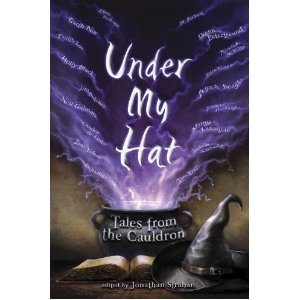
Jonathan Strahan has been luckier than any one person has a right to be. Happily married with two lovely daughters, he has edited or co-edited more than fifty books, has been the Reviews Editor for Locus for ten years, is the producer and co-presenter of more than a hundred episodes of The Coode Street Podcast, and a long time ago he once worked on a magazine called Eidolon. He is a recipient of the World Fantasy, Locus, Aurealis, Ditmar, Atheling and McNamara awards, and is a six-time Hugo Award nominee. Although his Twitter profile says he dreams one day of being covered entirely with jam, this is not entirely true.
It’s true that I do tend to have a number of projects going at any one time, but Under My Hat has always been special. About three years ago I was having a conversation with my youngest daughter, who was about eight years old at the time. We were talking about what it was I did for a living, and at one point she asked me if there was any of my books that she could read. That really struck a chord with me, and I became determined to do a book that would really appeal to both her and her sister.
As it happened, both girls grew up loving witch stories, and when visiting the US to attend World Fantasy Convention each autumn I would search through stores for wands and hats and witchy stuff to bring home for them. A witch book seemed perfect. The title came to me when reading one of Terry Pratchett’s Tiffany Aching books, and the whole thing seemed inevitable.
The book was actually a dream to work on. I sat on the idea for a while, busy with other projects, but then one day I did the calculations that made it clear the girls would only be the right age for the book if I did it now so I really got my act into gear. It sold quickly to Random House in the US – my editor Jim Thomas has been a dream to work with – and the book itself has come together quickly and easily. Everyone got the idea immediately, and everyone seemed to love it. The final book is one I’m really happy with. One of the nicest things about doing it was working with my daughter, who actually read some of the stories in the book and provided editorial opinions on them that I sent to the authors. It’s been a real family affair.
Speaking of themes, over the last few years you have brought out four anthologies in the Eclipse line, which is a consciously non-themed set of anthologies. How different is it to solicit and edit for non-themed rather than themed anthologies? What has it been like to see the Eclipse ‘brand’ develop over the last four years, and how have they been received?
It’s both similar and quite different. Obviously with a theme anthology you need to solicit stories within quite a narrow range. They have to address the theme, but not be repetitive, and while you have scope to control the feel of the book the direction is pretty much set. With an unthemed project like Eclipse you have almost total freedom, at least at the outset. You’re only limited by what you and the publisher have agreed, and by the stories you can find. I revelled in that freedom, and really tried to reach out to a broad range of writers whose work I loved.
As happens, though, over time the series evolves its own character, which I think became most clear with Eclipse Three. It really is quite a wide-ranging book, and it has quite a diverse range of writers and subjects, but they all never quite lose touch with genre or story. The books have been received incredibly well, with stories winning many awards and the books themselves either winning or being shortlisted for awards. I’m very, very happy with and proud of the series, and am even now contemplating its future.
As well as original anthologies, you’ve also been involved in putting together collections, particularly of Jack Vance. What do you regard as the value in collections such as these, and how are they different from anthologies to work on?
I’ve been remarkably lucky to collaborate with some wonderful people at Subterranean Press and Night Shade Books on collections by Jack Vance, Bruce Sterling, Kim Stanley Robinson, Joe Haldeman, Fritz Leiber and others. Probably the heart of them are the seven books of Vance stories I’ve co-edited with Terry Dowling, and probably my favourite is the Robinson book.
The value of these books is that they either preserve an important piece of genre history, or they present a chance to look at a writer’s body of work through a different lens. I think that’s what happened with the Robinson book, which really highlighted the variety and strength of the short fiction he’d done over a long period of time.
The main difference between editing single author collections and anthologies, the obvious one of there only being one author to deal with aside, is that you do get to go into a different sort of depth. You’re balancing styles, approaches, flavors while also trying to remain true to the historical perspective on the author. It’s a challenge and a delight and I hope to do many more.
What Australian works have you loved recently?
I don’t read as much at novel length as I’d hope to these days, so I’ve only read a small number of novels by Australians over the past decade. The most interesting and exciting of those that I have read was Kim Westwood’s The Courier’s New Bicycle, which I came to quite late in the piece, but loved. At shorter length, Margo Lanagan’ continues to amaze, and the stories in her short collection Cracklescape are simple terrific. I also spent some time recently taking a second look at Deborah Biancotti’s Bad Power, which I enjoyed a great deal, and would happily recommend Tansy Rayner Roberts’ Love and Romanpunk.
Two years on from Aussiecon 4, what do you think are some of the biggest changes to the Australian speculative fiction scene?
When I started to think on this my initial reaction was to back away from the question a little. I think a lot has been happening in Australian SF, but initially I wasn’t sure how transformative it was. On reflection, though, I think there have been changes. The most obvious one, from a personal perspective, is the rise of podcasting. Before Aussiecon 4 it was a side event, but now it’s an important central part of Australian SF and we contribute significantly at an international level, with two of them (he notes immodestly) currently up for the Hugo Award. I think the small press has also been invigorated. Perth’s Twelfth Planet Press has been undertaking a series of really ambitious projects and publishing some very fine books, and Ticonderoga Press has really emerged from a long quiet period with some terrific books. That change has to be good for the field. I also think there is some potentially important change with our major publishers. I’m not sure if a publisher like Voyager would have published Westwood’s The Courier’s New Bicycle five years ago. They seem, perhaps, willing to take more artistic chances, and that can only be a great thing.
All in all, the the nearly two years have proven really vigorous and adventurous and I’m optimistic for the future (though I’d still like to see some more SF being published <g>).

This interview was conducted as part of the 2012 Snapshot of Australian Speculative Fiction. We’ll be blogging interviews from 1st June to 8th June and archiving them at ASif!: Australian SpecFic in Focus. You can read interviews at:
http://thebooknut.wordpress.com/tag/2012snapshot/
http://kathrynlinge.livejournal.com/tag/2012snapshot/
http://helenm.posterous.com/tag/2012snapshot
http://bookonaut.blogspot.com.au/search/label/2012Snapshot
http://www.davidmcdonaldspage.com/tag/2012snapshot/
Solaris Rising: an anthology

I will admit that I am enough of a pathetic die-hard fan that I got this anthology off the back of its inclusion of an Alastair Reynolds story; others in the contents page also grabbed my attention, of course, so it wasn’t a completely ridiculous buy. Since saying farewell to Last Short Story I have got interested in reading anthologies again – well, actually, I was never very interested in anthologies before LSS introduced them to me, and then a few years of that burnt me out. Anyway, I was dead keen about giving this one a go.
Unsurprisingly, but unfortunately, it’s quite a mixed bag. Let me go through the stories. (The short version: there are some good, and a couple of very good, stories; plus a whack of indifferent ones.)
The good:
Ian McDonald’s “A Smart Well-Mannered Uprising of the Dead” is a delightful take on how social media might interact with local culture in order to impact on the political arena. With the events of the last 18 months this isn’t a radical notion at all, but McDonald here imagines a company offering virtual space for the dead – spirit-houses created by the bereaved for the recently departed. And what’s a virtual space like that without forums, and interaction? It’s really just the next step for the departed themselves to take part in those discussions, and to be commenting on contemporary affairs. I really enjoyed the style of this story as well as the content, although it was a bit confusing to begin with; it jumps from posts written by the dead, to interviews with the website’s creator, to discussions between the relatives of the talking dead. And gradually a picture builds up of what is going on in this country (which I think is never named, but seems to neighbour Mali), and the impact of the dead speaking out. It’s a really great opening to the anthology.
On a completely different wavelength is “The Incredible Exploding Man,” by Dave Hutchinson. Rather than jumping around points of view, as with the McDonald, this story jumps around chronologically but centres on one main event: an accident at a Collider somewhere in the US, and its effects on the people in the room. There’s no black hole as some of the more hysterical media suggested when the LHC was turned on at CERN, but a more subtle impact on the physiology and very existence of the people. It’s fast-paced and features some nicely differentiated characters to bring out some of the ramifications of the event.
Paul di Filippo’s contribution, “Sweet Spots,” is similar to the McDonald in that it involves an individual having an impact on society, but different because it has nothing to do with social media: instead, here an adolescent boy discovers that he can see how to influence events by a word, a nudge, an appropriately directed foot… and of course, there are ramifications, some unforeseen. The story harks to some superhero ideas of great responsibility with great power, and it is interesting to watch Arp (the protagonist) come to certain conclusions himself. I can’t say I particularly liked Arp; he was too genuine an adolescent for that! But again it’s a well-paced story with a clever premise.
With Stephen Baxter’s “Rock Day,” the anthology goes rather melancholy, being about a boy and his dog and a world that is not quite right. Baxter draws out the boy’s curiosity and confusion gently and sympathetically, and although the scenario of the ‘Rock Day’ discussed seems too farfetched (I know, crazy thing to say about a science fiction anthology), the consequences fit all too well into a science fictional universe. All of the stories to this point have been recognisably set on Earth. Stephen Palmer takes us away from that – if not spatially then certainly temporally. “Eluna” imagines a society with what at first looks like a radically different way of doing things, which on closer inspection may not be as different as readers might like. It’s about individuality and curiosity, innovation and tradition and sacrifice. And machines.
Adam Roberts begins his story with a disaster, which might be seen as a bold move. But pretty much all of “Shall I Tell you the Problem with Time Travel?” is concerned with disasters of one sort or another, usually of the fairly significant variety, and it does indeed suggest a potential problem with time travel, which I can’t possibly even allude to here without spoiling what is quite nicely revealed as it progresses. Going forwards and then backwards in time as the story unfolds, this is a very enjoyable if quite horrifying little story about one of science fiction’s more beloved tropes. And taking as his inspiration the revolutionary Che Guevara, Lavie Tidhar imagines a world in which that soldier-cum-poet-cum-politician did not die when he did. There’s only one science fictional element to “The Lives and Deaths of Che Guevara,” and although it’s a crucial one the story could be read as a commentary on the politics of the last forty years or so just as much as science fiction. It ranges across numerous countries and contexts, using interviews and magazine excerpts to break up the plot, and is a quirky and entertaining piece.
Steve Rasnic Tem, in “At Play in the Fields,” offers one of the few stories involving non-human characters. He wonders what it would be like to wake up one day and discover that the world has not only been discovered by aliens, but that it’s also a whole lot later – in years – than when you went to sleep. This is a story about a man and an alien, but also about a man coming to terms with these sorts of profound changes through the mundane objects around him. It’s a quite tactile story, and one to make the reader wonder which of the objects around them might survive long into the future – and what this will say about us as individuals and as a culture. On the other hand, “Yestermorrow” by Richard Salter is concerned with time rather than objects; specifically, what it would be like to always wake up not knowing which part of your life today is, because you are living quite literally from day to day – one day waking up as a baby, the next at forty, but you don’t take that knowledge with you. Which of course means you know when, calendrically speaking, you will die. Certainly presents some interesting problems for the police.
Jaine Fenn’s story is one of exploration that initially seems like it could almost be straight out of Star Trek or StarGate SG1 – a gate to another world, can’t get back through, whatever will we do?! However it is saved from falling into tired tropes thanks to engaging characters and a nicely intriguing twist that suggests some rather interesting things about those characters. In style, it mixes up transmission reports with conventional third-person narrative.
There’s a suggestion of postcolonial ideas about “Eternity’s Children,” from Keith Brooke and Eric Brown. A world that is both a long-term killer of human visitors and the long-term ensurer of their longevity is visited by a representative of the company responsible for it; naturally things do not progress in a straightforward manner. It would have been possible for this story to follow the old idea of white-man-seduced-by-exotic-place, but I think it mostly avoids that by the awareness of the main character, Loftus, of what he is about, and his willingness to think beyond his task.
The penultimate story of the anthology is actually the one I read first and may or may not be the main reason I bought the anthology… “For the Ages,” by Alastair Reynolds, is a wonderful far-future story about the big things – the entirety of cosmology and leaving a message for the ages – and the small things – messy human relationships and just how messy they can get. The characters are finely drawn and utterly believable, the task preposterous and glorious and utterly fitting for the hubris of the human race. It’s easily my favourite story of the entire set.
The indifferent:
In “The Best Science Fiction of the Year Three,” Ken Mcleod combines lack of interesting plot (editor searching for stories, French government launches a curious balloon) with lacklustre characters, resulting in a story that utterly fails to compel. The next story was also a disappointment, because although there is a potentially intriguing idea in “The One That Got Away” – ocean creatures are washing up onto the beach in vast quantities, and something might be found within their bodies – Tricia Sullivan does not provide enough political or historical background to explain what is being searched for or why. That could be forgiven if the characters were compelling enough that their quest was an end in itself, but sadly this is not the case.
Looking at a broken father-son relationship, Jack Skillingstead’s “Steel Lake” has both Too Much and Too Little: too much sentimentality, and too much wrong with the father for him to be at all approachable or sympathetic; too little overall point, either in plot or characterisation. Being overly sentimental also characterises “Mooncakes,” a collaboration between Mike Resnick and Laurie Tom. I like stories about spaceships heading out into the unknown and how people cope with the stress of leaving family, but this one left me cold. The ‘all cultures are precious’ line (which I agree with already) was hammered out without a care for subtlety – too much telling, not enough showing – and the family relationship depicted was boring and predictable.
Ian Watson’s “How We Came Back from Mars (A Story that Cannot be Told)” is (maybe) an alien contact story, with a team of explorer (maybe) on Mars managing to get back to Earth a whole lot faster than expected, who then have to deal with the ramifications of people not believing their story, made particularly problematic by the place they arrive back at. It’s an interesting enough premise, but the story tries too hard to be conspiratorial and suggestive without having the atmosphere or characters to pull it off. Sadly, Pat Cadigan’s “You Never Know” also failed to grab me – sad because I usually love Cadigan’s work, and because it means I disliked two out of the three works by women (the third, by Jaine Fenn, is discussed above). The atmosphere – a secondhand shop – and premise – the shop assistant and his experience with a new security system – are approachable and familiar-seeming. The denouement, however, left me confused and grasping for understanding, and not in a positive way.
Sadly, the last story of the anthology definitely falls into the ‘indifferent’ camp. When a writer writes about a writer, it’s hard for me at least not to wonder about the level of congruency going on. For Peter Hamilton’s sake, I hope there is no congruence between the writer in “Return of the Mutant Worms” and himself, because the thought of having an editor bring up an unpublished 21-year-old story and offer to publish it must be nightmarish to many successful authors. Anyway, this is ultimately a smug and unsatisfying little story that does little good for the memory of the anthology as a whole.
One last thing to mention: I found the author notes preceding each story generally a bit tawdry. They seemed to be trying for a mix of bibliography + interesting factoid, and did not often hit the right note; there was too much effort at sounding quirky for it to be genuinely appealing.
Deep Navigation
What better book to take on an astroholiday than an Alastair Reynolds anthology? Dude’s an astronomer! It’s perfect!
I’d read maybe a third of these stories already, in other places, but I enjoyed re-reading all of them – and it was interesting to read them in the context of his other work. Given this was a collection of previously-published work, I was a little disappointed that it wasn’t arranged chronologically, because I think that would provide some interesting insight into the authors’ development of style and changing interests. I have no idea how the order of stories was decided. I did read them mostly in order (it’s what I do) although I did read one of the middle stories, “On the Oodnadatta,” first since hey: he’s Welsh, but he wrote a story set in waaay outback South Australia. What’s with that? Turns out, quite a lot – it’s one of those stories that starts off innocuously enough but ended up sending deep shivers of horror through my spine. Reynolds also managed to capture the slang and conversation of outback racist bogans very effectively.
I had a number of favourite stories from the collection. For a start, it was nice to see a story set in the Revelation Space universe, since I love it; “Monkey Suit” is about a ship fleeing Yellowstone and the plague there. It’s a closed system, of course, and it’s always interesting to see how authors handle personal interactions in that sort of environment. It’s made me want to re-read the Revelation Space books….
Although I ultimately felt a bit unsatisfied by it, I loved the idea behind “The Fixation”, because I’m fascinated by the Antikytheria Mechanism. I do wonder how people who aren’t familiar with the thing dealt with the story; it’s not vital to know anything about it, of course, because the story is about how history might be changed by seemingly-small things, but still – I think having knowledge of it helped. I liked the conjunction of alternate history timelines, sf theories of multiple universes, and ancient history.
I adored “Fury” when it was first published in Eclipse 2, and I adored it still on the re-read. The grand scope of the story, the slowly unfolding revelations about both personal and galactic issues, the moral conundrums… it’s breathtaking. It’s the essence of space opera, encompassing both the minutiae of the personal and the grandstand of human affairs over thousands of years.
On the other hand, this was the first time I’d read “Fresco.” It’s not really a story, more a vignette. And given that I read it while at an astronomy camp, amidst talk of galaxies and extraterrestrial life… well, I nearly cried.
Deep Navigation is not the easiest book to get hold of – it was published by NESFA, in honour of Reynolds being the Boskone Guest of Honour. It’s apparently limited to 1000 copies, but I’m not sure whether that means overall or just in the hardback version (I got #938). I’m awfully glad I got it, but that’s not a surprise, since I’m a Reynolds tragic…

 Randomly Yours, Alex