When There are Wolves Again, EJ Swift
I read this courtesy of Netgalley and the publisher. It’s out in October.

I have never read a book quite like this.
It is one of my favourite books of the year.
Partly it’s the structure. We open with Lucy and Hester talking in 2070, and then swiftly move to Lucy recounting her life, starting as a child going to stay with her grandparents during 2020 (yes, the real 2020). Chapters alternate between Hester – documentary film maker, estranged from her family, a lineage of dogs her constant companions – and Lucy, growing up in a Britain rapidly coming apart thanks to climate change, also largely estranged from her parents. Both women provide a lens through which to understand the ecological changes being wrought – the heat, the floods, the fires – as well as the attempts at mitigation, particularly through rewilding efforts. These two interwoven narratives – lives that have brushed against one another over decades, then finally cross in 2070 – are a beautiful way of exploring different reactions to events, giving two generational perspectives on those events, and laying out the similarities and differences between the two women.
Partly it’s the climate change. I have read a few books focused on its near-future impacts, but it’s not something I have sought out; I generally find such speculation too depressing to want to immerse myself in. And Swift’s vision definitely has its grim aspects. As well, my exposure has tended to focus on America (because cultural imperialism) or Australia (because home). To read about what might happen in Britain – the fires, the impact of 40+ degree heat in a place where homes REALLY aren’t designed for it, let alone the impact on wildlife and particularly birds – was shocking all over again. Perhaps, even probably, this sort of thing has been written before. But I haven’t read it, and I’m going to go out on a limb and say very little will have been written with the lyricism and intensity that Swift brings.
And partly it’s the ultimate hope that Swift holds out. Between 2020 and 2070, truly devastating things happen, death and destruction and political evil (I haven’t even mentioned Albion First yet). And yet. And yet, there are people actively trying to mitigate the worst effects, who struggle on in the face of immense pressure. Greta Thunberg is name-checked. People push on despite obstacles, mostly as a group, and this offers hope.
I loved it.
Green Earth
 I remember when the the Science in the Capital books came out; I was unconvinced about whether I could face a near-future story about climate change. So I did nothing about reading them. Then I recently discovered that the books had been released as an omnibus edition, and I figured – why not. And the introduction to this edition reveals that it’s a director’s cut – and not in the way that Raymond E Feist did his version of Magician: in this case Robinson has actually cut extraneous material, for a variety of reasons, and I’m quite impressed by that whole process.
So anyway, now I have read the trilogy-that’s-really-one-long-book. And it must be said that it’s rare for me to finish a book where I kinda loathe the main character.
The book opens in a style that suggests the story will be told through a variety of voices. Each chapter opens with some extended comment on science or politics or global events, and then the chapter proceeds with different characters going about their everyday lives – which frequently interact with each other, and with making science- and climate-related decisions. There’s Anna, a scientist at the National Science Foundation; Frank, a visiting scientist at the NSF; Charlie, Anna’s husband and advisor to a senator, who works from home and is mostly caring for his youngest son; Leo, a scientist in a small biotech startup lab; and a couple of others. As it went on, though, there was somewhat less of this multi-focused approach.
It was intriguing to read a book that paired the domestic, sometimes banal, frequently humdrum lives of its characters – in the office, or the home, or the lab – with important scientific discoveries or crucial policy decisions. Like in real life. The conversations often looked really odd on paper… until I listened to them properly in my head, and then they sounded like just normal conversations. Zagging in odd directions, incomplete sentences, and so on. Robinson has often captured actual life with true verisimilitude, and I mostly enjoyed it.
However, the character that I initially liked the least is the one who ends up having most of the narrative. This is Frank. He has what I regard as a poor attitude to science, and an even worse one towards women. If I had realised that this was going to be largely Frank’s narrative, I may not have kept going. In fact it’s possible that if I had been reading this as three separate books, I would not have picked up the second after the first.
Now, I have little objection to abandoning a book – I mean I hate doing it, but I will, because life is too short to read crap books. So why didn’t I abandon this book? Because I did want to know what would happen to the other characters. And because I was truly interested in where Robinson would go both in destroying the world through climate change, and suggesting possible ways of dealing with it.
Was it worth it? I still didn’t like Frank. In fact I got really impatient with him, and his whole personal storyline seemed pretty weird and actually beside the point for the overall story… and this sense is growing the more I think about it. However, as a way of thinking about how science might help the world deal with the repercussions of climate change, it’s certainly an intriguing novel. And like many of Robinson’s books, ultimately hopeful. (Perhaps too hopeful?) So I don’t regret reading it. For a reader who is interested in both politics and science, I expect this would hit a lot of buttons (unless you’re very over the ‘America saves the world’ narrative, which this leans into pretty heavily, so be warned).
Sadly, Robinson made yet another odd statement about an Australian animal (he implied there’s not that many black swans in Red Moon). This time, a character comes across an animal dead in the snow: it’s a wombat, and then there’s mention of warm-weather critters needing to be looked after.
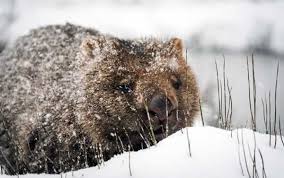
From here; I’ve seen wombats in the snow a lot, so… nah. Not so much.

 Randomly Yours, Alex