Canterbury 2100
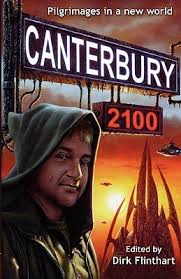
I really thought that I had reviewed this fifteen years ago when I first read it, but apparently not. How ridiculous! Anyway, I decided to reread it on a whim, and it’s still a delight.
It’s based on Chaucer’s Canterbury Tales, of course – pilgrims telling stories as they travel to Canterbury. Here, after a series of apocalyptic events only vaguely referred to, a bunch of people (mostly pilgrims) are travelling to Canterbury on a nuclear and steam-powered train. They’re delayed by rain (and worse), and start telling stories. The same sort of stories, at heart, as those told in Chaucer’s story: individuals and communities, loss and love and hope and tragedy, believable and not; all revealing tantalising glimpses about the people and their world.
There’s a great range of styles, as there should be in an anthology like this, and maybe sometimes the stories don’t seem like they’re quite coming from the same world. But honestly, would someone from Kununurra tell the same sort of story about Australia as someone from Canberra? And did you really think all of these people were telling the unvarnished truth? … all of which is to say, the collected stories feel real in a very human way.
Published in 2008, one of the fun bits is to look at the authors and see who I still know. Third up is Angela Slatter, who is still going from strength to strength; likewise Trent Jamieson, Lisa L Hannett, Kaaron Warren. There’s Martin Livings and Laura E Goodin and Grant Watson and Thoraiya Dyer… and of course it’s edited (and with connecting text) by Dirk Flinthart. Truly it’s a who’s who.
If you can still find it, this is such a fun anthology.
Kaleidoscope
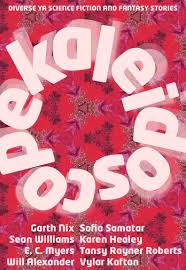 Declaring my connections: the publisher and half the editors of this anthology, Alisa Krasnostein, is a Galactic Suburbian with me; so is the author of the first story, Tansy Rayner Roberts.
I’m a lucky person because I’m white, and straight. I’m marginalised in fiction because I’m a woman who reads science fiction. I’m one of those female readers who long ago learned the trick of imagining myself with the fellas in the books I was reading – courtesy of all those Biggles books, mostly, and all that never-written-down fanfic of joining the Fellowship of the Ring (mostly to swoon over Legolas). So my emotional connection to the idea of needing diversity in fiction is somewhat less than, say, Julia Rios – one of the editors of this anthology – who notes that “As a bisexual Mexican-American woman, I didn’t see myself reflected very often in books I read as a child or teen…”. Nonetheless, I do get personally terrifically bored of straight while male characters, and I intellectually and ethically passionately support the need for diversity in all fiction. All of which is a long-winded way of saying that this project was a great one in theory, and has turned out to be a great one in practise.
Krasnostein and Rios got themselves an awesome set of authors to approach the idea of stories whose protagonists represent diversity, but where that diversity isn’t the point – it just is. Just like it should be in life. So this isn’t an issues book, and it’s not even really a themed anthology. There’s superheroes (hey Roberts, where’s that novel?) and d-mat transportation and mythology and aliens. There’s neurodiversity and mental health issues and gender and sexuality questioning and non-whites! and teens being teens and why haven’t you bought it yet?
I’ve noted before my assumption that picking the first story of an anthology must be hard. I say this with no reference to Tansy being a friend: “Cookie Cutter Superhero” really does deserve to springboard more stories. A universe wherein machines to create superheroes have appeared around the world? Where different countries take different routes to figure out who gets to use it, and the machine decides what they’ll be like? Seriously. Someone get that woman a contract and option the TV rights. And Roberts setting this in Sydney, casually mentioning the indigenous superhero who refused the media’s attempt to make him tribal, and our soon-to-be-superhero lacks a hand and it’s not the focus of the story… everything is right about this story. Up to and including the ending.
There are other stories in the anthology too. Sean Williams throws in a story set in his Twinmaker world, and it’s mighty fine. Gabriela Lee’s “End of Service” is a bit creepy both for the SF elements and for its real-world elements. Faith Mudge’s “Signature” is wonderful and not only because it reminded me strongly of The Changeover which is a pretty sure way to my heart. I hadn’t read a new Dirk Flinthart in a while, so finding “Vanilla” in here was a delight. The title suggested one thing, especially with the discussion around identity and what being a ‘proper’ Australian, or Somali, or Somali-Australian actually means… and then it turned out to have another meaning as well. Karen Healey’s “Careful Magic” is a bit Holly Black, and all awesome. I should not have read Sofia Samatar’s “Walkdog” in public – let that be a warning – I love her use of footnotes, and the eccentric spelling works beautifully, and the format does too. It’s not often you see Celtic mythology get utilised in a story, and Amal El-Mohtar does so wonderfully in a story about owls and displacement.
This isn’t a complete list, by any means. There’s also Jim Hines, Ken Liu and John Chu, Shveta Thakrar and Alena McNamara, and a bunch of others coming at the notion of diversity in YA from different points. As a reader, therefore, thanks to everyone who helped get this anthology off the ground – this is a great book that should do the rounds of every YA reader you know.
You can get this from Twelfth Planet Press direct – Australian release coming in October!

 Randomly Yours, Alex