Cinder House, Freya Marske
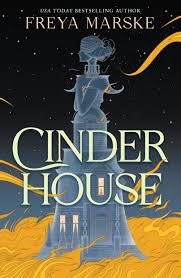
My main take away from this novella is “do not come at me with your ‘fairy tales are dead’ takes.”
This is probably the most imaginative reworking of Cinderella I’ve ever come across. Not least because it starts with the death of Ella’s father… and of Ella herself.
Yes, Ella is a ghost. No, that doesn’t stop her from having the traditional Cinderella adventures. Yes, it makes it more complicated; yes, it makes it absolutely intriguing.
Honestly, don’t even keep reading this review. Just go read it. It’s that good. (Also, novella! I basically read the whole thing while donating plasma!)
If you want more detail: Ella dies at 16. She becomes a ghost and haunts her house. The only people who can see her are her stepmother and stepsisters, and she can’t leave the house… until she finds a way to do so, temporarily.
This is a world with magic and fairies; the fairies are treated much like exotic humans (I choose the term advisedly), and magic has a difficult place in the world. Ghosts are not unknown. Ella’s tie to the house is used brilliantly – I think it’s one of the more clever explorations of that idea that I’ve come across, too, although given my general avoidance of haunted-house-stories (because I’m a wuss), maybe it’s not as novel as I think. At any rate, in not very many pages Marske creates (for me) a whole new way of thinking about hauntings, and I bought it completely.
Marske also manages to make the prince complex and interesting, with – again – a really brilliant take on his character.
Also also: a queered fairytale.
And finally also: gorgeous prose.
I loved this book a lot.
Beast, by Jade Linwood
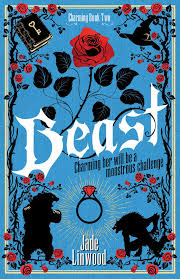
I read this courtesy of the publisher and NetGalley. It’s out in June, in Australia.
This was a lot of fun.
I haven’t read the first book, Charming, which presumably introduces the titular prince and the variety of ladies he has rescued. Fortunately, there was enough backstory provided – and without it being super info-dump-y – that that wasn’t too much of a problem; I picked up fairly quickly that Charming is every Prince Charming, that he’s therefore regarded as a conman and a rogue by the rescuees who have now banded together, and that there’s also some sort of curse on Charming himself, organised by Mephistopheles, that the ladies need to work with Charming to break. Which is all well and good until Charming gets pulled into yet another curse – the focus of this novel, which is of course the Beauty and the Beast one. And it’s gender-swapped, with Charming as the Beauty and a woman as the Beast.
It’s interesting to read a flipped B&B, especially when it’s primarily from the man’s perspective (now I want to read a flipped version from the woman’s perspective). Because of the sort of story this is, Charming never finds Beast particularly offensive, and indeed appreciates many of her qualities from early on. The novel does acknowledge that other men have not been as generous, with some reduced to gibbering wrecks because they’re incapable of seeing past the idea of a very large furry bipedal ‘animal’ coming towards them while inside a house. There’s no great interrogation here or psychoanalytical discussion of what it means to have been transformed; that’s not what this novel wants to do. But there is commentary on Beast having to use a tankard rather than a wine glass, and not wanting to eat in front of potential suitors, and a few other notes that compare how a well-bred lady of the pseudo-medieval society would be expected to look and behave compared with how she looks now.
Other fairy tales also get a look-in here, in particular Red Riding Hood and Hansel & Gretel; they are likewise fractured in really fascinating ways. Linwood seems to have had a lot of fun playing with all of these stories and thinking about how to make recognisable and yet just a bit other. (Red’s hanging out with werewolves; Gretel is traumatised from her childhood – and not by a witch – and now protects herself with bears.)
Fast-paced in a good way, easy to read, some delightful characters: this book was great.
Upon a Starlit Tide
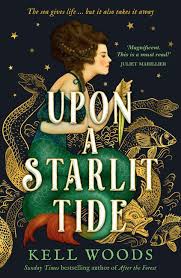
Read courtesy of NetGalley. It’s out in mid-February.
A simply glorious addition to the world of fairy-tale re-imaginings.
Did I think that mashing Cinderella and The Little Mermaid with a dash of Bluebeard (and a lesser known Breton tale) would work? I had doubts, but I did love Woods’ first novel so I decided to have faith. And it was amply rewarded.
Set in Saint-Malo in 1758, it seemed at first like this is going to be a largely real-world story… until it becomes clear that the Fae exist, although they have appeared less often to mortals in the last generation or two. And Saint-Malo, a coastal town thriving on the revenue of its sailors – both through legit trade and through privateering – is protected by storm-stone, which is also magical in some way.
The focus is Luce, youngest (and adopted) of three daughters of one of Saint-Malo’s chief and richest seamen. Her damaged feet only slightly hamper her determination to get out of the house when everyone else is asleep, to go beachcombing and even sailing with a pair of English smugglers she has befriended. And one day, she rescues a young man from drowning… you can already see some of the fairy-tale shapes here. Woods does a brilliant job of using familiar beats and combining them into an intriguing, captivating, and highly readable story.
I enjoyed Luce, and the stories of her sisters; I was generally delighted by the world (with the usual caveat that it’s not aiming to be an utterly realistic and historical warts n all story, plus it’s about a super wealthy family); I liked the way the Fae are imagined and presented.
I can’t wait to see what Woods does next.
A Sorceress Comes to Call

Read via NetGalley. It’s out in August (sorry).
My experience of reading this went like this:
– Got the email that I was approved to read this.
– Thought, “oh, I’ll just download that so it’s ready to read.”
– Thought, “oh, I’ll just start it to see what it’s like.”
– A few hours later, thought, “oh. Now I’ve finished it and I no longer have a Kingfisher novel to look forward to.”
So that’s my tragedy. Of course, I DID get to read it in the first place, so it’s not MUCH of a tragedy.
This book is, unsurprisingly, fantastic. I adore Kingfisher’s work and this is another exemplar. Cordelia’s mother is able to literally control her body – she calls it ‘obedience’ – and as a result, even when she is in control of herself, Cordelia is always on her best behaviour. She has no other family, and no friends except for Falada, the horse, and the passing acquaintance of a neighbouring girl. She has no control over anything – doors are never to be closed in their house – and all she expects of the future is that she will marry a rich husband: so her mother has told her.
Things begin to change when her mother’s current ‘benefactor’ decides to stop seeing her, and providing for her. In order to remain in the style to which she is accustomed, Cordelia’s mother decides to find herself a rich husband, both so that she herself will be looked after and to aid in the effort to marry off Cordelia. This brings the pair into the orbit of Hester and her brother, a rich squire. Through the mother’s machinations, they come to stay at the squire’s house, and Cordelia’s mother sets about wooing the squire. Meanwhile, Hester gets to know Cordelia, and… well. As you might expect, there are ups and downs and revelations and terrible things happen and, eventually, most things turn out okay.
The writing is fast-paced and glorious. The characters are utterly believable. Apparently this is a spin on “The Goose Girl” but it’s not a tale I know very well, so I can’t tell you where Kingfisher is being particularly clever in that respect. But it makes no difference; this is a fabulous novel and Kingfisher just keeps bringing the awesome.
Thornhedge, by T Kingfisher
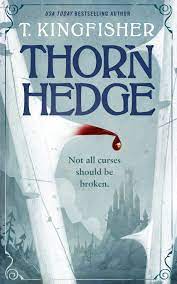
Read courtesy of the publisher, Tor, and NetGalley. It’s out in August 2023.
Sleeping Beauty, but make it WAY more complicated.
I pretty much love everything I’ve read by T Kingfisher, so it’s a no-brainer that I would want to read this novella; I don’t think I even read the blurb before requesting it. And I have no regrets, having just read it in a sitting (it’s under 100 pages, so not THAT extreme).
Toadling has been sitting behind, and sometimes within, a hedge of thorns and brambles for centuries. She’s despaired of knights and adventurous boys coming along with axes to try and cut down the hedge, because she really doesn’t want them to. One day, when it’s been a long time since anyone approached the hedge, Halim camps outside the wall… and she ends up speaking with him.
Toadling is not who you think she is, and this story is not what you might expect. It’s wondrous and twisty and a bit heart-wrenching, and all in all a really great story. I love Toadling and I will not look at Sleeping Beauty the same way again.
Never Afters, by Kirstyn McDermott
I don’t tend to read the works of Kirstyn McDermott. Even though she’s a friend. And not for the usual reasons that friends give, either; instead, it’s because she is too good. Kirstyn tends to write horror, and I tend to find her work just too distressing.
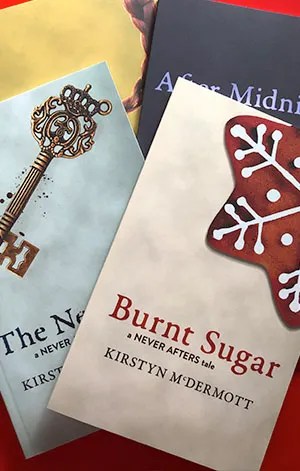
We’ve also had fruitful and fascinating conversations about the nature of horror as a genre, so I’m not going to say that this novella series, the Never Afters series, isn’t horror. Perhaps they’re gothic and gothic is the overarching category and horror fits in that, as I believe Kirstyn would argue, and perhaps other people would formulate it differently; I don’t know. All I know is that these fairy tale continuations, while not exactly the stuff of Disney-fied dreams, also aren’t quite the stuff to bring me nightmares. So that’s nice.
#1: Burnt Sugar. Now adults, childhood long behind, Gretel is a baker and Hansel is drunk more often than not. So far, so not exceptional. But Gretel brought back more than memories from the gingerbread house…. I appreciated that the siblings’ past trauma was dealt with sympathetically without making them only victims (they’ve managed to build a life around it). I know I said these novellas aren’t the stuff of nightmares; maybe what I should have said is that it’s not more nightmarish than the original stories. Because the truth is that this is a horrific story, in the ‘being controlled is terrifying’ way. Very clever.
#2: The New Wife. I don’t think of Bluebeard’s story as being in the same category as Hansel and Gretel – perhaps my fairytale omnibuses (omnibi??) left it out, or I skipped over it in an early aversion to horror? Who knows! But this may be my favourite of the Never Afters. Unlike Burnt Sugar, this story begins within (what I remember of) the original: the new wife unlocking the room that she was never supposed to enter… and goes from there in a rather different direction, involving ghosts, and what I understand is a classic gothic trope – the terrifying house.
#3: After Midnight. How do you do a new take on Cinderella?? Add a few decades, make the prince-now-king as feckless as such types often are, and the now-queen mother to only daughters – and also hardened by her experiences (or maybe she was always so?). Make the story a diary, complete with crossed out sections. Make veiled suggestions about what other things might be happening. Maybe this is my favourite, actually.
#4: Braid. I’d read this one previously – I don’t remember where – but I do remember a conversation about how hair, out of its appropriate place, is surprisingly distressing. Because Zel’s hair is as surprising and unexpected as it was back when she lived in the tower. Like Burnt Sugar and After Midnight, this is set many decades after the time of the fairytale, and deals with what it’s like to live with the consequences of those seemingly romantic and dramatic events of youth. Zel’s life has been complicated, mostly in mundane but nonetheless real and emotional ways – good and bad, love and loss. You just keep living…
#5: By the Moon’s Good Grace. In some ways the least unexpected of the stories. Like The New Wife, it picks up in the middle of the classic story; this has Little Red learning important truths about who her family is, who she is, and the consequences of that.
#6: Winterbloom. Somehow I know the Beauty and the Beast story least well, since I had completely forgotten that the whole saga starts with the father picking a rose without permission. This final novella is another set some years after the fairytale. The Beast is a composer and musician, Beauty is intrigued by roses and creating hybrids; their marriage is generally fine but shows some cracks. And then they have a visitor, aaaand… well. That’s rarely without consequence. Maybe this is my favourite instead?
Alone, excellent; as a set, they show how old stories continue to have resonance, can be used to explore modern and perennial themes.
The books can be bought from Brain Jar Press.
The Path of Thorns
I read this courtesy of NetGalley. It’s out at the end of June, 2022.
You know those authors where you know you love their work but somehow they’re not automatically at the top of your mind and then you see a new book by them and you think, oh yeah I should read that; and then you do read it (perhaps eventually) and you think WHY DO I FORGET HOW MUCH I LOVE THEM?
Maybe that’s just me.
Sorry, AG Slatter. I really do love your work.
This novel is set in the world of Slatter’s mosaic novels – Sourdough and Other Stories, and The Bitterwood Bible and Other Recountings. You don’t have to know those stories to love and appreciate this one; they’re not about the same characters, or even necessarily the same places in the world. This is a world where magic is real, at least some of the time, but not everyone approves. Magic is mostly done (at least in these stories) by women, which feeds into the disapproval of that ‘not everyone’. It’s used for good and for ill and sometimes doing it for one reason ends up having the opposite consequences. In her Author’s Note, Slatter points that the world is a mishmash of the Victorian, Renaissance and Medieval – and asks readers not to go looking for historical accuracy. So there are moments that maybe kind of feel familiar from history, but they’re set with moments that really don’t.
What I particularly love about this and the other Sourdough stories is that they feel like fairytales, even though they’re definitely not tales that I know. There’s something about the ideas and themes – as Slatter suggests, “weird family dynamics, manipulation and lies, false faces, lost families and found, terrible acts and the potential for redemption”. There’s also something about the way Slatter writes, and here I am completely lost for words. I can’t tell you what words or phrases she uses to evoke a slightly eerie world, the sense that this is a world just slightly off from ours; that makes me a bit amazed that this is NEW work, rather than something that was told ages ago and has that patina of tradition, of being a well-worn and beloved story – of familiarity. And that last is particularly odd, frankly, because I really didn’t know what on earth was going to happen from page to page. She uses phrases and stories-within-stories that read like they SHOULD be as old and familiar as the wine-dark sea and Achilles’ rage, but … they’re not.
So: Asher goes to Morwood Grange, to be governess to three young children. She has a frightening experience on arrival, and brings with her some things that she immediately puts under a floorboard. And see, right from that, you just know things aren’t going to be straightforward. And so the story proceeds – making friends and enemies and figuring out how to do what she’s come to do; you already guessed that Asher didn’t come to Morwood accidentally, right? In some ways a bit claustrophobic – Asher mostly interacts with the family and few servants at Morwood – it’s saved from being TOO gothic the-house-is-trying-to-eat-me by occasional visits to the village and out into the grounds of the estate, and also through Asher’s occasional reminiscences, It’s an intense story, intensely inwards-focussed – and look, I read it in a day.
I loved it. A lot. It’s not always easy to read; the family is a deeply broken one, Asher’s not exactly perfect, and there are definitely actions that people regret (or should, but don’t). And yet, I loved it.
Nettle and Bone
I read this courtesy of NetGalley.
If you’re a fan of T. Kingfisher, I can say “this is exquisitely T. Kingfisher” and know that you’ll run for a copy of this book. (Fair warning: book does include reference to family violence, and an abusive partner.)
If you’re not already… maybe you’re a fan of Angela Slatter? Kingfisher’s books remind me of her work too.
What does that mean?
They’re both doing fascinating things with fairy tales… except not really fairy tales, because they’re not always familiar stories, but it’s the vibe of fairy tales – fairy tale logic – fairy tale expectations and narrative structures. And I don’t mean Disney versions, I mean grim/m and sometimes gritty and meaty and fully embedded in the world, where not everything is lovely and wonderful but sometimes they are, and sometimes by force of personality you can make a change in the world and sometimes you just have to roll with the world’s punches.
I loved this book a lot.
There’s a princess who doesn’t especially want to be and who is really sure that she’s good at it, and a bone dog, and two godmothers, and a dust-wife. Also a quest and a heavy dose of gritted-teeth determination and a good level of snark, generally dished out by old ladies, which is of course the best sort. It goes at a good pace – not so fast as to leave you spinning, but you’re also not just sitting around always admiring flowers. I read this quickly and it felt just right.
This book keeps Kingfisher as one of those novelists whose work I just read pretty much automatically. I mean, it includes such gems as: “My dog trusts me… My dog is witless and also dead” and also this, addressed to a chicken: “I know you aren’t broody, demon, but you’re going to make an exception or so help me…”.
Definitely should go on your to-read shelf.
Robots vs Fairies
 I am reminded, perhaps obviously, of Zombies vs Unicorns, the Justine Larbalestier and Holly Black anthology from several years ago. It’s the same sort of idea: which trope is better? Which sort of close-to-but-not-human species can authors have the most fun with, do most with, and so on? But more than zombies and unicorns, the authors in this anthology make powerful statements in their afterwords for why both robots and fairies can and do have such enduring power in our narratives. They are like us, but unlike. Robots are made by us; fairies live in parallel; both can be imagined to have legitimate grievances with humanity; both can potentially blend into humanity… and so on. Max Gladstone suggests robots are the future, and fairies are our roots.
So there’s a lot to explore in an anthology inviting authors to choose one of these archetypal features of our speculative fiction.
What surprised and amused me the most in this set of stories was the number of times authors decided to play with both. Seanan McGuire starts the ball rolling, and Catherynne M Valente finishes it; along the way, there are a couple of variations on Pinocchio that I didn’t always pick up – it’s not a significant story for me – as well as A Midsummer Night’s Dream; and other ruminations on how robots and fairies might be seen to fade into one another, one way or another. I really, really liked this aspect.
In fact, I liked this anthology in general. The stories are generally very well written, and there’s a marvellous balance of fun and heart-wrenching or somewhat horrifying, as well as often having significant points to make about humanity and how we interact with our world. McGuire’s views on theme parks were great fun to read; Ken Liu’s story on automation was chilling and brilliantly written (unsurprisingly). Sarah Gailey also contributed a supremely chilling story that I really wasn’t prepared for, and Madeline Ashby’s was haunting and lovely, and Maria Dahvana Headley got me with a rocknroll and fairies story that was always going to push my buttons.
Themed anthologies can be a fraught business. This one gets it right.
Beauty, by Robin McKinley
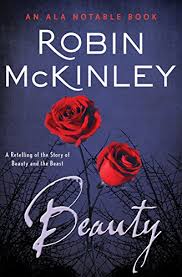 I have never read a Robin McKinley book before. I gather, from looking around, that this might be a slightly scandalous announcement? At any rate, that’s the case. I have a feeling that I got this, and The Hero and the Crown, from a Humble Bundle or similar. It’s not something I would have bought off my own bat.
This is fairly straightforward retelling of Beauty and the Beast. It goes into a substantial amount of background for Beauty’s family, which I really enjoyed – the discussion of the family, and their changing circumstances, was a perfectly delightful story all by itself. Because here’s the thing: even though it’s a standard retelling of the fairytale, insofar as that bit goes (and I recently read Angela Carter’s version, which WHOA), what makes this stand out is McKinley’s fabulous prose. Reading her work is utterly effortless, and a joy. I love her descriptions and I enjoy her dialogue and the characters are delightful. Beauty has two older sisters – and they’re distinct from one another, and although they’re not the centre of the story I still know them and care about them. Her father is a bit more distant, which makes sense as it’s Beauty’s perspective we get. And Beauty herself is wonderful: not entirely content with herself and her life, for various reasons, but also devoted to her family and doing what is necessary, generally happily. Her conflict in staying with the Beast is presented clearly, with duty meeting fear and so on…
This is not a fractured fairy tale nor a complete reimagining. It’s a story that takes a well known story and makes it more rounded, and presents it wrapped in lovely words.

 Randomly Yours, Alex