The Everlasting, by Alix E. Harrow
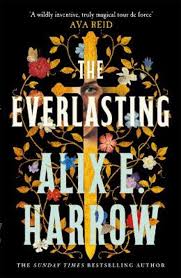
I keep not reading books by Alix E. Harrow as soon as I should, but at least this time I didn’t leave it a couple of years. Which means really I’m fairly up to date, right?
TL;DR this book is simply superb and if you have any interest in knights and adventure and time travel and stories that do very clever things with stories, this needs to be at the top of your To Be Read pile.
My thoughts on this magnificent novel are split into two bits: thoughts for readers with extensive (some might say tragic) Arthuriana knowledge, and thoughts for everyone else.
For everyone else: truly this is a beautiful novel of love and determination and the power of story. It can and should be read as a romping adventure story across time, with its share of heartbreak and despair but also a great deal of hope and bloody-minded teeth-gritting stubbornness. It can and should also be read as a dissection of the uses to which Story and History can be put, at a personal and a national level, which has a significant element of caution as well as its own element of hope. This is also a novel with fantastically well-developed characters: Sir Una, the knight whose image is used Kitchener-ly for Dominion wars (and I was also put in mind of Emily Blunt’s character in Edge of Tomorrow), whose devotion to her queen a thousand years ago is literally the stuff of legends. Owen Mallory, a nearly-failed historian with an alcoholic deserter father, struggling with his own demons, unexpectedly flung into Una’s story. The queen herself, Owen’s academic supervisor, the murderous horse – there’s not a misstep throughout.
… for the Arthuriana tragic, there’s even more going on here. The historian is Owen Mallory. Dominion is playing on the idea of England; the Arthur story is (or perhaps was) after all England’s national myth, in many ways, as Una’s is. There’s a wonderful interplay between Owen and his academic mentor about the Everlasting stories as a palimpsest, and stories being changed to fit a national moment, and irritation at audiences who think the later stories are the authentic ones – all of which applies to Arthuriana, in amusing and sometimes heated ways. There’s the idea of a knight being undying, the reference to a grail, most of the other knights’ names are plays on names from the various cycles – there are so many moments at which I just flailed at Harrow’s cleverness.
I adored this novel. And I read it just a few weeks after reading Tasha Suri’s The Isle in the Silver Sea; these ideas about stories and nations, their use and abuse, are clearly floating around in the zeitgeist. But I hasted to add that having read one does not detract from reading the other – the opposite is true: reading both (maybe not one after the other) is more like… some clever analogy with structures supporting one another. I’m sure you get the idea.
The Dead Withheld
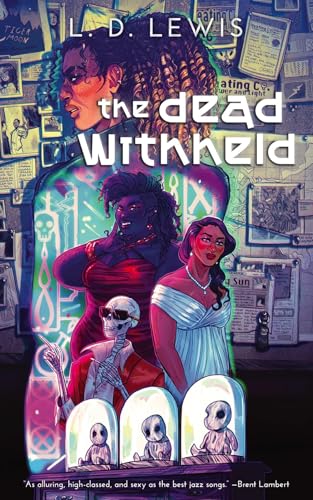
Oh look, another Neon Hemlock. Am I finally catching up on all of the novellas that have been piling up in my electronic TBR? Yes I am!
I love it when folks play with the hardboiled detective story, and make it way more interesting than ‘morose middle aged white man who drinks too much and investigates sad crimes.’ In this case, we have ‘morose unclear-aged woman who drinks too much and investigates sad crimes’ – who can also see ghosts (not entirely unusual in her town) and summon them, occasionally has to deal with demons, is in a friends-with-benefits relationship with Carmen, a demon running a bordello… and got into the PI business in an attempt to find the killer of her lover, now dead several years.
Dizzy is a wonderful character. Once a musician, she’s given that up to be a PI, and she is currently fairly messed up by the unanswered questions in her life; and she has done some questionable things in trying to resolve them – violence, and holding souls captive, to name just two. She’s also a devoted and fierce friend, honest about her failings, and has the sort of drive to get answers that can make or destroy a person.
Exactly when and where the story is set is opaque – there’s mention of “the Former United States”, but if there are clues about exactly where this is set, this Australian could not find them. But that’s irrelevant to the story, because it’s not about technology it’s about magic. The story also doesn’t care about politics; it cares about love, and revenge, and finding your way after you’ve been lost for a long time.
Again: it’s Neon Hemlock. High quality.
No Such Thing As Duty
Do I know anything at all about W. Somerset Maugham? I do not! Have I ever read anything he wrote? I have not! Did I still enjoy this fantastical take on a period in his life? Certainly did!
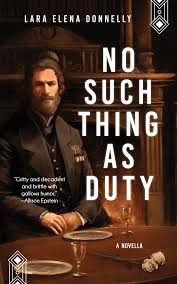
William is in Romania. He is dying of TB, and he has left his unhappy marriage – but also his daughter – in England. His lover Gerald is somewhere on the western front, current fate unknown. On paper he is working for a newspaper; in reality he is… sort of a spy. Ish. It’s World War 1, but you’d be forgiven for not realising that – there’s only one mention of the Kaiser, and no other leaders. In fact initially I thought it was WW2 from some other hints, but that mention of the Kaiser seals it.
An assignment comes to William: contact a man who can apparently get one of their agents out of Bucharest, which an Englishman would be unable to do. And so he contacts Walter, and they start getting to know each other, and things happen, and Walter is a surprise.
It’s a Neon Hemlock, so you know you’re going to get a) quality and b) queer content. This novella does not disappoint; it’s well written, well paced, and made me go look up Maugham’s life to see where Donnelly had shoehorned this story in.
New Philippine Speculative Fiction 1
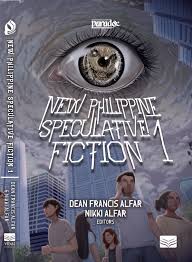
And another book sent by Charles! You can buy it from the publisher.
This anthology is both a mixed bag and a diverse collection – ah English, you are hilarious.
Some of the stories brought together here are absolutely brilliant. There are very few names that I recognised, and many that I hope will have their work picked up by and read further afield.
Of course, any anthology is going to struggle to please a reader with every story. So as expected, there were stories that really did not resonate with me here. Most of those were the horror stories – which is entirely to be expected, since that is not my vibe at all. In particular some of them leaned far too heavily on body horror for my tastes, so I simply skipped them. If that’s your vibe, then I’m glad for you that they’re included here. There were plenty of other stories here that did work for me: there are 35 stories included!
Some stories were clearly and obviously leaning into Filipino places, ideas, history, and language; I definitely didn’t get all of the references in those, but I got enough that I could appreciate the story. Others were, I guess, more “universal” – whatever that means, given the stories are presented largely in English. One of the fun things about an anthology like this is that the only connective tissue is the identity of the authors: there are no themes or ideas tying the stories together, so you have absolutely no idea what you’re going to read next.
Some favourites:
- Jose Elvin Bueno, “Cadena de Amor” – the narrator’s perspective here was intriguing, and the story tantalising
- Vida Cruz-Borja, “Call of the Rimefolk” – art, space, aliens, love, family. This story is magnificent.
- Exie Abola, “Shadow Sisters” – difficult to characterise, gut-wrenching if you’ve got siblings.
- Ian Rosales Casocot, “The Apologist” – I don’t like this story. It made me angry and feel powerless. It’s very well written and it reflects modern media too well for my liking – how rich people can get away with anything, and how PR works. More people should read it.
- Kate Osias, “The James Machine” – AI stories are still very Now. This is a simple story, in the sense that the narrative is straightforward and it doesn’t dive deep into philosophy; it’s also poignant and lovely, and the subtitles throughout are a masterstroke.
Highly recommended for getting a taste of what the Philippines is producing.
Cinder House, Freya Marske
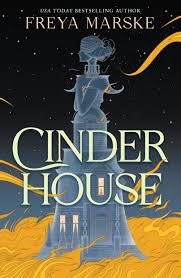
My main take away from this novella is “do not come at me with your ‘fairy tales are dead’ takes.”
This is probably the most imaginative reworking of Cinderella I’ve ever come across. Not least because it starts with the death of Ella’s father… and of Ella herself.
Yes, Ella is a ghost. No, that doesn’t stop her from having the traditional Cinderella adventures. Yes, it makes it more complicated; yes, it makes it absolutely intriguing.
Honestly, don’t even keep reading this review. Just go read it. It’s that good. (Also, novella! I basically read the whole thing while donating plasma!)
If you want more detail: Ella dies at 16. She becomes a ghost and haunts her house. The only people who can see her are her stepmother and stepsisters, and she can’t leave the house… until she finds a way to do so, temporarily.
This is a world with magic and fairies; the fairies are treated much like exotic humans (I choose the term advisedly), and magic has a difficult place in the world. Ghosts are not unknown. Ella’s tie to the house is used brilliantly – I think it’s one of the more clever explorations of that idea that I’ve come across, too, although given my general avoidance of haunted-house-stories (because I’m a wuss), maybe it’s not as novel as I think. At any rate, in not very many pages Marske creates (for me) a whole new way of thinking about hauntings, and I bought it completely.
Marske also manages to make the prince complex and interesting, with – again – a really brilliant take on his character.
Also also: a queered fairytale.
And finally also: gorgeous prose.
I loved this book a lot.
A Forest, Darkly, by A.G Slatter
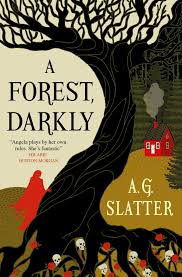
Read courtesy of NetGalley and the publisher, Titan. It’s out in February 2026.
The short version is that I like everything Slatter writes, and this was no exception. If you’re interested in reading complex characters, fascinating worldbuilding and plots that feel familiar and then go in entirely unexpected directions, with a “this feels like a fairytale but WOAH” vibe, then she is definitely one for you to look out for.
This is very loosely a version of Red Riding Hood, but I promise you have absolutely no idea what’s going on with any of the characters from my having said that. The central figure is a witch – I could say she’s a good witch, but that’s way too patronising and shallow and, well, inaccurate. She’s trying, ok? She’s not a witch who’s looking to eat children. There are, though, a significant number of children in the book, to whom some unpleasant things do happen. There’s also a blacksmith, and some non-humans, and a forest.
Mehrab, the witch, has been getting on well enough in her little cottage in the forest, far away from any signifiant towns. The nearest village is also far enough away that getting there requires a conscious choice, and anyone coming to her is doing so deliberately. One day, Fenna – the woman who brought Mehrab herself to this cottage, and who has brought other girls to stay there over the years – brings Rhea to her: the girl is a witch, and is on the run. Part of the novel is about Mehrab and Rhea figuring out how to be around each other.
A mother and father arrive at the cottage soon after Rhea; their little girl went missing a few days ago, and they ask for Mehrab’s help to find her – but she has no luck. And then the girl arrives home some weeks later… but seems to be different. Part of the novel is about figuring out what’s going on with Ari, and other children too.
Mehrab’s past is very mysterious; she gives little away to Rhea, or the reader. The gradual revelation of why she was herself on the run when Fenna brought her to this forest, and why she makes the particular choices she does, is a thread running through the entire novel.
I loved everything about this novel.
The novel is within Slatter’s Sourdough universe, but there is absolutely no need to have read anything that comes before; there’s reference to a couple of characters from other novels but they’re very much just as background, in the way that a complex world will always have background. However, if you’re already a fan, REJOICE! It’s always good when there’s a new one.
Starling House, by Alix E Harrow
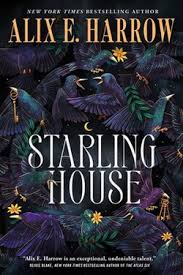
I think I avoided this when it first came out because it was called horror – or perhaps it was called ‘gothic’ and my brain generally translates that to ‘horror’ and as a rule, I avoid horror unless I know precisely what I’m getting; I do not enjoy being scared. However, it was turned face-out at the library when I went to pick up one book, and I decided to give it a go partly because it’s Harrow, and I have liked her other work, and partly because I’m beginning to suspect that much ‘gothic’ work is actually work that I do like. Nuance! It’s a good thing.
So anyway yeah I read this really quickly and it’s brilliant.
In terms of genre: I would not personally call it horror. For me, there was no moment when I was afraid: worried for the characters, yes, because they were likely to make truly stupid decisions; but no literary equivalents of jump-scares. So that’s an interesting discovery for me.
More importantly, the novel: it’s wonderful.
The writing is a delight – so easy to read, so lovely and lyrical, so evocative.
The characters are compelling – and, like I said, showing tendencies towards stupid decisions, although often for good – “good” – reasons.
The story – well. We have two points of view: one is Opal, in first person, and the other is third-person and focused on Arthur. Small-town USA, not a great place to grow up if you don’t really fit in, and Opal really doesn’t. She’s been looking after her brother since their mother died some years ago, working a crappy job and occasionally stealing as well. And she’s having dreams about a house. Through unlikely circumstance, she becomes the housekeeper at Starling House – a house that no one else ever visits, that even kids don’t approach on dares, so basically your classic threatening gothic house; Opal even references Boo Radley for its lone inhabitant. As you can probably imagine, things rather quickly go… well. Sideways? Weird, anyway.
The House is utterly central to the whole book – it’s where things happen, it’s what outsiders are obsessed with, it’s determined everything about Arthur’s life. Perhaps this is one of the key aspects of being a gothic story. And it’s a wonderfully developed house, too.
Harrow has done a wonderful thing here. She notes in her introduction that this is a story about staying, rather than leaving, and that made me really think about leaving and staying as tropes and what they tell us about how to approach the world.
I loved it. I should just trust Alix E. Harrow to write amazing stories.
A Letter to the Luminous Deep, by Sylvie Cathrall
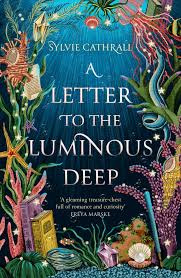
I picked this up because someone mentioned the sequel, and I thought it sounded amazing. And because it turns out I’m a bit of a sucker for the epistolary novel.
There’s a tangle of letters here. Henerey Clel and E. were writing to each other for some months… and then they disappeared, presumed drowned. Their correspondence is pieced together by Henerey’s brother and E.’s sister, some months later again, through their own correspondence. And notes from other people are also included, to flesh out various issues along the way.
Why are Henerey and E. presumed drowned? Because the world they live on has almost no land above the ocean; because E.’s house is literally underwater – and there was some sort of disaster while they were outside, near that house. The world itself is one of the most wonderful and intriguing parts about the novel; exactly how it works is gradually – very gradually – teased out over the course of the entire book, and piecing together its history is almost as much fun as learning about E. (reclusive, highly intelligent and curious, anxious, probably has OCD) and Henerey (scholar, slightly awkward, frustrated by academia, highly intelligent and curious), and of course about Sophy and Vyerin.
The language won’t work for everyone: it’s a bit on the highly-stylised end. “O dearest E.!” and so on. But for me, I felt it was done with such love – Cathrall isn’t making fun of the language, but writing it with immense enjoyment – that I was prepared to go along with it, and even enjoy it most of the time.
I must admit that I put a hold on the second book… and then let it lapse. I read the blurb, and I’m not really convinced that it sounds as compelling as the first book. At least, not enough to read it immediately. Does this first book need a sequel? I think it probably does, but also I’m willing to let the mystery just sit, at least for now.
Brigands & Breadknives
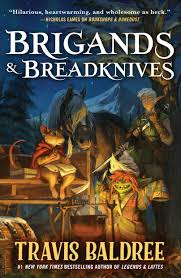
I received a copy of this book from the publisher, Tor Books, in exchange for a review. It’s out in November.
I was a few months late to the Legends & Lattes party, but I don’t regret getting there; sometimes, what I need is exactly that sort of low-stakes cosy fantasy. If you are of similar mind and want a near repetition but with different characters, this book… is not quite that. Note: you can read this without having read Legends, I promise!
Where Legends was about knowing both that you want to change career and how you will go about doing that, Brigands & Breadknives is the opposite: thinking that you’re content with your career and then realising how terribly wrong you are – but having no idea what to do instead. And that, too, can be okay.
The rattkin Fern thinks she is perfectly happy as a bookseller; she’s had a small adventure by moving cities to set up a new shop, and when she arrives it all seems very promising. But she realises she isn’t happy at all. Then, she gets drunk one night, falls asleep in a wagon, and ends up in a completely unexpected adventure: Astryx the mighty elf warrior and bounty hunter, is travelling across the Territories to collect the bounty on Zyll, a goblin with a remarkable talent for chaos. Numerous adventures ensue, some because of other bounty hunters and some not. And throughout it all, Fern is struggling with her own sense of purpose and self – and guilt, since she left her friends with no warning.
The comparison with Legends is, of course, inevitable. The stakes are higher here: many more sword- and knife-fights, people actually getting hurt, the moral quandary of a bounty when you’re not sure it’s valid. And arguably the stakes are personally higher for Fern, too, as she struggles with her own identity and purpose in life. (I’m not saying Viv doesn’t struggle with this, but it’s different when it’s something you’ve chosen, I think.) Plus, where Legends is set entirely within one town – in fact almost entirely on one street – Brigands ranges over a broad swathe of the Territories.
The book doesn’t need these comparisons, though. You can come to Brigands & Breadknives without having read Legends (or the prequel, where Viv meets Fern). All you need is an interest in a world with a huge variety of sentient races all living together (companionably, for the most part), grace for the occasional pun, and a desire to read about characters who have both fights and personal conversations. It’s a fast read, I enjoyed the characters a lot (Zyll is glorious), and this is going straight to my Comfort Reading Pile.
To Ride a Rising Storm
I read this courtesy NetGalley and the publisher, Del Rey. I’m really sorry: it’s not out until January 2026.
There’s a social media joke that does the rounds occasionally, where an author is asked to explain their work in the most boring way possible. So: small fellow goes on long journey, loses family heirloom (LotR). If Moniquill Blackgoose played this game, she’d say something like “young woman goes to boarding house, makes some friends and enemies.”
It’s silly because of course there’s more to it than that. Superficially, that’s what this book – and the first in the series, To Shape A Dragon’s Breath – is about: a girl bonds with a dragon and must therefore go to a dragoneer boarding school to learn what it means to be a dragoneer. So far, so somewhat recognisable. But the world is an alternate one where Vikings took over in what we would call Britain; the story is set in what we would call North America, but it’s very different in a lot of ways. Like, for instance, the presence of dragons, and the fact that amongst other things their breath can be “shaped” in order to do some intriguing (al)chemical things. So Anequs has to go learn about all of that. But she’s not Anglish, or from another European background; she’s a “nackie” – one of the Indigenous folk of the area – and, in one of the very familiar turns Blackgoose employs, she and her people have in no way been embraced by the colonisers.
All of this is what happens in the first book. As with many boarding school books, this second one is in the second year of school – Anequs is 16, her dragon Kasaqua is big enough to ride but not fly, and society is starting to come to turns with two nackie dragoneers. The book is concerned with both personal and political issues – although Anequs, as with many in a position like hers, would recognise “the personal is political” as being a lived reality. So Anequs must navigate friendships that don’t always make sense and people who don’t rate her abilities and Anglish expectations of how she will comport herself, and what is respectable. At the same time, there is a growing group of people in wider society who are unhappy with how their state is being governed (ie too leniently for their tastes), and Anequs becomes something of a symbol they can oppose.
As with the first book, this one is easy to read: the pacing is perfect, the conversations are believable, the characters are engaging. There are parts where I was very angry about what was being said and done, and I’m not going to lie: it feels like a particularly apropos moment for this novel to be coming out. Highly recommended.

 Randomly Yours, Alex