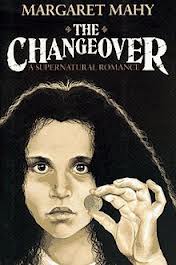
The Changeover
So back in Feb, my friend Kate challenged dared suggested that we re-read The Changeover, by Margaret Mahy. I agreed readily enough, not having read it for a number of years – and then discovered that I didn’t actually own a copy any more, how is that even possible?? Kate went all silent-running on me for a while, but she has now posted some of her own thoughts, so I will finally do the same… spoiler: the Suck Fairy did not visit!
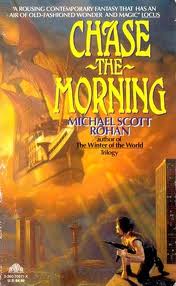
Chase the Morning
I have loved this book for a fairly long time now, but have not re-read it in a rather long time, leading to some sweating over the possibility of the Suck Fairy waving her wand. Fortunately, overall that was an unnecessary concern…
 The Good
This is still a rollicking fun adventure story. Pirates! Evil! Rescues! Fights! Sailing ships!!
I still adore the concept of ships that can set off at dawn or dusk into the cloud archipelago, and that places exist in both the Core and the Rim. That is, places exist in what we understand as the ‘real’ world, but those places with long histories especially of trade and contact with the exotic, and thus I guess have a firm grip on the imagination, can exist… outside of the mundane. And this applies to imaginary places as well as real – so Prester John gets a mention, and there’s one rather awesome place I remember from one of the later books too. Rohan goes so far as to discuss and explain why this Rim world uses old-fashioned weapons, too, which shows that he’s put a deal of thought into it.
I like the characters, mostly. I still love Mall – apparently based somewhat on a real woman attested by occasional mentions in historical records – I love that she is fierce and independent and a superb fighter and a passionate friend. Jyp is still amusing, although seemed a bit… shallower this time around? That is, not as well-rounded as I seem to recall. Maybe he gets more interesting in the later books. And Le Stryge, a rather unpleasant magicky type, is magnificent. If chaotic neutral is allowed to swing towards evil and then towards good, that’s him.
And then there’s Stephen, our Point of View. I was intrigued to discover that I found him more interesting this time around, and not because I found him any deeper – exactly the opposite. There is less to him, especially initially, and that is indeed the point of the entire book. He’s hollow. He’s forced other people out of his life, he’s marginalised meaningful human contact, to progress his career – and he’s made to confront that as the story progresses. And while Stephen is an extreme example, I think it’s fair to say that Scott is taking a shot at a whole section of society who have sacrificed love, family, imagination and dreams on the altar of Getting Ahead.
The Bad, or at least The Less Good
There are two aspects that left me somewhat uncomfortable. One to do with gender/sexuality, the other to do with race.
In the first few chapters, Stephen is presented as almost Mad Men-esque in his approach to women. His descriptions of them are physical, and while not entirely callous he does call his secretary ‘girl’ and his gaze lingers long on boobs. However, this is not entirely approved by the narrative. In fact, his approach to sex and love is very definitely seen as part of his nature as nearing hollow-man status, and this disappoints a number of characters whom the story sets up as moral compasses. So that’s an interesting take. Additionally, there is a moment where a female character has a lesbian smooch and Stephen is aghast, and clearly suggests this is not a normal thing to do. Now, it does get written off as shock, this-isn’t-really-real, but one of the other characters has no adverse reaction to the kiss, and in fact makes Stephen feel pretty small and pathetic for the way he reacted. So, not entirely positive, but also not entirely negative. Which is better than entirely negative, I suppose?
Also, one of the women is damsel’d pretty early on. On the other hand, there’s Mall.
The racial aspect comes in with the voodoo aspect. There’s always an issue when a white writer uses a non-white religious/magical/ etc system to their own ends, especially when those ends are not entirely good. Now, Rohan does suggest through the story that the original positive aspects of the African/Carib beliefs have been twisted beyond recognition, and by a colonial desiring power at that, but there is no denying that this book essentially sets up Haitian voodoo as the Big Evil to be combatted. I’m not sure how to grapple with that, except that it made me somewhat uncomfortable to read such appropriation – even when Rohan shows every sign, here and elsewhere, of appropriating other religious systems just as wholesale, to his own ends. So at least he’s not limiting himself to non-whites? Also, voodoo is shown not to be entirely evil, which I guess is also something of a redeeming feature. Not entirely, but a little bit.
I still like it. I will read the sequels at some point in the near future. Hooray.
Verdigris Deep
 I have had this sitting on my TBR pile for ages, and given how much I adore Hardinge it doesn’t make sense it took me so long to pick it up. Oh well, water under the bridge… heh… Anyway, I went in expecting a rollicking adventure like Fly by Night. After all, how bad could it be to take coins from a wishing well, right? And even if there is a spirit in there who doesn’t like being stolen from, how bad can it be? And if she decides that you need to help her in fulfilling some of the wishes, that can’t go badly, can it? Especially if she gives you some shiny powers to aid you in that effort?
Yeah. This book was way darker than I had expected. On reflection Mosca Mye’s adventures weren’t all sunshine and skittles either, but I don’t think I ever actually feared for her life, or that Saracen the goose would end up in a pie (much as he might have deserved it). Nor did Mosca ever end up with eyes growing on her knuckles.
Josh, Ryan and Chelle sneak off to a village they’re not meant to visit, and they miss the last bus their tickets will get them home on. To get more money for tickets, Josh goes down a wishing well. Over the next couple of days, all three children discover that weird things are happening: Ryan is growing weird itchy wart-things on his knuckles, Chelle can’t stop herself from randomly spouting what seems like nonsense, and Josh is making light bulbs blow and phones go staticky. Naturally, with some experimentation and a weird dream experience for Ryan, they discover this is connected to their theft from the well and they have now been press-ganged into granting wishes, with powers to help. Fun, eh?
Of course, we all know that wishes are – as Ryan describes it – a bit like conkers. There’s the outside bit that you can see, but then there’s the inside bit – the meaty bit – that’s often darker, and spikier, and not so speak-out-loud. But the spirit in the well knows that bit, too.
Things get out of control. Of course. There’s adventure – some exhilarating and some terrifying – and some occasions of just sheer terror for Ryan, our point of view character, in particular. As with the best stories there’s more than one level of problems to be dealt with, and I’ve rarely read a YA/kids’ book where parental arguments are shown quite so realistically, along with the child’s reaction. Also the fact that your parents aren’t necessarily going to get along with your friends’ parents, although that was mostly just funny. Adolescent friendship and its highs, lows, difficulties, competition, and hierarchy is treated very tenderly: Hardinge pulls no punches but does allow her characters to develop over just a few days in reaction to their circumstances. I’m quite sure most people will recognise aspects of Ryan, Chelle and Josh’s little clique, and not necessarily with rosy memories either.
As for other characters… there’s also a mean old lady who was, on reflection, actually treated rather poorly – she was certainly nasty but probably didn’t deserve quite the ending she got – and a nice young lady whose agoraphobia wasn’t explored in great detail but was treated with sympathy. There are five parents between the three children, which is rather a change from your classic YA where the parents are got rid of or otherwise not involved in the story; Ryan’s parents are very present in much of the story, and they get to be appropriately complex. And the spirit in the well – I won’t say much because I don’t want to spoil it, but I was really impressed with the context Hardinge develops, and especially with the ultimate resolution.
Look, I read this in an afternoon. It’s utterly absorbing and gloriously written. Just read it already. You can buy it from Fishpond.
(Apparently it was released as Well Witched in America. I do not know why.)
Rapture: the last Nyxnissa novel
When I finished reading the second of the Bel Dame Apocrypha novels, Infidel, I was unable to write a review as such, so I wrote an open letter to the main character, Nynissa so Dasheem, instead. And now the series has finished, and… well. It wasn’t an easy ride, but it was a worthwhile one.
There are spoilers below. You know, things like Nyx is alive for this novel. Which shouldn’t be a surprise, but kinda is.

So, who would have thought that things could get more brutal than God’s War and Infidel? Well done to Hurley by surprising me with that one. I’m thinking particularly of the fact that while previously there have been references to what might happen if you bury a body with its head attached, I don’t believe the consequences have been described in quite such visceral detail. Er… squick. Also, the fight scenes. Brutal indeed.
As with the previous two novels, this one involves Our Nyx taking a a mark that she doesn’t particularly want to, but that she doesn’t feel she can refuse. It’s seven years since the last book, and this is perhaps one of the most remarkable things about Nyx: she got old. And slow. And maybe a bit on the pudgy side, like an ex-boxer or rugby player gets when they stop working out. You see this all the time in movies like Die Hard or Lethal Weapon, where the old heroes get to complain about being old before busting someone’s butt; it’s rare for it to be allowed to happen to a woman. Heck, even Ripley gets to come back as a fully modded clone rather than being old. But there are a number of references to Nyx being old, and a bit a slow, and by no means as stealthy as she would like to think she is. So that’s very cool, because of course she still gets the job done. Kinda. Mostly. Well, she gets something done, anyway.
Back to the plot: it sees Nyx move into quite unfamiliar territory, both literally – we go places we’ve barely even heard of previously – and metaphorically, because she’s actually not sent to kill someone, but rather to bring them back. And it’s a rather surprising someone for that particular mission for this particular ex-bel dame (no, it’s not Rhys). There’s a new set of crew that have to be broken in (er, perhaps a bit too literally), and seriously excruciating things like crossing deserts to contend with. There’s fights and unpleasantess and weird people and death to confront. Some of those things not even of Nyx’s doing. Also, a great big wall that could be a joke at GRR Martin’s expense, since this one is in a desert and has even weirder things on the other side than exist in Nyx’s ordinary world, and since that includes bugs that will turn a dead body into a zombie – well.
One of the really tantalising things that Hurley offers in this section of Nyx’s saga is a glimpse of the backstory of this crazy planet. Little hints about why and when it was colonised, and what happened in the early part of its human history, and how the human population manages to survive. It’s still not enough to make everything make sense, though, and OH MY do I wish Hurley would write a prequel (I know she’s written at least one short set in this universe, maybe that covers it?), because I really, really want to know about the moons and initial colonists and what the heck is going down with the surviving deadtech.
Anyway. The plot is a little bit convoluted but simple enough to follow. It’s not trying to be tricksy because dealing with the bugs is hard enough without having to unravel all sorts of narrative tricks. Once again, though, the characters are a highlight. Nyx doesn’t so much shine as reluctantly, grudgingly, and with a mean scowl shed as little light as she can get away with, but boy if she isn’t still mesmerising. Even when she’s spitting venom and being as cranky as she possibly can. As mentioned, most of her crew is new, with the exception of the shapeshifter Eshe, who is struggling to figure out how to be himself and not be like her, while still worshipping the ground she walks on. The rest of the crew are interesting enough in their own right, although I couldn’t help but see them as so much cannon fodder – much like Nyx sometimes sees them I think, for all she has a surprisingly well-developed sense of duty to those who sign on with her. Because, as well – and here’s a slight spoiler, sorry, but if you’ve read the other two this is important – they’re also outshone by Rhys. Yes, Rhys is here again, in a very surprising – for both himself and Nyx – twist. And that relationship is so fraught, so difficult, so sad and so bitter and so frustrating, that anything else rather pales.
Finally, it would be remiss of me not to mention the political side, which is important but somewhat overshadowed by the action. There’s the possibility of a treaty with Chenja (I know, right? The war’s only been going for like three centuries)… which means something rather unexpected: the boys are coming home. And they appear to be expecting that they’ll have, like, some sort of rights when they get there. And jobs maybe? Certainly some place in society. Outrageous, I say! I think this is one aspect that could have done with a little bit more development, if I’m being critical at all – but only because I’m intrigued by how the arguments could play out and would have liked to see more of the philosophical and political discussion that Hurley could bring to bear.
Nyx, you are heartless and cold, a drunk and a killer, mean and brutal. You have changed my perception of how female warriors can be portrayed, and your world has made me see bugs in a new, occasionally more revolted, light. Cheers.
You can buy Rapture from Fishpond.
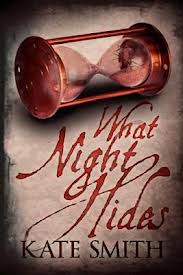
What Night Hides: review
I first read this book in manuscript form, because Kate is a long-time (I could hear the objections over the water and out of the future when I considered writing “old”) friend of mine. When it got published – last year! – Kate sent me a copy with the inscription “at last” – and at last I have got around to reading it. Of course, I remembered the awesome denouement, which meant I didn’t get the same thrill as I did the first time through; nonetheless it was still a wild ride.
 One of Kate’s great talents is an ear for odd, rhythmical, and charming description. She links together sometimes outrageous words to compose a scene, drawing in visuals and sounds and even scents to bring together a very real, if whimsical scene: “colder rays and tentacles of witch light fountained, splashing in an ever-widening search pattern over spines and shelves, turning the cobwebs infra-blue…” (34). She also has a habit of incorporating music and lyrics into her stories, sometimes making connections that seem quite peculiar unless you’re able to follow the devious turnings of her brain and keep up with the pop culture references.
As to plot – it’s urban fantasy, I guess? The chief characters are Josh, who appears to have no memories older than a few months; his new employer, Scarlet, a Nichtthane – someone responsible for keeping the bogeymen away from humanity; and Kelly, Scarlet’s seneschal, largely responsible for keeping Scarlet herself away from humanity, at least until she’s appropriately caffeinated. There’s a lot of banter and discussion of shoes in between dealing with vampires, were-creatures, and other, less immediately recognisable, supernatural critters. The common thread through it all, at least in theory, is Josh and his past; actually though I think Scarlet and Kelly’s relationship is the more interesting, as Scarlet continues to deal with being nearly immortal and Kelly shows that although intensely loyal, he doesn’t belong to Scarlet – there’s a wider world requiring attention. These stories were initially written as short stories, and sometimes it feels like it. Overall, though, they do hang together nicely.
I was also amused, of course, to recognise two of my very own connections to Kate within these pages: a vampire with a tshirt reading “it’s all liminal to me” – liminal being my very favourite word and one I’ve made Kate roll her eyes over too many times to count; and another character wearing a tshirt reading “Dear Pluto, no matter what they say you’ll always be a planet to me” – a tshirt that I own, courtesy of the author. Does this mean that I have been Tuckerised??
This is my first review for the Australian Women Writers Challenge for 2013!
You can buy What Night Hides at Fishpond.
Galactic Suburbia 77
 In which Alex eats fig frangipane made by her friend Dan… and Alisa and Tansy are bad at birthdays. If you eat cake while eating this podcast, let us know what kind! You can get us from iTunes or at Galactic Suburbia.
HAPPY BIRTHDAY US WE ARE THREE!
News
TIPTREE AWARDS
Random House and their new digital only imprints – specifically Hydra.
SFWA response to Hydra letter
Random House responds
NOTE: Since we recorded this, revisions have been made to the Random House imprint contracts.
Culture Consumed
ALISA: the life of a publisher…
TANSY: A Game of Thrones (the book) and nothing else ever again because THERE ARE MORE BOOKS.
ALEX: Warehouse 13, season 1; Shadow Unit; Arc 1.4; The Triangle; Anita Sarkeesian’s first Tropes vs Women in Video Games
Since we recorded this, Sean the Blogonaut has also posted about his thoughts on rape threats & gender issues in “grimdark” fantasy.
Please send feedback to us at galacticsuburbia@gmail.com, follow us on Twitter at @galacticsuburbs, check out Galactic Suburbia Podcast on Facebook and don’t forget to leave a review on iTunes if you love us!
Saga: a graphic novel

Look, I’ll be honest: when Tansy wrote her blog post with some recommendations for the Hugo graphic novels category, and mentioned this one, and then made a rather pointed comment about me having to read it, I kinda skimmed the post because I don’t NEED another graphic novel to be reading! This is meant to be my year of reading books I already OWN! So, you know, I was just going to… not pay much attention… 😀
Then, Tansy discussed said graphic novel on Galactic Suburbia, and made it sound even more compelling – comparing it very favourably to the Deathstalker series, which she just KNOWS is bound to pique my interest.
I went and downloaded the first instalment. (I know there’s controversy around paper vs electronic comics, but I don’t want to start buying hard copy comics – I already struggle to find space for my books, this would just be another imposition. Plus, convenience.) And then I downloaded the next one. And then… yeh. So now I am as addicted as that nasty Tansy KNEW I would be. Maybe I should send her the bill. I do, though, disagree slightly with her comparison – I think the relationship is closer to that of Hawk and Fisher than Deathstalker.
Look closely at the cover and you’ll see why Tansy was smitten so quickly. That’s a mixed race (species) couple, with the woman breastfeeding a baby. And this image was on the very first issue. Remarkable, no? The story itself is actually told from the point of view of the baby herself, which is a clever little quirk and – as Tansy pointed out with some relief – it means you know that THE BABY SURVIVES. This is a good thing. The couple themselves are soldiers from opposite sides of a galaxy-spanning war, which has been going on for more years than people care to remember. She’s got wings; he’s got horns; they’re both soldiers. Their relationship – once discovered – is naturally one that does not bring joy to their respective authorities. Especially after the revelation of the abomination that is their mixed-species child.
I am still coming to terms with the idea that I have to genuinely consider the art when I read graphic novels. First, I don’t have an instinctive love of the visual medium; second, I don’t always feel that the art is… integral?… to the comics I read. It is vital in Girl Genius but seems less so in the new Captain Marvel or Hawkeye. Maybe that just makes me a bad comic-book reader. At any rate, Fiona Staples’ art is wonderful and rich and nuanced and definitely adds to the story overall. Alana and Marko – the couple – are drawn with great expression and realism. Maybe the art works here because there’s such a range of characters and species and settings – which is more like Girl Genius and less like Captain Marvel and Hawkeye. Eh; that’s probably an indefensible proposition. Probably I just need to pay more attention to the art in those stories, like I do with Saga.
There have been 9 issues as I write. Brian K Vaughan has said that there’s a definite arc he has in mind for the story, but it’s not clear how long that will take. This could be a long term commitment, TANSY. So far, there have been mercenaries; ghost-girl nannies; subversive romance novels; attempted assassinations; robot-headed folks; in-laws; magic; blasters; secrets revealed; rocketship forests; space travel; and the sorts of domestic interludes that we’ve been complaining don’t turn up often enough in science fiction and fantasy but that clearly MUST if these people are to be believed and their relationships to function. It’s a science fiction and fantasy heroic domestic adventure. It’s Mad About You meets Guess Who’s Coming to Dinner. In space. With magic.
I second the nomination of this as a nominee for Best Graphic Novel 🙂
You can buy Saga Vol 1 here; it collects issues #1-6.
At the Mouth of the River of Bees
Turns out I have loved Kij Johnson longer than I thought I had. I first remember reading something of hers and being blown away with “Spar,” in 2009. Except, though, it turns out she wrote “26 Monkeys, Also the Abyss,” which I read and adored (possibly unreasonably) in 2008. And

now I own these two and a whole bunch of other glorious work in this fabulous collection. Also, “Ponies.”
“26 Monkeys, Also the Abyss” is told in 24 parts of varying length and purpose. It revolves around Aimee, who one day became the owner/manager/carer of a troupe of 26 monkeys (well, 25 monkeys and a primate), who travel the fairs and carnivals of America (127 in a year, with time off for Christmas) performing their routine… which ends with them disappearing from a bathtub. It’s a story of the unexpected things in life and how they are the things which can matter most; that the things we love don’t have to make sense, and it’s ok when they don’t. Life has loss and love and discovery. And, sometimes, monkeys. (And a primate.) I love, LOVE, this story.
“Fox Magic” is one example of Johnson’s penchant for Japan and Japanese culture and myth. Here, a fox falls in love with a man, and the magic is to make it reciprocal. This, of course, has Repercussions. One thing I admired about this story in particular is that the fox maiden is mostly very aware of the doubled world created by the magic. There is little pretence that the magic has made everything (some things, yes, but not everything) different. Also, it confronts some of the detrimental repercussions, beyond the fox and her beloved. This sort of honesty and, well, bluntness is a bit of a hallmark of Johnson’s.
“Names for Water” is utterly unlike the previous two stories – which, let’s face it, is also a hallmark of Johnson’s stories. You never quite know what you’re going to get. This one… well, it could be read as a reason for keeping up your studies; it could be read as a meditation on the long-term and unexpected consequences of small things, and on the inter-connectedness of the universe. Johnson takes the idea of static on a phone call and… goes places. It’s also lovely how many names for water she includes.
“The Bitey Cat” is a fairly unpleasant little story – that is, well written, but the narrative itself is not nice. A little girl and her bitey cat and the trouble they get into. It’s dark with the sort of darkness that you can only talk about with childhood.
“The Horse Raiders” is also dark, this time the sort of dark you get when a story’s about, well, horse raiders; a planet where things are not going that well, where communication between different groups has broken down, and different groups have very different sets of values. Katia’s family are nomads, travelling with their horse herd; she is the vet. Tragedy strikes and she must adapt, through pain and difficulty and anger, to a new life. One of the most intriguing parts of the whole story is the concept of n’dau. The world here turns so slowly that it is possible, being a nomad, to always be where a person and her shadow are matched in height; a right place. I love this idea of the psychic matching the landscape.
This is not a generally happy collection, is it? Brilliant, but by no means happy. “Dia Chjerman’s Tale” is in some ways the impersonal story of an entire planet – one that is theoretically part of an empire, and has contact with an alien race, and the repercussions of that. But it is also a heartbreaking personal story, as the opening indicates; Dia Chjerman is the 27-times grandmother of the woman relating the tale, who is now living those repercussions. Yeh. Personal and political, hello.
On a completely different note is “My Wife Reincarnated as a Solitaire – Exposition on the Flaws in my Wife’s Character – The Nature of the Bird – The Possible Causes – Her Final Disposition.” For a start, oh that title. This is Johnson playing with what I think of as 19th-century prose that’s quite different from her normal style. And it is clever. Oh, so clever. Nice layers, nice inversions.
It took me a little while to fully understand the joke that Johnson was making with “Schrodinger’s Cathouse,” but I got there. It’s a one-shot trick, but she does play it out nicely.
After those slightly more lighthearted tales, it is back to the bleaker side with “Chenting, in the Land of the Dead.” Choices that we make, and how perception is everything, how even when the outcome appears exactly the same for two people it’s not – it’s really not. She’s good at gently and softly and smilingly breaking your heart, Johnson.
I seem to be coming across tales of prophecy a lot recently. “The Empress Jingu Fishes” deals with that ever-vexed question of if you know the future, can and should you change it? Does trying to change it lead to exactly the foreseen outcome? Ah predestination; it will never cease to be a human challenge.
“At the Mouth of the River of Bees” is, I think, my really Great Big Discovery of this collection. It’s glorious and bewildering and comforting and inexplicable. It’s another story of a woman who makes a choice even though she doesn’t understand what motivates it, or where it will lead – in fact even though she knows that it might be a bit crazy. Like following a river of bees. I did not want this story to end, although when it did it was absolutely perfect.
“Story Kit” is one of those stories with multiple strands that don’t immediately seem to connect with one another at all until… and then… oh yes. The story of Dido and Aeneas; lists of reactions, of words, books; an author’s notes on her attempts to compose a story, the decisions she makes, the consequences around her. I suspect this is very much a writer’s story. I love this sort of playing with structure, through short stories.
“Wolf Trapping” is a story of obsession and the desire to belong, and ways in which that can go wrong. I don’t know where Lake Juhl is, or even if it’s real, but Johnson made me feel cold just reading about it – and glad to live in a country with no wolves. And also glad not to experience the sort of obsession that might drive someone to want to be a wolf. Interestingly, she doesn’t actually make that much attempt to explain that; it just demands to be accepted at face value, and if you can’t – well. Too bad.
“Ponies.” How I dislike “Ponies.” I appreciate that it is well written, but I just cannot like it. It’s just too, too unpleasant. Not least because on a symbolic level, it’s just too too real.
The last 130-some pages is made up of four stories; one quite short, the others novellas (I think). This is an interesting choice of structure; I would have thought you would want to spread the long ones out a bit more. Anyway, not my decision! I am conflicted by “The Cat Who walked a Thousand Miles.” It’s a rambly sort of story, and isn’t fantasy or sf – unless one counts the idea of self-aware cats as fantasy. Maybe that does fit. Anyway, it’s Japan, and has to leave its home. It has adventures… cat adventures, anyway, involving mice and lakes. It is captivating prose – it’s lovely – but… it’s kinda boring. The plot’s not that interesting, but neither are there particularly absorbing character developments or discoveries. Maybe this just isn’t the story for me.
… and then there’s “Spar.” Oh, “Spar.” A story that might have been written in order to answer the question, “can a story that revolves entirely around sex actually explore interesting issues?” with an “absolutely.” Because the story does just that – revolve around sex between a human and an alien – and explores questions of identity, and belonging, and communication, and ohmyhowcouldwehopetotalktoaliens? It’s squicky, that’s for sure, but it’s masterful too.
Penultimately comes “The Man Who Bridged the Mist,” and here I gave to admit that the first time I read this I skimmed it and did not appreciate it. It was while reading for the Hugos, and it seemed so long and a bit dull and… yeh. I skimmed. And, it turns out, I missed a lot. It is long; it’s a novella, it’s allowed to be. But things do happen; a bridge, for one, plus lots of complex and interesting and beautiful and difficult human interactions. To what extent are we what we do? Do we get to make our own decisions about things like that? While I appreciated the story of Kit and his bridge-building this time, I also really savoured Kit’s back-story, which I completely missed last time; it has some wonderfully poignant moments. I loved the affirmation of life and love and choice. I now fully endorse, long after it matters, its inclusion on the Hugo ballot. And I kinda wish it had concluded the collection, because
“The Evolution of Trickster Stories Among the Dogs of North Park After the Change” does not really compare. It too is poignant, and clever, and the rumination on what might happen if our pets suddenly developed the ability to speak is chilling and pointed and discomfiting. But it’s just not on the same level as “The Man Who Bridged the Mist,” for me. Maybe I’m just not enough of a pet person.
Overall, this collection cements for me that Kij Johnson is one of the most talented and varied writers of speculative fiction going at the moment. She changes style and genre effortlessly, she pokes fun and makes serious comments on the human condition, and she writes glorious prose. MORE.
Galactic Suburbia 73
 In which Alisa recovers from the brainsplosion that is World Fantasy Convention, Alex finally reads THAT Margo Lanagan story, and Tansy travels in three kinds of time. You can get us from iTunes or at Galactic Suburbia.
News
The WFC Report
Stop Reviewing Movies with Strong Female Leads!
at the Mary Sue
at Jezebel
at Bitch
Fake Geek Girls Unite:
Mary Sue Coverage 1 2 3
The New Statesman
Peter M Ball Pledges His Allegiance to the Fake Geek Army
What Culture Have we Consumed?
Alisa: Dexter S6 and S7; Episodes 2; In Treatment S1; The Shield S1; Remember Why You Fear Me, Robert Shearman; Hair Side, Flesh Side, Helen Marshall
Alex: Singing my Sister Down, Margo Lanagan; some Kij Johnson, from At the Mouth of the River of Bees; One Little Room, KJ Parker; Holmes Sherlock, Eleanor Arnason
Tansy: The Diviners, Libba Bray; All New X-Men #1; Chicks Unravel Time edited by Deborah Stanish & LM Myles.
Don’t forget to send us nominations for the GS Award: for activism and/or communication that advances the feminist conversation in the field of speculative fiction in 2012.
Check out our sibling podcast, Galactic Chat – in the latest episode, Sean interviews Joe Abercrombie.
We are running away for summer! Back at the start of February!
Please send feedback to us at galacticsuburbia@gmail.com, follow us on Twitter at @galacticsuburbs, check out Galactic Suburbia Podcast on Facebook and don’t forget to leave a review on iTunes if you love us.
Galactic Suburbia 72
In which a new listener is born, Canada gets a Stella too, and we review a bunch of great stuff including Black Widow, Infidel, Swordspoint and Big Finish’s special releases. You can get us from iTunes or at Galactic Suburbia.
News
Baby Announcement: Daniel Wessely is born!
WFA winners announced
Genrecon!
Tansy talks Genrecon on the Voyager blog
And again on her own blog
Jason Nahrung on what he got out of Genrecon
Neil Gaiman’s new Doctor Who episode will feature the Cybermen, Warwick Davis & Tamzin Outhwaite.
Boing Boing
io9
Canada is getting a Stella too – theirs is the Rosalind!
Galactic Chat – Rowena Cory Daniells
What Culture Have we Consumed?
Alex: Infidel, Kameron Hurley; The Deep (BBC series); Black Widow, Marjorie Liu; and books on women’s suffrage… (only on the day on which I post this!)
Tansy: Bitter Greens by Kate Forsyth, Swordspoint by Ellen Kushner; Big Finish Specials: UNIT Dominion, Love and War by Jacqueline Rayner & Paul Cornell; Voyage to Venus; Dorian Gray
Please send feedback to us at galacticsuburbia@gmail.com, follow us on Twitter at @galacticsuburbs, check out Galactic Suburbia Podcast on Facebook and don’t forget to leave a review on iTunes if you love us!

 Randomly Yours, Alex