Galactic Suburbia 66!!
 In which we suffer post-Olympics slump but make up for it by talking about sport in SF/F: from coyote baseball, holodeck racquetball and the points system of Quidditch to the history of sport in Doctor Who. And don’t forget that Buffy was a cheerleader! You can get us from iTunes or Galactic Suburbia.
News
World Fantasy ballot released.
Mythopoeic Awards include Delia Sherman and Lisa Goldstein
New Science Fiction Awards Database Website by Mark R Kelly (Locus)
Kirstyn McDermott makes Jason Nahrung a mug based on Alex’s GS review of Salvage
New Galactic Chat: Sean interviews Trudi Canavan
Readercon Apology sets the standard.
Feedback: Sean & Kitty on the harassment at cons issue.
What Culture Have we Consumed?
Alex: Existence, David Brin; all of Planetary, by Warren Ellis; Caliban’s War, James SA Corey
Tansy: “Foundlings” by Diana Peterfreund in Brave New Love; Shooting the Poo 14 (Sherlock Holmes) & 15 (Alien movies part 1)
Alisa: Coode St Podcast Ep 112 featuring Genevieve Valentine, and… reading unapologetically is a life skill!
Pet Subject: Sports in SF/F
The tennis match Alisa refers to is this one with Billie Jean King.
Please send feedback to us at galacticsuburbia@gmail.com, follow us on Twitter at @galacticsuburbs, check out Galactic Suburbia Podcast on Facebook and don’t forget to leave a review on iTunes if you love us!
Galactic Suburbia 65!
 In which we discuss gender at the Olympics and sexual harassment policies at conventions, fight about whether we should read the comments, and Alisa reads more novels than Alex & Tansy PUT TOGETHER. You can get us from iTunes or download from Galactic Suburbia.
NEWS:
Readercon harassment discussion:
Masterlist & timeline of links
Cheryl looks at the practical side of developing harassment policies for conventions
Translation awards winners
Travel Fund Mark II sends two Swedish authors to WFC.
What Culture Have we Consumed?
Alisa: Earthly Delights by Kerry Greenwood, Naked in Death by J D Robb
Alex: Stargate Universe season 1; Ashes to Ashes season 3; Silently and Very Fast, Catherynne M Valente; Birds of Prey: Death of Oracle
Tansy: X-Men S.W.O.R.D No Time To Breathe; Uncanny X-Men: Dark Phoenix (The Ultimate Graphic Novels Collection, not Marvel Masterworks as I said in the podcast, worth also noting that the US are more than 20 issues ahead of Australia); Besieged, Rowena Cory Daniells
For next episode: send us your favourite examples of sport in SFF.
Please send feedback to us at galacticsuburbia@gmail.com, follow us on Twitter at @galacticsuburbs, check out Galactic Suburbia Podcast on Facebook and don’t forget to leave a review on iTunes if you love us!
Reign of Beasts: a belated review
It always takes me ages to review Tansy’s books, because there are so many things I want to say that they get in the way of each other and I know it will take ages and then I put it off and… you get to this point, where it’s five months since I read the book and I’ve forgotten half the things I wanted to say. So this is just a few comments, really, about things I enjoyed (because I did enjoy it, and there’s not much I didn’t).
Spoiler for book 1 and 2; why on earth would you read this review if you haven’t already read them?? Also, I’m friends with Tansy, if it makes a difference to you.
 Roberts takes a different narrative tack with this novel: she introduces a reminiscing point of view, the identity of whom is hidden for most of the book. Of course I think it’s obvious in hindsight, but there really were a number of people it could have been! It is clearly someone currently involved in the Creature Court, but who… yeh, that’s clever. This serves a really important purpose: the perspective of an outsider becoming an insider. Velody sort of performs this task in the first two books, but she is older than this perspective (at least at the start), and also comes from a different background – in terms of family, and class, and expectations too. Also gender. So seeing the Creature Court from this (also much earlier) view gives a whole new angle on the interactions between various characters, and the events preceding our events, too. This was a very excellent part of the novel.
I don’t think it’s a spoiler to say that there’s a lot of catastrophe in this novel. This should not be a surprise. Velody has returned with Garnet, which was always going to bring down ruination and destruction of one sort or another, on the city or the Court or both and/or the sky. Also, Rhian starts telling everyone that everything will be decided at Saturnalia, which is awfully soon when the novel opens. So, there’s that. Plus Garnet in full flight (heh, literally), other members of the Creature Court acting as only they can, and Rhian and Delphine… well. Acting as we’ve come to expect. Except when they don’t. Roberts does seem really interesting things character-wise that are quite unexpected but at the same time entirely in keeping. Which is awesome.
It might also be a slight spoiler to say that Velody actually leaves Aufleur for a brief period in this novel, which is another quite different and awesome aspect. Too often third books are merely, if awesome, conclusions to a series, following on from everything that has come before. Roberts manages to introduce entirely new elements of her world, which – as with the characters – are still entirely in keeping. Seeing more of this world, outside the jaded, familiar, decayed and corrupt Aufleur, adds a whole new dimension to our understanding of Aufleur and our characters – just as understanding its history does, with the new point of view.
Keep in mind that Roberts is a bit mean, and you won’t be surprised that few if any of her characters escape without scars (literally) from this novel. That said, it’s a worthy and brilliant conclusion to the trilogy, even if you might not be entirely happy with some of the resolutions. I mean, really, would you expect to be? It’s not like she has been in the two earlier novels.
Galactic Suburbia 64!
 In which we talk Smurfette, gender bias on Wikipedia, Redshirts, Regency magic and Captain Marvel. Also, Tansy turns the microphone off a lot so you can’t hear her sneezing. You have much to thank her for.
News
Shirley Jacksons! Winners announced.
A new Sleeps With Monsters column by Liz Burke: The Smurfette Principle – We Can Do Better
How Kate Middleton’s wedding gown reveals the gender bias in the Wikipedia system.
Journey Planet Issue 13 – specifically special section on gender parity for con panels including our own Alisa
The ComicCon Batgirl returned to SDCC this year, asking DC Comics about why Stephanie Brown has been removed from the Smallville comics.
What Culture Have we Consumed?
Alisa: Redshirts by John Scalzi (read by Wil Wheaton)
Tansy: The Truth by Terry Pratchett, Sherlock Holmes The Final Problem/The Empty House (Big Finish Productions), Captain Marvel & The Avenging Spider-Man #9 by Kelly Sue DeConnick
Alex: The Secret History of Moscow, Ekaterina Sedia; Salvage, Jason Nahrung; Glamour in Glass, Mary Robinette Kowal
Please send feedback to us at galacticsuburbia@gmail.com, follow us on Twitter at @galacticsuburbs, check out Galactic Suburbia Podcast on Facebook and don’t forget to leave a review on iTunes if you love us!
Glamour in Glass (and spoilers)
Edited to correct a gaff in how I refer to the author!
This is an entirely spoilery, and probably rambly, discussion of Glamour in Glass. It will also spoil the first in the series, Shades of Milk and Honey.

It’s fair to say that I adored Shades of Milk and Honey, and was really looking forward to reading the sequel. I did not love it quite as much as the first, but I think that’s mostly because it wasn’t new – the joy in Shades was in its being so new and full of the discovery of glamour and how that changed, or didn’t, the Regency period in England. Also, and yes I know I’m a terrible romantic, but the thrill of boy-meeting-girl-meeting-boy, and the trials and tribulations that follow, make for a very different story (hopefully) from that about a married couple. Not better, just different.
Anyway, the premise here is that Vincent and Jane are married – yay! – and working together – yay! Their first big commission is a huge drawing room do for the Prince Regent (… who gets called Prinny by his friends, apparently. I mean, really?). I loved that they work together, and while she is quite nervous and a bit unsure of her place and feels overwhelmed by Vincent and his experience, his attitude is entirely embracing of her and her contributions.
From there, it’s off to the Continent for them, because the Ogre – aka Napoleon – has been sent off to his island retreat, and it’s safe to go visit France, I mean Belgium, I mean the Netherlands. Vincent has a fellow glamourist to visit, and this will also serve as a honeymoon. Of course, things do not progress as expected. Vincent gets all distant, which has Jane naturally worried; even in this alternate world Napoleon quickly escapes his island and attempts to regain the imperial crown; and Jane gets pregnant. Boo, hiss, yay. Right?
Boo: absolutely. Vincent is a total prat at various times in this novel, and I was totally with Jane is being bewildered and upset with him. I was pretty sure Kowal wouldn’t turn this into an adultery plot, and even Jane doesn’t worry that that’s the problem. In fact, it’s directly related to…
Napoleon (hiss). Ah, Napoleon. I wish we had met him in this novel, but he stays off stage. I thought Kowal did a really good with depicting the tension felt in Belgium in the immediately post-Napoleon period; it was such a contested piece of territory, and showing that some people feel violently pro-France/Napoleon, while others are decidedly anti, was done very nicely. I think this could have been explored more deeply, but then – it wasn’t really the issue for Jane, outsider that she is. More of an issue for her is…
Pregnancy. Which, it turns out, is not so much a ‘yay’ here, or at least at this time, because when you’re pregnant you’re not meant to do glamour. The one big disappointment for me in the whole novel is that why is never explored or explained. I had really hoped that Jane would discover that this was a great big lie, but alas… no. In fact, she may actually confirm it, because – spoilers! – she miscarries directly after using glamour in desperation to save Vincent. Now, it’s not clear that there is a causal relationship here, and Jane herself can think of various other reasons for it, but nonetheless. There it is. And I think this is a very interesting, and potentially problematic, aspect of the whole novel.
Now, never having been pregnant myself, it may be presumptuous of me to make any comment here. But anyway: firstly, I say again that I wish there were some explanation for why no glamour when up the duff. The fact that it’s so heavily a female art makes this particular issue an additionally… interesting one. And frustrating. Moving on to Jane’s case, though, I thought Kowal wrote her reaction to pregnancy really well. Jane herself is unsure whether she’s happy about it or not: partly because she’s not sure what Vincent’s reaction will be, and partly because it will mean giving up the work that she loves and loves undertaking with him. And not being able to work takes quite a toll on Jane’s self confidence, and on her perception of her relationship with Vincent, too. This seems quite realistic, to me, and feels neither melodramatic nor purely done for plot reasons. And then she miscarries, and this too is problematic – not just for the obvious grief reasons, but because Jane feels guilt, for two reasons: for having done glamour, which might have contributed, and also because one of her first reactions is relief because she can work again. Which of course sets off its own cycle of guilt, at appearing (to herself) to be cold and hard-hearted. And this too seems quite realistic to me. I do have experience of grief and it does do weird things to the head, and I totally understand having such a mixed, involuntary, reaction. So… yeh. Interesting stuff. Certainly interesting stuff to address in what seems like a fluffy just-add-magic, Regency romance.
I really, really hope the third book – which I think is coming out this year too – has ongoing repercussions for the miscarriage, since that would be the realistic thing to do.
It is, overall, a great novel – very fast paced and mostly intriguing characters. Also, the physical product is a bit quirky: I couldn’t find the info on the type, but I’m quite sure it is (or based one) the sort of type used in ‘olde style’ Austen novels, which is nice and certainly helps it feel like it came out before 2012! I’ve read a few complaints about it not dealing with race and class and… well, yes. That’s true. The race aspect doesn’t fuss or surprise me: this is set in 1815, so it doesn’t amaze me that Jane has no experience of black people, as slaves or servants or even in the abstract, like through abolitionists or whatever. She’s not the most worldly of people, and she’s not in London or another major city most of the time, either. As for class, it’s true that her attitude towards servants is entirely that of a woman of the lower gentry, accustomed to service. She is conscious of feeling overshadowed by fancy titled ladies, but not of her own position above others. Yet… I dunno. It didn’t bug me much, to be honest. There’s not a whole lot of ordering servants around and lording itself over others, precisely because she’s not in that overwhelmingly powerful position and neither are most of the people she associates with. So this could certainly have been a more complex novel, problematising all sorts of issues from the Regency period. But it also doesn’t pretend to be that novel. And I think that’s ok.
One final irk: working glamour may be a feminine art, but who are the preeminent glamourists who get the commissions? Men. Yah.
Galactic Suburbia 63
 In which we look at the politics of female author portraits, why you shouldn’t tweet celebrities about their alleged irrelevance, and start thinking about what we’re going to vote for in the Hugos. You can get us at iTunes or from Galactic Suburbia.
News
Women in SF & Fantasy in Australian media – the article is a month old, but still relevant!
WA Premier’s Book Awards Shortlist announced and Penni Russon is on it!
Top 10 list of the greatest female SF/fantasy authors ‘of all time’ – do you agree?
Tansy’s Pinterest board of portraits of “Lady Novelists”
It’s Not Wise to Be A Jerk to Felicia Day
What Culture Have we Consumed?
Alex: Schismatrix Plus, Bruce Sterling; Embassytown, China Mieville; Snow White and the Huntsman; Bitter Greens, Kate Forsyth; Diamond Eyes, AA Bell
Tansy: Salvage, by Jason Nahrung; Medea, Kerry Greenwood; Captain Vorpatril’s Alliance by Lois McMaster Bujold; Ame-Comi Wonder Woman & Batgirl; Silk Spectre #1 by Darwyn Cook & Amanda Conner; The Invincible Iron Man, Matt Fraction
Alisa: Blackout, Mira Grant
Please send feedback to us at galacticsuburbia@gmail.com, follow us on Twitter at @galacticsuburbs, check out Galactic Suburbia Podcast on Facebook and don’t forget to leave a review on iTunes if you love us!
[photo: Stella Miles Franklin, older and more characterful than we usually see her in images]
Agatha H and the Clockwork Princess
*Some spoilers for the first Agatha Heterodyne novel/some of the graphic novels*
 Yes I am a fangirl. Let’s move on, and firstly talk about the look of this lovely book. I don’t mind the cover – I think it’s appropriate and quite pretty – but when I was reading I took the dust jacket off and oh my, I don’t think I can put it back on again. The hardcover itself is beautiful, with gorgeous gold embossing and little swirls and… it’s just wonderful.
So, the story. This covers, I think, volumes 4-6 of the graphic novels (I may be wrong). Agatha has escaped from Castle Wolfenbach and quite literally falls to earth in company with Krosp, the talking cat. She gets taken in by a travelling circus, after a few adventures, and things proceed from there: more adventures, some science, a little bit of romance, and some interesting characters too. Things are, of course, not entirely what they seem in the circus; and even if that were the not the case, odd things are afoot within Europa so Agatha and her friends are confronted with monsters and other unpleasant people as they travel around. And then there’s the castle with the slightly crazy people…
You probably wouldn’t enjoy this novel without having read the first one. If you’ve read the graphic novels, then you know exactly what happens here already. For me, I read the graphic version long enough ago that I’d forgotten many details, so it was still highly enjoyable. Additionally, I think the Foglios are adding more detail in, especially in terms of back story for some of the more minor characters – and for Europa, and the places visited, as well. I am still a word-reader at heart, and much as I love the graphic novels I don’t think I yet have my eye ‘in’ – I’m sure there are details I miss in pictures that I easily grasp in words. So, it works. Actually I think the main indication that this novelisation works is the fact that it makes me keen to go back and read with the pictures, because I do love them.
Another reason I enjoyed this novel is that the Jagermonsters feature. A lot. Which makes me happy. Also, it so passes the Bechdel test. There are women who are warriors, and schemers, and costumers, and mechanics, and while men feature in their discussions they’re not the sole focus. It’s not perfect, but it’s pretty good.
Continuum 8
Or
My Con Experience, by Alex, aged… quite enough thanks.
It was Craftonomicon, the 51st National Australian Science Fiction Convention, this weekend, and the first weird bit about it was that I got there by taxi, and not by plane.
My con started properly on Friday afternoon with a panel on space opera with m1k3y and Jonathan Strahan that went remarkably well, not least because the former was an admirable moderator. I got to gush about a few books and discuss why I like it and what makes something space opera; Tansy thinks I am very harsh because I said generally it has to move outside of the solar system. I say: if it doesn’t, it’s hard to be grand enough to count.
Next I helped Terri and Alisa move a mountain of cupcakes in preparation for Twelfth Planet Press Hour, in honour of two new Twelve Planets books and Jason Nahrung’s Salvage, and TPP in general. The cupcakes were wolfed in minutes, although it is fair to say that people did usually stop for a moment to admire the artwork that Terri had made of them out of frosting and sugar. So very much sugar.
I think Friday ended with dinner, and… I forget. It was a while ago now. There was a great deal of talking. Actually that was kinda the theme of the whole con. The official theme was craft, and I got a number of inches completed on my scarf; the unofficial theme was Talk As Much As You Can. Me and my peeps managed this quite well 😀 .
Saturday I sat in on a panel called “Masters of Podcasting,” which has to be said in an echo chamber to get the full effect, featuring Alisa and Jonathan and Kirstyn and Terry. Tansy and I were very restrained and did not heckle. They said some quite interesting things, like podcasts being the lazy person’s fanzine to create (that’s Kirstyn’s view), which SO resonated. Then I was on a panel called Fans and Faith, with three Christians and a Jew; we made the Jewish boy, Mondy moderate, and a very fine job he did by asking provocative questions and pointing out that while we might not like the representations of Christians we find, at least there are a few – not so much with Jews, especially of the Orthodox persuasion, nor Muslims (Kameron Hurley makes a start in addressing this). It was a good discussion in all and only derailed towards the end by someone basically asserting that you can’t have faith and accept the scientific method, which he believes is essential to SF…
In the afternoon we did a Galactic Suburbia that lasted just ONE HOUR – show notes to come when the Silent Producer has recovered from the con. After that I travelled with Alisa and nine of her Planets (and a few other audience members) to Embiggen Books, which oh my it might have been better for me not to find. What a BEAUTIFUL bookshop! With a door hidden as a shelf and everything!! Mondy hosted the podcast that involved all nine Planet authors and Alisa talking about the project and their individual approaches to it, and it was a lot of fun to sit in the audience and listen to such a diverse range of women talk about their approaches to writing and to the project. Drinks and dinner followed, and I got home… later than Friday.
Sunday I made it in to the con in time to see half of the “Elizabethans are awesome” panel, and then wandered around and helped restock the Twelfth Planet table and generally mooched and chatted. My last panel to contribute to was one on book blogging and reviewing, which went ok. I scurried from that to the live recording of The Writer and the Critic, which was entertaining of course even though they did not especially like Crystal Singer, by Anne McCaffrey, which I adored in my teens.
The evening was taken up with dinner, trying to find out when power might be restored in Perth, and then frocking up because it was Awards Night! And I love awards. It was the Chronos (Victorian state) and Ditmar (national) awards night, with a couple of others thrown in – mostly lifetime achievement type things, plus the Norma K Hemming, for a book which addresses gender/class/disability issues. I won’t go into all of the winners – that would be a Galactic Suburbia job! – but I will proudly mention that I won two! I got the Best Fan Written Work for Tiptree, and a collection of her short stories, which thrilled me immensely. And then… then, they announced that Tehani and I won the William Atheling award for criticism for our conversational review series of the Miles Vorkosigan novels. This thrilled me absolutely to bits, and if there hadn’t been lots of people there I may even have had a tear in my eye. The rest of the night involved much talking and laughing and a midnight run for ice cream….
Monday was hard to get to, mostly because it was a public holiday and my tram never showed, so I ended up driving in so that I could catch Alisa, Terri and Jonathan before they winged their way back to Perth. I managed it, and then I went to a panel that was officially meant to be about whether women are equal to men in sf and fantasy, but ended up ranging over a variety of mostly interesting topics. After a spot of chatting and lunch I concluded my con with a panel on “The Awards Debacle”, which was sadly lacking in any controversy because the panelists all agreed with each other.
Now, I am tired, but not as tired as those who had to actually travel to get home; I am anticipating an early night before returning to the so-called real world. But this con has been a seriously awesome experience: lots of talking, lots of knitting, lots of talking. I met a couple of people I only know via the ether, which was great, and it was really wonderful to spend face to face time with the people I talk to so often but so rarely get to experience with body language! We all had ‘the con voice’ by Monday morning – dropping about an octave – partly from aircon, partly from late nights, partly from talking too much but only just enough.
And that’s my con-going for the year.
Snapshot 2012: DM Cornish

An illustrator by training and a deeply unrepentant word-nerd, D.M.Cornish is old enough to have seen the very first Star Wars. From such delighted flights of fancy he has developed an almost habitual outlet for his passion of word conjuring through the invention of secondary worlds and in particular the vast and dangerous Half-Continent. A foruitous encounter with children’s publisher, Omnibus Books, gave him an opportunity to develop these ideas further. A thousand words at a time, this has lead to the writing and illustrating of the Monster-Blood Tattoo series – Foundling, Lamplighter and Factotum.
In 2010 you had a story included in the anthology Legends of Australian Fantasy, edited by Jonathan Strahan and Jack Dann. What was it like being included in an anthology with the likes of Sean Williams and Isobelle Carmody? And did you enjoy the opportunity to explore the Half-continent, initially created in your trilogy of novels focussed on the young character Rossamünd, from a different perspective?
It was an honour to be asked to contribute and an honour to be included amongst such lights as Sean and Isobelle: though I have such a thick and purple way of writing I fear some readers who were the for Isobelle or Sean or Ian etc might have found my own story a bit “lumpy”.
It was a delight to write from not just one but several different points of perspective about the Half-Continent, to tell a simpler tale with all adult characters not limited by their youth or social station.
Your (first, hopefully!) trilogy, formerly Monster Blood Tattoo and now often known as The Foundling’s Tale, was also completed in 2010. What was it like to have all three books out into the wide world? What sort of reception has the trilogy as a whole received?
It feels good, though kind of remote too: they have a life of their own where ever so often a reader contacts me with encouragement that lets me know the story is finding a good home somewhere.
Probably the change of series title from Book 2 to Book 3 in the USA has not helped its cause there, but here is Oz it has done okay. I did not perhaps take the story to places some were hoping for and can see myself now how I might have done things better
On your blog you have mentioned that you’re working on a new novel, which may or may not turn into a multi-volume series, that is definitely not about Rossamünd. Can you tell us who the focus is instead? Is it still set on the Half-continent?
It is indeed still set in the Half-Continent and it focuses on a very very minor character from the third book of Monster-Blood Tattoo, Factotum, who becomes a protagonist unto himself and has adventures all of his own. I am finding that he is in some ways a successor to Rossamünd, that the themes of MBT are carrying on in this new fellow’s story, though he is older – in his twenties and has a sense of direction and control over his life that Rossamünd never felt in MBT.
HINT: for those who have read Factotum, the character I am writing about now makes an appearance in MBT 3 based upon his ability to draw.
What Australian works have you loved recently?
Well, as lame as this is going to sound, I have not been doing a whole lot of reading for a little while now, but there is one beautiful gem that has got me fascinated, Anywhere But Earth, an anthology jammed with the luminaries of the Oz spec-fic scene.
Also, I very much loved the animated version of Mr You-rock-sir Tan’s The Lost Thing.
Two years on from Aussiecon 4, the World Convention held in Melbourne in 2010, what do you think are some of the biggest changes to the Australian Spec Fic scene?
Now that I cannot answer – I sit in a room on my own making up stuff and rarely poke my head out to test the wind’s direction. So, shame on me, I can only offer a shrug.

This interview was conducted as part of the 2012 Snapshot of Australian Speculative Fiction. We’ll be blogging interviews from 1st June to 8th June and archiving them at ASif!: Australian SpecFic in Focus. You can read interviews at:
http://thebooknut.wordpress.com/tag/2012snapshot/
http://kathrynlinge.livejournal.com/tag/2012snapshot/
http://helenm.posterous.com/tag/2012snapshot
http://bookonaut.blogspot.com.au/search/label/2012Snapshot
http://www.davidmcdonaldspage.com/tag/2012snapshot/
Snapshot 2012: Jonathan Strahan
Jonathan Strahan has been luckier than any one person has a right to be. Happily married with two lovely daughters, he has edited or co-edited more than fifty books, has been the Reviews Editor for Locus for ten years, is the producer and co-presenter of more than a hundred episodes of The Coode Street Podcast, and a long time ago he once worked on a magazine called Eidolon. He is a recipient of the World Fantasy, Locus, Aurealis, Ditmar, Atheling and McNamara awards, and is a six-time Hugo Award nominee. Although his Twitter profile says he dreams one day of being covered entirely with jam, this is not entirely true.
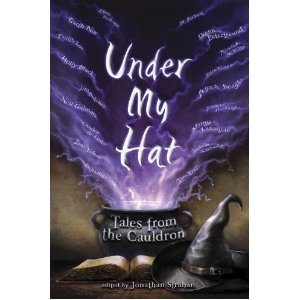
It’s true that I do tend to have a number of projects going at any one time, but Under My Hat has always been special. About three years ago I was having a conversation with my youngest daughter, who was about eight years old at the time. We were talking about what it was I did for a living, and at one point she asked me if there was any of my books that she could read. That really struck a chord with me, and I became determined to do a book that would really appeal to both her and her sister.
As it happened, both girls grew up loving witch stories, and when visiting the US to attend World Fantasy Convention each autumn I would search through stores for wands and hats and witchy stuff to bring home for them. A witch book seemed perfect. The title came to me when reading one of Terry Pratchett’s Tiffany Aching books, and the whole thing seemed inevitable.
The book was actually a dream to work on. I sat on the idea for a while, busy with other projects, but then one day I did the calculations that made it clear the girls would only be the right age for the book if I did it now so I really got my act into gear. It sold quickly to Random House in the US – my editor Jim Thomas has been a dream to work with – and the book itself has come together quickly and easily. Everyone got the idea immediately, and everyone seemed to love it. The final book is one I’m really happy with. One of the nicest things about doing it was working with my daughter, who actually read some of the stories in the book and provided editorial opinions on them that I sent to the authors. It’s been a real family affair.
Speaking of themes, over the last few years you have brought out four anthologies in the Eclipse line, which is a consciously non-themed set of anthologies. How different is it to solicit and edit for non-themed rather than themed anthologies? What has it been like to see the Eclipse ‘brand’ develop over the last four years, and how have they been received?
It’s both similar and quite different. Obviously with a theme anthology you need to solicit stories within quite a narrow range. They have to address the theme, but not be repetitive, and while you have scope to control the feel of the book the direction is pretty much set. With an unthemed project like Eclipse you have almost total freedom, at least at the outset. You’re only limited by what you and the publisher have agreed, and by the stories you can find. I revelled in that freedom, and really tried to reach out to a broad range of writers whose work I loved.
As happens, though, over time the series evolves its own character, which I think became most clear with Eclipse Three. It really is quite a wide-ranging book, and it has quite a diverse range of writers and subjects, but they all never quite lose touch with genre or story. The books have been received incredibly well, with stories winning many awards and the books themselves either winning or being shortlisted for awards. I’m very, very happy with and proud of the series, and am even now contemplating its future.
As well as original anthologies, you’ve also been involved in putting together collections, particularly of Jack Vance. What do you regard as the value in collections such as these, and how are they different from anthologies to work on?
I’ve been remarkably lucky to collaborate with some wonderful people at Subterranean Press and Night Shade Books on collections by Jack Vance, Bruce Sterling, Kim Stanley Robinson, Joe Haldeman, Fritz Leiber and others. Probably the heart of them are the seven books of Vance stories I’ve co-edited with Terry Dowling, and probably my favourite is the Robinson book.
The value of these books is that they either preserve an important piece of genre history, or they present a chance to look at a writer’s body of work through a different lens. I think that’s what happened with the Robinson book, which really highlighted the variety and strength of the short fiction he’d done over a long period of time.
The main difference between editing single author collections and anthologies, the obvious one of there only being one author to deal with aside, is that you do get to go into a different sort of depth. You’re balancing styles, approaches, flavors while also trying to remain true to the historical perspective on the author. It’s a challenge and a delight and I hope to do many more.
What Australian works have you loved recently?
I don’t read as much at novel length as I’d hope to these days, so I’ve only read a small number of novels by Australians over the past decade. The most interesting and exciting of those that I have read was Kim Westwood’s The Courier’s New Bicycle, which I came to quite late in the piece, but loved. At shorter length, Margo Lanagan’ continues to amaze, and the stories in her short collection Cracklescape are simple terrific. I also spent some time recently taking a second look at Deborah Biancotti’s Bad Power, which I enjoyed a great deal, and would happily recommend Tansy Rayner Roberts’ Love and Romanpunk.
Two years on from Aussiecon 4, what do you think are some of the biggest changes to the Australian speculative fiction scene?
When I started to think on this my initial reaction was to back away from the question a little. I think a lot has been happening in Australian SF, but initially I wasn’t sure how transformative it was. On reflection, though, I think there have been changes. The most obvious one, from a personal perspective, is the rise of podcasting. Before Aussiecon 4 it was a side event, but now it’s an important central part of Australian SF and we contribute significantly at an international level, with two of them (he notes immodestly) currently up for the Hugo Award. I think the small press has also been invigorated. Perth’s Twelfth Planet Press has been undertaking a series of really ambitious projects and publishing some very fine books, and Ticonderoga Press has really emerged from a long quiet period with some terrific books. That change has to be good for the field. I also think there is some potentially important change with our major publishers. I’m not sure if a publisher like Voyager would have published Westwood’s The Courier’s New Bicycle five years ago. They seem, perhaps, willing to take more artistic chances, and that can only be a great thing.
All in all, the the nearly two years have proven really vigorous and adventurous and I’m optimistic for the future (though I’d still like to see some more SF being published <g>).

This interview was conducted as part of the 2012 Snapshot of Australian Speculative Fiction. We’ll be blogging interviews from 1st June to 8th June and archiving them at ASif!: Australian SpecFic in Focus. You can read interviews at:
http://thebooknut.wordpress.com/tag/2012snapshot/
http://kathrynlinge.livejournal.com/tag/2012snapshot/
http://helenm.posterous.com/tag/2012snapshot
http://bookonaut.blogspot.com.au/search/label/2012Snapshot
http://www.davidmcdonaldspage.com/tag/2012snapshot/

 Randomly Yours, Alex