Galactic Suburbia 38
In which none of your fearless podcasters are impregnated by mysterious aliens for the duration of a single episode, nor do any of us experience a rapidly accelerated pregnancy or give birth to an otherworldly demon/alien/vampire. Also: Batgirl, Bujold and a cranky feminist rant or two. You can get us from iTunes or from Galactic Suburbia.
Cordwainer Smith Rediscovery Award – fascinating idea – given to a living writer for the first time, Katherine MacLean.
World Fantasy nominations, of course!
The Mystical Pregnancy trope – torture porn? Reproductive terrorism, exploiting women for being female. Violent degradation of women’s bodies for plot.
Vote For Top-100 Science Fiction, Fantasy Titles; Swedish Writing Fairy crunches the numbers.
Andromeda’s Offering Issue 1 – new fanzine to “open up new female voices in SF, raise the awareness of female SF writers and share ideas.”
(you can find them on Facebook)
Where are the women in the new DC Comics? Newsy; interview with Batgirl cosplayer.
SF Signal Episode 70 – 6 men talk about their favourite podcasts and illustrate what we mean by gender disparity in SF gatekeeping; Alisa makes reference to a recent Mind Meld.
What Culture Have we Consumed?
Alisa: Passage by Connie Willis; Red Glove by Holly Black; The Lifecycle of Software Objects by Ted Chiang.
Alex: Diplomatic Immunity and Cryoburn, Bujold; Chicks Dig Time Lords, ed. Lynne Thomas; The Sparrow, Mary Doria Russell; Shades of Milk and Honey, Mary Robinette Kowal; Songs of the Earth, Elspeth Cooper (abandoned). SF Squeecast.
Tansy Glenda Larke – Stormlord Rising; Malinda Lo – Huntress; Penni Russon – Only, Ever, Always
Feedback
We get to be Friday Hoydens!
Please send feedback to us at galacticsuburbia@gmail.com, follow us on Twitter at @galacticsuburbs, check out Galactic Suburbia Podcast on Facebook and don’t forget to leave a review on iTunes if you love us!
Shades of Milk and Honey are delicious

This has been on my to-be-read list for a long time – since Tansy recommended it at least, and definitely since it won the World Fantasy Award last year (2010). It’s not really the sort of book that might immediately seem appealing to me; I don’t think the list of books that I’ve read recently and reviewed here would indicate that I’m much of a romance, or Jane Austen, reader. (Hmm. Maybe the Carriger. And possibly the Bujold if you’ve actually read them….) The reality of course is that I am a sucker for a well-written romance that isn’t set in my normal world, and that includes other interesting elements. So, Austen – because I dig the social commentary, and it is indeed so far from my own experience. Not that I’m a great Janeite; I think I’ve only read three completely? (I Could Not get through Emma. She annoyed me too much.)
Anyway. This book is described as one that Austen might have written… had she lived in a world with magic. And, yes, I could pretty much leave a review at that, except that someone else has already stolen that line and where would be the fun in such a short discussion?
Kowal has clearly and consciously set out to write a Regency romance + magic – no attempt here to hide her influences. It is a comedy of manners – and one of those comedies that falls perilously close to being a tragedy, as such things must in order to make the comedy (not the laugh-out-loud sort, but the all-coming-good sort) all the more poignant and wonderful. The main character, Jane, is very plain indeed, but possessed of a remarkable talent for manipulating glamour – the art of using magic to enhance or change appearances. In the same way that the Bennet sisters were to be skilled at the arts of music in particular, well-bred young ladies in this Regency are to be familiar with magic. Its subtle and sensible use are key to a charming, upper-class home. Jane has little hope, though, that her talents will secure her a husband, being that terribly old-maid age of 28. The plot progresses with mishaps and misunderstandings, revelations and rescues, and some utterly delightful pieces of descriptive prose.
There are a number of things that make this book a wonderful, relaxing, read – much like a bath with a book and champagne, or a spring afternoon in the sun with a book and chocolate. The first is the assurance that, because Kowal has taken Austen as her muse, you just know that things are basically going to turn out all right. Of course, it was possible that Kowal would totally throw readerly expectations, but after the first couple of chapters – discovering that the mother is Mrs Bennet to the nth degree, and observing the love-tangles – I was fairly sure that I could rely on Kowal to subvert some aspects but not the basic premise of the comedy. The second is the really wonderful description that Kowal employs throughout, which makes both the setting in general and the idea of glamour in particular come alive. There is no attempt at really explaining how glamour works – just like Austen never attempts to explain how music works. It’s simply a part of the world, this idea of folding light to create illusion.
I enjoyed all of the characters, in the same way that one does with Pride and Prejudice; Mrs Bennet may be a car crash in motion, Lydia a tornado and Wickham a particularly nasty form of blight, but they’re still fascinating to watch. A similar principle applies to Shades, although I shan’t reveal any of the character parallels (some are obvious from early on, others not so much). Jane is an appropriately plucky, thoughtful, and sensitive heroine, one that I at least could certainly empathise with. She deals with her family, friends, and neighbours in the sensible and demure way expected of a Regency lady, always aware of her her social standing and the need to protect her own and others’ reputation. The reader is afforded more of an insight into her thoughts that Austen allows, though, so we also get some of the alternatives she runs through before doing The Right Thing, which modernises her a little but not to the detriment of overall believability.
The one omission I was surprised by was the lack of reference to church, which gets just one mention I think towards the end. I would have been quite interested to see how Kowal imagined her Regency working with the actual one, where church was one of the foci of village life and the minister an important member of the community. Perhaps we will get this in the sequel, which is apparently due early next year (hooray!).
Overall this is a really lovely, gentle, engaging and joyful novel.
Galactic Suburbia, #37
News
The Locus Awards
Prometheus Award winners
Sturgeon and Campbell Awards
Shirley Jackson
Recent announcement – Gollancz announces the SF Gateway, huge project to digitise & make available thousands of SF classics as ebooks.
Linda Nagata on ‘What’s in a Name’ and her career trajectory as a female writer of hard SF
Chris Moriarty on label in the women & SF conversation
via Thoraiya Dyer, women and the chilly climate
Liz Williams at the Guardian on the way science fiction reflects human belief
Alastair Reynolds to write Doctor Who novel: Tansy and Alex’s obsessions in one package!
What Culture Have we Consumed?
Alisa: Maureen Johnson on www.whyy.org/podcast; Twin Peaks; Mercy (not genre but interesting feminism);
Alex: sooo much Bujold (3rd, 4th and 5th omnibi, and Memory); lots of books, because of holidays! But particularly Heartless, Gail Carriger; Blackout, Connie Willis; Hundred Thousand Kingdoms, NK Jemisin… also Harry Potter 7 and Transformers 3.
Tansy: The Demon’s Surrender, The Holy Terror & Robophobia (Big Finish), Subterranean’s YA Issue
Pet Subject: Feedback from our Joanna Russ episode
Please send feedback to us at galacticsuburbia@gmail.com, follow us on Twitter at @galacticsuburbs, check out Galactic Suburbia Podcast on Facebook and don’t forget to leave a review on iTunes if you love us!
The Hundred Thousand Kingdoms
 I received a hard copy of this book in my Swancon bag, and have just read it in my effort to read all of the Hugo-nominated works before I have to actually vote in the Hugos. I’d heard a lot about the book and therefore had high expectations, although without the time incentive I don’t think I would have read it any time soon.
Yeine is a half-breed, basically; her mother, of the ruling tribe? clan? family? ran away with and married her father, a noble of a very minor and backwater clan, much to the disgust of her own father, the not-quite-ruler of the Hundred Thousand Kingdoms. Now, though, Yeine has been summoned to Sky – the centre of the world – after her mother’s death, and discovers that she has the dubious honour of being named as a potential heir to the throne. Naturally things are not going to proceed easily for her, not least because Sky is a weird weird place: the humans are a scheming, devious, unpleasant lot in general, and then you add in imprisoned gods who still have a remarkable amount of power….
I did enjoy the book, overall; not as much as I had hoped, but more than I feared. There were some engaging and clever plot twists, which made me glad I read properly rather than skimming – which I considered doing at about the 1/3 mark. Some of the characters developed nicely, particularly T’vril and Viraine, and some of the gods too. The backstory, about the God’s War, was nicely woven in – and the creation story was beautifully told with some neat original aspects – although overall it wasn’t that original.
However, I have not become a huge fan, and probably won’t bother with the rest of the series. Yeine did not engage me nearly enough to want to find out more about her character and story; I didn’t feel like she developed enough over this book, and the ways in which she did change were to become, largely, more unpleasant. And in terms of the story – actually I think that this works really, really well as a stand-alone. I was really surprised by the end because it feels like just that: a genuine end, a conclusion that makes sense and wraps up a lot of issues. Of course it left questions, but so do the conclusions of a lot of trilogies. So for me, this will almost certainly stay as a standalone; one that I enjoyed but that hasn’t had a huge impact on me.
Shattered by The Shattered City
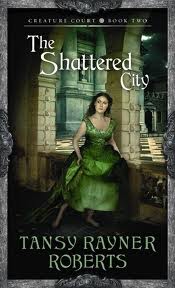 I read this about 10 weeks ago, and I’m not sure why I’ve left it til now to actually review it. I think it’s because I read it too fast, and was then a bit shell-shocked. I couldn’t face reviewing it immediately, and then I kept putting it off… so now the review isn’t as good as it might have been, but I can at least tick it off my to-do list and move it to the bookshelf, rather than having it staring at me accusingly from the shelf above my computer…
Tansy is very very mean to her characters. If you’ve read the first book, Power and Majesty, this will not be a surprise to you.
Velody is coming to terms with being the Creature Court’s Power and Majesty. Delphine and Rhian are not coping with the changes quite so well, and neither are swathes of the Court itself – never exactly predisposed towards being welcoming or accepting of another’s power in the first place. Ashiol is still having to do great soul-searching and agonising over what to do about his power, and Velody and Garnet… something bad might be happening to the Duchessa… and something really bad might be going down in the sky.
Shattered City is a magnificent second book in that it develops the characters in unexpected ways, furthers the plot in totally twisty, snarky, and unexpected ways, and ups the ante in occasionally devastating ways. The writing continues to be elegant and precise and enticing. The world of Aufleur grows more and more well realised, as details are added about the different festivals, the food, the clothes, and the architecture… nice details that add depth.
I am desperate for the third book. I really hope it comes out this year. And I will try my best to give it a better review than this one…
Werewolves, vampires, parasols…

This is the fourth book in the Alexia Tarabotti/Maccon series, The Parasol Protectorate. As such there are spoilers for the first three (Soulless, Changeless, Blameless), but there are NO major spoilers for Heartless.
When a ghost turns up in front of Alexia and mentions that there is a plot against the queen’s life, Alexia naturally flings herself into uncovering and halting it. Even if she weren’t muhjah and therefore responsible for such a thing, she could hardly help herself from meddling and being all Miss Marple-y. In the course of her investigations, Alexia must of course deal with the supernatural set – werewolves and vampires mostly – of London, have hair-raising adventures, and drink a great deal of tea. All of this while she is eight months’ pregnant. Oh, and her life is being threatened on a regular basis, too.
Readers of the previous Carriger novels will know, in broad terms, what to expect. Exciting chases, clever detective work, witty repartee, clashes between vampires and werewolves, unexpected twists in the plot. It delivers exactly what you expect from it, and is therefore very satisfying. There is further development of vampire/werewolf society, and a bit more of their collective and individual history; a bit more about preternaturals and Alessandro Tarabotti, too. It doesn’t stand out from Carriger’s other novels, but I wouldn’t have wanted it to. Alexia’s story, while clearly episodic, follows a naturally developing plotline overall – personally, in terms of how she fits into society, and more broadly in terms of how supernaturals fit into and impact on society. That each story feels the same thus makes sense.
I enjoyed the plot of this novel as much as I have previous ones. Just who might be plotting against the queen was revealed what I thought was surprisingly early, but the question of motive was made more suspenseful, and fit in well with the overall themes of the book. The subplots, mostly revolving around the interactions of various characters, was nicely played out; they made sense in the context of those characters as well as furthering our understanding of them. The characters are a large part of what makes this series so endearing. Here, we get an even larger dose of Lord Akeldama than previously (darling), and his fashion sense continues to surprise; his changed relationship with Biffy, once-drone-now-werewolf, is a touching and revealing aspect of the story. There is, sadly, little of Ivy and her daring hats, but a gratifyingly large dose of Professor Lyall.
One of the most intriguing aspects of this story is the fact that Alexis is heavily pregnant for its entirety. Too often in urban fantasy – or any other works, really, except those that are specifically about being pregnant – a woman’s pregnancy is either largely ignored or there’s a nine month slippage in events. Here, though, it’s both integral and not a limiting factor. When Alexia tries to run, she is hampered by her belly. Carriger frequently describes her as waddling, or other such words; she is eating more, sleeping badly, and needing to pee at inconvenient times. She is definitely, genuinely pregnant. But she also does as much as she can around the infant-inconvenience, as she calls it. I don’t have children, and it may be that some mothers will read these sections and shake their heads in ridicule at what Alexis accomplishes so heavily pregnant. For me, it seemed slightly unlikely, but that was forgiven by the fact that a) it’s fantasy, and b) it’s Alexia. I’m happy to be corrected, of course.
Two things are, sadly, beginning to make this series not the wonderful, joyous ride it was to begin with. The first is the snobbery. I understand that it is period-appropriate, and that perhaps it is undertaken with sarcasm or irony in mind. But actually there’s only so much withering scorn that I can put up with when directed towards the middle-classes – those who wear knitwear, or who might be in trade – not to mention the attitude towards servants. This is also a small part of my larger problem with the series… which is Alexia herself. I am beginning to find her tiresome. Her snobbery is a factor; I am also realising that I am nowhere near as interested in fashion as a true Carriger/Alexia devotee needs to be, to not find Alexia’s discussions of and thoughts about clothing a bit tedious. I also don’t think Alexia has developed that much over the course of the series, which means that those quirks that were initially endearing are now become irritating. This is not to say that I am abandoning the series; I am terribly excited to read the final novel, Timeless, when it eventually comes out. But I won’t be sorry (I imagine) that that’s the last novel.
All in all, fans of Carriger’s previous works will not be disappointed – although if you can, I would personally recommend waiting for the fifth book to be published, so that you don’t have to wait however months it is to get the finale.
Red Gloves are a bit creepy
This is the second book in the Curse Workers series. As such, it almost certainly contains spoilers for the first, White Cat (which was awesome).
We left Cassel Sharpe having discovered that he is not only a worker – possessed of magic – but the mightiest of all workers, capable of transformation magic. He had also discovered that his brothers had been using him as a tool for murdering people, that he had turned his best friend into a cat (which is better than having killed her, which he had thought), that she has now been cursed to love him, and that life is not, actually, going to be easier now that he is really part of the family. I think it’s fair to say that White Cat was a moderately dark book. It’s also fair to say that Red Gloves is, too. It’s not like things really can improve when you’re regarded suspiciously by most people at school, you’re in love with someone who’s forced to love you, your mother encourages you to help her con people, and you can’t trust either of your brothers. Oh, and your grandfather is a death worker, magic is illegal, and the mob wants a piece of you.
Fun times.
This is definitely a sequel. You could probably get by without knowledge of White Cat, but it would likely drive you a bit nuts. And rightly so; the power dynamics of the Sharpe family, and interactions with the Zacharov family, were neatly set up there and carried through here. (Also, at under 300 pages and a ripping read, it’s not like it would be a chore.) Those dynamics are fundamental to the plot of this story because when Cassel’s oldest brother, Philip, is murdered, both the Feds and the mob (with magic being criminal, of course there’s an underworld) come calling, wanting Cassel’s help and/or connivance. Cassel has to figure out how to deal with both sides of the law, not get kicked out of school, not get his mother sent back to jail, and how exactly to cope with Lila-in-love. It would be nice to know who is actually responsible for Philip’s death, too. There are some amusing moments in this book, mostly thanks to the witty banter that Black pulls out, but it is no light-hearted romp. The problems Cassel faces cannot be dismissed with witty banter and a clever con, much as he might like to.
I saw someone describe this as a ‘slice of life’ narrative, and that’s pretty accurate. There’s a fair bit of what could be seen as downtime – it’s not an action-on-every-page thriller, by any means. There’s having dinner, and doing homework, and catching up with friends. But neither is that dead time, because it’s developing characters, and the characters are a large chunk of what is so appealing about this series. Cassel himself is a very believable teen. His angst is real and heartfelt but also not overwhelming – broody Cassel never lasts that long; his family and friend relationships are appropriately messy and difficult to navigate. His school friends, Sam and Daneca, continue to play a large part in his life – helping, hindering, comforting, playing fall-guy. Their relationship also changes, separate from Cassel’s traumas. And then there’s Lila, who although central to White Cat in so many ways – her ‘death’ obsessing Cassel no end – hardly developed as a character at all, for obvious reasons. She gets much more of a showing here. Her awareness of the love-curse and her struggles with it are fundamental to much of Cassel’s own experiences. She doesn’t have much of a life apart from him, which makes sense in context, although towards the end there are some intriguing indications of What Might Be. In terms of minor characters, we get much more Mother Sharpe, which is fun if at times rather disturbing – the opportunities for emotion workers to be seriously creepy are legion. There wasn’t enough Grandpa for my liking, but I guess you can’t have everything.
The wider world of magic prohibition is slightly expanded in this volume, although the focus is still fairly tightly on Cassel and his issues. The main problem facing workers in New Jersey is a new proposal that would see everyone tested to find out whether they are hyperbathygammic – magical. The question then of course is how, or whether, that information would be kept private – and the fear is that the government would use that knowledge for nefarious purposes. There are overtones of the concerns raised by comics such as X-Men, of course, as well as other more general concerns about what the government (and other agencies, hello Faceblah) might do with personal information. There’s a very pertinent discussion of politics within this riveting fantasy.
I can’t wait for the third book.
Fly By Night: a review.
 Mosca Mye, 12 years old and named for the common housefly, has escaped the dreary confines of Chough with Eponymous Clent, a swindler, and Saracen, a goose. What could possibly go wrong?
This book was written by someone (Frances Hardinge) who loves books and words, for all of us who do likewise. It’s utterly enchanting, with a sly sense of humour and delightful characterisation. I just love it. I read it when it first came out, and reviewed it for the Victorian Association for the Teaching of English. I believe I had grand plans of donating the book to school; I think I convinced them to buy their own copy instead. I have re-read it this past weekend because I discovered that Hardinge wrote a sequel, and I finally got my hands on it… and it reminded me of how passionately I loved it the first time. Surely, I thought, the Suck Fairy can’t have visited in six years? Happily, she hasn’t.
Mosca lives in a world that borrows liberally from the Britain of the early eighteenth century but also, as Hardinge herself warns, takes great liberties with anything resembling historicity. It’s a world of coffeehouses that float on the river; beautiful ladies in awesome gowns who go to watch beast matches; men with monocles and gloves and dastardly plans; and one girl who can read, is desperate for words and stories, and has a rather large dollop of bloody-minded determination in her head. Who else would kidnap a goose when she runs away? And who else could persuade the goose to hang around? The world’s resemblances to historical Britain also include a recent-ish Civil War, but here the result has been a Fractured Realm: no monarch has been properly proclaimed, and Parliament is dithering in its effort to confirm one (and has done so for decades). Religion, too, has been fractured, and it’s based loosely on the Protestant Reformation and Catholic Counter-Reformation (I’ve just realised; sometimes I am seriously dim).
So Mosca runs away from the sodden Chough, after rescuing Eponymous Clent (I never get bored by that name); they have various adventures, and end up in Mandelion, where yet more adventures await them. There are traitors, and mysterious benefactors, and villains-who-aren’t, and a just-manageable cast who remain entertaining and enthralling for the entire story; I certainly never got bored by any of them. Mosca demonstrates hidden strengths, as befits a plucky heroine, who at times descends to genuinely murky depths. Hardinge plays very interesting games with Clent, leaving the reader guessing for quite a long time as to whether he is a blood-sodden genius or a silver-tongued skin-of-the-teeth and seat-of-the-pants petty crim. Even Saracen the goose has some wonderful moments.
The narrative is entertaining, the characters are endearing, and the world is enthralling. Over all and in all and making it all wonderful, though, is the prose. Hardinge has a wonderful turn of phrase, full of alliteration and poetic language. It never falls into the flowery trap, mostly because it’s often in Mosca’s mouth, which means it tends towards acerbic instead.
Example 1:
The roof of the dovecote stealthily rose, and two sets of eyes peered out through the gap. One pair of eyes were coal beads, set between a bulging bully brow and a beak the colour of pumpkin peel. The other pair were human, and as hot and black as pepper.
Example 2:
Clent: Where is your sense of patriotism?
Mosca: I keep it hid away safe, along with my sense of trust, Mr Clent. I don’t use ’em much in case they get scratched.
Hugely recommended.
Galactic Suburbia 34
In which we surf the wave of feminist SF news that has deluged the internet this fortnight, plus Margaret Brundage, why YA books are allowed to be as dark as they want to be, the Tiptree Award, Connie Willis, were-thylacines, Ted Chiang and Alex finally discovers Bujold… You can download us from iTunes, or download/stream from Galactic Suburbia.
News
Nicola Griffith on the m/f imbalance in an informal SF favourites poll in the Guardian.
The Guardian: Damien Walter, author of the poll & followup articles revises his comments in response to Griffith.
Niall Harrison follows up on Strange Horizons.
Cheryl Morgan on invisibility of women (some really interesting discussion in the comments, too).
The Guardian again, asking with wide innocent eyes if SF is inherently sexist.
Ian Sales announces the SF Mistressworks blog project.
Nicola Griffith asks you to take the Joanna Russ pledge.
Gwyneth Jones, Karen Traviss & Farah Mendlesohn talk on the radio about the perception of women in British SF. Transcript.
MK Hobson on the term ‘bustlepunk’ and why there is a place for a domestic sub-genre of steampunk; follow up post on the assumptions made about works coded ‘female’ .
2011 Chesley Award Finalists; Cheryl Morgan on female & trans artists.
Nine Reasons Women Don’t Edit Wikipedia (interesting in light of the recent spout of incidents we’ve watched, notably the one with Nick Mamatas where winning World Fantasy Award was considered too regional to be significant).
Wall Street Journal on YA fiction.
Change to the Norma eligibility guidelines.
Why Galactic Suburbia T-shirts are no longer available through RedBubble.
What Culture Have we Consumed?
Tansy: Thyla, Kate Gordon; Will Supervillains Be on the Final? Naomi Novik
Alisa: Coode St Podcast with Ellen Klages, Eileen Gunn and Geoff Ryman; Connie Willis – Even the Queen; Octavia Butler – Bloodchild
Alex: Chill, and Grail, Elizabeth Bear; The Lifecycle of Software Objects, Ted Chiang; Welcome to the Greenhouse, Gordon van Gelder; Steampunk! Kelly Link and Gavin Grant.
Please send feedback to us at galacticsuburbia@gmail.com, follow us on Twitter at @galacticsuburbs, check out Galactic Suburbia Podcast on Facebook and don’t forget to leave a review on iTunes if you love us!
Galactic Sububria 33!
In which we wax lyrical about awards, short stories and the love of reading. Because it’s that time of year! You can download us from iTunes, or get us at Galactic Suburbia.
News
Aurealis Awards and Ceremony!
Aqueduct links to 25 commemorations of Joanna Russ
New podcast – How I got my Boyfriend to Read Comics
Last Short Story is on Twitter @lastshortstory
New Galactic Chat: Kirstyn McDermott
What Culture Have we Consumed?
Tansy: The Shattering, Karen Healey
Alex: The Wise Man’s Fear, Patrick Rothfuss; How to Suppress Women’s Writing, Joanna Russ; Welcome to Bordertown, Ellen Kushner and Terri Windling; finished Stargate SG1 for the second time.
Alisa: Ken Liu’s Paper Menagerie (F&SF March/April), Joanna Russ’s We Who Are About To
Pet Subject: Last Short Story 2011
Please send feedback to us at galacticsuburbia@gmail.com, follow us on Twitter at @galacticsuburbs, check out Galactic Suburbia Podcast on Facebook and don’t forget to leave a review on iTunes if you love us!

 Randomly Yours, Alex