Galactic Suburbia: the Tiptree biography spoilerific
Galactic Suburbia Spoilerific – James Tiptree, Jr.: The Double Life of Alice B. Sheldon by Julie Phillips

In which we celebrate Alli Sheldon’s centenary with the first of our James Tiptree Jr spoilerific episodes and stand in awe of her extraordinary life, and the hard work of her biographer, Julie Phillips.
You can get us at iTunes or Galactic Suburbia.
James Tiptree, Jr.: The Double Life of Alice B. Sheldon by Julie Phillips
It’s Tiptree month, and this spoilerific is a bit different from our usual ones because we’re focussing on a biography – Julie Phillips’ biography of Alice James Raccoona Bradley Davies Tiptree Sheldon. Her life sounds a bit like a novel and it’s all the more amazing for being real…
Join us for our next episode when we talk about some of Tiptree’s short works, including
Houston, Houston, Do you Read? and
“Your Faces, O my Sisters! Your Faces filled of Light!”
(both are available in the Tiptree collection Her Smoke Rose Up Forever, and Tansy particularly recommends the ebook which is nicely laid out)
IMPORTANT ANNOUNCEMENT: Galactic Suburbia now has Messagebank on its Skype number, so you can leave us audio feedback. I know, right??? This month, we would particularly appreciate comments about your favourite Tiptree work, thoughts on the Julie Phillips biography, or on the short fiction we’ll be discussing later this month. We would love to be able to include your audio feedback in future episodes (so make sure to let us know if your comment is not something you wish to be broadcast).
03 90164171 (within Australia)
+613 90164171 (from overseas)
You can order the upcoming Letters to Tiptree from Twelfth Planet Press – a selection of thoughtful letters written by science fiction and fantasy’s writers, editors, critics and fans to celebrate her, to recognise her work, and in some cases to finish conversations set aside nearly thirty years ago. The book also contains archived letters between Tiptree and some of her dearest correspondents.
Please send feedback to us at galacticsuburbia@gmail.com, follow us on Twitter at @galacticsuburbs, check out Galactic Suburbia Podcast on Facebook, support us at Patreon; and don’t forget to leave a review on iTunes if you love us!
Galactic Suburbia 124
An all culture consumed special (with a little awards chat just for old time’s sake). You can get us from iTunes or at Galactic Suburbia.
Hugo Awards update – how we voted. If you’re voting, get in before the eleventh hour!
World Fantasy Awards: Aussies on the ballot.
What Culture Have we Consumed?
Alisa: The Almighty Johnsons; Wayward Pines
Alex: Arrow season 1; Beauty, Sheri S Tepper; Poseidon’s Wake, Alastair Reynolds; Of Noble Family, Mary Robinette Kowal
Tansy: Uncanny Magazine No. 5: “Midnight Hour” by Mary Robinette Kowal, “Woman at Exhibition” by E. Lily Yu, “Ghost Champagne” by Charlie Jane Anders, “Catcall” by Delilah S Dawson, Natalie Luhrs “Ethics of Reviewing”. Black Canary #1. Glitch.
In August we will be reading:
James Tiptree Jr: The Double Life of Alice Sheldon, Julie Phillips
“Houston, Houston Do You Read?” and “Your Faces, O my Sisters, your Faces filled of Light!” by James Tiptree Jr.
Please send feedback to us at galacticsuburbia@gmail.com, follow us on Twitter at @galacticsuburbs, check out Galactic Suburbia Podcast on Facebook, support us at Patreon and don’t forget to leave a review on iTunes if you love us!
Galactic Suburbia 123
In which classics, what classics, we’ll pick our own canon thanks, and reading Heinlein becomes less and less compulsory every year, so try not to worry about it. Actually, no books are compulsory. Read what you want to read. Book-shaming is the worst. Don’t do that. You can get us at iTunes or at Galactic Suburbia.
Introducing The Wimmin Pamphlet: serving you a diverse range of feminist thought since this fortnight.
Strange Horizons essay by Renay – Communities: Weight of History
Renay, we are with you! Anti-Impostor-Syndrome Reading and Life Support Group Is Go!
James Nicoll’s reviews of Women of Wonder, the Pamela Sargent books Tansy refers to as her SF education, highly recommended: 1 & 2
What Culture Have we Consumed?
Alisa: The 100 Season 1; Tiptree Bio, Julie Phillips, Sens8
Tansy: Rocket Talk Ep 53 on Spec Fic 14 & online writing in the spec fic scene, Loki: Agent of Asgard; Fresh Romance #1
Alex: Hugo fiction reading: short stories, novelettes, novellas, novels. OMG the decisions! The Goblin Emperor by Katherine Addison, The Three Body Problem by Cixin Liu, Ancillary Sword by Ann Leckie.
Also New Horizons!!
Please send feedback to us at galacticsuburbia@gmail.com, follow us on Twitter at @galacticsuburbs, check out Galactic Suburbia Podcast on Facebook, support us at Patreon and don’t forget to leave a review on iTunes if you love us!
Galactic Suburbia 122
You can get us from iTunes or at Galactic Suburbia.
Continuum 11 debrief: panels and programme stuff we loved.
Tansy’s Guest of Honour speech: Fantasy, Female Authors & the Politics of Influence.
FictionMachine announcement: Something New Can Come Into This World, a book of film essays by Grant Watson.
Discussion piece: “Stop Asking Is This Feminist” at the Mary Sue.
What Culture Have we Consumed?
Alisa: Prep for the Alice Sheldon’s 100th Birthday Spoilerific episode in August: James Tiptree Jr: The Double Life of Alice Sheldon, Julie Phillips; Tiptree’s short stories – read “Houston, Houston Do You Read?”, “Your Faces, O my Sisters, your Faces filled of Light!”; Call the Midwife S1 -3
Alex: All Men of Genius, Lev AC Rosen; Prudence, Gail Carriger; Aurora, Kim Stanley Robinson; Jurassic World
Tansy: Lois Lane: Fallout, by Gwenda Bond; Uprooted, by Naomi Novik, “Waters of Versailles” by Kelly Robson, illustrated by Kathleen Jennings; Once Upon A Time Seasons 1 & 2
Alex is reading fiction for Hugo voting next episode!
Please send feedback to us at galacticsuburbia@gmail.com, follow us on Twitter at @galacticsuburbs, check out Galactic Suburbia Podcast on Facebook, support us at Patreon (http://www.patreon.com/galacticsuburbia) and don’t forget to leave a review on iTunes if you love us!
Letters to Tiptree submissions period
I am very excited to say that I am currently working on a project with Alisa Krasnostein of Twelfth Planet Press, and it currently has a (short!) open submissions period! The project is called Letters to Tiptree, and… well, here’s the deal:
The great James Tiptree Jr was born sometime in 1967, a little over forty-eight years ago. Fifty-two years earlier Tiptree’s alter-ego, the talented, resourceful and fascinating Alice B. Sheldon was born. And somewhere in there, about forty years ago, poet Racoona Sheldon showed up.
In celebration of the 100th Anniversary of Sheldon’s birth, and in recognition of the enormous influence of both Tiptree and Sheldon on the field, Twelfth Planet Press is publishing a selection of letters written by science fiction and fantasy’s writers, editors, critics and fans to celebrate her, to recognise her work, and maybe in some cases to finish conversations set aside nearly thirty years ago.
LETTERS TO TIPTREE will be a collection of letters written to Alice Sheldon, James Tiptree or Racoon Sheldon; a set of thoughtful pieces on the ways her contribution to the genre has affected (or not) its current writers, readers, editors and critics.
… we are looking for two types of submissions.
Firstly, letters that are between 1000 and 2000 words, exploring personal and/or literary reflections on Tiptree/Sheldon.
Secondly, briefer responses addressing questions such as:
Does it make a difference, reading James Tiptree Jr’s work, knowing that Tiptree was Alice Sheldon?
Who is James Tiptree Jr to you?
Why do you care about James Tiptree Jr?
What impact has reading James Tiptree Jr’s fiction had on you?
We are paying 5cpw up to $USD100 to be paid on publication. We are looking for World First Publication in all languages, and exclusivity for twelve months. LETTERS TO TIPTREE will be published in August 2015.
Submissions are open between May 18 and June 8.
Please send your essay to contact@twelfthplanetpress.com
Soooo… got an opinion on Tiptree? Write it down! Send it to us!
The Tiptree Award Anthology vol 3
 I just love these anthologies. I love what it showcases – the diversity of what the different Tiptree panels have judged as falling into the category of ‘exploring and expanding gender,’ which is the remit of the Tiptree Award each year. I love that it shows diversity within the genre, full stop. I love that the anthologies don’t just have fiction, and don’t just have fiction from one or two years, but that there’s non-fiction and older works as well. And that the introduction and sometimes the introduction to each piece are interrogating themselves, the pieces, and the scene in general.
There’s a lot to love.
I’ve had this volume waiting to be read for aaaages. I thought it appropriate to read as I rode public transport on my way to interviewing Rosaleen Love – what I’ve read of her work fits into the broader milieu of the works represented here. As I read, I couldn’t believe that I’d allowed myself to leave this book festering on the shelf for so long.
The non-fiction includes an essay of Pam Noles’, called “Shame,” which struck me very deeply: about the experience of watching and reading science fiction as a person of colour, and not seeing yourself. Her dad sounds awesome: he called the movies she was watching “Escape to a White Planet,” and “Mars Kills the White People.” There’s an enormous amount in this essay that I, as a privileged white reader (gender does not trump race – it’s not a competition) probably need to read it again. Several times. And that the editors paired it with Dorothy Allison’s essay on Octavia Butler was very nice – the latter doesn’t talk all that much about race, more about Butler’s vision of women in the future, but the two are surely entwined… perhaps not especially in Butler, but certainly in Butler. And then there’s a letter from L Timmel Duchamp to Alice Sheldon/James Tiptree Jr, which is a lovely musing on what Sheldon/Tiptree as person and as author has meant to one individual.
Geoff Ryman looks at some possible consequences of the internet arriving in an out of the way village; Nalo Hopkinson goes domestic, sinister and mythological all in one hit; Margo Lanagan does weird weird things that I’m still figuring out in “Wooden Bride” – the story that, I think, gets the shortest introduction of all, since “some stories shouldn’t be introduced” and doesn’t that just describe all of Lanagan’s work? Aimee Bender’s “Dearth” is a devastating, heart warming, bewildering story about maternity and mothering… and I’ve just realised the protagonist is never named. And isn’t that a statement in itself. All of the stories so far were new to me, and Bender was a new name. And then it gave me Ursula Le Guin’s “Mountain Ways,” one of my favourites of her short stories. I can’t possibly pick a favourite story, because that would mean choosing between Le Guin and Ted Chiang: “Liking what you see: A Documentary” is another of his glorious mucking-with-structure stories in which the question about whether you should turn off the ability to see/appreciate beauty is presented as if as a transcribed documentary. And the fact that there are no visuals to accompany this story about visuals just adds to its power and general gloriousness. And for the editors to pair this with Tiptree’s “The Girl Who Was Plugged In” – well, I’ll admit that I did not reread the Tiptree. It was just going to be too raw an experience. So too was “Litte Faces,” by Vonda McIntyre, but I didn’t know that before going in. Deeply disturbing and weird (but not entirely in an unpleasant way), as well as powerful and impressive – and so very different. So, too, the final story – different that is, slightly less weird and disturbing – is “Knapsack Poems,” from Eleanor Arnason. She uses a character who is effectively distributed over eight bodies to tell a story of travel and experience, and I couldn’t help but be reminded of Ann Leckie’s Ancillary Justice. I’m not sure the similarities are much more than superficial, but they’re intriguing anyway.
This anthology works as something read from cover to cover in a sitting or two; it could be dipped into over months; it could be hopscotched. It should be read in any way you can.
Tiptree Award Anthology #2
 For those just joining us, James Tiptree Jr was a magnificent SF writer whose work Robert Silverberg once described as “ineluctably masculine.” Which is amusing because she was actually Alice B Sheldon. Anyway, in 1991 some people decided there should be an award named for a woman, and that it should be given to works that “explore and expand gender”. So, to be quirky, they named it for Sheldon/Tiptree. And the award has been going since then, and there are now a number of anthologies that reflect it: excerpts from novels, complete short stories, but also other work that reflects the issues that the award desires to highlight. Which is awesome.
Debbie Notkin’s introduction does a marvellous job of discussing the very first award and how it was decided on, as well as – most interestingly – pointing out that each jury has been forced to decide all over again what it means to “explore and expand gender.” Which is good to be reminded of, because there are definitely stories in the anthology whose inclusion I was a little confused by. And this, Notkin says, is totally fine.
In honour of Tiptree/Sheldon, the anthology opens with a short essay from Julie Phillips, the biographer of Tiptree/Sheldon (which I reviewed here, and as I write I am listening to The Writer and the Critic discuss it), about talking and talking too much which is completely fascinating (and somewhat connected to the current furore over Hilary Mantel’s words about the media representation of royalty?). It’s matched with a letter from Sheldon herself, to the psychologist Rudolf Arnheim, talking about identity and science fiction and science and friendship, which is such a nice touch. And then the anthology jumps straight into Raphael Carter’s “Congenital Agenesis of Gender Ideation by KN Sirsi and Sandra Botkin,” which can only be read by itself, must be read in a single sitting, and may then require that you sit staring at a wall for a few minutes. Because it is mind blowing. It’s written as a thoroughly researched scientific article, where two scientists from different backgrounds come to a startling discovery about how gender is perceived and what that means for identity and… that doesn’t really explain it at all. It’s very accessible as well as challenging and I can absolutely understand why it won.
L Timmel Duchamp’s collection Love’s Body, Dancing in Time was shortlisted in 2004, and from it this anthology includes “The Gift.” For all that it’s set in a distant future where the narrator is a travel writer who discusses other planets rather than other countries, there’s something rather medieval in its suggestion that there is more to an understanding of gender than a basic dichotomy. And I don’t mean ‘medieval’ in a pejorative sense, but in the sense that some medieval thinkers seemed to be groping towards a similar sense – and for similar reasons as suggested here. That aside, one of my favourite parts of this story is the description of the meal composed around the ideas of Matrix Aesthetics. And made me wish that something similar could possibly exist, that combined visual, aural, and taste sensations all designed to complement one another.
The next two parts of the anthology are again from 2004, this time excerpts from the winning novels. The Tiptree Award is an interesting one in that it seems to me one of the few really big-name awards that considers all work for one award (shorts and novels), and which is not afraid of having a tie (which has happened a few times). Firstly here, Joe Haldemann’s Camouflage – the first four chapters and “and two from a little further along,” according to the reading notes. I HAVE to read this novel. It’s utterly gripping, right from the start: an alien comes to earth millennia ago, and is capable of changing its outward appearance to be… whatever it likes. Imagine the consequences of that on ideas of gender and identity. This is complemented by an excerpt from Johanna Sinisalo’s Troll: A Love Story, which I imagine I will also get around to reading. Translated from the Finnish, it does indeed involve a troll, as well as (again according to the reading notes) mail-order bride slavery and Finnish folklore and homoerotic imagery. In this excerpt, the narrator’s night has started badly, with a failed date, and gets worse when she finds a bunch of boys attacking an animal. Things get weirder after that.
“Looking for Clues” is Nalo Hopkinson’s guest of Honour speech from WisCon (the convention where the Tiptree is announced) in 2002. As a woman of colour, as she explains in her speech, finding people “like her” was one of the aims of her extensive early reading – because there weren’t that many. She takes a winding road through various media and her experiences to look at the different sorts of role models (and not) available through her childhood and teenaged years, as well as making pointed remarks about people who insist on remaining ignorant about the issues. It would have been a brilliant speech to hear in person.
Eileen Gunn’s collection Stable Strategies is another one that got shortlisted in 2004, and as a representative this anthology chose “Nirvana High,” co-written with Leslie What. This is one of the inclusions that I simply do not get. It’s a clever story and it says interesting things about difference, and about growing up as ‘different’, but I don’t see that it says things about gender that connect it to the Tiptree. But I’m sure Notkin would say “and?”
From 1996 comes Jonathan Lethem’s “Five F***s” (sorry, I would like to keep this profanity free!). It’s a series of six vignettes, and in all of them there is a woman whose life appears to be different each time she has sex with a particular man. Indeed, it’s not just her life, but the world around her; in this sense it reminds me a bit of Lathe of Heaven. The lover does not appear in every story; in all but the first, there is a different man – Pupkiss, a policeman (mostly). So there are elements of the procedural to some of the sections, but not really. It’s one of those stories, as you may be able to guess, that is particularly hard to explain. It should just be read.
Carol Emshwiller’s “All of Us Can Almost…” is another story in the I don’t entirely get it pile. Shortlisted in 2004, it’s about desire and lying and determination, and while I think it’s a very good story and fascinating in what it says about interactions between people and expectations, I don’t entirely see that the gender aspects – which I can see – are an interesting enough or explored enough aspect to get it shortlisted. Again, refer to Notkin’s advice.

Gwyneth Jones is rapidly becoming one of my favourite authors, so I was pleased to see an entry from her here. Rather than a piece of fiction, it’s a paper she gave called “The Brains of Female Hyena Twins: On the Future of Gender,” presented at the Academic Fantastic Fiction Network conference in 1994. In it, she ranges far and wide over scientific papers that discuss aspects of gender and biological sex in animals (those hyenas, peacocks, lizards and fish…), as well as gender and sex in humans and their malleability, as well as some frightening aspects of the battle of the sexes. It’s erudite and occasionally witty (insofar as such a topic ought to be), and outright challenging to biological determinists.
The penultimate place belongs to Ursula le Guin, for Another Story, or A Fisherman of the Inland Sea which I have read before but fell in love with all over again, reading it here. The planet of O is such a richly realised place – their marriage customs so breathtakingly original – and they’re not even the centre of the story, which is I think mostly about scientific research and its impact on individuals, as well as the impact of family, and the choices that we make… It’s wonderful.
Finally, Jaye Lawrence’s “Kissing Frogs” is described as “a pleasing after-dinner mint of a story” by the reading notes, and I think that’s about right. It’s a retelling of the fairy story, of course; it’s amusing and sweet and I can’t go into any details because the point of it is the little twists Lawrence weaves in. A highly enjoyable way to complete the anthology, anyway.
What this anthology does, and I presume what it set out to do, is give a broad overview of the point of the Tiptree Award – showcasing works that various juries have thought worth honouring, as well as including work that must help to inform the juries, and authors, and readers about the ideas of gender that the award wants to recognise. It succeeds in this aim, and no doubt in a secondary aim as well – of publicising those names whose work has been recognised, so that they get more recognition, and more people are challenged and inspired by their words.
You can get this anthology from Fishpond.
Galactic Suburbia: now half a century old
 In which we leap happily back and forth (with occasional ranting) over those fine lines between feminist critique and anti-female assumptions, plus share our bumper collection of holiday culture consumed. Happy New Year from the Galactic Suburbia crew!
NEWS AND LINKS
Hugo nominations open and we’re gonna have our say
Aqueduct Press will be publishing Brit Mandelo’s thesis, “WE WUZ PUSHED: On Joanna Russ & Radical Truth-telling”!
Islamic superhero comic turned animated series The 99 to screen in Australia (ABC3)
Amanda Palmer’s wedding post
Great piece on how the very idea of ‘Mary Sue’ is sexist, ties into this episode’s theme about the criticism of female characters.
The wealth of powerful girl heroes in today’s YA
WHAT CULTURE HAVE WE CONSUMED?
Alisa: Shades of Milk and Honey, Mary Robinette Kowal; The Freedom Maze, Delia Sherman (with cover art by Kathleen Jennings); The Vampire Diaries; Primeval; The 99; Planetary; Homeland and Boxcutters.
Alex: The Double Life of Alice Sheldon, Julie Phillips; Changing Planes, Ursula le Guin; Perchance to Dream, Lisa Mantchev; Twilight Robbery, Frances Hardinge; Chronicles of Chrestomanci vol 1, Diana Wynne Jones. DOA and Going Postal.
Tansy: The Freedom Maze, Delia Sherman; Beauty Queens, Libba Bray; Snuff by Terry Pratchett, Going Postal (TV) – Batman (animated) & My First Batman Book by David Katz, David Tennant & Catherine Tate in Much Ado About Nothing (DIGITAL THEATRE DOWNLOAD AWW YEAH).
Please send feedback to us at galacticsuburbia@gmail.com, follow us on Twitter at @galacticsuburbs, check out Galactic Suburbia Podcast on Facebook and don’t forget to leave a review on iTunes if you love us!
Alice Sheldon and James Tiptree Jr: a remarkable life
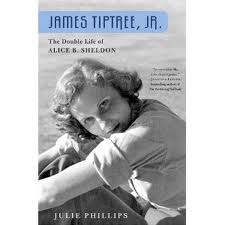
It’s probably impossible for me to give an adequate review of this amazing biography. It is written so beautifully, and Sheldon/Tiptree’s life so extraordinary, that it’s hard to encapsulate in anything other than this book.
For those late to the party: Alice Sheldon wrote SF as James Tiptree Jr and remained incognito for many years. This biography sets out Sheldon’s entire life, though, not just the fiction-writing part, because it is truly a life worth recording. She went to Africa three times, with her parents, before the age of 15 – one time on a gorilla-hunting expedition. Life at home was no fairy tale… and she got married at 19 to a man she had only met a few times. They stayed together for about 6 years. She tried university, she tried being an artist, she tried journalism. She joined the WAC during WW2 and thus met her second husband, Ting. She got a doctorate in psychology, she tried chicken farming, and – the reason most people will read this bio – she wrote science fiction, mostly in short story form. She was a complex woman, probably a difficult one, beset by a number of demons – how to deal with emotions, her mother, depression, anger, and drug use. I’m not convinced I would have liked her as a person. That’s beside the point, though.
This is not a happy story. There is a lot of heartbreak and difficulty in Sheldon’s life, on large and small scales. Phillips’ discussion of her depression and drug use is sympathetic: not so delicate as to ignore it, not romanticising it or making excuses, just… this is how it was. Which was heartbreaking, to be honest. The way Sheldon herself wrote about her feelings and frustrations was agonising, perhaps because, frankly, it was (for me) just faintly recognisable.
One thing I really liked about this biography is Phillips’ use of names. She calls her subject Alice early on, and Alli after Ting’s mother starts using that nickname (she loved it apparently). She also uses Tiptree when referring to the fiction and letters and possible thoughts of that alter-ego, which I think is a lovely way of complicating what could otherwise be dismissed as ‘simply’ a nom-de-plume. (Phillips also devotes some time to Raccoona Sheldon, and how Tiptree and Raccoona were seen to interact by editors etc.) It’s a true history book too: Phillips has used a lot of primary material, and – delightfully – quotes from it frequently. This worked really well, and was utterly riveting, when it came to Tiptree’s letter writing. Tiptree was an inveterate letter-writer; fan letters, letters accompanying stories, the occasional letter to a magazine… Tiptree was a regular correspondent of a huge number of people, and by regular that might be a letter every fortnight or so. And the people? Oh, Ursula le Guin and Joanna Russ, for example. (My head exploded a little bit at the idea of those three exchanging letters and talking about each other to the other. Which they did.) Yes, it did inspire me to write a fan letter to Julie Phillips.
I am not of the opinion that one must know the gender, sexual orientation, ethnicity and schooling history of an author in order to understand or appreciate their work as a piece of art. There is, however, no denying that some background or knowledge can add depth. Knowing Tiptree to be a woman does change how we read some of his/her fiction; and knowing something of her struggle with sexuality and sex can add depth, too, as well as her experiences of colonialism in Africa an Europe after WW2.
These comments haven’t even touched on Sheldon’s sexuality, her politics, or any number of other issues in her life. It’s a really, really great biography – even if you’re not interested in Tiptree’s fiction, this is a remarkable life, and illuminates all sorts of interesting things about life in one part of America from the 1920s to the 1980s.
Tiptree, and a collection of her short stories

I bought this collection of James Tiptree Jr’s short stories (and two of Raccoona Sheldon’s) because I was going to be part of the 2011 Women in SF Book Club, being run over at the (now-defunct) Dreams and Speculation blog. D&S’s now-defunct status is part of the reason why it’s taken me the whole year to read the collection – although to be fair it would have anyway, since the idea was to read 1-2 stories per month for the book club. But instead I’ve read the last third in the lat two days. I tried to host the Tiptree bit here on my blog: I posted my own spoiler-y thoughts on Delicate Mad Hands and Houston, Houston, Do You Read? However, I didn’t get much interest in them, so I discontinued it.
Now, however, I have finally finished the collection! And what a collection.
I have read bits and pieces of Tiptree’s work before, but most of these stories were completely new. The thing that most immediately strikes is that that they are intimately concerned with life and death, and with reproduction in defiance of the latter. I know this could be said about a lot of authors, but it really is a clear and obvious preoccupation in many of these stories. Perhaps not coincidentally, Tiptree can in no way be described as a happy writer. Which is not to say that she lacks joy; there is a great deal of that fierce, loving-life-in-the-face-of-death joy that can be both poignant and exultant, in these stories.* But you could bet on a story having a not-entirely-happy ending, and much of the time you would win.
And yet I love it. Tiptree breaks my heart and yet I love her writing. She is confrontational – about humanity, about individuality, about reason – and she is challenging, she is grim and she breaks my heart but there are very few stories that I didn’t love in this collection, even if they gave me agony.
What didn’t I like? I didn’t enjoy the titular “Her Smoke Rose Up Forever”, nor “Love is the Plan the Plan is Death.” The former was, I think, too… cold? for my liking; the latter was, dare I say it, a bit too weird – it was too hard to really figure out what was going on, who was speaking and why. Really, it just didn’t grab me. Ditto “And So On, and So On,” which was a let-down of a piece to end the collection with, although I guess I can understand the rationale; it sort of wraps up the entire collection and everything it’s been saying, and suggests that maybe it’s just the self-involved mutterings of a “kid these days.” That sort of deliberate invitation to dismiss everything that came before really didn’t work for me.
However, that leaves 15 stories that really worked for me.
The collection opens with “The Last Flight of Dr Ain”, and it meshes quite nicely with “The Screwfly Solution.” Both appear to deal with some sort of plague affecting the whole world, although the diseases have different impacts. “Screwfly” in particular is a scary read, as a woman – how male sexuality could be manipulated.
“And I Awoke and Found me Here on the Cold Hill’s Side” – the title an allusion to Keats – is one that I had read before and one that gets me every single time. Human-alien contact stories generally fall into two categories: “zomg they’re going to kill us!!!” or love-in. Tiptree presents a third option: we care, they don’t. It’s a subtle story, and I think one that tends to play on the mind – whose impact deepens the longer you think about it. “The Women Men don’t see” deals with a similar-ish story, and is probably the least obviously SF of the stories in the collection. But the description of male/female interaction, and the perception particularly of men’s behaviour, is brilliant. And heartbreaking. Probably the weirdest story of the lot, also dealing with an alien encounter, is “A Momentary Taste of Being.” It’s also I think the longest in the collection, I’m sure reaching novelette length. It’s amazing and horrendous at the same time: the interactions of the humans on a survey mission are, to a large extent, frightful; the backstory Tiptree gives some of the characters abhorrent; the reality of the alien is weird and mind-blowing and masterfully original. I’m not sure that I loved it, but I’m definitely in awe.
“The Girl who was Plugged In” is a most remarkable piece for 1973, anticipating as it seems to GPS and reality TV is horrendous ways. This is one that made my heart bleed and yet I loved it. It’s so clever – Tiptree had such a searing way of evaluating humanity, our foibles and penchants, and they come through here, in talking about what we love and what we discard; in this case, humans who do and don’t fit our preferences. That also connects in some ways to “With Delicate Mad Hands,” which is another heart-rending but fiercely awesome stories – of beating the odds, of being what you want to be, and finding fulfilment. Cold Pig is one of the most wrenching of Tiptree’s protagonists, because of what she endures and the dreams that she holds.
“The Man who Walked Home” is post-apocalyptic and takes place over a long period of time, and shows Tiptree’s very clever manipulations of time and physics; it’s one of the few stories that doesn’t deal with aliens, in some way or other. It suggests a somewhat gloomy view of humanity’s future, which isn’t necessarily present in all of her work – for example, “And I Have Come upon this Place by Lost Ways” and “On the Last Afternoon,” along with numerous others, imagine humanity having spread out through at least part of the galaxy, if not always to everyone’s betterment. “And I Have Come” reflects a certain view of how to colonise, I think, which Tiptree challenges in really interesting – if somewhat nihilistic – ways – while “Last Afternoon” has a human dealing with two different types of alien creature and being confronted with his own, and his species’ mortality. Also post-apocalyptic-ish is “She Waits from All Men Born,” which is Tiptree’s most obvious meditation on the issue of death and its intimate connection to life. Very, very, clever.
“Your Faces, O my Sisters! Your Faces Filled of Light!” seriously, seriously broke me. IT’S SO SAD. I’m pleased to see that this one was published as Raccoona Sheldon, because I cannot imagine anyone thinking this was actually written by a man. At the same time, “Houston, Houston, Do You Read?” was published as Tiptree, and it’s one that I can kinda understand as being seen as masculine, but at the same time – so, so not. “Houston” is one of my favourites of the whole collection; it’s just so damned clever, the reveals come so teasingly and obviously, once they’re there.
“We Who Stole the Dream” is, I think, the only story not written from the point of view of humanity. Instead humanity is in the place of ignorant, unhelpful alien – which is quite a shock in the middle of the collection. It’s also, to my grieving heart’s extra battering, apparently set in the same universe as Brightness Falls from the Air, because it references Star Tears which are intricately involved in that (brilliant) novel’s plot. This is another really clever story about the lengths people (in this case non-human ones, but whatever) will go to, for their children. And so, in some ways, is “Slow Music” – another of my absolute favourites. Here humanity has interacted with aliens, but we never see them – we just see the result, which is the River, which appears to have attracted almost everyone on Earth. And so we’re left with a boy, who comes across a girl… and then there’s a most marvellous examination of modern life and its trappings.
This is a seriously brilliant collection. I would recommend, though, not reading the introduction first, because there are a few spoilers, as I found to my annoyance.
*In case you’re just joining us, James Tiptree Jr = Raccoona Sheldon = Alice Bradley Sheldon.

 Randomly Yours, Alex