Tiptree book club: With Delicate Mad Hands
Welcome to July’s Tiptree Book Club story-discussion-thing, which I have inherited from TJ on the closing down of Dreams and Speculation. This month we’re looking at “With Delicate Mad Hands,” which marks the halfway point in the anthology Her Smoke Rose Up Forever. (A note on the next few months – I’ve changed it around a little so that we’re reading kinda-sorta the same number of pages each month: August will be “A Momentary Taste of Being;” September “We Who Stole the Dream;” and “Her Smoke Rose up Forever;” October “Love is the Plan the Plan is Death” and “On the Last Afternoon;” November “She Waits for All Men Born” and “And So On, and So On;” December “Slow Music” (yes those last two are not in the order given in the anthology).)
This discussion is completely riddled with spoilers, so don’t read on if you’d like the joy of discovery all for yourself!
It’s worth saying up front that this story did not go in any of the directions I had expected, which shouldn’t have surprised me with Tiptree. That a story could go from a discussion of how awful a girl’s life was because she had a squashed nose to her being the first human on a extra-solar planet, beloved by an alien and bequeathing an enormous amount of new knowledge… yeh, that’s pretty awesome.
Of course, to get to the awesome you have to struggle through some quite awful stuff. CP’s life is horrid right from the start – and I hope I’m not the only one slightly frustrated by the tantalising looks into this ?post-apocalyptic world offered by Tiptree, where you can rarely see the sky and Managers are the be-all and end-all. CP’s drive to get into Basic Space Crew Training eventually gets her there, and while I was initially impressed with a society that eventually lets girls in, that was rapidly quashed: she has to pay for her own sterilisation, which was awful on numerous levels, and, along with her other duties, she has to allow the men onboard to use her as a sexual ‘waste can’. My horror knows no limits…
The events on the ship, with CP eventually getting rid of the men and taking off towards Galactic North, I found surprising and I’m not sure why. Perhaps because of the no-nonsense way it was all described; and perhaps because CP’s preparedness for just this eventuality is chilling. I did, though, really enjoy her enjoyment of solitude, and finally doing just what she wants; that she went around and pulled off all the blinds to be able to see out felt so familiar that I think at this point I was able to identify with CP, just a bit. And then to have her find a roving planet… as I said, it was unexpected, and utterly utterly intriguing. That life could grow somewhere like this! That radiation could have a positive impact on life… that telepathy etc would develop, and the different ways that can be found to do science… Tiptree had a seriously amazing imagination. (Also, did anyone else feel like she might have been a little influenced by Yoda, in characterising some of her little aliens?? This story came out in 1981, so it’s just feasible….) The poignancy of discovering that yes, there really had been a voice in her head all that time, and that she was and had been loved, was a wonderfully touching conclusion.
Some questions to get discussion going:
How did you feel about CP, and did this change over the story?
Did the story develop as you were expecting?
What did you think of Auln, the alien world?
Tiptree link of interest
This is from a while back, but Niall Harrison of Strange Horizons wrote about Her Smoke Rose up Forever and raised some interesting issues about some of the stories – including “Houston, Houston, Do you Read?” Some of the comments are very interesting too. Those of us who are reading the anthology for the Book Club started by Dreams and Speculation may find it stimulating – although I did skip over some of the discussion, because I haven’t read those stories yet!
June Tiptree book club discussion
Along with everyone else, I was sad to see that TJ had made the (sensible!) decision to let her blog, Dreams and Speculation, go. I came across her because of the Women in SF Book Club, and have so far really enjoyed the books and discussion. Rather than letting a good thing go, Shara at Calico Reaction and I have made the decision to jointly host and continue the Book Club; she’s doing the novels, and I get the joy of talking about James Tiptree Jr. So, welcome! And enjoy.
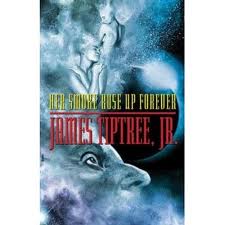 June’s story from Her Smoke Rose Up Forever is “Houston, Houston, Do you Read?” – a story I have previously read as novella double, paired with Joanna Russ’ “Souls” (there’s a headspin for you). What follows is some of my thoughts on the story – completely full of spoilers, so if you haven’t read it yet, back away! Following in TJ’s footsteps, I’ve added a couple of questions at the end of the post – feel free to consider them in the comments or completely ignore them, as you see fit.
This story sees three astronauts on a solar mission; they encounter a flare and when they come back around to the Earth side, things are… different. Houston doesn’t answer, but someone else does. They get picked up by a very different spaceship, one that seems almost entirely crewed by women – and it’s several hundred years into their future.
This story does what my favourite stories do: with an awesome sf story, its focus is on the people – their reactions, their attitudes, their problems. The astronauts are appropriately different from one another such that a range of reactions can be explored, but they don’t feel like ciphers; Tiptree deftly sets them up as individuals. I believe this story first came out when Tiptree’s true identity was unknown; all I can say is, Seriously? Did they just not see the feminism?
Anyway, the slow unravelling of the men’s good nature at being rescued by women is very cleverly done. I found the attitudes of the men towards the men really quite harrowing; their patronising tone, their easy assumption of supremacy, automatic belittling of the women’s competencies – it was presented as so horrendously normal and obvious. Bud, in particular, is horrendous in his attitude towards women as nothing but sex objects. That said, in some ways Lorimer is almost more horrifying; as the narrator and because of his scientific background I felt sympathy for him, but still his attitudes and perceptions of the women are almost entirely sexist.
The gradual reveal that not only is the entire ship crewed with women but the entirety of the human race is women, thanks to an epidemic three hundred years previously, is very cleverly handled. The idea of a single-sexed humanity has been explored in other science fiction, with varying results; I quite like this idea, with clones to allow reproduction. The most poignant reflection on the differences between a single-sex and two-sex world comes right at the end, when Lorimer tries to defend Bud and Dave’s aggressive actions. I could almost feel sorry for all of them at that point.
Questions:
1. Did you pick that the future society was single-sexed before it was revealed?
2. Was the futuristic society believable for you?
3. What were your reactions to the men’s characters and attitudes?
4. This story was published in 1976. Do you think it is still a relevant story?
The 24th episode of Galactic Suburbia
In which we flit over the first shortlist of the year and some charitable links, sweep though a fortnight of culture consumed, and then leap with both feet into the pet subject of Inside Indie Press. You can download or stream us from Galactic Suburbia, or get us from iTunes.
News
BSFA Awards Shortlists
QLD Flood fundraisers for writers & readers: After the Rain; Authors for Queensland auction; QWC appeal launches Saturday, on Twitter at @writersonrafts
What Culture Have we Consumed?
Tansy: no books for me, shockingly! More Big Finish audio plays.
Alex: Agatha H and the Airship City, Phil and Kaja Foglio; Transformation Space, Marianne de Pierres; Dust, Elizabeth Bear; two stories from James Tiptree’s Her Smoke Rose Up Forever (spoilery discussion); The Name of the Wind, Patrick Rothfuss. Also begun a rewatch of BSG…
Alisa: No Ordinary Family; Dexter season 5
(diversion on the subject of Whether Alisa Should Watch Doctor Who)
Pet Subject: Inside Indie Press
Big news in TPP space is the closure of Speakeasy.
Is there an obvious point at which a project becomes a non-viable project?
How do you know that you’re ditching a project just because the stories don’t fit your particular idea/viewpoint?
The older books are harder to use as examples because lots of things about them were learning.
Horn – first to break even BUT I got caught on the selling to bookstores so i ended up having to sell 80% of the print run after review and buzz copies (1/4 of the print run) to break even.
Pay scales, writing contracts, competing with the US indies…
Please send feedback to us at galacticsuburbia@gmail.com, follow us on Twitter at @galacticsuburbs, check out Galactic Suburbia Podcast on Facebook and don’t forget to leave a review on iTunes if you love us!
Starting the Book Club: Tiptree
Over at Dreams and Speculations, the first of the year’s book club discussions is up and running. TJ has done a very clever thing by having not only one novel a month, but introducing a mid-month discussion on a couple of James Tiptree’s short stories from Her Smoke Rose Up Forever. This month, it’s “The Last Flight of Dr Ain” and “The Screwfly Solution.” I managed to be the second commenter, hurrah! … because she’s in America and has, I presume, automated the initial post to go up at midnight. Which means I’ll be waaaay behind on the conversation, but at least I got to say something early on 😀 . Essentially, while I liked “Ain” and it was certainly an interesting story for 1969, “Screwfly” was brilliant with all sorts of crunchy things to say about gender relations and sexuality and religious fanaticism.
The post is chock-full of spoilers, of course, but if you’ve read them or are interested in Tiptree’s work, it would be worth reading it and the comments.
Brightness Falls from the Air
One of the most interesting things about this book as an object is that nowhere (that I could find) does it mention that James Tiptree Jr is actually Alice Sheldon. Neither, though, is there any personal pronoun used for the author. This is really only interesting when you know something about the history of Tiptree, I guess, but it is revealing. It came out in 1985, which puts it only a couple of years before Tiptree’s death and several after s/he had been ‘outed’ as Alice Sheldon. So was the publisher trying to cash in on the Tiptree name and people now knowing the ‘truth’? Was it Sheldon/Tiptree’s decision? I’d be fascinated to know.
Going in, I thought this would have some of the terribly interesting gender discussions that many of Tiptree’s short stories have, and that – combined of course with the reality of Tiptree’s life – led to the Wiscon award for gender-bending in SF/fantasy being named after her. However, it’s not there. This isn’t to say anything against the story itself, which I’ll get to, but it was something of a surprise for me. There are awesome female characters; a female in command of a base, who is never questioned by the males under her, and a bunch of other women playing vastly different roles from one another – very few of the female characters or their dialogue had me cringing, which is laudable. There’s a homosexual relationship that’s neither more nor less obvious than the hetero ones… and everyone is referred to by the same honorific…. hmm. Ok. Maybe it actually is quite gender-subversive, or at least was for 1985.
Mild spoilers
There is a certain attitude in books and films that I – no doubt derivatively – refer to as the Agatha Christie Vibe. A group of people get together somewhere nice, mostly unknown to each other, and you just know that something very bad is going to happen. Brightness Falls from the Air, by James Tiptree Jr, is strong in that vibe. A planet where few humans live in order to monitor (in a good way) the indigenous sentients is about to experience a phenomenal cosmic event, and a select few tourists get to land for the show. Hello, sinister vibe.
I’ll admit, somewhat guiltily now, that I went into this book not entirely sure that I was going to enjoy it, but figuring it would be worthwhile because yo, it’s Tiptree, right? Yes, well. This is one of the best action-SF books I’ve read in a long, long time. The characters are awesome, the plot is skilfully drawn and brilliantly brought together, the worldbuilding is exquisite, and the issues it addresses – because there are some – are relevant and not overdone. Also, the writing: I could Not. Put. It. Down.
Whoever would have thought that a book which includes kiddie p0rn could have me waxing so lyrical?
Yeh. Kiddie p0rn. When I realised what was going on I was initially horrified – and, honestly, still am. It’s not a major focus of the book, but I have to put it out there, as I imagine it was picked up by contemporary reviewers. So: there’s a group of four teenagers who, with their manager, are among the tourists who arrive on the planet. It’s clear from the outset that they are TV-equivalent stars. But it’s only maybe a third of the way through that you discover there’s a sexual element to their stardom, and that there has been for a number of years. There are a number of fascinating things about this element, which account for why it didn’t immediately make me want to throw the book across the room. For a start, the manager is not the one exploiting them – he’s sympathetic, and looks after them as well as he can. For another, they’re mostly doing p0rn with each other; there’s a vague suggestion that they have been in such situations with adults, but it’s unclear. The main thing that makes this… not acceptable, because it is still horrendous, and Tiptree never suggests that it’s a good thing, but… easier to read about, is the adolescents themselves. They don’t suggest it’s a wonderful life; they’re pragmatic about their careers; and it’s never actually a central element of the story. I don’t think I’ve explained this at all well, to be honest, but all I can say is: despite its presence, I am not hesitating to recommend the book.
So, the characters. They’re marvellously entertaining. There’s an aloof one, a slightly crazy one, the teens, an on-the-surface pleasant one, sensible and earnest ones – and all of them, basically, are given interesting backgrounds, sound motives for all of their actions, complex and intriguing interactions with everyone else, and individuality. Seriously, Tiptree was a master at characterisation. There’s maybe one character who doesn’t get much explanation overall, but that’s not bad in such a large ensemble.
The plot? As I said, there’s an Agatha Christie vibe: something is clearly going to go disastrously wrong. And it does… in fact, several things do. I anticipated one of them, but the other major plot point was totally unexpected – in a good way: it made perfect sense, and upon revelation I could see where Tiptree had been leading up to it by stealth. And the two disasters weave around one another, without tripping the other up. One is an intensely personal disaster, while the other is on a more mercenary level, which is really nice; they deal with different issues and allow Tiptree to explore different reactions, emotions, and all that stuff.
Finally, there’s a really interesting element of, essentially, post-colonial critique, particularly at the very end. I have no idea whether Tiptree was into literary theory – I should hurry up and read that bio I guess – but I know post-colonialism was starting to be discussed at around the time the book was published. There are aliens on this planet, and they were terribly abused by humans in the past. Now, humans have taken it on themselves to try and rectify that… but of course, that’s still a colonial, paternalistic attitude, assuming the aliens are completely incapable of looking after themselves. Towards the end, then, there’s a suggestion of how this could change. It’s neat.
It should be clear that I adored this book, of course. It’s brilliantly paced, full of awesome characters, deals with meaty issues without getting moralistic, ponderous, or annoying, and the plot is just wonderful.
Galactic Suburbia 20!!
You can download us from iTunes or from our website!
In which we talk World Fantasy, female editors, Joanna Russ, James Tiptree Jr, Connie Willis, Pat Murphy, and more World Fantasy – plus Alisa tells us off for not mentioning how awesome certain books actually are (we totally did).
News
World Fantasy Award winners!
Peter Tennant at Black Static looks at the stats for women being published in recent horror & dark fantasy anthologies; the Hathor Legacy compares representation of female authors in two recent horror anthols.
Cat Sparks is the new fiction editor of Cosmos, taking over from Damien Broderick.
Discussion on the lack of female editors in pro fantasy publications (read through the comments which raise many important points about the post).
Steampunkgate (yes, really):
Charles Stross criticises the “glut” of steampunk and calls it out at a subgenre;
Nisi Shawl talks about the literary side of steampunk just isn’t as diverse and interesting as the other aspects of steampunk… yet;
Catherynne Valente rants and then raves about steampunk;
Scott Westerfeld gets cranky about the steampunk haterz.
Small press turned imprint to publish line of multicultural SF/Fantasy for children.
Jeff VanderMeer reports on Amazon Best of SF/F lists for 2010.
What have we been reading/listening to?
Alex: Changeless, Gail Carriger; The Two of Them, Joanna Russ; Brightness Falls from the Air, James Tiptree Jr; Full Moon City, ed Darrell Schweitzer and Martin Greenberg; backlog of Tor.com (esp. AM Dellamonica’s “The Cage” and Robert Reed’s “The Next Invasion“) and Strange Horizons (esp. Sandra McDonald’s “Seven Sexy Cowboy Robots“).
Alisa: Fire Watch, Remake (both Connie Willis); White Cat by Holly Black; Ethan of Athos by Lois McMaster Bujold.
Tansy: The Hundred Thousand Kingdoms, NK Jemisin, Adventures in Time and Space with Max Merriwell, by Pat Murphy.
Pet Subject
Capclave and World Fantasy Convention! Alex and Tansy interrogate Alisa about her trip away, her loot, her adventures and all the gossip.
Please send feedback to us at galacticsuburbia@gmail.com, follow us on Twitter at @galacticsuburbs, check out Galactic Suburbia on Facebook and don’t forget to leave a review on iTunes if you love us!
Tor double
Twelfth Planet Press has started doing some novella doubles, which I really like. It’s a clever idea, not least since the idea of just buying a novella – or a novelette – sometimes feels like a bit of a waste of time, depending on how much it is and who the author is. But with two novella, back to back, you feel like you’re getting a better deal.
TPP is not original in this idea, of course, and does not claim to be. Ace Books did doubles years ago and, I discovered recently, so did Tor. I discovered this because, in browsing Better World Books I found a double of Joanna Russ (whose work I’ve been meaning to read more of) with James Tiptree Jr (ditto)! How awesome is that! And, of course, the idea of the great feminist critic and author matched with Tiptree, the revelation of whom as Alice Sheldon totally rocked the sf world and who is now remembered through an award honouring gender exploration and disruption – well, it’s just perfect. It would only have been made more awesome if the double had been published before Tiptree was revealed as Sheldon, but alas that was not the case.
Tiptree’s story is “Houston, Houston, Do You Read?” (glaringly announced as a Hugo and Nebula Award Winner on the front). I could tell you what story it really reminded me of, but then I’d totally spoil it for you. At any rate, three astronauts are on a solar mission and when they come back around to the Earth side, things are… different. Houston doesn’t answer, but someone else does. This story does what my favourite stories do: with an awesome sf story, its focus is on the people – their reactions, their attitudes, their problems. The astronauts are appropriately different from one another such that a range of reactions can be explored, but they don’t feel like ciphers; Tiptree deftly sets them up as individuals. I believe this story first came out when Tiptree’s true identity was unknown; all I can say is, Seriously? Did people think that he was an awesome feminist man? Or did they just not see the feminism?
Russ’ story is totally different. Called “Souls” (and glaringly announced as a Hugo Winner), I was quite dubious about it, reading the cover quote: “The Vikings thought the pickings would be easy – but the Abbess was more than she seemed!” Urgh; tacky. Anyway, I was interested to see where Russ could take a medieval-ish story, and hey – I’m a bit of sucker for Vikings stories, usually to see how bad they are. This one is told from the point of view of a young boy who follows the Abbess, Radegunde around, and who is consequently on hand when a bunch of Vikings come marauding. I had hoped that the story was going to be set on Lindisfarne, having been there last year, but it wasn’t identified as such. Again, I shan’t give away any of the story; suffice it to say that it was definitely worth reading. Again, it’s a fascinating study of humanity, and the variety of reactions that people can have in difficult situations. For me, one of the really interesting aspects was the religion. I’m guessing Russ is an atheist, and she said some things that made me a trifle uncomfortable, but said some really insightful things at the same time – about Christianity in general, and about its status in the historical context. (I also really, really liked that the narrator was hoping that the Vikings would have horns on their helmets, and then notes that Vikings never actually did that.)
This double? Totally worth it. And there a number of others listed in the cover… I wonder how book stores categorise these: under which author?

 Randomly Yours, Alex