The Far Reaches: an anthology
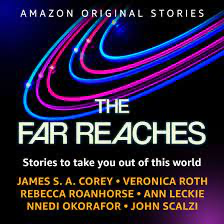
Read courtesy of NetGalley. It’s out now.
Honestly you just look at this list of authors and you can’t help but be impressed, right? I don’t love the Behemoth but this is a pretty amazing anthology.
James SA Corey gives a non-Expanse short story where the goal is humanity populating the galaxy. Which isn’t necessarily a goal I can subscribe to, but the method proposed here is an ingenious one. Clearly the distances are too great to send actual humans; generation ships are deeply problematic. So instead, Corey invents “slow light” that (don’t ask questions) allows for duplication of… stuff. So you can scan people and things and beam it out into the void – and ta dah! Humans colonising worlds that may or may not actually support them. Unsurprisingly, there’s not a lot of focus on the science; instead, this is all about the people. Because it’s the same people going to each of the maybe-settlements, and they can communicate with each other – albeit only at the speed of light. I loved this a lot.
I’ve never read anything by Veronica Roth! But I was fairly impressed by “Void”, which takes a completely different spin from the Corey: while it’s not quite a generation ship, the Redundancy moves people between our solar system and that of Centauri – so the crew lives on ship time, speeding along, while history goes on around them. Again, this is not a story of war or empire or politics of any sort; it’s human relationships and failings and friendships. It’s nicely done, and is exactly the sort of story that works well in the short format.
Ann Leckie, though! A new Ann Leckie story is always to be celebrated! And this is a super weird one from her. Humanity is not at the centre; instead it’s an alien whose planet has been discovered and settled by humans. This particular alien has the uncommon ability to look to the future, and organise its people to make its plans reality – partly inspired by the humans, and partly through its own intuition. So it’s a story of bootstrapping, and of individual genius and shortcomings, as well as the functions of society. It’s enthralling.
Then Rebecca Roanhorse, whom I have also never read. And “Falling Bodies” is heartbreaking. Ira, newly arrived at the space station Long Reach (which is, I’m sure, unintentionally hilarious to the Australian reader), is hoping for a fresh start. He’s human but hasn’t grown up with a human family; he’s got a new name and identity to live on this station, rather than spending however many years in prison; and he’s not sure how to fit in, and whether it will all last. The fitting in bit won’t be unfamiliar to anyone who’s gone away to uni, or moved towns in general; Ira’s particular circumstances just make it that much harder. Set more against a political background than most of the other stories, this one is still intensely personal.
And THEN there’s Nnedi Okorafor’s “Just Out of Jupiter’s Reach”. Seven people in all the world are chosen not at random or for skills but because of their genetics – the fact they happen to match with a genetically bio-engineered creature/machine, in partnership with which they must go exploring the solar system. As with the other stories, the main character, Tornado, isn’t anyone special – she says so herself – and so it’s a story of solitude and companionship, resilience or not… it’s beautifully written, and it’s hopeful and heartbreaking, and I loved it.
Finally, John Scalzi’s “Slow Time between the Stars” is another non-human story. In this case, the narrator is an AI: a ship, for want of a better word, launched by humans, containing the “Alexandria Module” – a repository of all human knowledge – and the task of finding a human-habitable planet and then creating those humans and whatever they required to survive. But of course, sentient beings often end up with their own intentions and goals, and so here. It’s a story of becoming, more than anything – learning about self, and figuring out what to do with it.
The unifying theme here is that these are individual stories. For all the title is “Far Reaches”, these stories are intensely personal. They’re not even really ABOUT exploration or anything else on the grand side of things. They’re about people, and much more about internal discovery and knowledge than external. These stories are fantastic.
Kaiju Preservation Society
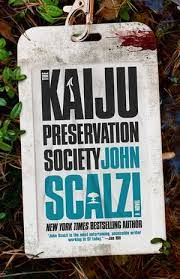
I read this book courtesy of NetGalley. It comes out in March 2022.
This is my first written-in-COVID, mentioning-COVID, novel. If you’re not ready for that yet, maybe skip this for now.
Having said that, it’s not like it’s ABOUT COVID (you should avoid Station Eleven more than this book if it’s the ABOUT COVID aspect you’re worried about). Instead, the realities of businesses being shut down and people being frustrated is a catalyst for our narrator to take an… unusual job. He doesn’t realise the full weirdness of the job when he signs on, of course.
Look, you can see the title. Kaiju Preservation Society. You’re already ahead, since Jamie just knows he’s signing on to lift things for KPS, a group who help look after ‘large animals’. What sort of large animals? He doesn’t know until after he gets on a plane with other newbies, and then through a door, and then… ta dah.
This is what I take to be classic Scalzi. Super fast-paced – not TOO fast, so I never felt lost, but also nothing extraneous and very few lulls and I read it in a single afternoon. Effortless diversity, delightful banter, and persuasive enough that I was content to read about ludicrous kaiju biology and just go along with it.
It’s pretty obvious from the set-up – newbie gets involved with group who are looking after kaiju, which are secret from most people in the world – that eventually something is going to go wrong. That’s no spoiler, but I’m also not going to reveal WHAT goes wrong, because I am not a monster (heh). I was fascinated, though, by some of the commentary Scalzi gets into what could just have been a romp (this is not unexpected, of course). The idea that private corporations AND governments might work together on something as expensive as this is… kinda weird from an Australian point of view. I mean it happens, sure, but I feel like we’re less at ease with it than the American standard. (Maybe I’m just naive.) The discussions about how start-ups sometimes work, and how the American system let people down during COVID, were also particularly sharp – while completely fitting into the narrative.
This book is bonkers, and was an absolutely delightfully madcap ride. An excellent read when you when you want to immerse yourself into something delightfully ridiculous.
Redshirts
I read this courtesy of NetGalley.
I am very late to this Scalzi party, clearly.

I remember when Redshirts first came out and a lot of the discussion about it. But although I’d seen all the Star Trek movies to that point, I’d never watched any of the tv, and I didn’t feel that much affinity for the show – and given all the talk was of this book being a riff on that, I didn’t feel compelled to read it.
Now, though, I have watched all of Voyager; and all of Discovery and Picard to date; and even, perhaps most relevantly, most of Lower Decks. So really, for me, this is the right time to read this book.
I also, at the original publication, had read zero Scalzi. I know, this is kind of amazing for someone so into the genre. But he just never really came across my radar. And then I finally came across the Interdependency trilogy, and gave it ago, and fell very heavily in love with those books. So, now I can say that I like what I’ve read of his work. Again, this timing was good for me.
So, what of Redshirts? Having read Mary Robinette Kowal’s introduction, I was expecting this to be hilarious. And… it wasn’t. At least, not for me. That is, there were some funny bits, mostly in dealing with expectations and stereotypes, sometimes in the language, and such things. But I didn’t laugh out loud. So in that way I was a bit disappointed. As a narrative, though, it really is very clever and very well done; as Kowal also said, it takes an idea at the start – the lowly types of Star Trek etc who never get much screen time – and develops them into characters, and THEN completely turns what you’re expecting not only on its head, but sideways and inside out and into configurations I couldn’t imagine. So all of that was surprising, intriguing, and enjoyable. I will admit that the very end I found … not disappointing, exactly, but perhaps bewildering? That is, I didn’t feel like it added much, if anything, so I was left feeling blinking and a bit confused – there was a lack of resolution, because too much had been added on (perhaps this is the complaint about the “too many endings” of Return of the King…).
Is this a fun book to read? yes. Did I actually have to watch a lot of Star Trek to enjoy it? No; but I think a bit of knowledge does deepen the appreciation of what Scalzi is doing. Does my slight disappointment mean I’ll never read another Scalzi? Oh heck no. I don’t think he’ll ever be a “must buy now” author for me, but I will always be keeping an eye out for his work.

 Randomly Yours, Alex