The Tragedy of Macbeth (2021)
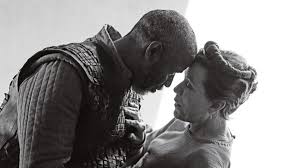
Via Apple.
The cast is wonderful, the filming is fabulous, and I love it very much. This might be my favourite Macbeth.
The weird sisters:
- First appearance:
- The first speech is just narration to a black screen… until suddenly it’s a cloudy sky, with three birds circling, and then it’s NOT the sky but sandy ground.
- Brief interlude to Duncan hearing about the battle, and then back to the witches…
- Except it’s not a trio: it’s one woman, a contortionist with an amazing voice and honestly she’s the most terrifying witch I’ve seen yet.
- She seems to be on the battlefield, and she squawks like a crow – the symbolism is glorious.
- And when she speaks to Macbeth, she’s in front of a pool of water – with two versions of her reflected. And her voice is echoed to sound like more than one person…
- And then her two reflections leave the pool and come to stand next to her!
- Second appearance:
- Three figures in the ceiling, looking down at Macbeth – he hasn’t had to go looking for them.
- There are multiple voices, but only one face.
- “Double, double” is put here, as a way of calling the witch’s master. All ingredients thrown into a pool of water that’s in the castle.
- The emphasis on “no more” was some ominous foreshadowing.
Macbeth:
- First appearance: walking out of the sun, into our view: that’s a symbol. In appropriately worn medieval-ish battle dress
- Second appearance: There’s love for Lady Macbeth, but it’s more restrained than in some other versions. Possibly because they’re much older?
- I think this is my favourite version of the “he’s here in double trust” speech. Washington isn’t a coward, he’s being rational and thinking it all through.
- I like Washington’s thoughtfulness as Macbeth. I do think it’s about age; he would be much less convincing as an impetuous, ambitious man. Which is not to say that he is emotionless: his anger at the idea that Fleance might be the reason he has soiled his soul is real.
- Macbeth seeing Banquo, post-death, is preceded by a crow flapping down the hall… and then when he is fighting Banquo, it turns out to be a crow. Like the crow the witches appeared to turn into at the start….
- Unravelling terribly as the English army approaches.
- He’s so tired by the time the English arrive. And resigned to fate. The way he hears that Macduff was untimely rip’d… again, I think it’s age.
Lady Macbeth:
- First appearance: Long pale dress walking down a long, bright corridor. Hair is a crown.
- Her use of fainting is beautifully timed.
- As queen: she is now in a dark dress, beautifully embroidered. Hair still up in a crown, with an actual crown added to it.
- After the Banquo hallucination, she gives Macbeth a cup of wine and adds a drop of… something… and then the next thing we know, it’s “Tomorrow” and Macbeth wakes up and sees the witches. So… playing into Lady M as a witch herself…
- And then when she comes in to him, her hair is in a rough plait and very messy.
- We actually see her once more, briefly, just before the army arrives – and Ross sees her too, and approaches her… menacingly…
Macbeth: the start of a project
I have loved the play ever since I encountered it. I have seen many versions since then – several on stage (a memorable one at Melbourne Uni, performed in the round, with costuming to make it classic leathers-n-chains punk gangs), and several on film. Now I embark on an endeavour to watch as many versions I can find…
It’s a lot about Lady Macbeth – she is so active and yet she’s not allowed to be powerful without being punished. I’m also fascinated by the way it portrays power. And then the text around it is fascinating too: the utter misuse of history that it represents (yo, English propaganda!); the way that aspects of Lord of the Rings (the Huorns going to the Hornburg/Ents going to Isengard, and the Witch King being killed by a hobbit and a woman) are apparently speaking to Tolkien’s annoyance with the play (the forest coming to Dunsinane; no man of woman born…) – and its many appearances in popular culture.
So: here go.
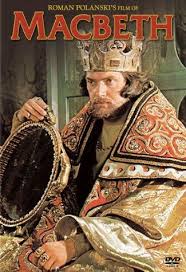
1971: Polanski / Finch.
The 1971 Polanski Macbeth is my ur-text for the play. We watched it in Year 11 English, and it has coloured my view of the play irrevocably. (This was 1995 and of course I had no idea of anything about Roman Polanski at the time.) Francesca Annis is what I most remember – even more than Jon Finch – because her Lady M was so fierce and then so completely undone.
The weird sisters:
- First appearance;
- Maiden/mother/crone styling.
- Entirely physical – no sense that they are magical
- The maiden flashes her genitals!
- Second appearance:
- A cave full of naked women, all contributing to the cauldron.
- Macbeth drinks their concoction and then has weird hallucinations. – it’s not clear whether they have done magic or just given him really trippy drugs.
Macbeth:
- You really don’t get a sense that Macbeth is very impressive at the start: we don’t see him fighting, just immediately confused by witches.
- He’s conflicted right from the start – even in front of his men. Distracted, rather than decisive.
- Malcolm and Macbeth suspicious of each other from the start.
- His haircut is doing him no favours.
- After the coronation, when he’s dealing with the murderers, is when Macbeth starts to show some determination (being bloody, bold, and resolute…).
- His behaviour is verging on manic.
- Macbeth dreams of Banquo and Fleance killing him, after he sends the murderers for them.
- By the time he’s told that the English and Malcolm are coming, he’s becoming cruel and rash.
Lady Macbeth:
- In the first shot, we marvel at the HAIR. And the CLEAN DRESS.
- She is excited to see Macbeth – and he to see her: they are shown to be in love.
- She suggests murder – to Macbeth’s complete surprise.
- Uses tears to manipulate Macbeth into assassination.
- She has a potion to hand already that will drug Duncan’s servants.
- She is already freaked out while Macbeth is doing the deed. And she never recovers the composure she had at the start.
- Lady Macbeth falls asleep doing embroidery – first sign that she does anything so ladylike. And she has her first hallucination of bloody palms: her behaviour is very distracted.
- Re-reading the first letter: hair in disarray, can’t read for tears.
- We do not see her fall, but hear the cry of the nurse at finding her.
The Tragedy of Macbeth (2021)
Well. I have a lot of thoughts! And… spoilers, I guess? If you don’t know the play, then definitely spoilers; and if you’d rather not know about the staging, then those will be too.
Straight up: I loved it. I think it’s beautiful to watch, I think it captures the play’s ideas, and I thought the actors were generally fantastic.
(Keep in mind, I am no drama teacher, and neither am I a film critic! I’ll probably have missed the point of some elements…)
As a film:
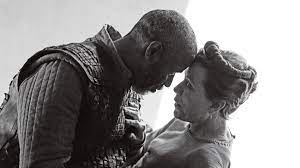
- Most obviously, it’s filmed in black and white, which was awesome. It was, oddly, so very rich – saturated, I guess – I certainly didn’t feel like I was missing much without colour. It made the fades between scenes more interesting, and it made everything much more stark.
- Some of the segues were glorious. And the use of silhouettes was brilliant.
- The use of birds throughout was a very nice motif: they’re the first thing you see – and, I realised only after a scene with the witches, it’s three of them; and circling “through the fog and filthy air”, in fact. Then Duncan sees them flying overhead, then you see them at other points too. In particular, the witches turn into birds after their final scene with Macbeth – and when Macbeth thinks he’s having a go at Banquo’s ghost, everyone else sees him flapping at a bird. (And Lady Macbeth opens a window and shoos the bird out, which is GOLD.)
- The movie is basically without context. There’s no attempt to make Washington have a Scottish accent, and Brendan Gleeson as Duncan has his Irish accent on full display. And then there’s the PLACE, which I adored: it’s utterly unplaceable. The witches and Macbeth and Banquo could be walking across dirt, or it could be sand, or dust. No idea! Duncan’s camp could be three tents or dozens; no idea! And then when we get inside, Lady Macbeth is walking down a corridor and Duncan arrives to a courtyard – but there’s no sense of how large this place is. Actually that’s not quite true; the bits of building we see are unreal, and far too large. Even when inside, there’s a tight focus on people, and especially on faces, so we basically don’t know what their surroundings are like most of the time. The only time we see a full building is the castle of Fife – and it’s a solid tower plonked on a cliff, also looking unreal. It’s almost like a cinematic version of a theatre – all hints at buildings, not whole. It lends the film a claustrophobic feel.
- The clothing is also interesting. It’s definitely not modern, suits and so on; but neither is it full-on medieval, or even faux medieval. Macbeth looks like he’s wearing a gambeson, the padded coat under armour, the whole time; Lady Macbeth is wearing long dresses but they’re not of a time. Timeless, in fact.
The story:
- Opening with JUST the witches’ voices was really interesting… and then to see just one witch, I was intrigued. But THEN she stands above water and there’s two witches in the reflection, and THEN they come out of the water? Very cool, and a nice way to differentiate this version. And Kathryn Hunter, the actress, actually DID all those contortions??
- Banquo’s eyebrows are quite the statement.
- This Macbeth is never happy. Not even at the start.
- They showed a dagger when he’s hallucinating, but then it’s actually the door handle! Very clever.
- Duncan is awake when Macbeth murders him! Now that’s a choice – and somehow makes it worse, I think.
- I paid close attention to Lady Macbeth’s hair, since it’s so often used as a signal for a woman’s state of mind, and… I think it is here? But not so dramatically as in other films. When she’s in control, her hair is very neatly and tightly and elaborately up. It’s in a plait when in bed, but that just makes sense. And at the end, when she’s sleepwalking, it’s definitely more on the loose-and-wild side.
- They kept the porter scene, which… I guess you need to let Macduff into the castle; they made him a bit silly but definitely didn’t play it up (and I think it may have been cut down, but it’s been a while since I read/saw it).
- The murderers are the least murderous-looking murderers I’ve ever seen.
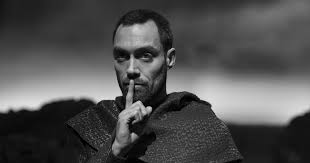
- What the heck is up with Ross?? He talks to an “old man”, who is played by the woman who plays the witches; he seems to be on everyone’s side. And then he’s the third murderer?? And he’s the one to find Fleance and consciously allows him to live? I’m very confused and intrigued. Because THEN you see Ross approaching Lady Macbeth at the top of the stairs – cut – and then Lady Macbeth is dead at the bottom of the stairs, so… ?? Ross is then the one to bring the crown – and Macbeth’s head – to Malcolm. And finally, the film ends with Ross going back to the old man, who has been hiding Fleance, and they ride off together … and when they get to a dip in the road, they don’t appear again – but a big flock of birds fly up and away… Ambiguous, to say the least.
- I’m always a fan of ‘Lady Macbeth as one of the witches’ and she puts something into Macbeth’s wine… and then he wakes up ‘tomorrow’ and there are the three witches, in the castle. So that’s another ambiguous touch.
- The testing of Malcolm is NOT included, which is an interesting choice. It does make the play longer, and it can be a bit confusing. I feel like there might have been a few other bits with Malcolm that were cut, early on; so Coen has chosen to focus just on Macbeth, and not bother with the comparison with the saintlier Malcolm.
This was just wonderful and I expect it will be embraced with joy by many English and drama teachers. And, hopefully, people who haven’t seen a Shakespeare production in years / ever.
All about Macbeth
I love Macbeth.
Yes, I know it’s almost a cliche. I also love Hamlet and loathe Romeo and Juliet.
I first studied the play in Year 10; we watched the Polanski/Finch/Annis version, which is why every Lady Macbeth will forever be compared to Francesca Annis for me, because she was breathtaking. Since then (lo these many years), I’ve seen it performed at least once by Bell Shakespeare – although their production list suggests I may have seen it twice, but 2007 is a long, long time ago. I saw it performed at least once at uni: it was done in the round, and the conceit was to have the characters all dressed as punks. And I mean stereotypical punks: spiked hair, rings, spiked leather jackets, the works. I was blown away by it at the time. I also feel like I must have seen it done another time at uni – it’s such an obvious play for that context. Anyway, there’s also been two film versions that got enough advertising that I saw them: the Australian – Melbourne, in fact – ganglands version which was amazing, and the Fassbender/Cotillard version that I was pretty disappointed by.
And now, of course, there’s a new version. With Denzel Washington and Frances McDormand. Which I am very excited by. So here’s the plan: to watch this version and then, over the next couple of months, watch the other versions as well. Just to see what happens.

 Randomly Yours, Alex