Death of the Author, Nnedi Okorafor
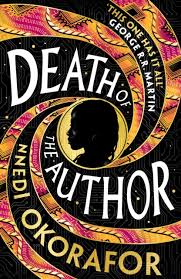
I am so torn by this book.
On the one hand, I really liked the structure and the themes and the way it developed, and the final twist did EXACTLY what it was meant to.
On the other hand… I did not particularly enjoy the writing itself.
The novel’s structure comprises three parts: sometimes we’re following Zelu’s life as she navigates being Nigerian-American, and a paraplegic, and unemployed, and a struggling author. Sometimes we get interviews with people in Zelu’s life, from later in time than the bit we’re reading of Zelu’s life. And sometimes we’re reading the science fiction novel that Zelu writes pretty early on in the book, which becomes a phenomenon: it’s about the robots who are left on Earth after the humans are gone (died?), and whether the embodied can coexist with the disembodied. So, for me, structure: big tick. This way of telling a story, and the story itself, are fantastic.
Themes? Well, they’re kind of obvious from the above paragraph, aren’t they. Zelu is impacted by multiple structural inequalities; she rages against them, and the way she does so informs a lot of the novel. Okorafor is doing A LOT with ideas of AI, both in Zelu’s novel and her life. There’s an enormous amount to unpack around questions of identity (for immigrants, the way people view those with disabilities, patriarchy, etc etc). Okorafor has a deft hand – the novel is in no way preachy, but it was also (at least for me) impossible to avoid thinking about the ideas. And I mean that in a good way.
And then there’s the reference to Roland Barthes’ essay, of course. That the author is just another reader when it comes to interpreting a text. You don’t need to have read his piece, or even have heard of it, to understand the novel, but it’s certainly another level if you have.
And yet. I did not especially enjoy the novel, on a word or sentence level. Rusted Robots, Zelu’s novel, is not a novel I would rate by itself – is that part of the point? I have no idea. Perhaps I am simply not connecting with Okorafor’s style – which is fine! There are plenty of novels that other people hate and I love! But it makes me sad, because I wanted to love this book a lot, and I cannot in all honesty say that I did. I did not find the reading experience a transportive one.
The Far Reaches: an anthology
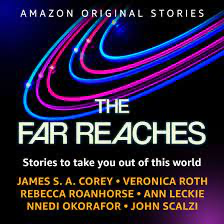
Read courtesy of NetGalley. It’s out now.
Honestly you just look at this list of authors and you can’t help but be impressed, right? I don’t love the Behemoth but this is a pretty amazing anthology.
James SA Corey gives a non-Expanse short story where the goal is humanity populating the galaxy. Which isn’t necessarily a goal I can subscribe to, but the method proposed here is an ingenious one. Clearly the distances are too great to send actual humans; generation ships are deeply problematic. So instead, Corey invents “slow light” that (don’t ask questions) allows for duplication of… stuff. So you can scan people and things and beam it out into the void – and ta dah! Humans colonising worlds that may or may not actually support them. Unsurprisingly, there’s not a lot of focus on the science; instead, this is all about the people. Because it’s the same people going to each of the maybe-settlements, and they can communicate with each other – albeit only at the speed of light. I loved this a lot.
I’ve never read anything by Veronica Roth! But I was fairly impressed by “Void”, which takes a completely different spin from the Corey: while it’s not quite a generation ship, the Redundancy moves people between our solar system and that of Centauri – so the crew lives on ship time, speeding along, while history goes on around them. Again, this is not a story of war or empire or politics of any sort; it’s human relationships and failings and friendships. It’s nicely done, and is exactly the sort of story that works well in the short format.
Ann Leckie, though! A new Ann Leckie story is always to be celebrated! And this is a super weird one from her. Humanity is not at the centre; instead it’s an alien whose planet has been discovered and settled by humans. This particular alien has the uncommon ability to look to the future, and organise its people to make its plans reality – partly inspired by the humans, and partly through its own intuition. So it’s a story of bootstrapping, and of individual genius and shortcomings, as well as the functions of society. It’s enthralling.
Then Rebecca Roanhorse, whom I have also never read. And “Falling Bodies” is heartbreaking. Ira, newly arrived at the space station Long Reach (which is, I’m sure, unintentionally hilarious to the Australian reader), is hoping for a fresh start. He’s human but hasn’t grown up with a human family; he’s got a new name and identity to live on this station, rather than spending however many years in prison; and he’s not sure how to fit in, and whether it will all last. The fitting in bit won’t be unfamiliar to anyone who’s gone away to uni, or moved towns in general; Ira’s particular circumstances just make it that much harder. Set more against a political background than most of the other stories, this one is still intensely personal.
And THEN there’s Nnedi Okorafor’s “Just Out of Jupiter’s Reach”. Seven people in all the world are chosen not at random or for skills but because of their genetics – the fact they happen to match with a genetically bio-engineered creature/machine, in partnership with which they must go exploring the solar system. As with the other stories, the main character, Tornado, isn’t anyone special – she says so herself – and so it’s a story of solitude and companionship, resilience or not… it’s beautifully written, and it’s hopeful and heartbreaking, and I loved it.
Finally, John Scalzi’s “Slow Time between the Stars” is another non-human story. In this case, the narrator is an AI: a ship, for want of a better word, launched by humans, containing the “Alexandria Module” – a repository of all human knowledge – and the task of finding a human-habitable planet and then creating those humans and whatever they required to survive. But of course, sentient beings often end up with their own intentions and goals, and so here. It’s a story of becoming, more than anything – learning about self, and figuring out what to do with it.
The unifying theme here is that these are individual stories. For all the title is “Far Reaches”, these stories are intensely personal. They’re not even really ABOUT exploration or anything else on the grand side of things. They’re about people, and much more about internal discovery and knowledge than external. These stories are fantastic.
Binti: The Night Masquerade
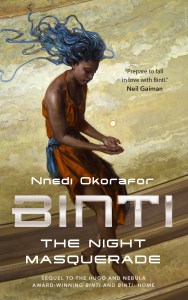 This novella was sent to me by the publisher, Tor.com, at no cost. It will be on sale in January 2018.
This story follows on from Binti and Binti: Home. You really need to have read them first, and you will really want to because they’re great.
Binti has changed: she changed by leaving home, she changed through her dreadful encounter with the Meduse, through her time at university, through her discovery about the truth of the Desert People. One of the major issues that she continues to deal with in this, the third and final story, is the ongoing consequence of those changes. Personally, and in her relationships with family and her wider community, and indeed the world. While there are broader things of concern going on, this is really the heart of Okorafor’s story and I really love it. She ends up feeling so many connections to so many people and groups; the question of how you please yourself, or everyone, is of ongoing concern.
Aside from her own personal tussles, this book is also focused on the ancient feud between the Khoush and the Meduse, which Binti discovers herself in the middle of. It’s been in the narrative since the start, since it instigated the events that made Binti who she is. Okorafor looks at how two large political entities might confront one another, as well as how that impacts on the non-involved around them.
All three Binti stories are wonderfully well written. Okorafor writes dialogue beautifully and she evokes the desert, here, powerfully. I do feel that this is the least satisfying of the stories overall, mostly because the conclusion felt slightly rushed and there were a couple of connections that didn’t flow as well as I expected. Nonetheless, it was a hugely enjoyable read and I definitely recommend reading all three.
Binti: Home
 This novella was sent to me by the publisher at no cost. It will be out on 31 January 2017.
What does it mean to go home?
What does home mean?
What does it mean to belong?
If others don’t accept you, can you belong?
Do genetics equal identity?
If you change, are you still yourself?
What makes people family?
Binti featured Binti leaving home and changing in some fairly drastic ways. Here, Binti goes home, for a bunch of complicated reasons, and is forced to confront the sorts of questions I’ve asked above. She’s forced to confront aspects of herself that have changed – and been changed – and, perhaps more difficult, how her family react to this. She’s also confronted with some unpleasant truths about home and family, all in (in my e-version) about 90 pages.
It’s a bold and striking story of humanity and tradition in the context of an alien-rich galaxy. It’s beautifully written (of course) and there’s a huge amount of tantalising detail that Okorafor just… doesn’t explain much. This in no way impacts on the story; it’s an indicator of rich Okorafor’s writing is. Binti is a wonderful character and I’m so glad to have another part of her story told. I suspect there may be at least one more story coming… .
Also, look at that cover! How awesome is that!
Highly recommended, likely to be on award ballots next year.

 Randomly Yours, Alex