New Philippine Speculative Fiction 1
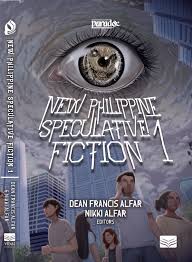
And another book sent by Charles! You can buy it from the publisher.
This anthology is both a mixed bag and a diverse collection – ah English, you are hilarious.
Some of the stories brought together here are absolutely brilliant. There are very few names that I recognised, and many that I hope will have their work picked up by and read further afield.
Of course, any anthology is going to struggle to please a reader with every story. So as expected, there were stories that really did not resonate with me here. Most of those were the horror stories – which is entirely to be expected, since that is not my vibe at all. In particular some of them leaned far too heavily on body horror for my tastes, so I simply skipped them. If that’s your vibe, then I’m glad for you that they’re included here. There were plenty of other stories here that did work for me: there are 35 stories included!
Some stories were clearly and obviously leaning into Filipino places, ideas, history, and language; I definitely didn’t get all of the references in those, but I got enough that I could appreciate the story. Others were, I guess, more “universal” – whatever that means, given the stories are presented largely in English. One of the fun things about an anthology like this is that the only connective tissue is the identity of the authors: there are no themes or ideas tying the stories together, so you have absolutely no idea what you’re going to read next.
Some favourites:
- Jose Elvin Bueno, “Cadena de Amor” – the narrator’s perspective here was intriguing, and the story tantalising
- Vida Cruz-Borja, “Call of the Rimefolk” – art, space, aliens, love, family. This story is magnificent.
- Exie Abola, “Shadow Sisters” – difficult to characterise, gut-wrenching if you’ve got siblings.
- Ian Rosales Casocot, “The Apologist” – I don’t like this story. It made me angry and feel powerless. It’s very well written and it reflects modern media too well for my liking – how rich people can get away with anything, and how PR works. More people should read it.
- Kate Osias, “The James Machine” – AI stories are still very Now. This is a simple story, in the sense that the narrative is straightforward and it doesn’t dive deep into philosophy; it’s also poignant and lovely, and the subtitles throughout are a masterstroke.
Highly recommended for getting a taste of what the Philippines is producing.
The Greatest Fight of Sunny Granada, and other stories

This is another of the book sent by a Filipino friend. You can buy it over here.
I’d not come across Kenneth Yu’s work before, but apparently this is his second collection of short stories. There’s a really interesting variety in the stories presented here.
The eponymous story is very clearly science fiction, and told non-linearly, about a man who starts off as a boxer/MMA etc on Earth and then leaves the planet to find more career options fighting aliens in the arena. Certainly on one level it’s about fighting as a sport and sport for money, but of course it’s also about family and inheritance and Place as home.
Then there’s “Spider Hunt,” which feels more like fantasy; “The Probe” is maybe SF, maybe fantasy, and works by muddying the lines. “Beats” is also genre-defying, intriguing and mysterious.
While I can see, and appreciate, what “Operation: Bleach” is doing, I’m as white as they come; I suspect it hits far harder for folks with browner skin than mine and who live in a society that upholds my sort of skin as somehow preferable. It’s another story told inventively – a series of newspaper articles and comments – and it’s probably my favourite story of the collection.
I found “Lost for Words” a bit confusing, to be honest – it’s very short, and I don’t think entirely works as a story. Then “All That We May See” tips into horror, “One Morning at the Bank” is a superhero story, and “Blending In” feels basically like realism.
And then “For Sale: Big Ass Sword” is told entirely as an ad on Talipapa, which I understand to be an online trading site for the Philippines; the story leans into folktales/fairy tales, and is a really solid conclusion.
It was never predictable what the next story would be like, and I really enjoyed that aspect, as well as the stories themselves.
Mapping New Stars: A Sourcebook on Philippine Speculative Fiction
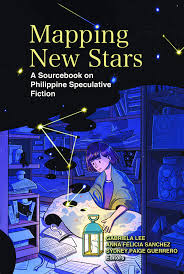
Available to buy from The University of the Philippines Press.
This is another book sent to me by the wonderful Charles Tan, who knows that I have an abiding interest in non-fiction about science fiction and fantasy…
I love that this book exists. The Philippines as a modern nation has such a fascinating (note: not necessarily a positive term!) and tumultuous modern history – the various waves of colonisation and everything that goes with them – that to begin unpicking influence and purpose and consequence is a hard thing. What I hadn’t realised and should have is that, as with so many groups (thank you, Joanna Russ and How To Suppress Women’s Writing, for always making me think about this), modern Filipino authors may not necessarily know all of the history of speculative fiction in their country, for one reason or another.
So the historian and SFF fan in me is both fascinated and thankful for the editors and authors of this book: the first half, “Reading Philippine Speculative Fiction,” is literally tracing some of the histories and places where it has developed and thrived. Two chapters in this section are in Tagalog, so I can’t speak to what they’re about; but the others were really fascinating, especially that on Komiks and the way Filipino authors have used external and local influences to create stories.
I will admit that I only flicked through the second half of the book: I don’t write fiction, so “Writing Philippine Speculative Fiction” is not for me. I do love that Emil Francis M. Flores wrote on “First World Dreams, Third World Realities: Technology and Science Fiction in the Philippines,” since this conjunction is one that I think has enormous potential for authors to explore.
This is a great book. Props to the University of the Philippines for publishing it.
Doomsday Dance Party, Nikki Alfar
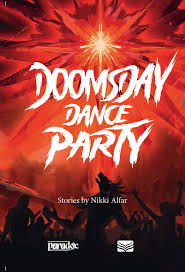
A friend in the Phillipines sent me a copy of this, thinking I would like it. They were, of course, correct; you can get it from the publisher.
I’m not sure if I’ve come across Alfar’s work before – possibly in anthologies? – so it was intriguing to see the variety of short stories she presents here. Some are realist fiction; more are science fiction or fantastical. Most have clear Filipino connections – set in the ‘real’ Philippines or an alternative version – with a couple of exceptions, most notably “The Riddle of the Great Khan’s Great-Great-Granddaughter,” which I loved and is not connected to the Philippines at all. As well, many have elements of Filipino mythology, like the tikbalang and ‘fey folk’ (in English) at the wedding in “Destination: Wedding,” which was absolutely one of my favourite stories. Sometimes, as with that one, it’s because the story is specifically about an experience in the Philippines; other times the Philippines is the setting because it’s the setting, not because Alfar is making a specifically Filipino point (I hope that makes sense). Styles changes across the stories, from relatively straightforward to the more lyrical styling of stories like “El Legado de Lana (Lana’s Legacy)”.
It’s a compact collection, at 155 pages of story. I’m glad it exists and that I got to read it: the stories are a delight and I hope Alfar gets ever more notice, both at home and abroad.

 Randomly Yours, Alex