Tooth and Claw
Tooth and Claw is, by its own admission, a modern attempt at writing a Victorian novel. As it opens, the patriarch is dying, and the family have gathered. Soon enough there is a squabble over the inheritance: there’s not much wealth left, and the eldest two children are already established, so the younger three are meant to get the lion’s share to help them out. But the brother-in-law decides he disagrees with the interpretation of the will, and takes more than what the younger son, in particular, thinks is fair. He then begins court proceedings to deal with it. (The blurb on my copy calls this a search for “greedy remuneration,” but I thoroughly disagree with this interpretation.)
The family is gently-born, but with little wealth and a fairly small estate this isn’t overly much use. The younger son is struggling to make his way in the corporate world, and could use all the help he can get. His older brother is established as a parson in a good living, with a fairly generous benefactress, a wife, and some children; the older sister is married, with children and expecting more. The situation is of course most desperate for the two younger sisters. Without significant dowries, attracting suitable (and nice) husbands is going to be more difficult than pleasant… and it’s made more difficult for the older one when an unwanted suitor very nearly ruins her completely.
The story revolves mostly around the three younger siblings, although the older brother gets an occasional look-in. The sisters are parcelled off to their older siblings with hopes of finding suitors or at least not being too much in the way; the younger son goes back to his city life, and the things he’d rather his family not talk about.
… all right, all right. Those in the know are amused and eye-roll-y by this stage, everyone else is confused.
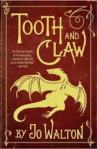
Everything I’ve written so far is true. But all of the characters? They’re dragons.
Yes. Dragons. Scales, claws, eating raw meat, flying, concerned about polishing their scales, sleeping on gold, breathing fire if they’re lucky, dragons. And it works. Walton takes some of the ideas of the Victorian novel and makes them real; her take on the blushing bride is brilliant. Her vision of menial dragons is perhaps the most shocking aspect – that their wings are tied down, such that they can never fly. This is a wonderful visual of the reality of life for many ‘in service’.
Also, dragons eat each other.
This is a great, fun story. It’s light-hearted overall with a serious social message (a few, really; perhaps closer to Gaskell than Austen?). The characters are approachable, the plot plays out nicely – it’s a delight to read.
Alanna #2: In the Hand of the Goddess
A while back, I read Alanna: the First Adventure. I said at that time that I would read the rest of the quartet at some point, but I wasn’t in a screaming hurry. Then the other day on Galactic Suburbia, Tansy announced that she was commencing a re-read. Well, I couldn’t let her re-read beat my initial read, could I? What if she said spoilery things?? So, I went out and borrowed the next three. And read them…
SPOILERS

So. The second book. First off, let’s talk about this cover. It’s from the 2011 re-release, and it is less than awesome. Her horse’s name is Moonlight, fercryinoutloud. At least she’s got a sword and is dressed in squire-ish clothes. Secondly, let’s talk about where I found it: in the junior section of the library. Not the YA section; the junior section. I can maybe see the first book fitting there, but not the entire series. I found that weird before I read them, and then as I read the casual attitude towards sex – the sex isn’t explicit, in the slightest, but it is very clearly present – I was even more astonished. Also, the killing of people with swords, which again isn’t the most graphic violence but still, not sure you’d want a ten year old reading it. Thirdly, the title… well, it makes sense in some ways, but it doesn’t inspire me and in fact makes me roll my eyes. I would not pick this up based on the title. (Of course I would already have been put off by the cover of this particular edition.)
Anyway. The story picks up with Alanna now being squire to Jonathan, the prince, who knows that she’s actually a girl. The story essentially covers her progression towards becoming a knight. It covers three or four years in 240 pages. Sometimes you blink and it’s a year later. Some writers carry that off with aplomb – mostly I’m thinking of Ursula le Guin here I think – but I’m not entirely convinced of it by Pierce. Over that time, Alanna acquires a cat, Faithful (many of the names that appear in this series I am entirely unimpressed by); a lover, in Jonathan; and of course becomes a knight. And, in a very rapid turn of events, she kills her nemesis, Duke Roger. That particular bit happened so fast my head was spinning.
Alanna grows up, as she needs to, and generally that’s well done. She frets about things fairly convincingly. It was good to see that Pierce allowed Alanna’s friends to accept her being a girl relatively easily; that she had proved herself enough that it was straightforward for them to still see her as a knight.
Battle scenes aren’t dwelt on, which I appreciated. The aftermath, though, is not ignored; Alanna throws up after her first real skirmish, the patching up of soldiers is shown in as detail as the battle itself – which isn’t glorified – and when Alanna isn’t able to fight, she goes off and helps the healers. I like how practical Alanna is; I like that the reality is shown, although of course Alanna is Super Gifted in every area necessary (which sometimes does get a bit wearing).
Jonathan is a bit boring. I was surprised when he and Alanna fell into bed together relatively easily; later, there is a suggestion that this diminishes Alanna’s virtue in some eyes, but she doesn’t worry about it at this stage. I can’t help wondering about the power issues of a prince sleeping with a vassal – although of course this has always happened in history – but also the rather weird situation of a knight sleeping with his squire… although of course this may well have happened in history….
As a rogue, George of course is more interesting. I’m a bit impatient with love triangles though.
Really, this book gets through things extraordinarily fast.
You can get In the Hand of the Goddess from Fishpond.
The Gates of Noon
Probably spoilers for Chase the Morning.
Ah Stephen. Forgotten the Spiral, really? At least it didn’t happen immediately… still, it shouldn’t be a surprise that your brain couldn’t cope with the weirdness for very long. Too much career, too many one-night stands, to enjoy.
Until it reaches in to grab you again.
 In Chase, a lot of Stephen’s hollowness seems to stem from his long-ago break-up with the lovely Jacquie. Here, Stephen has got himself – and his company – involved in a project to ship the cargo of a charity irrigation system to Bali precisely because of her name. But the project is dogged by malign forces, it seems, such that they cannot organise to move it any closer to Bali than Bangkok. And with a little bit of pushing from external forces, Stephen Fisher – the Hollow Man, defeater of nasty forces last time he ventured into the Spiral – manages to find his way out of the Core again, and sets up a rather unusual method by which to deliver his cargo. It involves an ancient steamer, a seven-foot tattooed Maori, and an outlandishly mixed crew. Also another magician-type, although Ape is nothing like Le Stryge, which is about the best that Stephen can hope for. Cue adventures.
As with Chase, many of the awesome things I remembered are indeed still present. I love Rohan’s descriptions of battles, and also his evocation of sailing – be it on seas or stranger tides. The very idea is still utterly captivating – sailing into the dawn or dusk, into the clouds! – as is the idea that places have shadows. Actually, perhaps they’re closer to Platonic ideals, since they capture what is and was and will be; the essential nature of a place, even if never actually existed anywhere but in the imagination of very many people. And the idea of moving out into the Spiral as somehow refining people, as well as places, is also a wonderful one for story.
Also as with Chase, there are a couple of things that bugged me, and the main one was Stephen and his hang-ups. While the first book was mostly all “woe, I am a hollow man!”, this book is replete with “woe, I done wrong by Jacquie!” – which he did, right enough, but I could have done with a little bit less breast-beating. He does, true enough, make some attempts at restitution – and he was pretty nasty, so maybe I should cut him some slack as his conscience actually teaches him a lesson. But I didn’t have to be subjected to everything going through his head every time; it could have been indicated with a sentence or two, easily enough, especially the fourth or fifth or tenth time.
Also, bit of eye-rolling casual sexism. Irked me. It mostly does all right on the not-racist front – which, given it’s set largely in South-East Asia, is a relief. There are some bits where people’s mannerisms or characteristics are referred to as ‘oriental,’ at which I cringed a little, but on reflection those things are not usually coded negatively so… yeh, not sure what I think about that. But the inherent desire of the book is to balance tradition and ‘progress’, and I cannot fault that.
The other thing I cannot fault, and found also in Chase, is the very suggestion that there must be something MORE. More than career, more than sex-as-an-end, more than selfishness. Stephen finds that in action, but also in helping others; Mall and Jyp and others find it in becoming, and doing, what they are meant to be. It’s a worthy aspiration.
Is it very different from Chase? Well, the intention of the adventure is different, and Stephen doesn’t have to go through all the rooky, learning-to-be-on-the-Spiral stuff, so things happen a bit more immediately. There’s more sexual tension; there’s also more at stake, which I think made it work as a sequel. If it had been yet another “save that girl!!”, I am unlikely to have bothered. Plus, quite different places and different villains, which is great.
The Suck Fairy has been kind.
Megan Whalen Turner’s The Thief
I picked this up because someone – maybe Tansy? – was appalled that I’d never read any Megan Whalen Turner. So here we go. (Slightly spoiler-y but not very.)
This is definitely aimed at a YA audience (ish), and I think I would have adored it if I’ve read it a little younger. That said, I enjoyed it more than the first couple of pages suggested I might.
 The book opens with a thief, Gen, in prison. He’s pulled out of his cell and taken for an interview with the king’s magus – head scholar, not magician, so an interesting choice of words there – because the magus wants to use his particular talents for a very specific mission. It’s a rahter intriguing beginning because it’s unclear how the reader should feel about Gen: clearly he’s a thief, so that’s bad; but he’s an engaging narrator, which is ambivalence-making; the magus isn’t that nice and the king is a bully, so that makes Gen look good. There’s also a question over Gen’s abilities, since lots of people are taunting him for the boasts he made before his capture, and clearly he’s been in jail for ages, so does that make him a bad thief? On the other hand, the fact that he’s going to be used by the magus is an indication of his skill, so… yeh, lots of ambivalence here. I like well-constructed ambivalence.
Turner keeps Gen an engaging character for the length of the novel. Various bits and pieces come out about his past, and his sense of self, and all of these go to construct an intriguing and likeable man. I had to stop after the first chapter or two and re-read some sections because I half-wondered whether Gen was going to turn out to be female… that would have been really awesome, but alas no. (There’s only two female characters, I think, who get any real airtime, and that not much.) I was really, really impressed with the twist at the end… I had been fully expecting a fairly straightforward ending, and would have been fine with that – although quite what could have been done with Gen when they got back I don’t know, maybe just allowed to slip away? Anyway, the way such a major revelation actually worked in perfectly with what had gone before? Genius. The magus is a bit fickle, especially in his attitude towards Gen but also towards his two students, and I could never quite figure out whether he was meant to be thawing out over the course of the journey or if he was indeed this mercurial, sometimes-ill-sometimes-even tempered teacher that everyone had to be careful of. Overall not entirely convinced. Of the others on the journey – I don’t feel that they were quite rounded out enough for me to care that much. Interestingly, Gen is big enough to basically plug that lack. There are other characters here and there but none that are memorable.
The plot, obviously, is that of a quest – go find this ancient artefact which could have ramifications on… stuff. Along the way there’s politics and mythology and personality clashes, and a lot of walking and some adventures. It’s fun and well-paced – the walking doesn’t drag (heh), the discussions the characters have enliven things nicely, and the conclusion packs a really brilliant punch. I ploughed through this very easily and with great enthusiasm.
So I liked the characters, and the plot was fun. The world is another aspect that made me ambivalent. The author’s note vindicated my feeling from the opening chapters that this was definitely heavily influenced by Greece, and its ancient (and semi-mythologised) past. However I was weirded out by scrolls and books in the same library – which I know must have happened, but it’s still weird – and Turner only notes that Gutenberg did movable type in 1445 in the author’s note, just to give context I guess. So it’s kinda real-world ancient, kinda medieval, kinda… not. That aspect bugged me a little but when they got into the countryside it wasn’t such a problem. For the world itself – I was impressed to see the levels of the politics discussed, which makes me wonder actually at my tagging it YA although it did get to be a Newbery Honor Book. I liked the Canterbury Tales-esque aspect of telling stories to each other, although these were of mythology not everyday life, and that these myths were clearly inspired by Greek tales but made wholly Turner’s own by twists and details; there was some discussion about how much the gods affect everyday life, although not much. In all it was quite a comfortable world, I guess.
This is the beginning of a series; I will definitely be looking out for the rest of them. You can buy a shiny new copy over at Fishpond.
A Trifle Dead: a conversation
Daughter
My mum and I don’t share books all that often. Not for any good reasons, but just… because. She is still game to buy books for me, all of which I read and enjoy, even if (like Amazons of Black Sparta) it sometimes takes me a while. She has promised me that when she can get her hands on it she will read China Mieville’s The City and the City; when that happens I may re-read and do another of these conversational reviews.
Mother
You need to get with my reading program. I read C and the C many books ago – and loved it!
Daughter
… MA!! You need to tell me these things!!
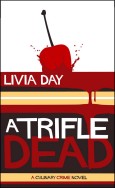 ANYWAY. A Trifle Dead is the first book I’ve bought for her in a looong time, and I was really hoping it would up her alley…
Mother
And it was. Can’t beat the crime and food combo.
Daughter
Phew.
I’ve been looking forward to A Trifle Dead for a long time now, and except for about four chapters – which I read one evening and then had to exercise a great deal of will-power to put down – I read it in one sitting. It’s a classic crime novel in that way, because it just kept on sucking me on.
My limited exposure to crime fiction means I think of them being set either in picturesque country towns or big cities. And I’m sorry Tasmania, but Hobart is no New York. I don’t know Hobart, but I still got a sense that the book is set in the real town – and PLACE is a really important part of the whole story, given that proximity matters a lot. I’m almost tempted to take a copy of the book with me to Hobart sometime and try to match up bits of the plot. That could be a bit freaky though.
Mother
I’m right into setting and atmosphere at the moment (writing an essay on its place in Henry James’ Turn of the Screw) and as I HAVE been to Hobart I was very impressed with its realism as regards setting. Not so sure I came across anyone who was nearly as interesting as these characters though.
Daughter
Day has made Hobart seem waaaay more interesting than most mainlanders would assume. I think my favourite bit is the Botanical Gardens description – and if she made up those bits, I’m going to be very cross.
Mother
My recollection is that the gardens are very lovely but it’s been a long time since I was there. Salamanca Place is fantastic if my memory serves me correctly.
Daughter
I’m still tossing up whether I most enjoyed the characters or the plot. I think the characters might be winning. Tabitha is an unlikely detective, no matter how much she like gossiping and prying and despite (really because of) being the child of a policeman. This aspect – her ambivalence towards the police force because of her father is totally believabe, as is her attitude towards her parents’ divorce and career changes. Mum, are you running away to a hippy commune any time soon?
Mother
I think I like my home comforts too much to do that.
Daughter
And hippies don’t play golf.
Mother
That hadn’t occurred to me, but is probably true as would be too busy tie dying or growing stuff. Nothing like a good bit of generalisation!
Daughter
It’s a really strong part of the whole novel, actually: complicated families and unconventional characters in general written with honesty and love and just a dash of slapstick. Many of the characters fit very broadly into general categories, but they also keep slipping out of them, refusing to be buttonholed. The female friends? Well, one keeps judging Tabitha with her eyebrows, and another hasn’t spoken to her for years and could break her with a little finger. The love interests? One is on the dark and brooding end but that’s because he’s a cop, and he’s more exasperated and brooding; the other is Scottish. And the housemate, Ceege, absolutely refuses buttonholing and I LOVE HIM A LOT I WANT MORE CEEGE. Because, fashion from an eng student will never cease being hysterical. Also I’m now inspired to have my own Oscars party.
Mother
I found all the characters highly entertaining and wish I knew a few people like them. Only in books, I fear. Ceege is definitely a winner. If you hold an Oscars party you’ll have to frock up pretty early in the morning.
Daughter
I know a lot of Engineering students, but I don’t think any of them could get away with the clothes Ceege does. If I had an Oscars party I would do the same thing as Tabitha – ignore Twitter and the news, and have it in the evening!
The plot would, I think, meet the requirements of the crime lover – do you agree Mum? It’s got a slow unravelling of clues, and tantalising hints of what’s going on and who might be involved and then POW something completely unexpected happens. Because I definitely did not suspect the true culprit.
Mother
It’s a good plot. I found the book a really entertaining read which met the requirements of a crime novel lover like me and gave me a welcome break from Dickens, James and Woolfe!
Daughter
Um yes. Which is good because otherwise your brain might EXPLODE.
Also I liked the food.
Mother
Me too.
Daughter
And if nothing else, the book does convey two essential truths: it’s all about food. And never try to outdrink engineering students.
You can get A Trifle Dead over at Twelfth Planet Press. Buy one for your mum, or your grandad, or your neighbour while you’re there.
Alanna: the first adventure
I was given this book by a student teacher placed with me some time ago, a major Margo Lanagan and Isobelle Carmody fan who was scandalised that I hadn’t read any Tamora Pierce. And I finally got around to reading it, hurrah! (She also gave me a pencilcase that she made herself and decorated with important history dates – how cool is that?? – and a copy of A Woman in Berlin which I haven’t read yet but I WILL, I SWEAR.)

So, I should say upfront that I don’t think I loved this book as much as M wanted me to, and I think that is entirely the fault of my age and cynicism. Oh, I fully intend to get my hands on the rest of the series at some stage because I do want to find out what Pierce does with Alanna, especially once her secret is out… but it’s unlikely to be a Great Classic in my heart.
That said… some spoilers follow, because I want to dissect a couple of bits.
So, that said… I liked Alanna, although the 30-cough-something in me is intensely amused and eye-roll-y at a ten year old having the nous to set up such a trick on her father. It’s interesting that Pierce made the father neither evil nor dead (the dead bit is left to Mum) but so intensely disinterested and absent that this trick could work; I would have thought this would have a rather larger impact on the child than it appears to. Anyway; it’s set up as ‘special child with special talents’ right from the start, so that’s not something I can complain about. And I DO genuinely like Alanna. Much as I deplore the violence I admire the pluckiness of wanting to beat your own enemies; I like that she speaks in a forthright manner, and her determination to be as good as the boys – and that she fully intends to reveal her secret when she’s passed her tests and go on to have adventures. I really, really liked that Pierce addressed the issue of menstruation and Alanna’s annoyance at having biology forced on her (also, the bit where she realises her chest is jiggling? Priceless). I am sad that she has the “but I’m not good enough because I’m a giiirrrlll!” tantrum, but I do like that it’s the male companion who tells her not to be so ridiculous.
I forgot to mention the premise of the story. Alanna wants to be a knight. Her twin brother doesn’t; he wants to be a sorcerer. Conveniently, boys are taught magic at the convent to which Alanna is to be sent to learn How To Be A Lady; and Thom, the brother, can forge Dad’s handwriting. So, switch-a-roo and Alan(na) is off to the big city to learn how to cudgel opponents… I mean how to be a knight. Essentially this is a boarding school story but rather than being nerds or wizards or international students, this is Knight School. There’s all the sorts of things you would expect – fitting in, working hard, dealing with bullies, annoying/scary/awesome teachers – with added swords.
There are some nicely subversive elements here, against the traditional Learning to be a Knight story, especially in the form of Sir Myles. (It must be said I was a little afeared that Myles was going to end up having a sexual attraction to young Alan, when he suddenly asked Alanna to accompany him to his home castle. Lucky it was only inspired by a dream! Haha!) The undercutting of chivalry, and the seeming contradiction of what is expected of a knight – honour vs beating opponents up, etc, isn’t fully fleshed out and may simply pass a young reader by – but I appreciated it. Especially in contrast to the “yeh, beat up the bully! That’s the solution!” rhetoric, which kinda revolted me.
Things that made me very eye-roll-y: Alanna is so fed up and tired after two days that she decides to leave (but of course changes her mind…) and THEN, a few months later, has enough time to go out and do EXTRA training with George so she can beat up the bully? Really? So she magically found time for travel AND for the lessons?
Also: George. I’m as much a fan of your King of the Thieves as the next person who read David Eddings as an impressionable teen, but… a king in their late teens? Named George? With such a highly developed sense of morality? I don’t buy it.
Also also: “the Gift.” The reality of this magical ability just wasn’t developed enough early on – either what it is or why Alanna hates it so much – for me to be particularly impressed when she pulls out the stunt of making Jonathan recover. I am intrigued by the fact it appears, at least in this use of it, to call directly on the gods – gods who don’t appear to have much impact on everyday life, as far as I can see, in terms of worship or morality.
Things that concern me: I worry that Alanna and Jonathan will end up having a Thing. That will annoy me. Or Alanna and George. So the prince and the king of thieves will end up fighting for her hand. That would be BAD.
All of this aside, I really will look up at least the next book, to see where Pierce takes Alanna. My version of this first book has the opening chapter of the second, as a teaser, and… yeh, I am intrigued.
Green Rider, by Kristen Britain
… meh.
 Look, it’s not that it’s bad, as such. It’s just not especially inspiring, in plot, character or world.
The world might be the bit that lets the book down overall, I think. A fairly straight quest-narrative can be made more interesting and worth reading thanks to an intriguing world. And Britain just doesn’t manage that. I didn’t care that the many-centuries-old wall was crumbling – and I don’t know Game of Thrones real well, but is that a bit similar? – not least because the opening chapter where this disintegration began was pretty overwrought. It’s hard to care about that sort of thing before you know anything about the world it’s affecting. And throughout the story, the world just wasn’t differentiated from any other pseudo-medieval-with-a-touch-of-magic-maybe world.
The characters were all pretty stock. The lead, Karigan, is a plucky schoolgirl, unfairly maligned and therefore running away from school, who falls into an adventure that she turns out to be quite well suited to. What a surprise. A couple of things here: it was never made clear whether this was Fate, or the work of gods, OR whether it was an entirely fortuitous accident. It didn’t feel like it was kept mysteriously ambivalent, either, just… undiscussed. Also: schoolgirl? Really? I don’t think Karigan’s age is ever made clear (if it was, I wasn’t paying attention), and while yes it’s all very exciting to have teenagers going on adventures, this one just felt incongruous. Perhaps I should decide that the ‘school’ is more like a university, and actually she’s at least in her late teens. Plus, there’s a certain bit later in the book where a certain (good) male character seems to be Looking at her, and if she’s 16 – ICK.
Most of the other characters come and go. I didn’t really understand why we got so much of Karigan’s dad; he helps the plot along occasionally, but really it didn’t warrant what felt like a lot of attention. The reader who really identifies with Karigan is unlikely to identify quite so much with Dad. I did like that the leader of the Green Riders, basically the king’s fast message service, is female – there’s no suggestion that women shouldn’t be Riders, nor that they shouldn’t be students. I don’t remember any mention of female governors though. Anyway, Mapstone is cool, and I’d probably rather read a book with her as a central character. The most interesting other characters are two sisters, who turn up completely incongruously at a vital point in Karigan’s adventure and provide all sorts of useful McGuffins. Despite the fact that they only exist for this purpose, they’re utterly delightful and hilarious as sisters living together with no one else around in a very weird house.
The plot… well, it begins as a quest. I like quests. Surprisingly, the quest is over just halfway through, and then it turns into a palace intrigue. Which made sense, given the quest mission was delivery of a message, but it was still quite a change of pace – literally, since now almost everything happens within the palace or nearby, rather than Karigan barrelling along at breakneck speed throughout the realm. The quest didn’t really work for me again because of the world-building; it was lacking. I didn’t get a sense for what made the world tick, and the story felt like a number of random events thrown together that didn’t, in the end, build up to a coherent world. The palace intrigue was, again, exactly that; there was nothing to set it apart from any other story of similar ilk.
So, in the end… meh.
The Changeover
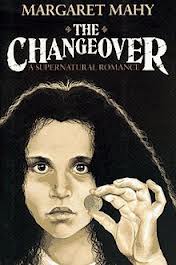
So back in Feb, my friend Kate challenged dared suggested that we re-read The Changeover, by Margaret Mahy. I agreed readily enough, not having read it for a number of years – and then discovered that I didn’t actually own a copy any more, how is that even possible?? Kate went all silent-running on me for a while, but she has now posted some of her own thoughts, so I will finally do the same… spoiler: the Suck Fairy did not visit!
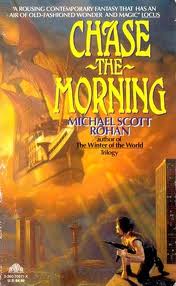
Chase the Morning
I have loved this book for a fairly long time now, but have not re-read it in a rather long time, leading to some sweating over the possibility of the Suck Fairy waving her wand. Fortunately, overall that was an unnecessary concern…
 The Good
This is still a rollicking fun adventure story. Pirates! Evil! Rescues! Fights! Sailing ships!!
I still adore the concept of ships that can set off at dawn or dusk into the cloud archipelago, and that places exist in both the Core and the Rim. That is, places exist in what we understand as the ‘real’ world, but those places with long histories especially of trade and contact with the exotic, and thus I guess have a firm grip on the imagination, can exist… outside of the mundane. And this applies to imaginary places as well as real – so Prester John gets a mention, and there’s one rather awesome place I remember from one of the later books too. Rohan goes so far as to discuss and explain why this Rim world uses old-fashioned weapons, too, which shows that he’s put a deal of thought into it.
I like the characters, mostly. I still love Mall – apparently based somewhat on a real woman attested by occasional mentions in historical records – I love that she is fierce and independent and a superb fighter and a passionate friend. Jyp is still amusing, although seemed a bit… shallower this time around? That is, not as well-rounded as I seem to recall. Maybe he gets more interesting in the later books. And Le Stryge, a rather unpleasant magicky type, is magnificent. If chaotic neutral is allowed to swing towards evil and then towards good, that’s him.
And then there’s Stephen, our Point of View. I was intrigued to discover that I found him more interesting this time around, and not because I found him any deeper – exactly the opposite. There is less to him, especially initially, and that is indeed the point of the entire book. He’s hollow. He’s forced other people out of his life, he’s marginalised meaningful human contact, to progress his career – and he’s made to confront that as the story progresses. And while Stephen is an extreme example, I think it’s fair to say that Scott is taking a shot at a whole section of society who have sacrificed love, family, imagination and dreams on the altar of Getting Ahead.
The Bad, or at least The Less Good
There are two aspects that left me somewhat uncomfortable. One to do with gender/sexuality, the other to do with race.
In the first few chapters, Stephen is presented as almost Mad Men-esque in his approach to women. His descriptions of them are physical, and while not entirely callous he does call his secretary ‘girl’ and his gaze lingers long on boobs. However, this is not entirely approved by the narrative. In fact, his approach to sex and love is very definitely seen as part of his nature as nearing hollow-man status, and this disappoints a number of characters whom the story sets up as moral compasses. So that’s an interesting take. Additionally, there is a moment where a female character has a lesbian smooch and Stephen is aghast, and clearly suggests this is not a normal thing to do. Now, it does get written off as shock, this-isn’t-really-real, but one of the other characters has no adverse reaction to the kiss, and in fact makes Stephen feel pretty small and pathetic for the way he reacted. So, not entirely positive, but also not entirely negative. Which is better than entirely negative, I suppose?
Also, one of the women is damsel’d pretty early on. On the other hand, there’s Mall.
The racial aspect comes in with the voodoo aspect. There’s always an issue when a white writer uses a non-white religious/magical/ etc system to their own ends, especially when those ends are not entirely good. Now, Rohan does suggest through the story that the original positive aspects of the African/Carib beliefs have been twisted beyond recognition, and by a colonial desiring power at that, but there is no denying that this book essentially sets up Haitian voodoo as the Big Evil to be combatted. I’m not sure how to grapple with that, except that it made me somewhat uncomfortable to read such appropriation – even when Rohan shows every sign, here and elsewhere, of appropriating other religious systems just as wholesale, to his own ends. So at least he’s not limiting himself to non-whites? Also, voodoo is shown not to be entirely evil, which I guess is also something of a redeeming feature. Not entirely, but a little bit.
I still like it. I will read the sequels at some point in the near future. Hooray.
Verdigris Deep
 I have had this sitting on my TBR pile for ages, and given how much I adore Hardinge it doesn’t make sense it took me so long to pick it up. Oh well, water under the bridge… heh… Anyway, I went in expecting a rollicking adventure like Fly by Night. After all, how bad could it be to take coins from a wishing well, right? And even if there is a spirit in there who doesn’t like being stolen from, how bad can it be? And if she decides that you need to help her in fulfilling some of the wishes, that can’t go badly, can it? Especially if she gives you some shiny powers to aid you in that effort?
Yeah. This book was way darker than I had expected. On reflection Mosca Mye’s adventures weren’t all sunshine and skittles either, but I don’t think I ever actually feared for her life, or that Saracen the goose would end up in a pie (much as he might have deserved it). Nor did Mosca ever end up with eyes growing on her knuckles.
Josh, Ryan and Chelle sneak off to a village they’re not meant to visit, and they miss the last bus their tickets will get them home on. To get more money for tickets, Josh goes down a wishing well. Over the next couple of days, all three children discover that weird things are happening: Ryan is growing weird itchy wart-things on his knuckles, Chelle can’t stop herself from randomly spouting what seems like nonsense, and Josh is making light bulbs blow and phones go staticky. Naturally, with some experimentation and a weird dream experience for Ryan, they discover this is connected to their theft from the well and they have now been press-ganged into granting wishes, with powers to help. Fun, eh?
Of course, we all know that wishes are – as Ryan describes it – a bit like conkers. There’s the outside bit that you can see, but then there’s the inside bit – the meaty bit – that’s often darker, and spikier, and not so speak-out-loud. But the spirit in the well knows that bit, too.
Things get out of control. Of course. There’s adventure – some exhilarating and some terrifying – and some occasions of just sheer terror for Ryan, our point of view character, in particular. As with the best stories there’s more than one level of problems to be dealt with, and I’ve rarely read a YA/kids’ book where parental arguments are shown quite so realistically, along with the child’s reaction. Also the fact that your parents aren’t necessarily going to get along with your friends’ parents, although that was mostly just funny. Adolescent friendship and its highs, lows, difficulties, competition, and hierarchy is treated very tenderly: Hardinge pulls no punches but does allow her characters to develop over just a few days in reaction to their circumstances. I’m quite sure most people will recognise aspects of Ryan, Chelle and Josh’s little clique, and not necessarily with rosy memories either.
As for other characters… there’s also a mean old lady who was, on reflection, actually treated rather poorly – she was certainly nasty but probably didn’t deserve quite the ending she got – and a nice young lady whose agoraphobia wasn’t explored in great detail but was treated with sympathy. There are five parents between the three children, which is rather a change from your classic YA where the parents are got rid of or otherwise not involved in the story; Ryan’s parents are very present in much of the story, and they get to be appropriately complex. And the spirit in the well – I won’t say much because I don’t want to spoil it, but I was really impressed with the context Hardinge develops, and especially with the ultimate resolution.
Look, I read this in an afternoon. It’s utterly absorbing and gloriously written. Just read it already. You can buy it from Fishpond.
(Apparently it was released as Well Witched in America. I do not know why.)

 Randomly Yours, Alex