Godlike Machines
I got to read a review copy of Godlike Machines a while back, and fell totally in love with it. It’s finally, finally, been published, so I get to talk about it!!
I am so in love with Big Dumb Objects. And Small Dumb Objects. And grand, time-spanning, galaxy-sweeping space opera. Godlike Machines was, basically, written for me.
The opening story is “Troika,” by Alastair Reynolds. Told be a cosmonaut to an old woman, Nesha, it details humanity’s reaction to an astonishing object appearing in our solar system – the Matryoshka. Reynolds has delicate character development, gripping plot development, and an all-too-real visualisation of near-future Earth. This story made me sigh with pure pleasure. A novella, it could easily be a full-length novel; in some ways it reminded me of Clarke’s Rama sequence. I have nothing bad to say about the characters, or the narration, or the climax. This one goes straight to the pool room of All Time Favourites.
Stephen Baxter’s “Return to Titan” was perhaps not as infatuation-producing as I have not yet read any of the Xeelee sequence; but it’s still a good yarn, about going to Titan – obviously; the reasons for doing that and the weird things the explorers discover. The characters were intriguing, and not very likable overall.
Cory Doctorow’s “There’s a Great Big Beautiful Tomorrow” seemed a bit aimless, after the first two which have such strong, driving, and relentless plots; still the characterisation is a marvel, and some of the ideas are breath-taking.
Having recently read “A Map of the Mines of Barnath,” I was immensely pleased to read “A Glimpse of the Marvelous Structure” by Sean Williams. This one goes up alongside “Troika,” for my money; the characters are drawn sparsely but believably; the plot unfolds gently, relentlessly, and suprisingly; and – and – I just loved it!
How can you make a story about a BDO sad and poignant?? Robert Reed manages it in “Alone,” but I’m still a bit bemused. This is another story going straight to my favourites list… a machine on an enormous ship, alone for enormous swathes of time: would it want to know its provenance? Is it possible to be self-contained to such an extreme, for any sentient? *sigh* it’s just wonderful.
And finally, Greg Egan’s “Hot Rock” is yet another take on what exactly a godlike machine could be. In this case, it’s a planet. Explorers from two different worlds come together to a wandering planet, which – despite having no sun – still manages to be balmy and atmospheric. Once again interacting with aliens is the theme of the day; managing your own prejudices and expectations, and figuring out how to make the best of a situation for everyone involved. In this case, it was the action that pulled me along; the characters are interesting enough, but not quite at the same level as Alone or Reynolds’ cosmonaut.
Basically, this anthology has ruined me for space opera for a while. It will be hard for anyone else to compete.
Racial stereotyping and plot development: the Belgariad, book 2
Tehani and I continue our re-read of David Eddings’ The Belgariad. Tehani’s got it over here, if you’d like to read the comments she gets; there are more spoilers ahead!
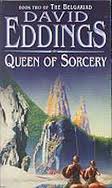
Queen of Sorcery: Book 2 of the Belgariad
David Eddings
Me
I’ve never figured out whether the title refers to Polgara or Salmissra, but that’s ok. Maybe it’s both of them.
Tehani
I reckon Polgara. Salmissra is a queen, but not a sorcerer really is she?
Me
But she’d like to be… and Polgara’s not a queen. Maybe it’s an amalgam of both of them??
One of the really interesting things about the Belgariad when I think about the stereotypes is that not only are the people stereotypes, but so are the nations. I think the Sendars are probably meant to be British: solid farmer-types, a mixture of every other race, practical and polite. The Nyissans – well, I’m fairly sure they’re meant to be the Egyptians: snakes, hot weather … and, I dunno, maybe the stereotypes of using poison? Y’know, I like the Nyissans. They’re so different from all the other cultural groups. And the countryside itself is also different – horribly represented, so far as I’m concerned, child of the tropics that I am, but nonetheless: I like it. The Chereks are Vikings. I haven’t figured out who the Drasnians are, but the Tolnedrans are Romans: they like building roads, they are inherently merchants, oh and they have legionnaires. And an Emperor.
Tehani
I actually wrote a mini-thesis on this when I was at uni! It was called “Representations of reality in fantasy fiction” or some such (much edited and published in an issue of Andromeda Spaceways some years ago!). Fun fact: my very first forays on the Internet were researching this topic, which gives you some idea how long ago that was… There’s a lot more on it in today’s digital world, and Wikipedia gave me this. Which tells us that Drasnians are kind of Western Russians with a twist of Renaissance Italians!
It’s an interesting thing Eddings did here, because by making the “evil” characters analogous to nations such as Egypt and the Middle East, it casts a social commentary of the time. Of course, Eddings might turn around and tell you it’s all completely unintentional, as Tolkien tried to claim of his own worldbuilding…
Me
Ooh, interesting! I’d have loved to write something like that!
All of this makes me think about the Brotherhood of Sorcerers, and it makes me wonder if they’re a little microcosm of ancient Greece – and Athens specifically. You know: philosophy, thinking more deeply than everyone around them… Belgarath as Socrates, maybe? Beldin as Diogenes, the original Cynic who lived in a tub on the streets? And … does that maybe make Belzedar Xenophon, going off to serve with both the Spartans and the Persians? Does that make the Angaraks Persians?? I’ve always considered the Angaraks to be Generic Racially Stereotyped Asians (GRSA) – after all, it was written in America, in the “eee Yellow Peril!!” ’80s. Maybe I’m just reading way too much into this.
Tehani
Wow, you’re good! The articles DOES suggest the Angaraks are Persians (with a hint of China in the worldbuilding). Well done!
Me
So, yes: the Angaraks. Often described as having slanted eyes, I recall, adding to the GRSA feel. I could start speculating on what nationality each of the sub-groups was meant to be based on, but that way leads to buying into some frightful racism, I think. I have always felt sorry for the Thulls, being roundly loathed by everyone.
On to the plot.
I think Garion getting kidnapped by Salmissra is about the most interesting thing to happen in these first two books. She is cool: the very idea of her is cool. A woman picked at childhood, trained to become exactly like the original Salmissra, and fed so many drugs to keep her looking young that weird things happen to her system. A genuine hedonist, someone so totally and utterly self-obsessed that the entire world basically revolves around her – at least within the palace. Hmm, sounds like a particularly misogynistic Roman way of thinking about Cleoptara…. Anyway, there are flunkies who make everything work, and Sadi is another reason why I like Salmissra. He is the consummate politician; in fact, he is basically the Nyissan Sir Humphrey, and there’s a certain glory in that.
Tehani
Sadi doesn’t get as big a showing here as he does later in the books though, right? He plays a much bigger role in other books in the series, and I didn’t realise that he was really only a bit player in this one. Which is in itself kind of cool, because it makes you realise that Eddings really was clever at utilising his established players.
Me
Yeh – I think I love Sadi here remembering what he becomes. He’s like an awesome, possibly-evil possibly-good (does that make him chaotic??) vizier.
When Garion is kidnapped, we also get two awesome appearances, with Polgara being Most Awesome and Terrifying, and Barak turning into Big Scary BearMan. They scare the crap out of all the Nyissans in the palace, and get the boy back. Hurrah. And the queen gets turned into a snake. That is cool.
One of the other major events of this book, and which has ongoing repercussions, is that Garion finally realises that he too possesses the ability to use the Will and the Word, and the first time he consciously exercises it is to kill someone. There are all sorts of things to be said about this occurrence, but one of the big ones is: there is no external judgement for what he does. Yes, he keeps beating himself up about it, but eventually that just goes away. Yes, Chamdar was a dreadful enemy. But still, the fact that Polgara is able to fool everyone about who actually did the deed (and later, when it’s revealed Garion can do magic, no one bothers to dig this story up), and that it doesn’t have ongoing repercussions? There’s one of the biggest indications that these are seriously fluffy fantasy books. Despite the fact that burning to death is a horrible, horrible way to go.
Tehani
That’s a really good point – throughout the books, there’s little consequence for the frequent death dealing and maiming. Yes, Garion is distressed by what happened, just as Durnik expressed his horror over killing a man in the first book, but they kind of just … get over it? Get used to it? I understand that it’s the medieval setting thing, and the brutality of life blah blah, but it’s also a little bit, hmmm, privileged? As in, because they are on the side of might and right, there are no consequences? Maybe I’m off base with that…
Me
No, I think you’re right on track. It is might is right, when right is might. And Belgarath, Garion et al are inherently good and therefore their actions are inherently good. Very privileged and problematic.
We have some more fun characters in this book. Greldik: The most stupendous ship’s captain in the history of narrative, with the possible exception of Odysseus. Always drunk, but always willing to take the crazy option and get through. Mandorallen: the ridiculous, most stereotyped – consciously stereotyped – knight since Don Quixote. (Actually, I only just thought of that. I’ve not read Cervantes, but I know a little about him. Mandorallen isn’t totally deluded, but maybe he’s what Quixote wanted to be?). It was really when Mandorallen got going – and Barak too – that I realised something quite remarkable about this series: it is so bloodthirsty. Limbs go flying, people get their throats cut, and there is general mayhem every few pages. And there’s no “oh, no one really got hurt.” No, people die, all over the place – and it’s not just Murgos, that dastardly race. Random Arendians frequently die, people who get in Polgara et al’s way frequently die, and there is a remarkable lack of scruples about death more generally.
Then we have Hettar, one of the less stereotyped characters. Not in his taciturn, “You killed my father, prepare to die!!!” attitude, but in terms of being the Sha-Dar, and communicating with horses. Again, being good with animals is nothing new, but I think Eddings gives it an interesting twist. And the fact that it is most definitely not linked to magic is also interesting; in other books, Belgarath would have been snooping in Hettar’s mind to figure out if he was somehow using the Will and the Word. But not here. Of the other members of the band – Lelldorin gets remarkably little airtime, really, for all that he’s meant to be Garion’s bosom-buddy. Durnik just hangs around in the background. And then there’s Ce’Nedra.
Ce’Nedra may be the most difficult character in this entire series for me to deal with. She’s so awful, so stereotyped, such a little princess – she drives me nuts! But… even this early on, she starts to show some interesting character traits. The fact that she is so manipulative is actually kind of interesting, as is the way she plays some of the other (male) characters. And her attitude towards Garion does actually have some complexity, which is nice. I remember her improving as the series goes on.
Tehani
Regarding the characters, I was reminded early in this book that one of Eddings’ real gifts is writing characters – we’re bombarded with a huge cast in this series, but each of them is quite unique, which makes them easily identifiable and great to read. And while they may be stereotypical, as we’ve noted already, they are actually still multi-dimensional and their characters have growth. Sometimes it’s an unfolding of personality which is actually due to backstory (such as for Polgara, Belgarath and Silk), others is actual new growth, as for Garion, Ce’Nedra and Durnik. Even bit characters, such as those random legionnaires or castle guards that the band come across and generally intimidate into submission have their part to play and do it well!
Me
Sadly, this book ends on a very frustrating note, for me. Barak is going to kill himself because he’s the BearMan and he finds that unbearably humiliating. Fair enough. Then Polgara tells him he’s going to have a son, and he decides that’s worth living for. Fair enough. But. BUT. There are so many things wrong here. Firstly, he has two daughters already: aren’t they worth living for? I wish I could see this as Eddings’ take on a character like Barak, but he’s already shown him to be the doting father of the two girls. Maybe it’s the surprise that there’s a third on the way that made him remember his family? … yeh, I doubt it. And then there’s how his wife Merel got pregnant. The suggestion is very, very strong that Barak forced his wife to have sex with him, when they met in Val Alorn. And he gets rewarded with a child – a son, no less. This makes me angry and sad by turns.
Nonetheless, I choose to continue.
Tehani
I totally didn’t notice Barak with the son thing when I was younger – I guess it wasn’t on my radar at all. But I sure did this time around, and yes, it’s a pretty backward idea. However, I think I disagree on the Merel thing. The way Merel is written in the last book suggests to me that she actually does like/love Barak, but it still hooked on the situation of their marriage. She is supportive of him when it counts, which speaks volumes. And, well, Polgara did have words with her… It is a lazy plot device though, I agree.
And I too continue – the books are getting a little fatter as they go on and the cast of characters continues to grow. I find myself looking for the breaks in the books that indicate the initial trilogy The Belgariad was supposed to be! And thoroughly enjoying the ride.
Getting the band together: the Belgariad, Book One
Tehani and I have decided to re-read The Belgariad, and – partly to justify that, partly because it’s fun to compare notes – we’re blogging a conversation about each book. We respond to each other in the post itself, but you can find Tehani’s post over here if you’d like to read the conversation going on in the comments. Also, there are spoilers!
Pawn of Prophecy: Book 1 of The Belgariad
David Eddings
Me
My introduction to David Eddings came when I was about 13. I think it may have been because of a boy… anyway, David Eddings was, aside from Tolkien which I didn’t think counted, my introduction to fantasy.
I loved it. I adored the characters, I thought Polgara was the greatest character, I basically recognised Garion, and… yeh, I was hooked.
I re-read the Belgariad and the Mallorean when I was in first year uni, so about age 18. I read one a day for ten days. I still enjoyed it. I don’t remember whether I had a different opinion of the characters and plot from my first read, but I certainly read the whole lot.
I’m nearly 31, now, and I decided to read them again for the first time since then. Actually, I re-read Polgara because I was craving something familiar and reassuring. And then I realised, actually, that I enjoyed it. I still liked Polgara, I still enjoyed the world, and it was indeed familiar and reassuring. So I decided to re-read Pawn of Prophecy, which is the only one of the two series that I actually own. (I do own Belgarath and Polgara. In fact, I gave Polgara to myself as a Christmas present the year it came out in hardback; signed it as being ‘from Santa’, confused the hell out of my family for all of about 30 seconds.)
Tehani
I was a relative latecomer to being a fantasy fan. When I was 19, a friend of mine handed me Magician by Raymond Feist and said I’d love it. I stayed up until 3AM on Christmas Eve and read pretty much right through Christmas Day. On Boxing Day, I handed it back to him and said he was right. Then he gave me the first book of The Tamuli, and said I should try that too. And then I was hooked.
I came to the Belgariad backwards, having read The Elenium and The Tamuli first, but that didn’t mean I enjoyed it any less that first time round, and it was a staple annual reread for about five years. When Alex said she was planning a re-read I thought that sounded like a great idea (despite the groaning shelves of To Be Read books) and I realised it’s been at least five years, possibly more, since I’ve read these. So it’s almost like reading them for the first time!
Me
Now that I am more familiar with fantasy tropes and stereotypes, I understand that Eddings is totally stereotypical. In fact, I also recently re-read the first book of the Elenium, and I realised that most of the knights could be directly mapped onto tropes from the Arthurian mythology. I don’t think the same applies to the Belgariad, but of course most of the characters are recognisable stereotypes from other places. Some of them are in Tolkien, some are in medieval and earlier mythology. Some have become stereotypes perhaps because of Eddings. And … sometimes that matters. Sometimes it doesn’t.
Tehani
I wonder though how many later fantasies have enforced the stereotype and so the characters now seem more stereotypical? At the time the Belgariad was published, was there that much quest fantasy around? I think also that because the Belgariad is essentially YA, the “tropes”, such as they are, are okay for the audience. A good introduction, if you will!
Me
Well, quests were all the rage in ancient and medieval literature, but I’m not sure whether they went out the window in the early modern period – it’s possible that happened, and that Tolkien and Eddings etc reintroduced the concept. I think you’re right about Eddings being a good introduction to the ideas, though.
Anyway, Pawn is essentially all about getting the band together. We’re introduced to the young man on a quest – although we don’t really know, early on, that he will be the central character. I don’t know whether I guessed, the first time I read it, that he would be the main character; it seems so obvious now. He’s a foolish young boy, who makes very silly mistakes and has some fairly shallow young friends; he lives an idyllic farm life, with all good things around him and an aunt who cares for him deeply. Then, of course, he’s ripped from that life and thrown into turmoil. He doesn’t know why, he doesn’t know what’s going to happen, and he’s forced to go along with it.
Tehani
And isn’t it done well? It all makes perfect sense, and it all happens at the right time for the story, I think. There’s enough set up for us to really start to get to know the characters, then BAM! All of a sudden things are afoot and happening, and they start to change before our eyes. I think it is one of Eddings’ biggest positives, the way the characters evolve in what seems a very natural way. Unlike so many of the modern fantasies, where characters start out from nothing and are all of a sudden all-powerful!
Me
Two things strike me about this section of the book. One, I think Eddings captures whiny teenage boys quite well, actually. Garion’s just tagging along, and he doesn’t know why, and he eventually gets roundly ticked off. Sounds much like most teenaged boys I’ve met.
The other is of course another stereotype of the genre: no one seems to go to the toilet. Although there’s reference to being tired, and occasionally to eating, making camp and a fire and generally living rough all seem remarkably easy. It doesn’t actually bug that much because I’m so used to it, but I did actually notice it this time. And it may also be because this time, I skipped over at least some of those sections… they’re just a bit boring. And don’t add much to the story.
Tehani
They do bathe though! Polgara insists on it regularly.
I read so quickly that I routinely skim that sort of stuff – I think it’s one of the reasons I used to enjoy re-reading books so much, as I’d missed so much the first (or second or third!) time! It didn’t strike me as too onerous in Pawn though. I think because the book is short (relatively speaking), so I didn’t mind those bits to plump it up.
Me
As for the other characters: I love Silk, and I always have. The thief, the guide – so witty, so clever, so always-after-the-profit. And so entertaining. Barak? The enormous Viking-type, keen to have the biggest warship in the Cherek navy. The kings and nobles? Well, at least they’re a bit different from one another. Again, they’re stereotypes, but they are interesting. I like King Anheg: he’s awesome. I really like that he looks stupid but is actually really, really smart.
Tehani
I’m also a Silk fan. In fact, as I was reading I really felt he was the most interesting character in this book. I love all the characters, but in this first one, Silk is the only one who is really fun, I thought.
Me
One of the most important aspects about the Belgariad is the magic – the Will and the Word. There’s not a whole lot in Pawn, but there’s enough to realise that magic is enormous in the context of the world, and presumably will be in the rest of the series. I quite liked the tantalising hints about magic in this introduction. And this leads, of course, to talking about Belgarath and Polgara.
I still hugely enjoy that Belgarath starts as a tramp, a storyteller, and no one really cares about him in that guise. I like that it’s an effort, sometimes, for him to prove who he is. I like that he’s a grumpy old man, that he hates ceremony, and that he’s so blunt with everyone. Polgara? She is still awesome. Yes, she stereotypically cooks for everyone: but she likes cooking, and you know, I’m fine with that. I like cooking, and I still get to be a feminist. She also has delightfully snarky dialogue, she’s calm under pressure, she puts up with her father and a whingey teenaged boy, all with immense grace. Plus, she’s tall, and beautiful, and intimidates every single person she tries to, and most of those she doesn’t.
Tehani
Polgara really IS awesome! I found myself admiring her even more than I remembered. Her inherent power and will, despite everything going on, in the face of the general patriarchy of the nobility, is awe-inspiring, and becomes even more so as her backstory unfolds and you begin to realise exactly what her very very long life has been like. She’s one of my favourite fantasy women of all time.
Me
I really enjoyed Pawn of Prophecy. Again. In fact, to the point that I decided to reread the entire series. Because as far as I remember, it only gets better. And yes, it has also made me realise that I am easily pleased, especially when it comes to nostalgia (and especially of the kind where the bad CG doesn’t interfere with my enjoyment. Terminator, I am looking at you).
Tehani
Yep, you didn’t have to talk real hard to convince me either – have Queen of Sorcery underway!
Living in Galactic Suburbia
When we named our podcast Galactic Suburbia, I quite naturally googled the name. What kept popping up was a book by Lisa Yaszek, from 2008, of that name. She didn’t invent the term; no, that was Our Heroine, Joanna Russ, and I do believe she was using the term in a derogatory way. Yaszek, though, has written this book to reclaim the term, and to point out the subversive, radical, and altogether fascinating things that female writers of ‘galactic suburbia’-type stories were up to, in the roughly two decades following WW2.
Few things about this book to get out of the way first.
1. Although I don’t think it has come out of a thesis, it’s written like a thesis – and I know this because it sounds like mine. There’s lots of “in this chapter I have…”, which in a book actually gets pretty old pretty fast. But as with all writing, if you know the tropes, you can just skip over it.
2. It’s very American. There are a few points at which she mentions things that happened in Britain, but not many. Thing is, though, that she rarely comes out and says that it’s an American book. The reader is left to figure this out themselves from references to the civil rights movement etc that only make sense in an American context. As an Australian reader I found this somewhat alienating and off-putting.
3. She uses ‘woman’ as an adjective. Now, I presume this is because of issues over gender/sex identification, etc, but it still bugs me because ‘woman’ is a noun, not an adjective. Even more than that, I don’t think I’ve ever seen someone described as a ‘man writer’, whereas ‘woman writer’ seems totally de rigeur. Is it just me, or is ‘female writer’ less offensive – when it has to be specified at all, that is?
Anyway, these quibble aside – and I know they’re basically minor – I really enjoyed GS. I’ve been hugely enjoying my exploration of feminist science fiction from the 20th century, and acquainting myself with what I am increasingly identifying as ‘my’ history. But because I’m coming to it all largely through later anthologies, I fall into the very trap Yaszek sets out to rectify: that writers and anthologisers post-second wave feminism, in the 60s and 70s, have mostly discounted the writings of those women active in the 40s and 50s. Now, my 20th century history is so poor in areas like this that I didn’t realise this period is traditionally seen as a nadir of feminism, so I was quite blind to the sorts of history re-visioning that has, often not deliberately, gone on. And it makes me terribly sad that later historians of the field have apparently discounted women who were powerful in the time because they didn’t live up to those later ideals, which seems to be where Russ was coming from.
The book very cleverly places historical context and literary analysis together, over four chapters: Writers, Homemakers, Activists, and Scientists. In each chapter Yaszek uses contemporary events, non-genre writing, ads, etc to set the scene for those topics, and then puts forward case studies of authors who examined those issues in their SF writing.
In Writers, she looks at Judith Merril, Alice Eleanor Jones, and Shirley Jackson as three very different, contemporaries who all experienced significant success in their writing, and how they approached their writing – their influences, how they played with generic expectations and tropes.
The chapter on Homemakers was perhaps my favourite, and it made me realise that I really do like ‘galactic suburbia’ writing when it’s done well. I like imagining everyday life in the future. I adore the truly escapist writing – space ships, explosions, crazy adventures – but considering the impact of technology, or war, or alien contact on the things that I experience everyday? That’s breathtaking. And the other thing that was absorbing about this chapter was the contextualisation. I’ve seen the pictures, I know a bit about postwar America’s attitudes etc; but gosh it made me happy to be a child of the 80s, and an adult of the 00s. I’m allowed into the workplace; I’m welcomed into the workplace (hello, Mr Abbott). Should I choose to have children, I would still be welcomed into the workplace. Nyer nyer nyer. Most bizarre was the suggestion that by being a good housekeeper and mother, American women were being patriotic domestic cold warriors – fighting the good fight against Communism in their homes. I feel that this is one of the big differences between America and Australia; I just don’t see that sort of parliamentary politics being part of our households.
The Activists chapter was fascinating because for all my bluster that SF can be a magnificent way of exploring contemporary issues in a sophisticated way, I forget that sort of connection especially when I read older stories. To be shown ways in which authors interacted with the two most pressing postwar American issues – the threat of nuclear war and the civil rights movement – was uplifting, and exciting, and suggests ways in which modern writers can do the same. I know there are writers interacting with climate change etc now, but… I guess I hope they continue to do so. Yaszek certainly suggests that such writing can be powerful for change.
Finally, the last chapter is on Scientists, looking at both the ways in which female scientists were presented in mainstream media and science fiction, and at the women who wrote scientific books and columns. Did you know that there was a programme called WISE – Women in Space Early? Me neither. But how cool is that?? (It was run by a man named Lovelace!) Pity it got canned awfully quickly. Did you know that women wrote a lot of science books, especially natural history, for young readers? And wrote science columns for the SF magazines? Yeh. Sad, isn’t it? Anyway – great chapter, exploring those representations, the options available in reality and what authors could imagine.
The book finishes by looking at how these progenitors (progenitrices?) have influenced the field today. She points out a few men who have started incorporating galactic suburbia into their writing, and how gay&lesbian writing has also coopted some aspects. I wonder if we could have a revival of galactic suburbia? We’ve got space opera, and steampunk, and mannerpunk, and the new weird… maybe there’s room for sophisticated domestic SF, too. That would be nice.
As I said above, one of the things reading these sorts of histories makes me realise is that I am so glad I live today. And I actually really hope that my goddaughter and my pseudo-nieces think exactly the same thing, when they compare the world of their birth with the world of their adulthood.
New reviews
I’ve read Deucalion and The View from Ararat recently, both by Brian Caswell. I’ve read the first before, but not the second. I do love Caswell, but I’m actually reading these with a purpose – to review them for ASif! Which I have done.
I’ve also read and reviewed the stories currently up at New Ceres. New Ceres is a fascinating idea: it’s a world created by a couple of people, and other people are able to write stories about the place. A lot of time and effort has gone in to this already – the planetary system is completely worked out, the basic history is there… it’s very impressive. And the most interesting thing, I think, is that the culture is resolutely eighteenth-century. This, of course, allows for interesting things like coffee houses, highwaymen, and High Culture. Anyway, people can write both fiction and pseudo non-fiction: this first issue includes a travel piece, originally written for The Martian Eye, and a column on decorum and politness. The point of all of this, though, is that I am very much looking forward to reading more articles about the world… who knows, maybe I will even write something sometime. The idea that I could write non-fiction about a fictional place actually stirs my creativity a bit, which nothing has in a while.
The Left Hand of Darkness
I have, of course, heard about this book by Ursula Le Guin – it’s up there as a seminal work, really, of early scifi especially. I think it counts as spec fic more than scifi per se, but that’s a bit beside the point. I bought it last weekend and read it over the week.
I have a friend who is a big scifi fan who read the Wizard of Earthsea series and was incredibly disappointed – actually, I think he only read the first one and didn’t bother with the others. I may have mentioned this before; to me, Le Guin and some of those other early writers are doing line sketches, whereas a lot of the stuff coming out these days is oil colours – whether they’re consciously thinking about it or not, I think they’re heavily movie-influenced, and writing for a grander and more detailed vision than the earlier writers. Now, I’m perfectly ready to be wrong about that, but it sounds good.
The Left Hand of Darkness is named for a poem of the planet Gethen, where it’s set – light is the left hand of darkness, darkness the right hand of light. Very yin and yang, which is what the whole thing is about, really: the natives of Gethen are ambisexual, that is they are neither man nor woman, or perhaps both, for most of the month, and then come into ‘kemmer’ for a few days – their sex is then decided by the others around them who are also coming into kemmer.
This way of looking at gender was really interesting, but I’ve got to say I wasn’t entirely sure what Le Guin was aiming to do. Her narrator for most of the book was male (from off-world), and he referred to all of the Gethenians as ‘he’. The only times they were described as female were almost derogatory or insulting, which I was really surprised and disappointed by. Now, maybe this is because they were a fairly non-aggressive race, so this was a male reaction to pacificism, but still, it was a bit uncomfortable to read.
Nonetheless, I actually did like the story. It was a poignant story, and she certainly doesn’t spare her characters. It hints at a much grander story – of the Ekumen, the not-governing body bringing 83 worlds together… the Hain, who seeded all of those world with humans… but the story itself, on Gethen, is also very personal and immediate. I think I liked it.
Fly by Night
I finally finished this today – it’s one of the books VATE sent me to review. It’s by Frances Hardinge; I think it may be a debut. It was brilliant! Highly original and interesting. The writing was very entertaining – the descriptions were original and evocative; the characters were fascinating and believable; and the world as a whole is one I would love to read more about. I’m really looking forward to writing the review, and I think I will probably donate the book to school – I can’t in good conscience have it sitting on my bookcase and not being read by other people who might enjoy it.
Faking Literature
It’s been ages since I wrote about any of the books I’ve read, so I’m going back just a little way in time to comment on some of them.
This book, Faking Literature, I picked up at Readings from the cheapo academic table, partly because hoaxes/fakes fascinate me, but also because the author, Ken Ruthven, was the lecturer of a couple of subjects I did at uni. He was pretty hard to handle in first year – I really didn’t get it – but in second year I thought he was fantastic. I guess I’d grown up enough to understand him and his humour, not to mention lit crit.
This book is, of course, all about fakes and hoaxes in the literary world, and I learnt an awful lot about Great Scams in Literature. It was good to see that he included those few great Aussie ones, too – Helen “Demidenko” and Ern Malley; as well as Milli Vanilli, which was pretty funny. But given that he included that last, I was a bit surprised that he did not include Elizabeth Durack, a white female artist, and her great scam posing as Eddie Burrup, an Aboriginal male artist. The only reason I know about it, of course, is that it’s one of the family’s great stories. Anyway.
Aside from the historical pointof view, the book is also about the reactions of the ‘legit’ literary community to the deception – particularly when they have at first embraced the hoax/fake as itself being legit. His contention, I think, is that the legit vilifies the so-called illegit to stop people from questioning the legitimacy of the legit itself, and also becuase it is only legit by defining itself against the illegit. I love it… dichotomies only exist by defining what each side isn’t, which can only be done with reference to their opposite.
It was a great book. Quite easy to read, which was refreshing, and with some quite witty parts as well. And I’m sure Ken would be gratified to hear that I think so.


