Down Among the Sticks and Bones
So yes, I’m very privileged. I got to read Every Heart a Doorway a long time before it came 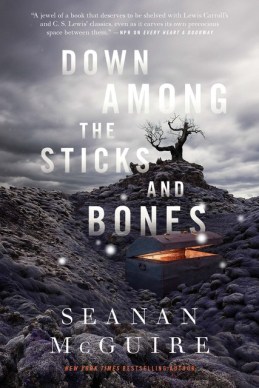 out. And now I’ve had the chance to read the prequel a long time before it comes out, too. It’s out from Tor.com on 13 June 2017…
The blurb says
Twin sisters Jack and Jill were seventeen when they found their way home and were packed off to Eleanor West’s Home for Wayward Children.
This is the story of what happened first.
Jacqueline was her mother’s perfect daughter—polite and quiet, always dressed as a princess. If her mother was sometimes a little strict, it’s because crafting the perfect daughter takes discipline.
Jillian was her father’s perfect daughter—adventurous, thrill-seeking, and a bit of a tomboy. He really would have preferred a son, but you work with what you’ve got.
… and the opening, which is set in the Real World, is about the most horrifying part of the whole thing. Parents who have children because they think it will make them look good, who force children into preconceived notions and potentially do a lot of damage: it’s just hideous. And the worst part is the way that McGuire writes about this from a very knowing, self-aware position: the narrator is pointing out what the parents are doing, making sure the reader knows how dreadful this is. And it works to heighten the horror rather than defuse it; this is not ‘telling instead of showing’, this is a sympathetic yet almost malicious commenter making sure you know exactly what’s happening.
Then the twins find themselves in a different world, and they get to make choices for about the first time ever and those choices have serious implications. And the way they’ve been brought up has consequences for the choices they make, and also doesn’t in the slightest prepare them for them.
I can’t tell you how happy I am that Every Heart a Doorway wasn’t a standalone story. And this is an absolutely standout addition to the world of portal fantasies that McGuire created there, with Other Worlds matching the people who find them and having an irrevocable impact on the inadvertent travellers. I love how McGuire takes bits of other stories and fairy tales and weaves them into her story in her very own way: you get the pleasure of recognition combined with the shock of difference and it’s a delight.
Apparently there will be a third book. I’ll just be over here, watching my inbox, waiting…
Agents of Dreamland
This novella was sent to me by the publisher, Tor.com, at no cost. It will be on sale on 28 Feb, 2017.
 If you’re looking for resolution and answers, do not come to Caitlin Kiernan.
If you’re looking for a linear narrative that moves smoothly through chronological time, do not come to Agents of Dreamland.
If you’re afraid of mushrooms or fungus, do not read this novella.
And if you’re concerned that beings Out There are coming to get us, and that people Down Here are trying to hide that fact… well, you might want to read this, but it won’t give you any reassurances one way or another.
There’s a Waco-syle whacko, and a glitch with New Horizons (which really happened!), and super-secret agents trying to figure out exactly what’s going on and how to save the world. Which may not be possible but I guess we’ll try anyway, and it may require copious amounts of coping alcohol.
Kiernan develops a vision of possible impending doom across the twentieth and twenty-first century, mostly through the experiences of two opaque secret agents and one ex-junkie. It’s not always an easy read but it’s definitely a gripping one. Definitely recommended.
The Song from Somewhere Else
This book was sent to me by the publisher, Bloomsbury, at no cost. It will be out in Australia in December 2016; RRP $24.99 (hardback). Recommended ages 9-12.
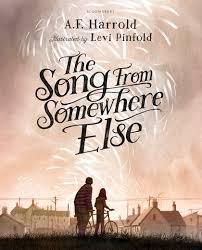 Uh, wow. This book is utterly beautiful and wonderful. Both the prose and the object itself.
The story: bullied girl one day gets rescued by the weird, despised kid. She goes back to his house where she hears haunting, enchanting music, so she goes back the next day. Things get weirder over the next couple of days – and worse, and better. There’s kind-of magic, and real friendship, and problems to overcome.
I smiled. I had tears. I audibly gasped.
This is one of those gentle, insistent, wonderful books that make me happy to be reading. It kinda reminded me of Patrick Rothfuss’ Slow Regard of Silent Things – there’s more plot here, but the sensibility somehow feels similar.
This is also one of those books where I think “by golly I hope I’m not one of those sorts of adults.” Harrold has captured Frank’s voice wonderfully, and an attitude towards adults – their jokes are embarrassing, they can’t or won’t help with bullies, they’re basically oblivious – that feels all too real.
Other things I love about Frank: she has regular cranky discussion with her stomach, which tells her to ignore interesting-if-maybe-dangerous things, points out that things are about to go badly, and occasionally ostentatiously ignores proceedings and reads a newspaper instead. Pure magic. Also, her name is Francesca Patel. One old lady makes some passing comment about “do they have tuna where you’re from?” but otherwise, that’s just her name and I have no idea what she or anyone in her family looks like.
Oh yes – she has a family. There was a slight undertone of Archer’s Goon here; not that the family gets involved, but that they’re present and loving. This is a really nice take on the ‘weird things are happening to the kid but the family has no idea’ trope, without the family seeming evil for their ignorance.
And the book itself? The version I have is a smallish hardback. The pictures, by Levi Pinfold, are gorgeous. Many of the pages have story-appropriate shadows about the edges, and the text largely stays away from them, which is really cute. The front cover gives you an idea of what the internal illustrations look like: as if they’re maybe done in pencil? I don’t know, I’m no artist, but they’re delicate and rely on shadow and light and they’re a wonderful complement to the text.
One slight warning: if you are distressed by descriptions of bullying then this may be just a bit too much for you. I have horrible memories of The Chocolate War and usually hate those sorts of books… and I found the treatment of Frank by the bullies quite nasty. But what makes it work here is that Frank, while definitely and understandably affected, isn’t completely ground down. She doesn’t pretend that everything is ok, and some days it affects her more than others, but she ends up coping. And my heart sang when, seeing one of the bullies having been attacked, she decides to help him: “This wasn’t about him, was it? It was about her and who she wanted to be. She wanted to be a better person. Better than him at least. And not because it was a competition, just because” (161). YES. Just because. I love it.
I have every intention of holding onto this book (… I don’t keep every book…) and putting it into the hands of any kid (and possibly adult) I can.
Imprudence

This is the second book about Prudence, daughter of Alexia Tarabotti and Conall Maccon of the Parasol Protectorate books. I’m pretty sure you’re only going to like these books (the first is Prudence) if ours already invested in the world and the characters.
This is a very silly book. There are silly amusing events, silly amusing misunderstandings, and very silly characters. I enjoyed it but… it is silly.
This book has a lot more about Alexia and Conall than the first Prudence book did – in fact the first third or so is explicitly about them and their relationship with Rue and what’s happening with them and the consequences for everyone. Then things proceed to be more about Rue and the crew of her ridiculous dirigible The Spotted Custard. The action is mostly well paced and the events follow one another smartly; there’s certainly no time for boredom.
As I said, I enjoyed this book but I would have liked it more if I had a better grasp of who Rue is. Perhaps I’m expecting her to be too much like her mother, which is a failing of other people as Rue has grown up and so I’m embarrassed to admit it. But I found her disconcerting because it feels like she vacillates between ‘I’d rather stay at home and have tea’ and ‘daring adventurer!!’ in a way that’s not particularly convincing. I wonder if this is partly because we see her as a toddler in the last Alexia book, and then in her first book she’s 20 – but there’s little filling-in-of-background, not that much explanation for how she came to be the sort of person she is (with the exception of being accepting of non-heterosexuality). So that was a detraction.
It’s a fun, bubbly read, with the sort of attention to dress and food detail that I’ve come to anticipate from Carriger. Not for the Carriger noob, but a nice light read for those fond enough of the world to want to revisit.
Swarm
This book was sent to me by the publisher, Allen & Unwin, at no cost. It’s available now; RRP $19.99.
When I read the first book in this series, Zeroes, I was a bit underwhelmed. I felt like it didn’t fully deliver on its promises – not quite dramatic enough, somehow, or heroic, or problematic. I didn’t hate it… I was just a bit disappointed. So while I was very excited to receive the sequel to review, I experienced some trepidation.
 And then I picked it up. And then I couldn’t put it down. And I read the entire thing in an afternoon… and, ahem, evening; it’s been a while since I read past my bedtime in order to finish a book.
Folks, the sequel is better than the first. Shocking, I know. Continue reading →
The Martian

I’m honestly not sure whether I would have kept on with this book without having the context of the film. Probably? The will-he-survive narrative is a gripping one, after all, and it’s so different from superficially similar narratives. But I was surprised, while reading, to see how different this is from the film. I don’t mean different in terms of plot, although there are a couple of differences – but nothing significant. I mean different in terms of … richness, I guess. Detail. I guess it’s not fair to compare a visual medium with a print one, but some writers manage to convey a richness of detail – not always in a lot of words (Okorafor, Le Guin). Weir is not that person – well, not in this book anyway.
Anyway, I did enjoy it – partly because I’d been wanting to read the source material having loved the film. I liked the science-heavy nature of it: there’s a lot of discussion about chemistry but it didn’t get to Greg Egan levels (I love Egan but even I glaze over at vector diagrams in my SF). Mark Watney is a somewhat less engaging character when he’s just talking to you, rather than accompanied by Matt Damon’s facial expressions – maybe I was spoiled in that regard by the film, but BookWatney has less of a sense of humour, I think. There’s still some nice interactions between the different characters, which I enjoyed, and at least some of the diversity that I enjoyed in the film is present in the book.
Also, because I love this stuff: I am now absolutely convinced that they cast Sean Bean in his role SOLELY for the purpose of that one LOTR joke, and no one will ever convince me otherwise. Plus there’s no way, despite what my beloved thinks about my obsession with conspiracy theories, that it was accidental that two characters who talk together about Watney’s communication access are called “Chuck” and “Morris”.
Recommended for people who like some science in their science fiction. Kudos to the developers of the film for seeing the potential in this book.
Binti: Home
 This novella was sent to me by the publisher at no cost. It will be out on 31 January 2017.
What does it mean to go home?
What does home mean?
What does it mean to belong?
If others don’t accept you, can you belong?
Do genetics equal identity?
If you change, are you still yourself?
What makes people family?
Binti featured Binti leaving home and changing in some fairly drastic ways. Here, Binti goes home, for a bunch of complicated reasons, and is forced to confront the sorts of questions I’ve asked above. She’s forced to confront aspects of herself that have changed – and been changed – and, perhaps more difficult, how her family react to this. She’s also confronted with some unpleasant truths about home and family, all in (in my e-version) about 90 pages.
It’s a bold and striking story of humanity and tradition in the context of an alien-rich galaxy. It’s beautifully written (of course) and there’s a huge amount of tantalising detail that Okorafor just… doesn’t explain much. This in no way impacts on the story; it’s an indicator of rich Okorafor’s writing is. Binti is a wonderful character and I’m so glad to have another part of her story told. I suspect there may be at least one more story coming… .
Also, look at that cover! How awesome is that!
Highly recommended, likely to be on award ballots next year.
Patternmaster
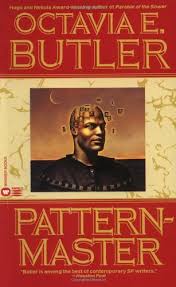 Well, this finally makes sense of Clay’s Ark. You can definitely read this by itself, but it is far stronger as the culmination of the preceding books. I’m genuinely astonished that this was actually her first published novel and that she then went backwards in the story. What a genius.
That said, this is not the strongest book of the series. The Clayarks are just ciphers, really, an enemy for the sake of an enemy; something for the characters to react against.
That also said, there’s definitely some interesting character work here. I especially love Amber, at working with the system but not within in. Teray got a bit wearing after a while.
With the background knowledge of Doro and Mary from previous books, it’s intriguing to fill in the gaps to see how the world at the end of Mind of My Mind could turn into the world here: the development of Houses, how people are seconded, and the attitudes towards mutes. Butler could so easily have written many more stories here, filling in those gaps, but it clearly wasn’t what she was interested in doing.
I was most sad to see Butler expecting there to be sexism and fear of bisexuality present in this future.
The Starry Rift
My copy claims that Sheldon died shortly after completion of this book. WOE.
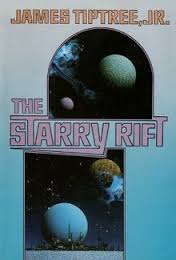 Confusingly, the quote on the front of my copy calls this a science fiction novel, which confused me immensely since I thought Tiptree only wrote two, and I have read them both. Anyway, it became a bit clearer as I read: this is three short stories linked together by the idea of two students asking a librarian at the Great Central Library of Deneb University, for help in their research on humans. So you could tenuously see this as one, 1001 Arabian Nights-style narrative, but I think that’s stretching it a bit..
Anyway, the three stories do all centre on humans; in the first and third, it’s humans in conflict with aliens – new aliens – and in the second it’s human on human violence. They are, despite the conflict, surprisingly positive stories about humans overcoming difficulties. All of the stories take place in or around a place called the Rift: an area of space that is relatively empty of stars, and therefore planets – which, pre-FTL, makes it hard to navigate through (something about needing landmarks, I think).
The first story is definitely my devastating favourite. “The Only Neat Thing To Do” got a number of accolades when it was published, and they are well deserved. Coati Cass is 16, space-mad, and has just been given “a sturdy little space-coupe” for her birthday. So off she goes exploring… and of course, runs into something unexpected. The nobility that Tiptree imagines for Coati, and the realism of her voice, are both just wonderful.
“Good night, Sweethearts” is an interesting story of identity, celebrity, loss and starting over. It’s a good story but it doesn’t really stand out for me.
Lastly, and longest, is “Collision”. This story is told both by humans and by the aliens with whom they are coming into contact; the conceit is that this story has been constructed through interviews with participants. There’s a human exploration team, and there’s bad humans called Black Worlders who have been doing some nasty things, and there are aliens who are getting angry at humans… The blurb says that “explorers cross impassable chasms of language, biology and hallucination to prevent a new age of war,” which about sums it up. Like I said before: surprisingly positive.
Overall this may not be quite the strongest of Tiptree’s work, but it’s still damn fine and should be read for “The Only Neat Thing To Do” anyway.
Bonus note: referencing your own work (Brightness Falls from the Air) to make sure it’s clear these stories are in the same world. Good work, Tip!
Clay’s Ark
 Having read Wild Seed and Mind of My Mind, this was not at all what I expected of a book set in the Patternmaster series. It seems only peripherally attached to the Patternmaster series courtesy of something Clay, whom we meet in Mind of My Mind, developed.
Still, the book deals with some of the same preoccupations as are developed in the first two books, in particular how people manage go live under compulsions and especially how that impacts on sex and relationships and children. It was interesting to see Butler explore similar issues coming about from different motivations.
In itself, this is a very different sort of contact story from what is more commonly written. The contact is almost just a macgyver to allow the exploration of how confinement and externally imposed obsessions might play out.
Not Butler’s strongest work, but intriguing and enjoyable (well… within the bounds of devastating sf…) nonetheless.
Later: having now read Patternmaster, this book makes a bit more sense. Interestingly, I think this is the stronger.

 Randomly Yours, Alex