Paper
 I have loved everything I’ve read by Mark Kurlansky. So when I was in a small bookshop in a small town and saw a new book from him, I was pretty stoked. I half considered buying it as an e-version, partly because OH THE IRONY, but then my darling fawned her how pretty it is (and it really is very pretty, with rough-edged paper and all), so I bought the bard-back. Supporting small book shops for the win.
Tragically, I am disappointed.
I was trying to pin down exactly why the book didn’t work, and halfway through I realised: each paragraph felt like an extended dot point. Like he had all of these great ideas and fascinating points, mostly connected to paper, but… couldn’t quite nail the flow and structure. There are weird disjointed bits that entirely lack in connection, there are some fascinating bits about language and so on that aren’t clearly tied to paper, and… well. Disappointed.
I appreciated his discussion of the technological fallacy: that tech happens and then society follows. Rather, he argues, society creates a demand and THEN technology follows, playing catch up: why else is so much money spent on market research? So I liked that bit. However, as someone has pointed out to me, Kurlansky is entirely too linear in his perspective on the relationship between change and society. Civilisation just isn’t like that.
More serious than the lack of sequencing, though, were a few points where he was just… kinda wrong. For instance: he suggests that some people credit Ada Lovelace with inventing computers, and then reveals that actually she was inspired by Charles Babbage. And, uh, no. She invented the first computer language, and it’s no secret she worked with Babbage! … so this makes me a little concerned when he’s discussing those bits of history that I don’t actually have knowledge of. Because… can I trust him?
I gave it a four over on Goodreads because the ideas and the history really are fascinating, but the book itself as a piece of text ought to get a three.
River of Teeth
 This novella was sent to me by the publisher at no expense. It will be on sale at Tor.com on May 23.
HIPPOS. Hippos, folks. There need to be more hippos in my literature.
The foreword states that the American Congress debated importing hippos at the start of the 20th century, to resolve a meat shortage. I have no idea whether this is true. I presume it is; the foreword says it is. I could google it… but I choose not to, and live in the world where I believe that America actually considered ranching hippos. Because that’s way more fun than not.
And what’s even more fun than living in that world is this, Sarah Gailey’s debut. (Seriously? debut? kick. ass.) It’s an alternative history (which means it’s definitely not true, despite some recent definitions of ‘alternative’), pushing the date of hippo-introduction back half a century and imagining the consequences of actually hippo-ranching. Like cowboys riding hippos, and hippos going feral, and breeding hippos for stealth to help deal with the ones being raised for meat.
I’m just going to stop here for a moment and consider eating hippo-meat. Because… I dunno, the Anglo-Celt of my heritage just wants to gag.
Anyway, this is a crazy romp filled with wonderful characters and, as the name suggests, a whole lot of hippo-teeth-gnashing. Winslow Remington Houndstooth, putative lead and leader, is filled with desires for revenge and does his own share of teeth-gnashing. He rides Ruby: black, sleek, fast and deadly. Wonderful as he is, I adore Regina Archambault more: “Nobody ever suspects the fat lady”… who pickpockets and breaks hearts and helps save the day. She rides Rosa: three thousand pounds of albino hippo. Hero is also wonderful, and all about blowing stuff up (always the way to my heart), and the rest of the team fills out nicely. There’s a good villain (or two, or three…), so that’s the character side all sorted. There’s explosions, and card games, and feral hippos that are happy to eat people; romance, confusion, and a lot of crankiness and snark. OH THE SNARK.
You’ll want to get your mitts on this one, folks. It’s just way too much fun to miss out on.
Cooked, by Michael Pollan
 This book was recommended to me by the sourdough baker whose course I took. It turned out that I had already one of Pollan’s books – The Botany of Desire, which was awesome and looked at various plants in light of the general idea of desire. (My biggest take away message: the Agricultural Revolution was the grasses using humanity to destroy the trees. Also that all edible apples are clones.)
This book is Pollan’s attempt to learn more about cooking, having looked at the gardening and the eating side for a long time. He divides the book into four sections: Fire, Water, Air, Earth. Or, basically: barbecue, braise, bread, and fermenting. Continue reading →
Proof of Concept
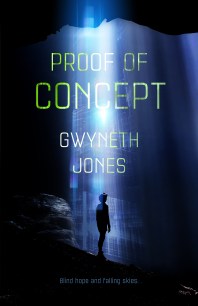 This novella was sent to me by the publisher, Tor.com, at no cost. It will be out on 11 April, 2017.
Um. Wow. No seriously. Terrifying and amazing and absolutely captivating.
Jones is saying a lot about modern society in this novella and most of it isn’t very nice. She’s also presenting a compelling story and believable characters and… this is yet more evidence that novellas are a fantastic length for stories.
There’s been a lot of discussion recently about how facebook mediates news and how people who only get their news from facebook can end up in an echo-chamber, essentially, with their own opinions endlessly reflected back to them. Jones presents GAM: Global Audience Mediation. An avatar, the AI of GAM, asks questions for news broadcasts – it’s “the statistical sum of… real-time responses” from the global audience (4). It’s crowd-sourced journalism, where presumably minority views and questions get drowned out in the fantastically huge audience. No room for dissenting voices then. Then there’s the broadcasts of the VLDMT (Very Long Duration Mission Training) – in theory Earth 2-like training situations for people who might go on interstellar missions, but effectively ending up like reality tv – Big Brother in extremis.
And this isn’t even really what the story is about. They’re just creepy incidental issues that Jones throws in to show that this is a real and believable future story. I love Gwyneth Jones.
What the story is actually about is getting off Earth as the population and climactic situation gets progressively worse and worse. There are two solutions being proposed: the VLDMT people imagine a space ship, while Margrethe Patel is working on a method of hyperspatial travel that shifts within 4D information space. (Happily, Jones is not Greg Egan, so there’s no vector diagrams to attempt to understand.) The two groups come together when an enormous abyss is discovered under Poland and it appears to offer a place to practise for both groups. They need complete isolation from the rest of the planet, and things go from there…
Did I mention that the focal character, Kir, has an AI in her head? Yeh. There’s a huge amount going on here.
I loved Kir and how she faces the various problems – like annoying people and difficult work – that confront her. I was gutted by how Jones imagines this possible future, and I was enthralled by what she imagines as solutions. If you like science fiction you need to read this story. When it’s available.
The Light that gets Lost
This book was sent to me by the publisher, Bloomsbury Children’s, at no cost. It’s on sale now; RRP $19.99.
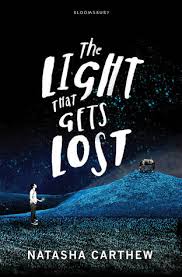
The promo material that comes with this says it’s for 12+ years. Me, I wouldn’t give this to a 12 year old that you wouldn’t give Lord of the Flies to – and I’m guessing that’s most of them. It’s been a while since I read Lord of the Flies but there are definite overtones of that scenario in Carthew’s book, especially in the second half. I rather feel a kid would need to be a bit robust to read and enjoy this, because it’s certainly not all rainbows and cupcakes. I know dystopia is (was) all the rage but this feels a bit closer to home than that…
The set up sees Trey, as a small child, hiding in a cupboard while his parents are murdered. What a cheery opening, right? And then the story skips forward eight years and Trey is getting himself into a farm camp for juvenile criminals, in theory intended to train the adolescents in useful skills but in reality more like forced labour. Trey has willingly gone there in order to try and find the man responsible for his parents’ deaths. Which is a bit messed up I think.
There are some really interesting ideas here, but for me some of the better ones are the ideas that get mentioned and then lost. It becomes clear int he second half that society outside of the camp isn’t exactly the society of Britain (I think) in 2016… but exactly what’s going on and how it got there is never explored. It’s just mentioned in passing, almost for no reason, and then ploop… disappears. The entire set up of the farm isn’t explored or explained in that much detail, so it just sort of… exists… as a place for things to happen.
The main focus of the story is friendship and revenge. Friendship in this kind of environment is always going to be a bit fraught, what with sadistic overseers and bullies and a system aimed at breaking kids down. The friendship between Trey and a boy in his bunk room, Lamby, is believable enough but I didn’t always buy the friendship between Trey and Kay, a girl with whom he ends up doing farm work. It might have been a bit more believable if there had been other female characters with whom we got to see Kay interacting, or even Trey interacting with them.
The revenge aspect drives the initial part of the plot and again I didn’t entirely buy the eight year old boy turning into an adolescent so driven by revenge that it’s as if there’s a demon under his skin. This idea of a demon gets a few mentions – including on the back cover – but isn’t really explained; Trey occasionally talks to it but it’s not clear what we’re meant to think is going on. Maybe that’s left deliberately ambiguous but it didn’t work for me in this context. There is some resolution to this revenge plot but, again, it didn’t entirely work for me.
This all makes it sound like I hated the book, but I didn’t. I didn’t love it, but neither did I loathe it. Cart hew writes beautifully on a sentence level; the Financial Times apparently described her as using “vivid, imagistic language” and certainly a lot of the language is vivid. Some of the lacunae are obviously deliberate and evocative, which I liked, it just didn’t always sit well with the plot.
Down Among the Sticks and Bones
So yes, I’m very privileged. I got to read Every Heart a Doorway a long time before it came 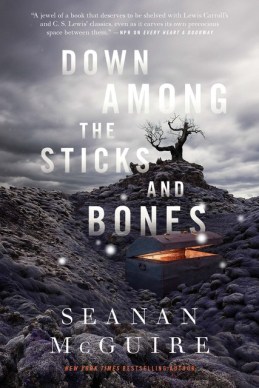 out. And now I’ve had the chance to read the prequel a long time before it comes out, too. It’s out from Tor.com on 13 June 2017…
The blurb says
Twin sisters Jack and Jill were seventeen when they found their way home and were packed off to Eleanor West’s Home for Wayward Children.
This is the story of what happened first.
Jacqueline was her mother’s perfect daughter—polite and quiet, always dressed as a princess. If her mother was sometimes a little strict, it’s because crafting the perfect daughter takes discipline.
Jillian was her father’s perfect daughter—adventurous, thrill-seeking, and a bit of a tomboy. He really would have preferred a son, but you work with what you’ve got.
… and the opening, which is set in the Real World, is about the most horrifying part of the whole thing. Parents who have children because they think it will make them look good, who force children into preconceived notions and potentially do a lot of damage: it’s just hideous. And the worst part is the way that McGuire writes about this from a very knowing, self-aware position: the narrator is pointing out what the parents are doing, making sure the reader knows how dreadful this is. And it works to heighten the horror rather than defuse it; this is not ‘telling instead of showing’, this is a sympathetic yet almost malicious commenter making sure you know exactly what’s happening.
Then the twins find themselves in a different world, and they get to make choices for about the first time ever and those choices have serious implications. And the way they’ve been brought up has consequences for the choices they make, and also doesn’t in the slightest prepare them for them.
I can’t tell you how happy I am that Every Heart a Doorway wasn’t a standalone story. And this is an absolutely standout addition to the world of portal fantasies that McGuire created there, with Other Worlds matching the people who find them and having an irrevocable impact on the inadvertent travellers. I love how McGuire takes bits of other stories and fairy tales and weaves them into her story in her very own way: you get the pleasure of recognition combined with the shock of difference and it’s a delight.
Apparently there will be a third book. I’ll just be over here, watching my inbox, waiting…
Agents of Dreamland
This novella was sent to me by the publisher, Tor.com, at no cost. It will be on sale on 28 Feb, 2017.
 If you’re looking for resolution and answers, do not come to Caitlin Kiernan.
If you’re looking for a linear narrative that moves smoothly through chronological time, do not come to Agents of Dreamland.
If you’re afraid of mushrooms or fungus, do not read this novella.
And if you’re concerned that beings Out There are coming to get us, and that people Down Here are trying to hide that fact… well, you might want to read this, but it won’t give you any reassurances one way or another.
There’s a Waco-syle whacko, and a glitch with New Horizons (which really happened!), and super-secret agents trying to figure out exactly what’s going on and how to save the world. Which may not be possible but I guess we’ll try anyway, and it may require copious amounts of coping alcohol.
Kiernan develops a vision of possible impending doom across the twentieth and twenty-first century, mostly through the experiences of two opaque secret agents and one ex-junkie. It’s not always an easy read but it’s definitely a gripping one. Definitely recommended.
The Song from Somewhere Else
This book was sent to me by the publisher, Bloomsbury, at no cost. It will be out in Australia in December 2016; RRP $24.99 (hardback). Recommended ages 9-12.
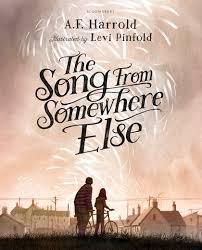 Uh, wow. This book is utterly beautiful and wonderful. Both the prose and the object itself.
The story: bullied girl one day gets rescued by the weird, despised kid. She goes back to his house where she hears haunting, enchanting music, so she goes back the next day. Things get weirder over the next couple of days – and worse, and better. There’s kind-of magic, and real friendship, and problems to overcome.
I smiled. I had tears. I audibly gasped.
This is one of those gentle, insistent, wonderful books that make me happy to be reading. It kinda reminded me of Patrick Rothfuss’ Slow Regard of Silent Things – there’s more plot here, but the sensibility somehow feels similar.
This is also one of those books where I think “by golly I hope I’m not one of those sorts of adults.” Harrold has captured Frank’s voice wonderfully, and an attitude towards adults – their jokes are embarrassing, they can’t or won’t help with bullies, they’re basically oblivious – that feels all too real.
Other things I love about Frank: she has regular cranky discussion with her stomach, which tells her to ignore interesting-if-maybe-dangerous things, points out that things are about to go badly, and occasionally ostentatiously ignores proceedings and reads a newspaper instead. Pure magic. Also, her name is Francesca Patel. One old lady makes some passing comment about “do they have tuna where you’re from?” but otherwise, that’s just her name and I have no idea what she or anyone in her family looks like.
Oh yes – she has a family. There was a slight undertone of Archer’s Goon here; not that the family gets involved, but that they’re present and loving. This is a really nice take on the ‘weird things are happening to the kid but the family has no idea’ trope, without the family seeming evil for their ignorance.
And the book itself? The version I have is a smallish hardback. The pictures, by Levi Pinfold, are gorgeous. Many of the pages have story-appropriate shadows about the edges, and the text largely stays away from them, which is really cute. The front cover gives you an idea of what the internal illustrations look like: as if they’re maybe done in pencil? I don’t know, I’m no artist, but they’re delicate and rely on shadow and light and they’re a wonderful complement to the text.
One slight warning: if you are distressed by descriptions of bullying then this may be just a bit too much for you. I have horrible memories of The Chocolate War and usually hate those sorts of books… and I found the treatment of Frank by the bullies quite nasty. But what makes it work here is that Frank, while definitely and understandably affected, isn’t completely ground down. She doesn’t pretend that everything is ok, and some days it affects her more than others, but she ends up coping. And my heart sang when, seeing one of the bullies having been attacked, she decides to help him: “This wasn’t about him, was it? It was about her and who she wanted to be. She wanted to be a better person. Better than him at least. And not because it was a competition, just because” (161). YES. Just because. I love it.
I have every intention of holding onto this book (… I don’t keep every book…) and putting it into the hands of any kid (and possibly adult) I can.
Imprudence

This is the second book about Prudence, daughter of Alexia Tarabotti and Conall Maccon of the Parasol Protectorate books. I’m pretty sure you’re only going to like these books (the first is Prudence) if ours already invested in the world and the characters.
This is a very silly book. There are silly amusing events, silly amusing misunderstandings, and very silly characters. I enjoyed it but… it is silly.
This book has a lot more about Alexia and Conall than the first Prudence book did – in fact the first third or so is explicitly about them and their relationship with Rue and what’s happening with them and the consequences for everyone. Then things proceed to be more about Rue and the crew of her ridiculous dirigible The Spotted Custard. The action is mostly well paced and the events follow one another smartly; there’s certainly no time for boredom.
As I said, I enjoyed this book but I would have liked it more if I had a better grasp of who Rue is. Perhaps I’m expecting her to be too much like her mother, which is a failing of other people as Rue has grown up and so I’m embarrassed to admit it. But I found her disconcerting because it feels like she vacillates between ‘I’d rather stay at home and have tea’ and ‘daring adventurer!!’ in a way that’s not particularly convincing. I wonder if this is partly because we see her as a toddler in the last Alexia book, and then in her first book she’s 20 – but there’s little filling-in-of-background, not that much explanation for how she came to be the sort of person she is (with the exception of being accepting of non-heterosexuality). So that was a detraction.
It’s a fun, bubbly read, with the sort of attention to dress and food detail that I’ve come to anticipate from Carriger. Not for the Carriger noob, but a nice light read for those fond enough of the world to want to revisit.
Swarm
This book was sent to me by the publisher, Allen & Unwin, at no cost. It’s available now; RRP $19.99.
When I read the first book in this series, Zeroes, I was a bit underwhelmed. I felt like it didn’t fully deliver on its promises – not quite dramatic enough, somehow, or heroic, or problematic. I didn’t hate it… I was just a bit disappointed. So while I was very excited to receive the sequel to review, I experienced some trepidation.
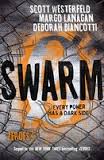 And then I picked it up. And then I couldn’t put it down. And I read the entire thing in an afternoon… and, ahem, evening; it’s been a while since I read past my bedtime in order to finish a book.
Folks, the sequel is better than the first. Shocking, I know. Continue reading →


