Hugo Awards: the novelettes
As I said in the last post, I decided to read the Hugo-nominated fiction because I wanted to be able to comment on their merit, as well as the politics.
The novelettes: no, no, no, no and no. Again, nothing worthy of a Hugo nomination in my opinion.
“Ashes to Ashes, Dust to Dust, Earth to Alluvium,” Gray Rinehart: I kinda liked the concept, but the characters were nothing and there was no fleshing out of consequences either physical or metaphysical. Could probably (can’t believe I’m saying this) make an interesting novel if some effort was put in to the characters, especially.
“Championship B’Tok,” Edward M Lerner: a somewhat interesting premise although not at all original. Some military speak, some boring characterisation.
“The Day the World Turned Upside Down,” Thomas Olde Heuvelt: I feel like this definitely owes something to “The Water that falls on you from nowhere” – which isn’t necessarily a bad thing, it did win a Hugo after all, but it doesn’t make itself different enough. I didn’t like the main character, which isn’t a problem necessarily, although I think we are meant to sympathise and I just couldn’t do that. Better than the other nominees buuuuut still not award material.
“The Journeyman: In the Stone House,” Michael F Flynn: did not finish. Excruciating to try and read, characters utterly unappealing.
“The Triple Sun: A Golden Age Tale,” Rajnar Vajra: plucky young things manage not to get themselves killed or thrown out of the service by being obnoxiously cleverer than people who’ve been on the ground for some length of time. Weird aliens are weird and not developed enough.
The Goblin Emperor
… There’s going to be more, right?
 This is really not the sort of book I would have been likely to read immediately off my own bat. 15 years ago, perhaps, but I haven’t really read secondary world fantasy like this for ages… and not necessarily for a reason I can put my finger on, aside from I Like Spaceships More.
Still, it’s on the Hugo ballot in The Time Of Rabid Puppies, and a lot of people whose opinion I generally respect have raved about it, so I wasn’t too sad to be sitting down with it as part of my Read The Hugo Ballot binge.
And I really liked it.
This stills seems improbable to me. Lots of ‘thee’s and formal ‘you’s and so on – the sort of thing that sometimes makes me break my eyes in the rolling. It’s goblins and elves for… no reason I can see? The elves have non-human ears which you only know because they’re described as doing things like flattening when the person is annoyed, and goblins just seem to have darker skin and maybe grow bigger than elves? But goblins and elves do intermarry; Our Hero is a product of just such an (unhappy, arranged) alliance.
And it’s not like the book is startlingly original in its plot. Emperor and his sons all die together, leaving one nearly-forgotten son by aforementioned unhappy marriage to inherit the throne. There are political machinations, palace intrigues, quandaries over who to trust, questions over whether someone in such a position can have real friendships… y’know, the normal things that happen when an unlikely heir takes the throne. We’ve all been there.
And yet. And yet. It works. Much of this is down to Maia, Our Hero. He may be the forgotten heir but he’s not completely stupid; clueless at times but not a Garion figure; possessed of a brain and determination and a desire to do some things his own damn way, thank you very much. I’m reminded somewhat of the story I heard once about Queen Victoria: that when she was crowned (I think?), one of the first decisions she made was to sleep in her room by herself – without her mother – for the first time ever. Maia isn’t just led around by the nose. But neither is he super arrogant, thinking he can do anything he likes and deciding to do just that; nor is he super capable in an impossible period of time. Addison strikes a good balance of learning the ropes and being actually, like, capable.
I liked many of the other characters (Csevet for the win), and the variety of female characters is really nice. I like the honesty with which Addison confronts the issues of arranged marriages, and the different ways of thinking about things like duty and honour.
Basically, when I finished reading it (in one day), I wrote that opening sentence: there
is going to more, right?
The Three-Body Problem
What on earth can I say? If I said “Liu Cixin is like a Chinese Greg Egan” that gives some idea of the complexity of the science… and I cannot imagine what it must have been like for Ken Liu to translate those sections.
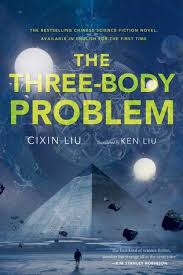 The focus of the novel is split over a few characters and periods:
Some of it is set in the Cultural Revolution of the 60s, and explores some of the consequences of this for academics in particular, via one woman and her family. I have taught this era (only once, but that’s better than naught), so I have no idea what the average reader would bring to this – and especially not what an average American reader would think. Ken Liu has done a good job of providing some footnotes with explanations, without (I thought) interrupting the flow of the narrative too much. A young woman, Ye, whose family was targeted ends up working at a mysterious scientific/military outpost…
Some is set in a ‘present’ that I don’t remember being identified, but is not one of William Gibson’s ‘tomorrows’ – it felt perfectly normal. Here, a scientist starts encountering weird things and gets drawn into an investigation that turns out to be even weirder than expected, and involves the whole world (there are scenes involving the Chinese military brass and NATO officers which had me shaking my head at the possible ramifications).
Some it is set in-game: the scientist, Wang, starts playing a game called Three-Body Problem – which it took me ages to realise is the conundrum of how to figure out the physics of three bodies interacting with each other gravitationally (it’s been a while since I thought physics, ok?). The game is connected to the investigation and also allows Liu to write THE most hilarious description of people physically being a computer ever, and this from someone whose knowledge of computational logic is non-existant (NAND and NOR gates? I admit my eyes glazed over somewhat…).
Some of it is set… elsewhere… not telling where.
I liked Ye a lot; the complexities of being first condemned, and then being considered useful but still politically unreliable, then rehabilitated into society – it’s done very nicely. I didn’t like Wang as much, which I think was mostly to do with his attitude towards his wife and son: basically he ignored them, and I found this quite unpleasant. Da Shi, a policeman involved in the investigation, is magnificent and is the character I would most like to see in a mini-series version of the book.
I had heard that some people thought there was a lot of emphasis on the Cultural Revolution, so I was surprised to find that for me, at least, it’s not actually a very big part of the story – page-wise anyway. It’s certainly of fundamental importance in Ye’s development, don’t get me wrong, but there’s definitely far more time spent in the present (and probably more time spent in-game by one of the characters, although I haven’t checked the page numbers to confirm that).
I am beyond impressed that this made it on to the Hugo ballot (yes yes after one of the Rabid nominees pulled out). I’m really glad it did, since it made me read it sooner than I otherwise would have. I really enjoyed it. There are some parts where, as with a Greg Egan novel, I skimmed over some science because I just can’t come at the physics anymore. But that wasn’t a problem with understanding the plot or the characters, and actually – especially considering this is a translation – much of the science-speak was quite accessible. (Ken Liu has an interesting discussion of the issues of translation at the end of the version I read, which was in the Hugo packet; it’s a very thoughtful essay about staying true to the vibe of the thing as well as/instead of staying true to the actual words and phrases used.) I discovered only when I got to the end that this is the first in a trilogy… I believe I may well be reading the rest.
But who am I going to put first on my Hugo ballot?!?
Beauty, by Sheri Tepper
Sheri Tepper looked at a map showing the boundaries of different genres and, taking a fine black marker, drew her own shape instead.
 Fantasy: there’s magic and faeries and they’re a real part of the world.
Science fiction: time travel and a dystopian future are integral to the plot.
Fairy tale retelling: the titular character is meant to be Sleeping Beauty (… and that phrase should be understood in a couple of different ways).
Horror: a couple of sections, for my tastes anyway.
Christian allegory: tied in with the Faery aspects, they work quite nicely.
Bildungsroman: the novel covers pretty much the entirety of Beauty’s life.
Environmental cry for help: the future is a horrible place unless we get on with changing things NOW.
Family drama: oh yes. Oh my yes.
I know there are other authors who do similar things, but it’s rare to find such a magnificent combination of elements that are traditionally ‘fantasy’ (faery, fairy tales, etc) with those that are science fiction (time travel in particular). I can absolutely see why Tepper is being honoured with the World Fantasy Lifetime Achievement Award, and this is the first of her books I’ve read (… I’m pretty sure…). There is just no question for her that of course a dystopia can coexist with the concept of magic, that fairy tales can be reworked together with time travel.
14th-century Beauty lives with maiden aunts and her father, when he’s not off crusading. Her mother died in childbirth, or so she’s been told, but when her father intends to marry again, she discovers that maybe things are weirder than expected. And then things get really weird when she encounters people from the future and she is whisked away with them, to a decidedly brutal and unpleasant future of billions of people, little room to move and less food. She doesn’t stay there, but ends up travelling… elsewhere…
Look, I can’t say too much else about this book because finding all the amazing twists and turns is an absolute joy. Tepper writes beautifully, at times grimly; she constructs a complex character in Beauty and surrounds her with genuinely varied friends and foes and family. SO MUCH happens in fewer than 500 pages. It’s magnificent.
Aurora, by Kim Stanley Robinson
New science fiction from Kim Stanley Robinson! HOORAY.
(This book was provided to me by the publisher. You can get it from Fishpond.)
 PRETTY excited to get this book. Enough that I actually started reading it the day it arrived – and would have finished it that day too had I not decided to Be An Adult and stop reading at a somewhat sensible hour in order to sleep. And overall I was very happy with it – some nice big ideas, characters fairly good, some action and good plot twists. My delight is not unalloyed, but the issues I had are not enough to stop me from being happy about Aurora‘s existence.
The non-spoilers should-you-read-it: did you like Robinson’s 2312? Do you like Alastair Reynolds books? Then probably yes: don’t read more here, just go get it.
…
Slightly more detail: the book opens with Freya and her family living what appears to be a normal life. Her mother, Devi, is kept very busy dealing with issues of algae and salt and oxygen, because they live on a generation ship that is heading to what they hope will be a habitable world. I love a good generation ship story: Elizabeth Bear’s Jacob’s Ladder series was awesome, I enjoyed much of Beth Revis‘ Across the Universe stories (although the relationships were wearing by the end), and Stephen Baxter’s had a go at it too (plot taking precedence over character, usually). So this is already a good premise for me.
We join the crew within years of arriving at Aurora – of course, because it’s hard to do a good story about the middle of the journey, unless something is going drastically wrong. Anyway, they do eventually get to Aurora, and Things Happen (it’s approaching 500 pages in trade paperback; you didn’t think it was going to be all sunshine and roses, did you?). The Things That Happen are logical and consistent with the characters as revealed; they also give insights into how Robinson views humanity which, while not earth-shattering revelations, are nonetheless poignant and worthy of consideration. How do humans cope with setbacks? How do humans cope with disagreement? What price progress?
For a ship of 2000-odd, the cast of central characters is relatively small. Freya is the central human character, so there’s an element of the coming-of-age story – she’s becoming an adult as the ship completes its quest, there’s dissension within the family, and so on. I wasn’t entirely happy with Robinson’s description of Freya at some points; he suggests things about her nature and then never builds on it or challenges it. Nonetheless I found her a useful focus for the narrative; being young she’s out and about learning and meeting people, rather than stuck in a job. And given that the novel covers a fair amount of time, Freya gets to age and I think that’s often a really great thing in a character.
Interestingly, the other point of view character is the ship’s AI, thus allowing Robinson to have intimate knowledge of humanity and show the broader sweep of actions, decisions, and ramifications. I liked, too, that the AI developed and changed. There’s a little section that tickled the Arts student in me pink: the computer learning about how to construct a narrative. So meta, very wonderful.
However… issues. I had a couple.
Firstly, it surprised me that a book set in the 26th century would talk about the Old and New Worlds. Really? Maybe this is an American thing because it’s not something we in Australia say – and surely in 500 years that will be even less relevant? If the builders of the ship (who lived around Saturn, making this demarcation even weirder) insisted on some Earth-analogue in splitting up the two Rings, why not make it Northern and Southern Hemisphere? It does at least have some basis in geography, rather than an old and surely irrelevant socio-political perspective.
Secondly, the ending. SPOILERS. (Other spoilers follow, too.)
WHY? I presume Robinson is trying to say something about physicality and Earth being the right place to be? I dunno. To me it came across as ‘if you don’t surf you don’t understand the world.’ It felt out of place in the story overall and disappointed me given how much I liked the rest of it. I would have liked a bit more from Freya’s arc.
Thirdly – and something that I’m not sure, overall, whether I’m entirely on board with – the decision to go back to Earth. It’s only feasible, in the end, because they get the hibernation thing worked out, although I guess when they leave Aurora the situation didn’t look so dire. But… it’s been seven generations. Most people haven’t been paying attention to any of the news feeds from Earth for years, if ever. Would they really feel such a deep call to go back, when Aurora is a failure? I guess most of them would just have been thinking they’d be staying on the ship (all they’d ever known), and their children’s children etc would be the ones to arrive in the home solar system… but still. I’m really not sure. It feels like Robinson is suggesting there’s a deep feeling of attachment to this ball of mud that doesn’t just rely on personal experience.
All Men of Genius
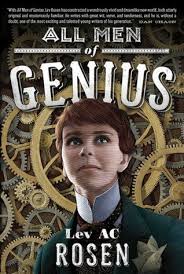
Rosen takes a large dose of Shakespeare (As You Like it, specifically); adds a liberal dose of mad science and a pinch of Ada Lovelace; shakes gently, and decants the resulting mixture in fairly smooth prose to produce a generally enjoyable book, with a somewhat abrupt and disappointing finish.
The first thing to know about me and this book is that with one exception (Much Ado About Nothing, thank you Kenneth and Emma), I basically loathe Shakespeare’s comedies. I do not like twins. I do not like mistaken identity. I do not care. I will not go and watch a comedy if I have a choice do not even try.
Rosen, however, made me care, because finally there is a good reason for identity swapping rather than just the amusement of seeing a man in a skirt pretending to be a man (oh HA HA geroffthastage). But taking your brother’s identity in order to get into the most prestigious science academy in London in order to make crazy beautiful science with the full intention of revealing yourself as a lady at the end of your first year? VIOLET I LOVE YOU.
The fact that your brother is gay and you don’t have a problem with that is just extra cute and an additional bit of sticking it to the establishment.
I liked it. If you like slightly artificial prose (not as jaunty as Gail Carriger but that sort of thing) and some seriously mad science, this is a fun book. There are lots of gears. And talking rabbits. No really, it’s funny, if lacking in ethics. Also invisible cats, difficult decisions, and cranky professors.
Thoughts for people who’ve read the book: SPOILERS AHOY!
I really enjoyed Violet’s interactions with the other students, overall; it’s a slightly grown-up version of boarding school romps, basically (like, the drinking is legal). I was really pleased that Rosen allowed Jack and Violet to be and remain good friends – I guess it helped that Jack had his sights firmly fixed on Cecily – and that it turns out Drew knew she was female for a while and it just didn’t matter. Hooray for cross-gender friendships!
I generally liked Cecily. I liked that she was good at science, and wanted to be good at science. I was bemused by her attachment to the rabbit, since it made this intelligent young woman seem like she was about six. I also generally liked Miriam, and I was fascinated by her status as a dark-skinned, widowed, Jew… but it did feel a bit tokenistic. That is, I am perfectly fine with her being all of those things, but Rosen begins to explore the ramifications of those aspects of her identity aaaaaand doesn’t fulfil the promise.
Other things that didn’t work so well:
The relationship between Violet and the duke is a bit ugh. The age difference is icky. The ‘but I don’t think I’m an invert!’ (Rosen’s word, presumably – I hope! – historically appropriate) attitude from the duke after kissing Violet-as-Ashton skirted, and may have fallen into, problematic (I’m cis, I’m no judge).
The switching of voices. What for, Rosen? The fact that it doesn’t properly start until well into the book makes it particularly weird. I liked Fiona well enough but I really didn’t need her perspective, nor that of the duke, nor Cecily or Miriam’s, unless they were all going to be as thoroughly explored as Violet’s. Which they’re not. And Ashton is distinctly left out, really, which makes no sense.
The ending. The marriage happens waaay too fast – or it could have happened in as few pages but there needed to be a bit more about how it all got resolved, and wait a minute isn’t she a bit young??
Incandescence
Another in my long slog towards Reading Everything By Greg Egan, Dammit.
When I started this last week, I was completely thrown: it was familiar. Like, I had definitely read this before. Yet I had definitely got it from the TBR shelf, so… wha? I thought about it, and I didn’t remember the ending, but let’s be honest – that’s not exactly unusual for me. So I read a few more pages – still familiar. I read ahead 20 or so pages – getting less familiar. Eh; I decided just to keep reading, and see what happened. Turns out that at some point, I read the first 50 or so pages, and then gave up. I have no idea why I would have given up at that point, because it’s not even like this is a particularly hard book as Egans go.
 That is to say, if you don’t like entire pages of dense scientific discussion and you’re not the sort of person who is happy to skim that to get back to the plot, do not read this book. It’s ok; it’s no reflection on you; it’s just not going to be a happy match-up between the two of you and it’s not worth your time getting annoyed.
Even more than any other Egan until the Orthogonal books (The Clockwork Rocket and Eternal Flame), half of this book is unashamedly working through a scientific revolution. In a society where things just are the way they are and curiosity isn’t rewarded – cooperation and teamwork are, hormonally – one misfit manages to co-opt a fellow worker into being curious about the way weight changes in different parts of their habitat, and… from there, you get an explosion of scientific discoveries. How does that even work? What sort of questions do you even need to ask in order to discover basic principles of gravity, for instance? Egan throws himself, and the reader, into these issues – without forgetting that they occur in a vacuum, and therefore also incorporating discussions of social change and disruption and, because this is Egan and it’s just what he does, a bit of gender role discussion as well.
Seriously. This man.
The other half of the book is a slightly more straightforward SF plot, where the far-future equivalent of a bored early-20-something seems to handed the puzzle of a lifetime and he sets off on a joyride around the galaxy, complete with sidekick. Well, not quite, but close. You could definitely take these chapters and have a fairly good SF novel, anyway, about the differences between living in the disk of the Milky Way and living in the bulge, and how you might go about being a detective with all sorts of cool gadgets (wait til you read about the telescope they construct). The reference to the sidekick is a little unfair; Parantham is not just along to have ideas bounced off. He/she is an undeveloped character in many ways; not descended from DNA but rather – to put it crudely – from AI, Parantham allows Egan to suggest issues around body perception and suchlike but doesn’t do that issue justice. The not-quite adolescent, Rakesh, verges on petulant and annoying and just manages to avoid being such, most of the time. Their interactions are interesting enough and certainly add a different dimension to the novel overall.
In the end, I enjoyed this. It’s not Egan’s greatest, by any stretch. It’s a clever way of thinking through some scientific issues, and it has some nice character moments. Probably not the place to start with reading Egan, though.
SPOILER –>
I really thought this was going to end with Rakesh helping the people of the Splinter, and with a discussion of the role of the Aloof. As the pages kept turning and there was no actual contact, I just could not figure out where Egan was going with it. When I got to the last page, I admit I was flummoxed at first. But then I realised: Rakesh had been interacting with much later generations of the Splinter. They weren’t happening at the same time, at any point! Not that Egan had ever suggested they were, of course. I quite liked this.
The Book of Strange New Things
 Importantly, I am a Christian.
Also, this is a complicated book and my reactions are complicated, so I may not always be completely coherent….
Overall:
A company called USIC has established a base – a colony in all but name – on a habitable planet they’ve called Oasis. It already has a sentient species living there. Peter, a Christian minister, gets the job to go and evangelise to these aliens. How is there even a question about whether this is science fiction?
The novel has a straightforward structure, with one intriguing aspect: the ‘title’ of each chapter is the last line, or sentence, of the chapter. This is… weird, and adds some remarkable suspense, and it means each chapter feels circular; it ends up where it began. I’m not sure whether this will turn out to have some greater significance than I currently perceive over the course of the novel.
Now, spoilers… Continue reading →
Ancillary Sword
Spoilers for Ancillary Justice (first review and second review).
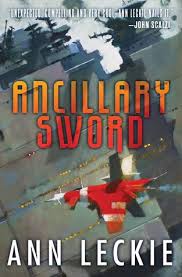 I loved this second book possibly not quite as much as the first, for which my love burns for its originality as well as its characters and action; but it’s a true love nonetheless, for a book once again dealing with complex issues without making them un-complex, and for characters who aren’t cardboard, and a plot that – stripped back – is really very straight forward but that kept me reading voraciously.
The issues are similar to Justice, as you would expect, although with a different emphasis. Of course the gender aspect is still there; yes I still found myself wondering whether that deadbeat was female or male, that that leader a man or a woman, and so on. A little bit less than when reading Justice, I hope, since I read this immediately after my re-read and I was a bit more in practise of just reading ‘she’ and remembering that genitalia is irrelevant. More importantly, and indeed driving the action to a much greater extent than in Justice, are the twinned notions of imperialism and colonialism. How does an empire genuinely make sure all of its new citizens are treated like the old ones? How does an empire deal with pre-existing racial and other tensions that are going to manifest even though you’re all now officially the same? And then you add corruption to the mix and of course things will not be pretty. And THEN, into that mix, you add someone new – someone with a powerful sense of justice – and you watch how things fall, and which things blow up.
It amazed me to discover that Leckie is an American, what with her Radchaai obsession with tea.
Breq continues to develop across this novel. Justice saw her get some form of justice, and then has her direction changed by Mianaai herself. She has more time, here, to reflect on the pain of losing Awn, and the pain of losing the majority of herself; there are some intriguing moments where Leckie thinks through what it would be like to be that one, remaining, very small part of something previously so large. How does that one small segment develop an identity? Does that experience bestow compassion or impatience with others experiencing similar issues of dislocation?
I was pleased to have Seivarden sticking around, and not be so whingy as in the first. I am very pleased with the new characters introduced; they provide neat foils for Breq and Seivarden. One baby lieutenant with issues (oh how I love the discussions of baby lieutenants and how they are brought up by ships and crews)
My prediction for the third book: it will have to deal with the alien Presger, as well as the outcome of the civil war within Mianaai herself. In fact, I don’t really see how this can be resolved in just one more book. MOAR BOOKS, LECKIE.


