More graphic novels: Birds of Prey and Castle Waiting
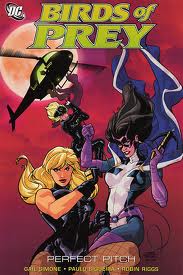
Perfect Pitch
I am beginning to see that not reading these in order may indeed have its drawbacks. This set appears to be the start of the Birds of Prey proper, with Huntress unconvinced that she really wants to be a part of it and Batman making a rather unexpected appearance (well, unexpected for me; I know nothing about Bats in comic-world). It also spans the Infinite Crisis… thing… about which I know nothing, except that a year is skipped and all of a sudden Black Canary is off doing weird things in a nameless Asian jungle while the mysterious Shiva is scaring the pants off people in Gotham.
In terms of plot, occasionally hard to follow for someone with little to no backstory, and also not a nice continuous arc like the previous Birds of Prey (Dead of Winter) I read. The art was usually pretty fun, although I did feel uncomfortable with some of the shots of Black Canary and her kicks. It’s nice to see a group of women working together with no arguments about who gets the guy (well, ok, some arguments, but ‘getting the guy’ in this case means ‘kicking the guy’) – they’re by no means perfect, and there is some dysfunction, but it makes sense. So that’s definitely a plus.

Castle Waiting
Starts off with only a slightly off-kilter telling of Sleeping Beauty – I really liked the focus on the fairies/witches at the start here and moves into the castle and surrounding area essentially becoming a refuge for people who have nowhere else to go, or nowhere else they want to be. The reader arrives via o
ne such, a pregnant woman who later gives birth to a rather… peculiar… baby. But for me, this set of stories is really all about the bearded nuns.
Yes, bearded nuns. Never did I think that someone could have the sympathy, and the art, to draw very attractive women with beards, but such is the accomplishment of Linda Medley. This order of nuns is begun by women escaping an unhappy fate and continues to present just such a chance for other unhappy women. There are many things I loved about the bearded women, just one being that the idea of a man loving one of them was perfectly natural – they are by no means freaks to anyone in the book except those who are clearly immoral/unpleasant/otherwise non-relateable anyway. There’s a nice variety within the bearded women community – the beards and being female are about the only thing they have in common, except that a few of them have also experienced being in the circus. If for nothing else, Medley won me as a fan for this aspect.
She does win me for other reasons: the art is delightful without being distracting or overwhelming; the numerous sub-plots are nicely woven, and I love that the knight in armour is actually a horse.
I look forward to reading more.
Rocannon’s World
 I believe this was le Guin’s first published novel, and I think it shows – it shares some themes with later novels, but the action is a bit jerky and occasionally confusing. (Also, the front cover makes it look a little bit too Masters of the Universe.) Nonetheless, it’s the first of the Hainish cycle which I generally adore, and I did enjoy it.
The book opens with the tale of Semley, who marries away from her family and comforts into an ancient but impoverished noble family. She determines to find an ancient necklace of the family, to restore some honour to them, and in doing so must have dealings with another, humanoid, race on her planet. To find the necklace they take her on a great adventure – to another world, although she doesn’t realise it – but her return is met with grief.
All of this is a prologue, and could easily pass as a short story in itself. Semley reminded me somewhat of Arwen, from LOTR, of what a continuation of Arwen’s story could have been. There’s certainly a LOTR/Celtic mythology feel to the different humanoid races on this world, and some of their interactions.
The rest of the story is about Rocannon, one of the people Semley met on her journey, and who is now directing an Ethnographic Survey on her home planet, many years later. Things go badly however when his ship is destroyed by unknown assailants, and all of a sudden he’s stuck on (to him) an exceedingly backward planet that might just have become the front line in a war the League has been anticipating for some time. He therefore has to deal with potential baddies being on this world as well as being cut off from all contact with his own people. This is, naturally, a difficult position to be in.
There’s action, there’s angst, there’s discoveries about some of the truths about the different humanoid races on the planet. Rocannon learns much about himself, as a leader and as a stranger and, most humbly, as a frail human who can actually learn things from seemingly backwards people.
It’s not as disturbing and earth-shattering as something like The Word for World is Forest, and I can imagine that an older le Guin might have added some more meaty stuff about gender or colonisation into the mix, which are just barely hinted at here. Still, like I said it’s an enjoyable enough story, and it’s largely very well written – there’s some beautiful prose. Interestingly this is one of the differences I noticed; this novel feels a bit more… poetic, perhaps, than many of her later novels, which while beautiful tend (to my mind) a bit more towards the sparse.
Galactic Suburbia 38
In which none of your fearless podcasters are impregnated by mysterious aliens for the duration of a single episode, nor do any of us experience a rapidly accelerated pregnancy or give birth to an otherworldly demon/alien/vampire. Also: Batgirl, Bujold and a cranky feminist rant or two. You can get us from iTunes or from Galactic Suburbia.
Cordwainer Smith Rediscovery Award – fascinating idea – given to a living writer for the first time, Katherine MacLean.
World Fantasy nominations, of course!
The Mystical Pregnancy trope – torture porn? Reproductive terrorism, exploiting women for being female. Violent degradation of women’s bodies for plot.
Vote For Top-100 Science Fiction, Fantasy Titles; Swedish Writing Fairy crunches the numbers.
Andromeda’s Offering Issue 1 – new fanzine to “open up new female voices in SF, raise the awareness of female SF writers and share ideas.”
(you can find them on Facebook)
Where are the women in the new DC Comics? Newsy; interview with Batgirl cosplayer.
SF Signal Episode 70 – 6 men talk about their favourite podcasts and illustrate what we mean by gender disparity in SF gatekeeping; Alisa makes reference to a recent Mind Meld.
What Culture Have we Consumed?
Alisa: Passage by Connie Willis; Red Glove by Holly Black; The Lifecycle of Software Objects by Ted Chiang.
Alex: Diplomatic Immunity and Cryoburn, Bujold; Chicks Dig Time Lords, ed. Lynne Thomas; The Sparrow, Mary Doria Russell; Shades of Milk and Honey, Mary Robinette Kowal; Songs of the Earth, Elspeth Cooper (abandoned). SF Squeecast.
Tansy Glenda Larke – Stormlord Rising; Malinda Lo – Huntress; Penni Russon – Only, Ever, Always
Feedback
We get to be Friday Hoydens!
Please send feedback to us at galacticsuburbia@gmail.com, follow us on Twitter at @galacticsuburbs, check out Galactic Suburbia Podcast on Facebook and don’t forget to leave a review on iTunes if you love us!
Grail, by Elizabeth Bear

The last thing I expect from the final book in a trilogy is for it to throw up major questions about the characters we have come to, if not love, like and admire over the course of two books. But that’s exactly what Bear does in Grail. It’s a remarkable move that I admit makes a fitting end to a remarkable series. As with Chill, there is no way of telling from the front cover that this is part of a series, although the blurb mentions that it brings Bear’s space opera “to a triumphant conclusion.” Unlike Chill, though, this book probably would make a bit more sense by itself.
As the third in the series, this review contains some spoilers for the first two books (Dust and Chill).
Grail opens not on the great generation ship but on a planet, with a completely new set of characters. At first I thought this was going to be the descendants – or perhaps even the ancestors – of our friends on the Jacob’s Ladder. Turns out that no, these people are human colonists who have been on this planet for generations, the descendants of the people who had initially populated Jacob’s Ladder.
You may think you can see where this is probably going. I certainly wondered if this was going to turn into an Us vs Them scenario, and whether it would lead to violence. However, I seriously underestimated Bear – always a bad idea. The inhabitants of Fortune (the planet, which the Jacob’s Ladder crew have jokingly named Grail as they approach) have not been static in their own development. They haven’t gone down the same route as Perceval and co, though. Rather, they have made explicit moves away from the religious zealotry that originally drove the generation ship into space. And they have done this via psychological and, I think, chemical means. Isolating the area of the brain leading to ‘sociopathic’ tendencies and… minimising them.
Bear does not set up a good/bad dichotomy here. From Fortune’s perspective – and especially through the eyes of Danilaw, currently in charge and the one who ends up interacting most with Perceval etc – those on board the ship are totally, utterly, unregenerate barbarians of the worst kind… and the reader gets to see just how weird some things about them are, from the outside. Things the reader has come to accept as normal, over the last two books, because that’s what you do when you suspend disbelief. To have that acceptance thrown back into my face was, frankly, shocking. I can’t imagine what it would be like now to re-read the series, with this new perspective thrust upon me at the end. At the same time, though, it’s not like Danilaw et al are that normal and comfortable. I almost found them harder to accept because at least on the Jacob’s Ladder, I know they’ve been deliberately making evolutionary choices, they’ve been in space for centuries, and weird semi-cyborg things of course happen out there in that context. Fortune’s inhabitants do not have that excuse. Their psychological and neurological changes happened initially on Earth itself, in response to perceived threats from religious and political zealots. I was reminded uncomfortably of ideas from 1984 and Fahrenheit 451 – not that Bear is riffing off them, but having choice removed from people, particularly choice that is dear to my heart? Squirm-y making.
The plot is appropriately twisty and intriguing, as befits the conclusion to this series. The characters continue to be intriguing, attractive and repellant almost at the same time. We finally get a better understanding of the ship itself, thanks to the outsider perspective, which is a nice culmination of the gradual reveal from the first two books.
All in all a very clever conclusion to a very clever series.
ASif! and volunteering
No, I’m not reverting to adolescence here. Aus Specific in Focus is a new website dedicated to reviewing all the Aussie scifi and fantasy it can get its hands on. I’ve volunteered to review stuff, starting with Garth Nix, of course. Looks like it will be great fun.
http://www.asif.dreamhosters.com/
I’ve also started doing proofreading for the Digital Proofreaders, for Project Gutenberg. You just sign up and start proofing… I haven’t had anything proofed at the second round yet (there’s at least two, if not three I think, rounds of proofing), so I don’t know if there is anything that I should be doing that I haven’t. Currently I am doing pages of Wordsworth poetry. I don’t have to stick with this, which I started on, but I think I will stick with it – might as well help it get through.

 Randomly Yours, Alex