Among Others: not a review
A friend asked me about this book the other day. She knows that I am into the Hugos, and she had heard people on Triple J – a radio station branding itself as the ‘youth station’ – talking about this as having won Best Novel. She said they described it as basically Harry Potter.
I imagine my reaction looked pretty funny, because I just. I can’t even. What?
Yes, there is a boarding school involved in both; yes, there is magic (…maybe?) involved in both.
But still. What?
 Anyway. I loved this book. I read it so long ago that it seems a bit pointless writing anything that pretends to be a review, so I won’t – I just want to note down a few thoughts.
For all that I loved it, I did not love it as much as others. I know it resonated strongly for a lot of people because it reflected their own experiences, of The Discovery of Science Fiction especially. Mine it does not. Partly this is an age thing: Morwenna, the narrator, who tells this book via diary entries, is doing stuff on my birthday. I mean my actual birth day. So there’s that. More significantly though, it does not record my experience of discovering science fiction. In specific terms, I haven’t read most of the authors and titles Morwenna reports discovering (and there are a few I hadn’t even heard of) – I had to promise myself that I will read the novel a second time with pen in hand, to stop myself from feeling bad about not keeping a list of books to read as I read it the first time. In more general terms, this isn’t how I came to it. I started more with fantasy, and I was also reading a broader range of stuff, in my teens. I can remember one kid at my school with whom I shared an interest in speculative fiction, and we never talked about it. So… yeh. For me this reads as a fantasy both in magical terms (which I still think might not necessarily be real) but perhaps even more in the finding-of-like-minds aspects. Outside of cons (and sometimes even there, let’s be honest) I’ve rarely had the sort of experience Walton describes for Morwenna. It’d be nice though.
I really enjoyed Morwenna’s voice, and the novel worked especially well as a diary. She often sounds a bit older than she is, but I think the diary format explains that (as well as her somewhat precocious nature, and her voracious reading lending her an excellent vocabulary): it makes sense for someone like her to be experimenting with language in a private forum, and giving herself permission to push her imagination and storytelling to its fullest extent. I liked her ambiguity – about herself and in her attitudes towards her parents, friends, and school. She has very sensible reasons to be concerned on some of those fronts, especially about her mother, that do not translate to ‘real life’ – but the general feelings can, and do.
I admit that I am surprised that it won the Hugo, given its competition. Everyone seemed to think that GRRM had it sown up; in a year without that, I would have thought Mieville would win hands down, but then I adored Embassytown immensely so possibly I’m biased. But no: a book with a smattering of magic that is all about the discovery of SF and SF fandom won. I think that’s rather lovely, actually, and obviously also reflects the voters themselves… although what it says about them, I’m not willing to speculate.
We Who Are About to…
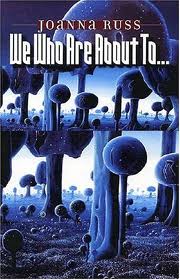 This is not an easy book to read. But it’s a Russ, so that’s not exactly a surprise, is it? She takes an SF trope – the idea that survivors of a crashed spaceship somehow colonise an uninhabited planet – and wreaks merry havoc.
This was apparently first published as two novellas (maybe even novelettes; the book is only 120 pages). By the end of the first half, all but one of the characters is dead. Surely the second half is going to show the sole remaining character that the planet is actually inhabited?
Yeah no. Not so much.
Told from the perspective of a woman who really doesn’t fit in with her fellow survivees, this is quite an uncomfortable read, for a lot of reasons. Firstly there’s the attitudes of each of the survivors: their entitlement, feelings of contempt, and the beginnings of a Lord of the Flies milieu. Then there’s the narrator herself, who while apparently more likeable – if only because the reader has insight into her thought processes – is still an uncompromising and actually rather difficult person to be around. And then there’s the plot, which is basically: crash; deal with each other; deal with being the only human on the planet. The end.
The other characters are very difficult to get your head around because we only see them from the narrator’s point of view, and for quite a limited amount of time. There’s a young girl, clearly spoiled and needy; her parents, who have all sorts of weird things going on with money and work and respectability that actually, when you deconstruct them, aren’t that weird and that makes it all the more uncomfortable (trophy spouse, use of marriage, etc). A jock in a universe that appears to have less use for such types, and a professor who appears to be the polar opposite and whose smugness speaks of all that’s wrong with academia. And two other women – quite different from each other, but sharing elements with our narrator, which makes her uncomfortable and serves to illuminate her character as the story progresses.
The narrator’s background is something of a jumble, which is unsurprising given that Russ writes much of the last half in almost a stream of consciousness. We learn a bit about her experimentation with niche religion and politics, a bit less about her relationships – platonic and sexual – and a bit more about her sheer determination in the face of difficulty. I don’t know that I liked her, but I certainly admired her.
The plot is definitely a secondary consideration here. While it is of extreme importance, because it’s the springboard for Russ’ investigation into character and because it’s an inversion of an SF trope, there’s so little to it (really taking place almost solely in the first half) that it must be secondary, I think. Which is not to suggest that it is poorly constructed or anything like that, of course. It’s confronting and minimal and all the more confronting for that.
This must have issued an important challenge to SF when first published – and still does, I think. It’s not easy, but it is worthwhile.
Trouble and Her Friends
 So… I’ve been meaning to write this review since August, when I read it. I’ve therefore managed to get to it before a year is out, if only just. Which is good. But the reason it’s taken me so long is because there are so many things I wanted to say! … and of course I’ve forgotten most of them. Because that’s the way these things work. I did make a little list of notes as I went, so this is going to be a somewhat disjointed review as I write those notes and try to remember what I meant by them. Bear with me?
Firstly, this is a really really great book. Seriously. I went and bought two or three more Scott books pretty much immediately (the fact I haven’t managed to read them yet says nothing about Scott and everything about my teetering TBR pile). It has plot, it has characters, it has a brainworm… for me, this is like the pinnacle of cyberpunk. This is what it should do. The plot has action and intrigue and nice twisty bits; I quite enjoyed the description of being on the brainworm and participating in the net. The characters are nicely varied, and Trouble herself is complex and sympathetic and compelling. The blurb makes it sound like a techno-western (Trouble as “the fastest gun on the electronic frontier”) and while I’m not entirely sure it works, I think I can see where it’s going.
As I was reading, I had this really awesome revelation about how it connects being a cracker to gender, and how old-school crackers don’t like the idea of the brainworm because it allows bodily experience within (what is effectively) virtual reality or the internet. And I thought – hey, woman dealing with physicality, which men so often don’t do! … yeh, turns out this was by no means something that I noticed all on my own, but something that was in my head because Helen Merrick had pointed it out in The Secret Feminist Cabal… which is the main reason why I wanted to read Trouble in the first place. Oh, so meta. And so dumb.
Anyway, for a book published in 1994 it’s a bit depressing that, in this indeterminate time in the future, women and homosexuals are not still equal. Scott also says some interesting things about inequality and the willingness or desire to have the physical experience: “it was almost always the underclasses, the women, the people of colour, the gay people, the ones who were already stigmatised as being vulnerable, available, trapped by the body, who took the risk of the wire” (p128-9).
There’s also a pessimism in Scott’s thoughts on how society will view the net: with suspicion, is the answer. She imagines fairly rigorous policing of it, both externally and internally (maybe because of that same notion of the ‘wrong’ people hanging out there?); the net is scary, in need of tight controls – slowed down, checked thoroughly – so that mainstream upright society isn’t threatened.
It’s awesome. Cyberpunk and gender stuff and a ripping story. Awesome mix.
You can buy Trouble and her Friends at Fishpond.
Castles Made of Sand
Jones begins this story just minutes after the conclusion to Bold as Love, such that I had to go back and read the last chapter of that book to make sense of this one. Which, to my mind, doesn’t happen very often; it made it feel like this was less a sequel, as such, and more a continuation of the same story. As it should be, I think.
*Spoilers here for Bold as Love*
I loved this novel. A lot. Maybe not quite as much as I loved the first one, because that was all bright and shiny and shocking and new… but it’s love nonetheless.

I still liked the characters. Fiorinda is a bit more grown up and less annoying baby-rock-princess; still vulnerable (if not as much as the boys think) and spiky with it; she’s not my favourite person to read but she is sympathetic. Mostly. Ax, now dictator of Britain in some sense (I found the politics a bit hard to follow, especially figuring out how the rocknroll counter-culture side fit in with the still-existant Westminster government), struggles believably with the difficulties of leadership and relationships. Sage… well, Sage was always going to be my favourite, but/and he gets darker here too. He struggles with love and with science-cum-magic, and with music, too.
The plot… well, it’s hard to go into it without being spoilery, which I would like to avoid. But there are metaphorical dragons that our heroes must confront: some political, especially in the form of neo-Celtic pagans who’ve read a bit too much about maybe-druids and their sacrifices; some personal, both in how to balance one relationship with another and how to balance any relationship with power and expectations. And then there’s the people who are actively trying to bring down this counter-culture, for their own political and personal reasons.
Look, it is wonderful. Not without flaws, and not without uncomfortable bits (those two not always the same); but it’s a fascinating view of the world and explores some provocative ideas for how to make the world a better place. Also, she brings the magical aspect just a little bit more into view…
For a spoilerific and eye-opening (for me) description of this novel, especially as it relates to Arthurian and medieval fantasy tropes, my hat goes off to the Wikipedia contributors for this novel. Well done indeed.
Agatha H and the Clockwork Princess
*Some spoilers for the first Agatha Heterodyne novel/some of the graphic novels*
 Yes I am a fangirl. Let’s move on, and firstly talk about the look of this lovely book. I don’t mind the cover – I think it’s appropriate and quite pretty – but when I was reading I took the dust jacket off and oh my, I don’t think I can put it back on again. The hardcover itself is beautiful, with gorgeous gold embossing and little swirls and… it’s just wonderful.
So, the story. This covers, I think, volumes 4-6 of the graphic novels (I may be wrong). Agatha has escaped from Castle Wolfenbach and quite literally falls to earth in company with Krosp, the talking cat. She gets taken in by a travelling circus, after a few adventures, and things proceed from there: more adventures, some science, a little bit of romance, and some interesting characters too. Things are, of course, not entirely what they seem in the circus; and even if that were the not the case, odd things are afoot within Europa so Agatha and her friends are confronted with monsters and other unpleasant people as they travel around. And then there’s the castle with the slightly crazy people…
You probably wouldn’t enjoy this novel without having read the first one. If you’ve read the graphic novels, then you know exactly what happens here already. For me, I read the graphic version long enough ago that I’d forgotten many details, so it was still highly enjoyable. Additionally, I think the Foglios are adding more detail in, especially in terms of back story for some of the more minor characters – and for Europa, and the places visited, as well. I am still a word-reader at heart, and much as I love the graphic novels I don’t think I yet have my eye ‘in’ – I’m sure there are details I miss in pictures that I easily grasp in words. So, it works. Actually I think the main indication that this novelisation works is the fact that it makes me keen to go back and read with the pictures, because I do love them.
Another reason I enjoyed this novel is that the Jagermonsters feature. A lot. Which makes me happy. Also, it so passes the Bechdel test. There are women who are warriors, and schemers, and costumers, and mechanics, and while men feature in their discussions they’re not the sole focus. It’s not perfect, but it’s pretty good.
More graphic novels: Birds of Prey and Castle Waiting
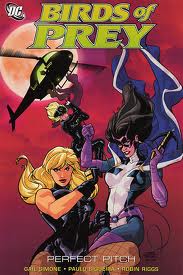
Perfect Pitch
I am beginning to see that not reading these in order may indeed have its drawbacks. This set appears to be the start of the Birds of Prey proper, with Huntress unconvinced that she really wants to be a part of it and Batman making a rather unexpected appearance (well, unexpected for me; I know nothing about Bats in comic-world). It also spans the Infinite Crisis… thing… about which I know nothing, except that a year is skipped and all of a sudden Black Canary is off doing weird things in a nameless Asian jungle while the mysterious Shiva is scaring the pants off people in Gotham.
In terms of plot, occasionally hard to follow for someone with little to no backstory, and also not a nice continuous arc like the previous Birds of Prey (Dead of Winter) I read. The art was usually pretty fun, although I did feel uncomfortable with some of the shots of Black Canary and her kicks. It’s nice to see a group of women working together with no arguments about who gets the guy (well, ok, some arguments, but ‘getting the guy’ in this case means ‘kicking the guy’) – they’re by no means perfect, and there is some dysfunction, but it makes sense. So that’s definitely a plus.

Castle Waiting
Starts off with only a slightly off-kilter telling of Sleeping Beauty – I really liked the focus on the fairies/witches at the start here and moves into the castle and surrounding area essentially becoming a refuge for people who have nowhere else to go, or nowhere else they want to be. The reader arrives via o
ne such, a pregnant woman who later gives birth to a rather… peculiar… baby. But for me, this set of stories is really all about the bearded nuns.
Yes, bearded nuns. Never did I think that someone could have the sympathy, and the art, to draw very attractive women with beards, but such is the accomplishment of Linda Medley. This order of nuns is begun by women escaping an unhappy fate and continues to present just such a chance for other unhappy women. There are many things I loved about the bearded women, just one being that the idea of a man loving one of them was perfectly natural – they are by no means freaks to anyone in the book except those who are clearly immoral/unpleasant/otherwise non-relateable anyway. There’s a nice variety within the bearded women community – the beards and being female are about the only thing they have in common, except that a few of them have also experienced being in the circus. If for nothing else, Medley won me as a fan for this aspect.
She does win me for other reasons: the art is delightful without being distracting or overwhelming; the numerous sub-plots are nicely woven, and I love that the knight in armour is actually a horse.
I look forward to reading more.
Rocannon’s World
 I believe this was le Guin’s first published novel, and I think it shows – it shares some themes with later novels, but the action is a bit jerky and occasionally confusing. (Also, the front cover makes it look a little bit too Masters of the Universe.) Nonetheless, it’s the first of the Hainish cycle which I generally adore, and I did enjoy it.
The book opens with the tale of Semley, who marries away from her family and comforts into an ancient but impoverished noble family. She determines to find an ancient necklace of the family, to restore some honour to them, and in doing so must have dealings with another, humanoid, race on her planet. To find the necklace they take her on a great adventure – to another world, although she doesn’t realise it – but her return is met with grief.
All of this is a prologue, and could easily pass as a short story in itself. Semley reminded me somewhat of Arwen, from LOTR, of what a continuation of Arwen’s story could have been. There’s certainly a LOTR/Celtic mythology feel to the different humanoid races on this world, and some of their interactions.
The rest of the story is about Rocannon, one of the people Semley met on her journey, and who is now directing an Ethnographic Survey on her home planet, many years later. Things go badly however when his ship is destroyed by unknown assailants, and all of a sudden he’s stuck on (to him) an exceedingly backward planet that might just have become the front line in a war the League has been anticipating for some time. He therefore has to deal with potential baddies being on this world as well as being cut off from all contact with his own people. This is, naturally, a difficult position to be in.
There’s action, there’s angst, there’s discoveries about some of the truths about the different humanoid races on the planet. Rocannon learns much about himself, as a leader and as a stranger and, most humbly, as a frail human who can actually learn things from seemingly backwards people.
It’s not as disturbing and earth-shattering as something like The Word for World is Forest, and I can imagine that an older le Guin might have added some more meaty stuff about gender or colonisation into the mix, which are just barely hinted at here. Still, like I said it’s an enjoyable enough story, and it’s largely very well written – there’s some beautiful prose. Interestingly this is one of the differences I noticed; this novel feels a bit more… poetic, perhaps, than many of her later novels, which while beautiful tend (to my mind) a bit more towards the sparse.
Galactic Suburbia 38
In which none of your fearless podcasters are impregnated by mysterious aliens for the duration of a single episode, nor do any of us experience a rapidly accelerated pregnancy or give birth to an otherworldly demon/alien/vampire. Also: Batgirl, Bujold and a cranky feminist rant or two. You can get us from iTunes or from Galactic Suburbia.
Cordwainer Smith Rediscovery Award – fascinating idea – given to a living writer for the first time, Katherine MacLean.
World Fantasy nominations, of course!
The Mystical Pregnancy trope – torture porn? Reproductive terrorism, exploiting women for being female. Violent degradation of women’s bodies for plot.
Vote For Top-100 Science Fiction, Fantasy Titles; Swedish Writing Fairy crunches the numbers.
Andromeda’s Offering Issue 1 – new fanzine to “open up new female voices in SF, raise the awareness of female SF writers and share ideas.”
(you can find them on Facebook)
Where are the women in the new DC Comics? Newsy; interview with Batgirl cosplayer.
SF Signal Episode 70 – 6 men talk about their favourite podcasts and illustrate what we mean by gender disparity in SF gatekeeping; Alisa makes reference to a recent Mind Meld.
What Culture Have we Consumed?
Alisa: Passage by Connie Willis; Red Glove by Holly Black; The Lifecycle of Software Objects by Ted Chiang.
Alex: Diplomatic Immunity and Cryoburn, Bujold; Chicks Dig Time Lords, ed. Lynne Thomas; The Sparrow, Mary Doria Russell; Shades of Milk and Honey, Mary Robinette Kowal; Songs of the Earth, Elspeth Cooper (abandoned). SF Squeecast.
Tansy Glenda Larke – Stormlord Rising; Malinda Lo – Huntress; Penni Russon – Only, Ever, Always
Feedback
We get to be Friday Hoydens!
Please send feedback to us at galacticsuburbia@gmail.com, follow us on Twitter at @galacticsuburbs, check out Galactic Suburbia Podcast on Facebook and don’t forget to leave a review on iTunes if you love us!
Grail, by Elizabeth Bear

The last thing I expect from the final book in a trilogy is for it to throw up major questions about the characters we have come to, if not love, like and admire over the course of two books. But that’s exactly what Bear does in Grail. It’s a remarkable move that I admit makes a fitting end to a remarkable series. As with Chill, there is no way of telling from the front cover that this is part of a series, although the blurb mentions that it brings Bear’s space opera “to a triumphant conclusion.” Unlike Chill, though, this book probably would make a bit more sense by itself.
As the third in the series, this review contains some spoilers for the first two books (Dust and Chill).
Grail opens not on the great generation ship but on a planet, with a completely new set of characters. At first I thought this was going to be the descendants – or perhaps even the ancestors – of our friends on the Jacob’s Ladder. Turns out that no, these people are human colonists who have been on this planet for generations, the descendants of the people who had initially populated Jacob’s Ladder.
You may think you can see where this is probably going. I certainly wondered if this was going to turn into an Us vs Them scenario, and whether it would lead to violence. However, I seriously underestimated Bear – always a bad idea. The inhabitants of Fortune (the planet, which the Jacob’s Ladder crew have jokingly named Grail as they approach) have not been static in their own development. They haven’t gone down the same route as Perceval and co, though. Rather, they have made explicit moves away from the religious zealotry that originally drove the generation ship into space. And they have done this via psychological and, I think, chemical means. Isolating the area of the brain leading to ‘sociopathic’ tendencies and… minimising them.
Bear does not set up a good/bad dichotomy here. From Fortune’s perspective – and especially through the eyes of Danilaw, currently in charge and the one who ends up interacting most with Perceval etc – those on board the ship are totally, utterly, unregenerate barbarians of the worst kind… and the reader gets to see just how weird some things about them are, from the outside. Things the reader has come to accept as normal, over the last two books, because that’s what you do when you suspend disbelief. To have that acceptance thrown back into my face was, frankly, shocking. I can’t imagine what it would be like now to re-read the series, with this new perspective thrust upon me at the end. At the same time, though, it’s not like Danilaw et al are that normal and comfortable. I almost found them harder to accept because at least on the Jacob’s Ladder, I know they’ve been deliberately making evolutionary choices, they’ve been in space for centuries, and weird semi-cyborg things of course happen out there in that context. Fortune’s inhabitants do not have that excuse. Their psychological and neurological changes happened initially on Earth itself, in response to perceived threats from religious and political zealots. I was reminded uncomfortably of ideas from 1984 and Fahrenheit 451 – not that Bear is riffing off them, but having choice removed from people, particularly choice that is dear to my heart? Squirm-y making.
The plot is appropriately twisty and intriguing, as befits the conclusion to this series. The characters continue to be intriguing, attractive and repellant almost at the same time. We finally get a better understanding of the ship itself, thanks to the outsider perspective, which is a nice culmination of the gradual reveal from the first two books.
All in all a very clever conclusion to a very clever series.
ASif! and volunteering
No, I’m not reverting to adolescence here. Aus Specific in Focus is a new website dedicated to reviewing all the Aussie scifi and fantasy it can get its hands on. I’ve volunteered to review stuff, starting with Garth Nix, of course. Looks like it will be great fun.
http://www.asif.dreamhosters.com/
I’ve also started doing proofreading for the Digital Proofreaders, for Project Gutenberg. You just sign up and start proofing… I haven’t had anything proofed at the second round yet (there’s at least two, if not three I think, rounds of proofing), so I don’t know if there is anything that I should be doing that I haven’t. Currently I am doing pages of Wordsworth poetry. I don’t have to stick with this, which I started on, but I think I will stick with it – might as well help it get through.


