Notes from a Regicide, Issac Fellman
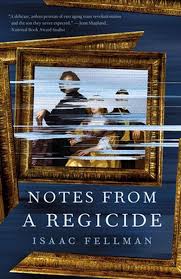
This is a complicated and complex, beautiful, fierce, glorious novel. There are so many things going on. The short version is: if you want a beautifully written novel involving a political story (I mean, look at the title), trans stories, a love of art, dealing with families, and a hint of science fiction – just read this. Don’t bother reading this review, just go find it.
If you need some convincing, well:
I feel like the only way I can talk about this book is to identify some of the strands, but also begin by saying all of the strands work together perfectly.
In part this is a son editing and presenting his father’s memoirs, particularly from when the father was in prison. The son, Griffon, includes notes at the start of those chapters – just a little William Goldman-esque, noting that he’s done some pruning. Those sections are where most of the politics are. The father, Etoine, lived for many years in Stephensport, an island that has completely turned its back on the wider world, ruled by a prince chosen by electors – who otherwise sleep in “the stone yard” and for whom citizens pray. Etoine is an artist, and gets drawn into revolutionary activity mostly against his will. It’s here Etoine meets fellow artist Zaffre (which really is a beautiful colour); she is a much more willing revolutionary. As someone who taught kids about revolutions for many years – well, the political bits here ring true, in the most devastating and fierce and poignant ways.
It’s also a memoir of Griffon, finding his family with Etoine and Zaffre, and also finding himself: he is trans, and it’s only on meeting Etoine and Zaffre that the possibility of living as himself starts to seem feasible. As an adult, looking back on his adolescence, Griffon is both harsh on his younger self for being self-centred and arrogant, and also forgiving for not knowing any better. It feels right.
So there is a lot about family here – having one, ignoring them, the frustrations and embarrassments and comfort, the impossibility of ever knowing people fully and the joy of being known and loved despite that. All of that alongside the politics.
And then there’s the art. Etoine and Zaffre are artists: for both of them, although in different ways, art is at the core of their identity. Fellman captures the obsession and drive of some artists, not romanticising the despair but also not ignoring the difficulties; for both, art is about life and life is about art – and it’s inextricably connected to politics, too.
I haven’t finished yet. There’s also mental illness – Etoine is an alcoholic, Zaffre has schizophrenia (maybe; her diagnosis is unclear), which they manage to varying degrees across their lives, to different effect on themselves and those around them. Again, not romanticised, but it also doesn’t make either of them a villain – and nor is it necessary to their art. It just is.
And, finally, this is a science fiction novel. Honestly it would be easy to ignore that part. It’s not quite blink-and-you’ll-miss-it, but it’s not far off. It is completely necessary to the world of the story, but it’s also not at the heart of the narrative. It’s supremely well done. I feel like there will be a lot of people who go into this expecting A Science Fiction Novel who may be disappointed by the way it uses the genre; that would be sad, but I would get it. I also think there will be a lot of readers who would love this book – for all the reasons listed above – who will avoid it because it’s called science fiction. That, my friends, would be a great tragedy. But if the foregoing words don’t convince you of that, there’s not much I can say.
Really. Just read it.
This is yet another book I have read by Ian Mond, and – intriguingly – he’s never steered me wrong. I’m not going to say we always agree, because there’s a lot he reads that I never will, but the circles of our reading Venn diagram do have some overlap.
Speculative Orientalism, by Sang-Keun Yoo
I read this courtesy of the publisher, Bloomsbury, who sent me the ebook. It’s out now.
It’s been a while since I read a book doing such serious literary analysis. And I don’t remember the last time I read one looking at such a range of science fiction authors, so that aspect alone was really awesome.
I believe that this book came from Yoo’s PhD thesis, and having read a few theses – and read a few books that have come out of theses – I can say that overall Yoo has done a good job translating what is necessary for a very specialised academic audience into what works for a slightly more general audience. There are a still a few bits – in particular, some repetitions – that I think are hold-overs from the thesis; they weren’t bad, as such, just not quite what I would expect from a book written first and foremost as a book.
I should note, though, that this is not a read-in-one-sitting, easy-going book. It requires you to actively pay attention, and think seriously about the words and ideas, because the ideas about ‘orientalism’ and Yoo’s points about how English and, in particular, American authors have used and changed orientalism, particularly as part of the New Wave – these aren’t entirely straightforward, and you want to follow the changes over time closely.
So, if you’re up for a serious read, this will suit you well!
I’ve been reading science fiction for a long time, but I am a child of the 80s, which means that “new wave” fiction was already ageing when I first became aware of it – and honestly I would still struggle to point out the real differences between pre-new wave, new wave, and post-new wave. Maybe I’m just not analytical enough? Whatever the case, one of the initial things that actually really worked for me was Yoo’s general introduction to what the new wave authors were doing, and why this was important, and what it looked like in both the UK and the USA. So that was one very useful result!
The meat of the book is looking at the – well, I hesitate to use ‘progression’ or ‘development,’ for their implications of positive change over time. I think Yoo does make a claim for progression, eventually, but it’s still a somewhat fraught term.
Let’s stick with ‘change.’ So, Yoo opens with looking at how William S Burroughs (whose work I have never read!) uses orientalism in his work: that is, references to “Asian” ideas, places, or things, whether that’s a generic “Asian” or a specific ethnicity like Chinese. Uh, spoiler? It reads as super racist. (Who am I kidding, it is super racist.) So that’s… fun.
The really serious analysis comes with next three chapters: Philip K. Dick (do I get kicked out of the club if I say I didn’t enjoy the few stories I’ve read); Samuel Delany (I’ve read a few! I refuse to read Dhalgren, though, on the grounds of too darned long), and Ursula K. Le Guin (I have read most). With these authors, Yoo traces the various influences on their writing – personal experiences, personal belief systems, and so on – and how this plays out across their fiction, and what this suggests about attitudes towards “Asian” ideas, in particular religiously and politically. Unsurprisingly, Le Guin’s use of Taoism is noted as the most nuanced and thoughtful use of those ideas, and as developing across her long career. I was also very interested to read about the African-American and Asian connections that were apparently being discussed in the 1960s, about which I knew nothing.
Overall? This is not a book for a casual reader. It is a book for someone who likes thinking about meaty issues, and who already has at least some familiarity with some of the works being discussed. I’m very pleased that I got to read it.
Artifact Space, Miles Cameron
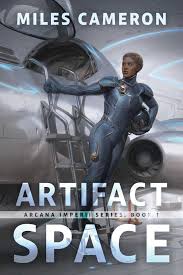
I received this to review courtesy of the publisher and NetGalley.
Is Marca Nbaro really just too good, too fast? Yes.
Is some of the ‘science’ highly dubious, and does much of the technology require quite a lot of hand-waving? Also yes.
Did I absolutely devour this book and am I eyeing off the sequels? Also yes.
Nbaro grew up in an orphanage, which was hell, and now she’s shipping out on one of the nine greatships of human space, the Athens. It’s all she’s ever wanted to do and be. Of course, getting there wasn’t at all straightforward, and the first few weeks aren’t straightforward either. And then when things settle down for her personally, things go very sideways for the ship.
One thing I appreciated, in my current need for not-too-confronting fiction, is that we don’t start off in the Orphanage. There’s enough to understand just how dreadful Nbaro’s life was there, but there’s no dwelling on the horror. Instead, this is a very smartly paced story: it’s basically the written version of an action movie, and it’s good at it.
I can’t quite figure out the politics behind the human world here: Nbaro hasn’t exactly joined the military – they’re a merchant service more than a military – but there are nonetheless marines, and the ship has weapons… everyone is encouraged to be involved in trade while they’re serving… it’s a weird mix of capitalism and socialism. Doesn’t really bare close examination, but at least it’s slightly different from unrestrained capitalism. Mostly.
Look, overall, this is a swash-buckling action novel with an outrageously clever and capable lead character who is nonetheless very appealing, and I enjoyed it a lot.
Countess, by Suzan Palumbo
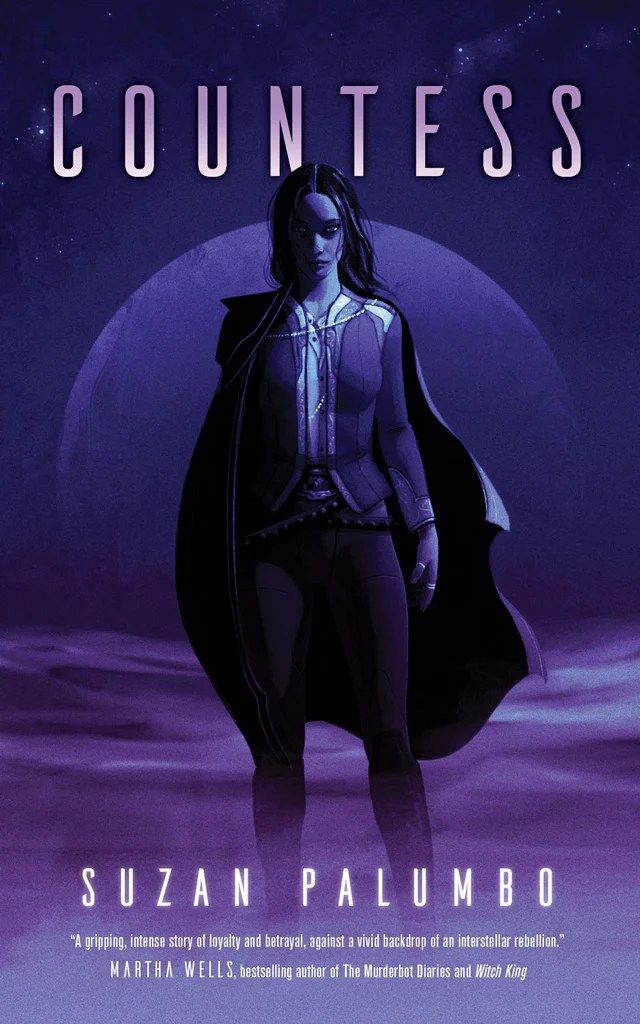
Did I ignore this book for several months because I have never read The Count of Monte Cristo? Yes.
Was that foolish? Also yes.
Should I have paid attention to the fact that this is a) gender flipped (mostly), b) space opera, and c) a novella, NOT LIKE the 1000+ PAGE PLUS ORIGINAL? Oh yes.
So, this book is great. Like everyone who has raved about it has suggested. A young migrant woman rises through the military hierarchy of her beloved adopted home, desperately proving that she can be as good as any of the white-skinned folks (did I mention this is anti-colonial as well?) of her new planet. And then, of course, things go very bad because Jealousy, and she ends up in prison. It’s not too much of a spoiler to say she escapes (the original is basically one long revenge fantasy, as far as I can tell), and then things… well. Things change.
Palumbo writes beautifully, illuminating the relatively-newly-colonised planets as distinct places but also evoking the original Terran homelands, especially of the Caribbean. I did go and read the Wiki for The Count after reading this, to get a sense for how closely she kept to the original, and the answer is ‘pretty close but also not slavish’ – SEE LENGTH in particular. Having said that, this is obviously an excellent example of how you don’t need to have read the original even when it’s clearly a book riffing off another: Palumbo has made this story all her own.
Magnificent.
The Folded Sky
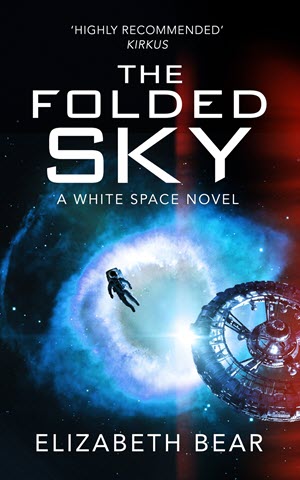
Apparently I didn’t review either Ancestral Night or Machine? Oops.
Quick recap: very far future, galactic colonisation, (most) humans live alongside other species, they have ‘right-minding’ to deal with anti-social tendencies, and there’s an ongoing search for the remnants of long-dead very powerful alien predecessors. Also, there’s FTL travel, through White Space.
The three books in the White Space series are connected by being set in the same universe and dealing with some of the big issues, and events from previous books make the next books happen, but there’s basically no character connections.
In this book, the archinformist (historian) Dr Sunya Song has left her family to go do research in one of the most exciting discoveries in centuries – an ancient AI left by that predecessor civilisation. Of course, things do not go at all as planned, starting with the very snarky AI ship she travels on, moving rapidly to a pirate attack, and then the arrival of her arch-nemesis. And there are the actual and attempted murders.
This is a space opera, with a whole lot of discussion about inter-species relationships on a personal and societal level, with both the continuation of racism and the desire to understand The Stranger playing significant roles. There’s also some interesting crossover between this and Arrival / “Story of Your Life” in terms of how someone can come to understand a species whose entire way of looking at reality is utterly different from your own.
On a more mundane level, this is also a murder mystery, since Song gets involved in that side of things, when perhaps she shouldn’t.
Overall this is a really fun story, with characters I enjoyed and a plot whose resolution I didn’t entirely expect. However I must note that there were disappointments, particularly in some poor editing. For example on p414 of the trade paperback, and a few other times, questions are asked and then not answered in the conversation. Obviously this is sometimes deliberate, but there’s no suggestion that’s the case here – it just feels like a line is missing. There’s also some repetition of information that feels like it’s been doubled up because someone wasn’t sure where it should go.
Will I read another book in this series? Of course I will.
New Philippine Speculative Fiction 1
And another book sent by Charles! You can buy it from the publisher.
This anthology is both a mixed bag and a diverse collection – ah English, you are hilarious.
Some of the stories brought together here are absolutely brilliant. There are very few names that I recognised, and many that I hope will have their work picked up by and read further afield.
Of course, any anthology is going to struggle to please a reader with every story. So as expected, there were stories that really did not resonate with me here. Most of those were the horror stories – which is entirely to be expected, since that is not my vibe at all. In particular some of them leaned far too heavily on body horror for my tastes, so I simply skipped them. If that’s your vibe, then I’m glad for you that they’re included here. There were plenty of other stories here that did work for me: there are 35 stories included!
Some stories were clearly and obviously leaning into Filipino places, ideas, history, and language; I definitely didn’t get all of the references in those, but I got enough that I could appreciate the story. Others were, I guess, more “universal” – whatever that means, given the stories are presented largely in English. One of the fun things about an anthology like this is that the only connective tissue is the identity of the authors: there are no themes or ideas tying the stories together, so you have absolutely no idea what you’re going to read next.
Some favourites:
- Jose Elvin Bueno, “Cadena de Amor” – the narrator’s perspective here was intriguing, and the story tantalising
- Vida Cruz-Borja, “Call of the Rimefolk” – art, space, aliens, love, family. This story is magnificent.
- Exie Abola, “Shadow Sisters” – difficult to characterise, gut-wrenching if you’ve got siblings.
- Ian Rosales Casocot, “The Apologist” – I don’t like this story. It made me angry and feel powerless. It’s very well written and it reflects modern media too well for my liking – how rich people can get away with anything, and how PR works. More people should read it.
- Kate Osias, “The James Machine” – AI stories are still very Now. This is a simple story, in the sense that the narrative is straightforward and it doesn’t dive deep into philosophy; it’s also poignant and lovely, and the subtitles throughout are a masterstroke.
Highly recommended for getting a taste of what the Philippines is producing.
Flight&Anchor, Nicole Kornher-Stace

Reasons to read the Acknowledgments at the end of the book: you find out that the brilliant book you just read is a prequel written some years after two other instalments.
Cue happy dancing.
In some medium-term future, America has gone entirely corporate, and there’s wars between the main ones (I mean…). This is, however, not the focus of this story at all (but possibly is of the main novel, Firebreak?). Instead, the focus is on 06 and 22 – two children who are no longer children in many ways, but still have some child-like aspects. They have been changed by a corporation, and I don’t really want to go into exactly how or why because discovering that was part of the absolute joy in reading this book. It’s not exactly pleasant, so maybe don’t read it if you’re feeling particularly attuned to nasty things happening to kids, but there’s not a lot of terrible detail, so there’s that.
The story is basically split in two. The main bits are focused on 06 and 22 – biologically 12, kept in a secret facility for four years – having broken out and now trying to find food and survive in what is basically a foreign environment. There’s an intense focus on the relationship between the two (don’t be gross, not like that), which is clearly a huge aspect of the later books but still works without knowing anything of their futures. It’s beautiful and sometimes funny and also quite affecting.
The other, smaller part of the story is the experience of the Director, as she tries to figure out how to get the pair back. For someone who is quite clearly reprehensible, Kornher-Stace does a good job of both humanising her and never minimising how awful she is. It’s an admirable presentation and again, makes me very keen to read more about her, even though I do now know some of what will happen to her in the future: Kornher-Stace is clearly writing this for people who’ve read the other stories, and yet the future-reflections actually still work for someone like me.
I enjoyed everything about this story and have every intention of going to find the rest.
The Iron Garden Sutra, A.D Sui
Um. Wow. This is absolutely brilliant.
I read this courtesy of NetGalley and the publisher; it’s out in February 2026.

Humans have spread through the stars. People die on spaceships, and in accidents, and sometimes lost slow-traveling generation spaceships are found with all crew dead. In those instances, monks of the Starlit Order are often called on, to lay the dead to rest, and to remind the dead that they are one with the Infinite Light. Not everyone believes in the Infinite Light (and the Infinite Light doesn’t care about your belief), but the monks seem to carry out a role that people need. People have always needed closure with death.
Iris is a Starlit monk, and as such has a personal AI in their head – not something that is very well regarded any more. Iris isn’t sure that he’s a very good monk, but he wants to be good at it. He is sent to a newly ‘arrived’ generation ship – sent many generations ago, just now arriving in populated space, and all crew dead. When Iris arrives onboard, however, he is not alone: there’s an archaeological team onboard as well, which just makes everything more difficult. And then things get even MORE difficult, but it’s not the fault of the humans…
I’m tempted to say that this is a little bit gothic – a giant spaceship is kind of like a house, right? I’m not sure whether or not it’s horror; I did not find it scary, although I imagine that if it were a film I would have found it so. Guess it’s a good thing I’m not doing the genre marketing.
No matter the genre, I absolutely adored this book. I love Iris and his inner conflict, although I definitely wanted to scold him at several (many) points and urge him to take better care of himself. I was deeply amused by Iris’ relationship with his AI (VIFAI), as well as occasionally troubled. The archaeologists and engineers are characterised swiftly and beautifully – even the ones who don’t live all that long (spoiler!). The arguments between the different groups were all too believable. And I was utterly intrigued by the eventual reveal of what was going on; it may not be an entirely unique take, but it’s incredibly well done and feels like a really fascinating direction for further exploration.
AND THEN I got to the end and discovered there’s another book in the offing! Truly a wonderful surprise. A.D Sui keeps being one to watch.
Death of the Author, Nnedi Okorafor
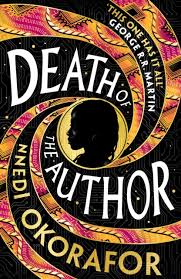
I am so torn by this book.
On the one hand, I really liked the structure and the themes and the way it developed, and the final twist did EXACTLY what it was meant to.
On the other hand… I did not particularly enjoy the writing itself.
The novel’s structure comprises three parts: sometimes we’re following Zelu’s life as she navigates being Nigerian-American, and a paraplegic, and unemployed, and a struggling author. Sometimes we get interviews with people in Zelu’s life, from later in time than the bit we’re reading of Zelu’s life. And sometimes we’re reading the science fiction novel that Zelu writes pretty early on in the book, which becomes a phenomenon: it’s about the robots who are left on Earth after the humans are gone (died?), and whether the embodied can coexist with the disembodied. So, for me, structure: big tick. This way of telling a story, and the story itself, are fantastic.
Themes? Well, they’re kind of obvious from the above paragraph, aren’t they. Zelu is impacted by multiple structural inequalities; she rages against them, and the way she does so informs a lot of the novel. Okorafor is doing A LOT with ideas of AI, both in Zelu’s novel and her life. There’s an enormous amount to unpack around questions of identity (for immigrants, the way people view those with disabilities, patriarchy, etc etc). Okorafor has a deft hand – the novel is in no way preachy, but it was also (at least for me) impossible to avoid thinking about the ideas. And I mean that in a good way.
And then there’s the reference to Roland Barthes’ essay, of course. That the author is just another reader when it comes to interpreting a text. You don’t need to have read his piece, or even have heard of it, to understand the novel, but it’s certainly another level if you have.
And yet. I did not especially enjoy the novel, on a word or sentence level. Rusted Robots, Zelu’s novel, is not a novel I would rate by itself – is that part of the point? I have no idea. Perhaps I am simply not connecting with Okorafor’s style – which is fine! There are plenty of novels that other people hate and I love! But it makes me sad, because I wanted to love this book a lot, and I cannot in all honesty say that I did. I did not find the reading experience a transportive one.
When There are Wolves Again, EJ Swift
I read this courtesy of Netgalley and the publisher. It’s out in October.

I have never read a book quite like this.
It is one of my favourite books of the year.
Partly it’s the structure. We open with Lucy and Hester talking in 2070, and then swiftly move to Lucy recounting her life, starting as a child going to stay with her grandparents during 2020 (yes, the real 2020). Chapters alternate between Hester – documentary film maker, estranged from her family, a lineage of dogs her constant companions – and Lucy, growing up in a Britain rapidly coming apart thanks to climate change, also largely estranged from her parents. Both women provide a lens through which to understand the ecological changes being wrought – the heat, the floods, the fires – as well as the attempts at mitigation, particularly through rewilding efforts. These two interwoven narratives – lives that have brushed against one another over decades, then finally cross in 2070 – are a beautiful way of exploring different reactions to events, giving two generational perspectives on those events, and laying out the similarities and differences between the two women.
Partly it’s the climate change. I have read a few books focused on its near-future impacts, but it’s not something I have sought out; I generally find such speculation too depressing to want to immerse myself in. And Swift’s vision definitely has its grim aspects. As well, my exposure has tended to focus on America (because cultural imperialism) or Australia (because home). To read about what might happen in Britain – the fires, the impact of 40+ degree heat in a place where homes REALLY aren’t designed for it, let alone the impact on wildlife and particularly birds – was shocking all over again. Perhaps, even probably, this sort of thing has been written before. But I haven’t read it, and I’m going to go out on a limb and say very little will have been written with the lyricism and intensity that Swift brings.
And partly it’s the ultimate hope that Swift holds out. Between 2020 and 2070, truly devastating things happen, death and destruction and political evil (I haven’t even mentioned Albion First yet). And yet. And yet, there are people actively trying to mitigate the worst effects, who struggle on in the face of immense pressure. Greta Thunberg is name-checked. People push on despite obstacles, mostly as a group, and this offers hope.
I loved it.

 Randomly Yours, Alex