Thor (MCU 5)
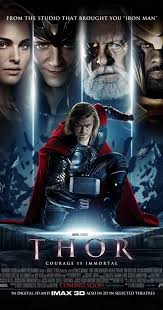
This is one of the films that I wasn’t sure of, going back. It’s been a while since I saw it, and I just wondered…
Everything about this film is fine. Hemsworth is pretty good (although gosh a decade is a long time); Portman is great, actually; Hiddleston is fine. Idris Elba is always wonderful, as is Jamie Alexander. And Kat Dennings as Darcy and Stellan Skarsgaard can help me with my research any time. Also the criminally underused Rene Russo.
There’s just something about the film that feels … odd. Or off. Especially coming on the heels of Iron Man.
I think that, compared to those (internally) earlier movies, Thor – and Thor – feel… naive, somehow. Matched against the cynical, world-weary but still philanthropic Stark, Thor feels… young. Arrogant – or proud? – although at least theoretically committed to doing what’s right; and naive, even innocent. And still so much in his father’s shadow (which, actually, is very much a Tony thing too. OMG how much of the MCU is actually about fathers?? Wait, I don’t want to think about that too much or I might get really sad). The film itself is an example of how the MCU films are allowed to have their own aesthetic, matching the different aesthetics of the comics (I assume); and I think this more fantasy-oriented feel does feel jarring, coming after the very-high-tech, very modern, Iron Man – and even Captain Marvel.
The plot is nothing exceptional; it’s fine as an introduction to Thor and his world. I had forgotten what we learn about Loki and his relationship with Thor; it felt simultaneously like a lot and too little. The one thing I did notice and appreciate greatly is that right from the start, it’s unclear whether Loki is being devious for the sake of evil, or because it’s his nature to be a trickster. Does he know that he’s revving Thor up about their father, and is he doing it for nefarious purposes, or… not? There’s so much about Loki that is vital to however many films, and I think some aspects of him remain unknowable. At the same time: it is clear he loved Odin and Frigga, and that his world being shown to be a lie is the catalyst for most of his later actions.
Iron Man 2 (MCU 4)
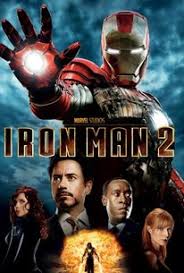
THIS FILM.
It’s not quite the Platonic Ideal of Captain Marvel, but. Well. It’s definitely in my top 5 MCU films.
And it’s not just because of Sam Rockwell. Not… entirely, anyway.
It is definitely problematic that a narcissistic, arrogant man like Stark is so compelling as a character. I think partly it’s his self-awareness that helps this. Also, what I noticed on this viewing – perhaps more than any other time – is just how much of his behaviour in this film is driven by the knowledge that he is, in fact, dying. I don’t think I had fully appreciated that before. I continue to love watching his genius at work, and the fact that he is perfectly willing to take a sledgehammer to walls in order to build – what? a synchrotron?
I continue to like Pepper. I like that the development of her character makes sense – also driven by a desire for getting things right, at heart – and that she was perfectly capable of cutting off from Tony when it was clear that he was going in a bad direction. And then there’s Rhodes – now played by Don Cheadle, and maybe it’s just because he’s been Rhodes for longer than Howard had the chance but Cheadle really IS Rhodes for me. There’s something that he brings to the character – understated determination and resilience, and humour, that I really love.
Far, far more than Obadiah, the villains really make this film. I do not love Mickey Rourke as an actor, but as Vanko here he is magnificent (“I vant. My boid”.) It’s just such an off-the-wall character – out of proportion, an exaggerated and distorted vision of Stark himself, as shown by Vanko making an arc reactor in his own version of a cave – and all of his actions are outrageous. He’s so much fun to watch. And then there’s Justin Hammer. Truly, any opportunity to watch Sam Rockwell cut a dance move is all right by me. Everything about Hammer’s character is such a spectacular cringe: he wants to be the exaggerated vision of Stark and he just. Never. Will. Be. Calling Stark Anthony! Trying to sleep with a woman who slept with Stark! Copying his weapons! Oh Hammer. You’re terrible.
Another thing that makes this film is the soundtrack. I am not the biggest AC/DC fan, but it works in this context. As with Captain Marvel, all of this comes together with a fact-paced narrative with an appropriate number of explosions, chases and well-choreographed fight scenes to make a really great film.
This makes it sound like I’m mostly here for the characters, but that’s not true: the story is great! Genius-billionaire-playboy-philanthropist goes on self-discovery trip that nearly destroys the people around him and is nearly brought low by psychotic Russian genius-poor-convict-revengenut!
Also, Scarlett Johannsen in some of the most ridiculous outfits a woman has been compelled to wear while pretending to be “from Legal” or while being an assassin. Plus a cold, tired, take-no-shit Fury, who really can’t be having with Stark’s nonsense.
I am so ready for Avengers. I don’t mind watching Thor first, but… I am so ready for Avengers.
Captain Marvel: MCU 2 (internal)

I guess it would be foolish to call any movie perfect, but Captain Marvel comes pretty close to the Platonic Ideal for me.
Brie Larson is fantastic: has the comedy timing when required, serious and distressed and determined when required… I read about how she went up with female fighter pilots to get a sense of what it was like being in the cockpit, which is awesome. And I love the character of Vers/Carol: always committed to what’s right but not so fanatical that she can’t accept when her truth is challenged. An excellent friend; balancing compassion and ruthlessness (looking at you, Yonn Rogg); her persistence as a child and young woman make me so happy. Also, THAT COMMENT to Yonn Rogg at the end makes me SO HAPPY every time.
I adore that this film has no romance. Don’t get me wrong: I am totally here for romance in my stories; ask me why I like Empire Strikes Back so much. But so often when the focus of a story is a woman, romance gets shoehorned in as if audiences can’t cope with a woman not having men fall over her, or her over men (and let’s be honest, it’s usually hetero). So it’s refreshing to have a female hero with male and female friends, but no hint of romance.
The friends! Maria Rambeau is awesome – the right mix of courage and guts with appropriate trepidation (going into space in a vehicle not designed for it…) – what a great best friend; just falls back into the friendship after six years of anger and grief. Monica is also cool and I look forward to seeing her as a hero in her own right. And Fury… well. Fury. I adore that we got a younger Fury in this film, to see where he was before the Avengers Project really blew up in his face. And maybe it’s a bit tacky but I love the jokes about his eye throughout the film.
Then there’s Ben Mendelsohn. MENDO. Playing brilliantly on the expectation that he plays a villain – inspired casting! – I think the writers did a really great job with the character of Talos, and Mendo fulfils it wonderfully. Why would I want to turn into a filing cabinet?
AND Annette Bening! Such a delightful cameo; I know it mucks with the comic canon to have her as Mar Vel but ask me how much I care.
The mid-90s setting is hilarious for someone of my age; the Blockbuster always sets me to reminiscing about getting 5 weeklies for $10, and the awesome responsibility of getting an overnight rental. The flannel, the NIN tshirt, the waiting for the modem to connect… and of course, the music. What a soundtrack. I’d forgotten about Elastica and “Connection” before seeing this; back in heavy rotation now. Aside from Guardians, this makes the best use of music of any MCU film.
All of the characters and the setting work together with a really great narrative. The contrast between the high-tech Hala and what looks like a very low-tech Earth is pretty funny; the gradual reveal of Carol’s past and the truth about the Kree is paced beautifully; there are a good number of chases, well-choreographed fight scenes, and explosions. Like I said: Platonic Ideal for me.
Oh, and I forgot Goose. Sorry Goose. Who’s a good pussy cat, eh?
MCU 1 (well, 2 for us)
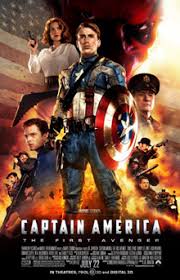
We got Disney+; we decided to rewatch the MCU; we decided (after watching Iron Man) to watch in internal chronological order.
Thus, we went back to Captain America: The First Avenger.
This is… not my favourite MCU. It’s fine. It’s a solid war film. And that’s what this is: a WW2 film. It’s Where Eagles Dare without Richard Burton, but with weird ray-guns and a disfigured villain (because that’s such a novel idea; see: every James Bond film ever).
This is actually one of the positives about the MCU. The Powers That Be haven’t insisted that every film have exactly the same feel; Iron Man and this film are very different. And so they should be! They’re telling different stories, and Rogers and Stark are very different men, and so on.
The film is: little guy doesn’t like bullies, undergoes radical transformation, becomes a ripped Chris Evans… manages to stay the virtuous little guy in a buff bod, and punches villains. Don’t get me wrong, I do think Chris Evans is great in this role; as an Australian I can say that he seems to fill a very particular idea of American masculinity (which, ahem, given the period of this film, is remarkably like the Nazi version of Aryan…).
I love Stanley Tucci in the minimal time he’s given; I would watch Tommy Lee Jones in basically anything (fight me if you don’t like Space Cowboys); Hayley Atwell is excellent, of course. And Sebastian Stan is fun, and it does make me excited about re-watching the Winter Soldier stuff. Hugo Weaving is a marvellous scenery-chewing villain, and Toby Jones is also fantastic.
Having seen the rest of the films, this feels like such a prequel in many ways. It sets up Cap’s personality – his quirks, his doggedness, his reasons for the at times holier-than-thou attitudes that so pisses off Stark; and of course, the dedication to Bucky. Which is integral to all that is to come, and the depths of which I had probably forgotten when I watched Winter Soldier last time.
I didn’t love this film, particularly, but it does make me excited for what’s to come.
Iron Man: MCU 3 (well, 1 for us)
We’re however far into lockdown 2.
We have however long left until things even begin to be ‘normal’.
And so we have caved. We have subscribed to Disney+. Partly for The Mandalorian… partly for the MCU.
And so, we have begun The Epic Rewatch Of The Entire MCU (movies only).
(We love Agents of SHIELD and look forward to catching up on the season/s we haven’t seen yet, but I have zero intention of rewatching the whole lot. Also, I watched the first couple of eps of Agent Carter, and it just didn’t work for me.)
Initially, we planned to go on production order, and so:

Iron Man
We’ve probably seen this three or four times, I guess? Of the individual-focused films, Iron Man would have to be my favourite set. I haven’t seen this in a while and I did wonder whether it had aged.
The answer: nope.
Downey Jr is still marvellous to watch as Tony. Tony is an unpleasant, arrogant, wilful, privileged, and selfish man, who actually begins to change through the movie. The fact that he is also a mechanical and theoretical genius makes his other traits more frustrating, for me – but yes, I still like him overall. Yes, this is a problem. I really liked the cave-construction part of the film, and the fact that it’s clear Tony is no Elon Musk; he can actually make stuff. He’s a Tesla rather than an Edison; a Robert Hooke or Robert Boyle. In fact one thing I really like is the somewhat-reality of the iterative nature of making the suit: that it’s not perfect, needs refining, etc. (And looking forward, the way that this progresses for Tony’s character is truly fascinating.)
Everyone else in the film is also great. Jeff Bridges is outrageous as Obadiah; Terrence Howard is fine as the long-suffering Rhodes; yes, I like Paltrow as Pepper, too. The pacing works, the soundtrack is infectious, the graphics still look fine to my eyes (which may be slightly rosily-hued, who can say). It was delightful to see people who carry on through the whole set – especially Coulson, of course, and Fury in the end-of-credits scene; and Iron Man’s musical motif, too.
Overall, this is a film that really stand up.
————————————————————
… as foreshadowed, after we watched this, we reconsidered our viewing order. We’ve decided to go internal chronology, which means we go back to The First Avenger and Captain Marvel next, rather than moving straight to Iron Man 2. So that will be fun.
The Gurkha and the Lord of Tuesday
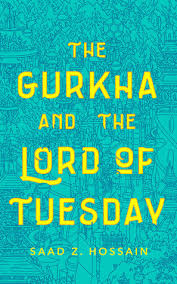
I have a question. And that question is, what the heck was I doing this time last year that I didn’t rush out to get myself a copy of this novella? Because it really can’t have been that important. I didn’t even know what it was about! I just can’t quite get my head around that; what a failing on my part. Still, thanks to WorldCon and whoever mentioned it on a panel, I finally got my act together and I inhaled it pretty damn quickly.
At some unspecified point in the future – definitely a ways into the future, but not so far that humans are off colonising the far reaches of the galaxy – Melek Ahmar, the Lord of Mars, the Red King, the Lord of Tuesday, Most August Rajah of Djinn, wakes up. Turns out he has been asleep for a rather long time, and things have changed. Wandering through the Himalayas trying to figure out what’s going on, he comes across Bhan Gurung, a Gurkha living fairly contentedly, it seems, by himself in a cave. Melek Ahmar is disconcerted by Gurung’s lack of servility but makes use of his knowledge about the modern world – like the existence of nanobots, and that there is a city nearby, Kathmandu, which might be ripe for him to take over; after all, a great king like him needs subjects. Melek Ahmar and Gurung go to Kathmandu and… things progress from there. Poorly, for some people; certainly sideways for a number of them. It turns out Gurung has ulterior motives; and things aren’t quite what they seem in Kathmandu – although the fact that it is run by an AI, allocating karma rather than money as currency, isn’t a secret.
There’s a lot going on here. Melek Ahmar, the Lord of Tuesday, himself has a lot going on; all sorts of references to Greek and Egyptian and I think Hindu? mythology/ ancient history that make me long for a prequel story about the dastardly deeds of Ahmar’s youth. The slow unravelling of the story behind Kathmandu, and why the world runs with nanobots, is superbly paced and very exactly revealed, until it all finally slots into place. The same with Gurung and the revelation of his character, his story. And the story overall is a joy to read; a variety of characters and their interactions, a setting that’s sketched more than detailed but nonetheless brought to life, and a pace that keeps it all rolling along.
This is one heck of a story. I’ll be getting hold of the two other novels Hossain has out, and looking out for more.
The Space between Worlds
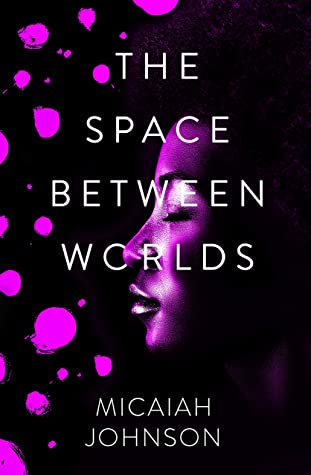
This book was sent to me by the publisher, Hachette Australia, at no cost. It’s due out on August 11; RRP $32.99 (trade paperback).
This is a debut novel – which doesn’t mean Johnson has never written a novel before, of course, just that this is the first one to be published. And it’s pretty great.
It is unclear to me exactly when this is set; some time in the future, but not unimaginably so. It’s also unclear where this is set – I just assume it’s meant to be America because as an Australian, I assume most novels are set in America unless they’re evidently in the UK somewhere. (Realising the setting is Australia, or somewhere other than the US or UK, is often a very surprising moment, unless I’ve gone in knowing the story is deliberately set in, say, Nigeria.)
Anyway. Both the when and the where are basically irrelevant to the story, because the most important where is that most of the action is on Earth Zero. This is a world where not only have parallel universes been discovered to be real, but someone has discovered how a person can travel between them.
These sorts of stories have happened before (says the fan of Fringe) but the particularly clever thing that Johnson does is the caveat that you can only survive traveling to a world where your dop (doppelgänger) is dead.
Barring unfortunate accidents, you know who makes the most valuable traversers, therefore? who are the people able to access the most worlds? It’s the people whose survival to adulthood is unlikely. For wealth, ethnic, gender, location, and other systemic reasons. Those who grow up in areas with a lot of violence. Those from families or suburbs or countries with widespread violence. Those who, in the general course of a capitalist world, are seen to have little real value.
This is a brilliant twist, and I love it. And I also love that Johnson doesn’t present this as meaning that those people suddenly get great lives. Instead, the protagonist – Cara – is always aware of the fact that she could be replaced by robots when that tech works; that the people who were born in the nice town, as opposed to where she grew up (very much not-the-nice town), look down on her or fear her. Her existence is precarious despite her value to the company.
So partly the narrative is about Cara and her navigation of the two worlds – the rich and the poor, in brutal essence – that she straddles. It’s also, of course, about literally moving between worlds, and seeing how different choices have led to different outcomes – on a societal level or an individual one. Unsurprisingly Cara ends up being more involved in one of these other worlds than is appropriate by company standards, and that has knock-on effects for that world as well as her own, which is the bulk of the story.
The novel has little interest in explaining how moving between the worlds works; the science and technology are irrelevant to the story. Instead, Johnson is interested in the people: what secrets are kept and why; how relationships work; why certain decisions are made, and how they change human interactions. I enjoyed this focus a lot.
One aspect didn’t quite work for me; there’s an undercurrent of science v religion, especially in the way that Cara talks about the experience of moving between worlds – as a goddess allowing her to do so. I didn’t feel like this really fit the rest of the story. However, this does not detract from the rest of the story; it just felt undeveloped, like there could have been a bit more discussion of the possible mysticism of moving between worlds; it’s just not there as much as I think I expected.
Overall, this was a very enjoyable book, and I hope that Johnson is able to write many more in a similar vein.
Murderbot #5
… whose proper name is Network Effect, but everyone just calls all these stories Murderbot, don’t they?
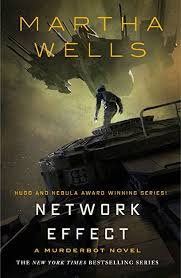
In case you’re late to this party: in 2017, a novella called All Systems Red came out and a lot of people went a bit nuts about a Security Unit robot who had hacked its governor module and was therefore under no one’s control, who kept doing its job because it didn’t know what alternatives there were – it just knew that sitting in one spot and watching media all day was going to land it in trouble. And thus, Murderbot. All Systems Red introduced Murderbot and its problems with humans (including that they keep trying to get themselves killed; Murderbot’s job is preventing that); its love of an epic drama called Sanctuary Moon; and a particular job that goes sideways because the galaxy it inhabitants is largely run by corporations, and the corps like to try and get away with everything. Security Units are used by other companies to try and prevent the other other companies from destroying or killing their stuff.
Artificial Condition, Rogue Protocol and Exit Strategy all followed, wth Murderbot trying to learn more of its own history, the possibilities for its future, and where it can access more media please and thank you except probably without the pleasantries.
If you haven’t read the four novellas yet, you want to stop reading here – partly because of spoilers and partly because seriously your life will be better for having read Murderbot why are you even still here? Ann Leckie says she loves Murderbot; NPR claimed “We are all a little bit Murderbot” and I have to say, right now: so true.
So that brings us to the novel, Network Effect. This picks up fairly soon after Exit Protocol; Murderbot is on Preservation, working for/with Dr Mensah and her family, and trying to figure out what it’s doing and what should come next. Well, it’s not actually on Preservation at the start of the novel; it’s with a survey team and we all know how well that tends to go. And that’s pretty much how it goes… and then things manage to get worse, right about when it shouldn’t. What a surprise. No wonder Murderbot despairs of humans.
Basically if you like the Murderbot novellas I don’t see any reason for you not to love the novel. It’s just… more. More snark from Murderbot, more hating on having emotions, more existential confusion about what it should be doing. Many, many more explosions and much drastic action and epic failures of plans (sometimes because of unforeseen events; sometimes because humans), opportunities for hating on the corporations, and conflicted feelings about the humans in its care responsibility.
I can only hope that Wells is interested in continuing to explore Murderbot’s developing sense of self, and their conflicted relationship with their risk assessment module. Murderbot isn’t human, has no desire to be human, and hates passing itself off as human even when that’s a security necessity. And there is no better way to explore the concept of humanity than through its interactions, its changes in response to stimuli, and its refusal to accept what’s right in front of its visual inputs.
The City We Became
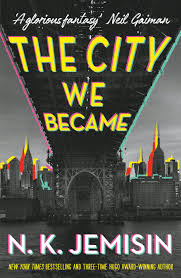 I loved the short story that turned into the prologue of this book. And I love this book.
It should be noted that I do not know New York. At all. I understand people who love NYC have a very particular reaction to this book, but that’s not me. You tell me it has five boroughs? OK. You tell me Staten Island doesn’t like being one of those boroughs? Happy to believe you. You could tell me that New York streets are all slightly curved either north or west and I would have to actually do research to see if you were right.
So anything I say about this book in relation to New York City should keep that in mind. My love for this book does not stem from my love for the city that is, in more visceral ways than is usually meant by this phrase, truly a character within the book.
Six characters, in fact…
Look, to some extent my reviewing this book is a bit redundant. There have been lots of other reviews by people who are far more eloquent than me; who know New York better than me, who can speak to the WHAT THE HECK WAS THAT twist that I seriously didn’t see coming (possibly because I don’t have a certain background, which I am completely fine with), who can speak to the way this book reflects Americana with much more knowledge than me. So what do I have to add?
I can say that even as someone who doesn’t know the USA or NYC, this book is visceral and captures a city brilliantly. And USES a city and the way people think about it to magnificent effect
I can say that it’s fantastically paced – meeting new characters and ‘getting the band together’ can sometimes be tiresome, but not here. Here, it’s all so intricately part of the evolving plot and understanding what the heck is happening that I barely noticed half the characters hadn’t met each other for a substantial part of the novel.
I assume that those who know NYC will agree with the choices made for who represents each borough, or at least see where Jemisin in coming from; the explanation for why you get a particular person in a particular area made sense to me in a fictional way, at least. So I can say I loved the variety of characters and the amount of backstory that is woven expertly into the current story and why those things are necessary and how each character could really just have a mundane story written about them and it would still be fascinating.
I can say that I have precisely zero regrets about pre-ordering this six months ago and have every intention of doing the same as soon as the sequel is announced.
And… SPOILERS BELOW:
Slow River
 I don’t often go to the library, privileged as I am to be able to afford books, as a rule – and I like owning books. But sometimes I think I might like to read a book and probably not own it.
This book is one that I picked up at the library because I was there getting something else; the yellow of the SF Masterworks stood out to me, along with Griffith’s name – I didn’t know she had a piece in that set. So, serendipity at play.
This is a fascinating novel and one that I can’t really do justice to in a review – I’d give too much away and I hate doing that.
At the centre is Lore, who either doesn’t know much about herself or doesn’t want to know much about herself when she wakes up naked on the street. She’s taken in by Spanner, who might have acted like a saviour but really isn’t one, not in how she acts and not in how she thinks, and she doesn’t want to be one either. The relationship between Spanner and Lore is… difficult, and sometimes unpleasant; necessary, too, at least for a while. Griffith does a good job at revealing details quietly, and slowly, and almost without you noticing, so that a complex picture gradually comes to light.
This is also the case with Lore’s own family and personal history. A glimpse here and an idea there, gradual filling in of gaps, and suddenly things make so much more sense.
The world Griffith created as futuristic in 1995 is really quite recognisable today. There are some things that are still futuristic – the bioremediation of waterways is probably still a long way off – but her descriptions of the city and the way things work is full of familiar detail. And that’s where Griffith’s genius is, I think; it’s in the detail. This isn’t a Neuromancer adventure; it’s not a Mellissa Scott adventure. This is a story about life and the difficulties – and joys – of relationships, set in a web of competing economics and politics. Above all it’s about identity, and whether identity is mutable or not; whether revelations can change who we are, and whether we want them to; whether other people can change who we are, and whether we want them to.
Just great.

 Randomly Yours, Alex