The City We Became
 I loved the short story that turned into the prologue of this book. And I love this book.
It should be noted that I do not know New York. At all. I understand people who love NYC have a very particular reaction to this book, but that’s not me. You tell me it has five boroughs? OK. You tell me Staten Island doesn’t like being one of those boroughs? Happy to believe you. You could tell me that New York streets are all slightly curved either north or west and I would have to actually do research to see if you were right.
So anything I say about this book in relation to New York City should keep that in mind. My love for this book does not stem from my love for the city that is, in more visceral ways than is usually meant by this phrase, truly a character within the book.
Six characters, in fact…
Look, to some extent my reviewing this book is a bit redundant. There have been lots of other reviews by people who are far more eloquent than me; who know New York better than me, who can speak to the WHAT THE HECK WAS THAT twist that I seriously didn’t see coming (possibly because I don’t have a certain background, which I am completely fine with), who can speak to the way this book reflects Americana with much more knowledge than me. So what do I have to add?
I can say that even as someone who doesn’t know the USA or NYC, this book is visceral and captures a city brilliantly. And USES a city and the way people think about it to magnificent effect
I can say that it’s fantastically paced – meeting new characters and ‘getting the band together’ can sometimes be tiresome, but not here. Here, it’s all so intricately part of the evolving plot and understanding what the heck is happening that I barely noticed half the characters hadn’t met each other for a substantial part of the novel.
I assume that those who know NYC will agree with the choices made for who represents each borough, or at least see where Jemisin in coming from; the explanation for why you get a particular person in a particular area made sense to me in a fictional way, at least. So I can say I loved the variety of characters and the amount of backstory that is woven expertly into the current story and why those things are necessary and how each character could really just have a mundane story written about them and it would still be fascinating.
I can say that I have precisely zero regrets about pre-ordering this six months ago and have every intention of doing the same as soon as the sequel is announced.
And… SPOILERS BELOW:
Slow River
 I don’t often go to the library, privileged as I am to be able to afford books, as a rule – and I like owning books. But sometimes I think I might like to read a book and probably not own it.
This book is one that I picked up at the library because I was there getting something else; the yellow of the SF Masterworks stood out to me, along with Griffith’s name – I didn’t know she had a piece in that set. So, serendipity at play.
This is a fascinating novel and one that I can’t really do justice to in a review – I’d give too much away and I hate doing that.
At the centre is Lore, who either doesn’t know much about herself or doesn’t want to know much about herself when she wakes up naked on the street. She’s taken in by Spanner, who might have acted like a saviour but really isn’t one, not in how she acts and not in how she thinks, and she doesn’t want to be one either. The relationship between Spanner and Lore is… difficult, and sometimes unpleasant; necessary, too, at least for a while. Griffith does a good job at revealing details quietly, and slowly, and almost without you noticing, so that a complex picture gradually comes to light.
This is also the case with Lore’s own family and personal history. A glimpse here and an idea there, gradual filling in of gaps, and suddenly things make so much more sense.
The world Griffith created as futuristic in 1995 is really quite recognisable today. There are some things that are still futuristic – the bioremediation of waterways is probably still a long way off – but her descriptions of the city and the way things work is full of familiar detail. And that’s where Griffith’s genius is, I think; it’s in the detail. This isn’t a Neuromancer adventure; it’s not a Mellissa Scott adventure. This is a story about life and the difficulties – and joys – of relationships, set in a web of competing economics and politics. Above all it’s about identity, and whether identity is mutable or not; whether revelations can change who we are, and whether we want them to; whether other people can change who we are, and whether we want them to.
Just great.
Made to Order
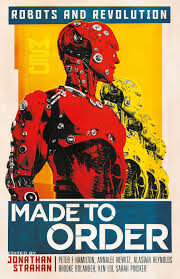 For the centenary of the coining of the word ‘robot’, Jonathan Strahan has compiled an anthology of new work about those… beings? objects? creations? The word ‘robot’ is derived from the Czech word for slave, so perhaps it’s appropriate that a description of what they are is hard to come by. Strahan begins by putting robots into an even greater lineage and ancestry than a hundred years, though, pointing out that the Greek god Hephaestus has golden assistants, and the many stories of golems, and coming up to Frankenstein’s creation too. He goes on to touch lightly on the myriad ways robot-like beings have influenced fiction more recently (tripods to chat bots). I don’t always read introductions (sorry J), but this one is well worth the time and really sets the scene for the entire anthology.
I won’t go over every story, because that would be a bit tedious. Basically every story was great, which pleased me immensely!
Vina Jie-Min Prasad starts off the anthology with “A Guide for Working Breeds,” written as a series of chats between two bots. One is required to be the mentor for the other, who is pretty new to the whole work-scene; the slight boredom and irritation of the first is set off against the enthusiasm of the newb and feels all too real. The entire narrative is in chat; Prasad works in enough detail that by the end of it I felt like I had read far more narrative than was actually on the page. Very nice.
On the other hand, Peter Watts’ “Test 4 Echo” is not nice. It’s a great story, but it’s not nice. It’s got solar exploration and an intriguing design for a robot on Enceladus, but the way that the robot is treated is not nice. It’s got discussion of developing robot sentience, but the way it works out is not nice. I really enjoyed it… but it’s not nice.
“The Hurt Pattern,” from Tochi Onyebuchi, is a terrifying look at a very near, very plausible future that is more about the humans than the robots, because it’s about how humans teach robots and what we can unconsciously impart, and how that can be manipulated and used for profit, or nefarious purpose. I found this story distressing, actually, because it’s so very believable: how algorithms can be used to affect society. Including law enforcement.
In-built obsolesce crops up a few times, and perhaps nowhere as poignantly as in John Chu’s “Dancing with Death” which features a robot that should be on its way out and a mechanic who is more than he seems and also a really, really good mechanic. This one really is beautiful.
Sofia Samatar contributes probably my favourite story, in “Fairy Tales for Robots.” Onyebuchi presented a nightmare scenario for what might happen with the way humans teach algorithms; Samatar presents someone trying to teach a ‘robot'(ish) to think for itself, to consider how stories might guide decisions and attitudes. The way Samatar takes fairytales and myths – some familiar to my Anglo-Australian upbringing, others not so – and demonstrates how they can be seen as relevant to an artificial life is just breathtaking, it’s so imaginative. I really, really loved this piece.
We Wuz Pushed
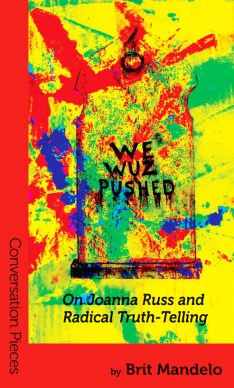
Basically if you’re interested in Joanna Russ’ work, or you’re interested in the way fiction, in particular, can be involved in radical truth-telling, you need to get this book. It’s from Aqueduct Press.
I am a big Joanna Russ fan, so I’m intrigued by everything that does any work deconstructing her work. Mandelo takes as her project the idea that Russ’ entire oeuvre is concerned with radical truth-telling – that art should bring not only pleasure but truth, and not only deconstruct myth but also present new realities. She goes through all of Russ’ science fiction novels, pointing out the truths that are present there and how Russ uses that fiction to suggest new ways of being. I especially liked how Mandelo presented her own journey to understand And Chaos Died – which I haven’t read – and how context can radically change how we understand an author’s intent. I also really, really appreciated how Mandelo addressed the very tricky subject of Russ’ transphobia in The Female Man, and stresses that being able to adjust our understanding of truth should be part of the truth-telling process. And the fact that Russ did, indeed, change her perspective (on trans women and other issues) makes me respect her the more, and gives me something to aim for.
Mandelo also addresses some of Russ’ non-fiction, particularly How to Suppress Women’s Writing and To Write Like a Woman, where the truth-telling is perhaps more obvious in some ways. Overall Mandelo presents Russ’ body of work as a series of writings deeply concerned with the multiple ways in which truth can be told or distorted and what we as a society must do about that. It kinda makes me a bit uncomfortable when I know that I do often go for escapist literature… and I’m not sure how much Russ would approve of that… but perhaps if I can do it with my eyes open she wouldn’t despair too much?
Elysium

I bought this book ages ago, I think because it was on the Tiptree Award (now Otherwise Award) honours list. And then I didn’t read it for ages because I thought it was horror – which makes no sense because why would I have bought it in the first place if I thought it was horror? At any rate, I finally decided it was time to read it, and Wow. What an astonishing, wonderful, weird, and very clever book.
It starts relatively easily, with Adrianne and Antoine, a couple whose lives are drifting apart. Nothing particularly odd – except Adrianne sees an elk, in the city; and there’s a brief interlude of computer code that makes no sense. But then the story continues… And then all of a sudden it’s Adrian and Antoine, and Antoine is ill, and Adrian is caring for him but life is so hard.
And then it’s Antoinette and Adrianne. And you can see why the Tiptree committee thought this was a worthy book to include on their list, as the characters slip in and out of genders and relationships and sexualities and the story evolves around them.
Sometimes the pair are lovers; sometimes they are biological family. Sometimes they have a strong relationship, sometimes things are fracturing. And as the narrative develops, the world in which they live gets stranger – not as time goes on but as their story takes place in different worlds; sometimes subtly different, sometimes spectacularly so (sometimes there’s a variation on a plague, so at the moment some readers may wish to avoid). And always the relationship between the two is significant: sometimes it actively influences events in the wider world, sometimes the focus is intensely personal. And always there are the computer-code breaks that hint at restoring or losing data, or resetting systems, and it’s really not clear what’s going on but clearly all is not as it should be (in case you didn’t guess that when there was an elk in the middle of a busy city).
This novel is lyrical and intense and passionately human. I’m so glad I finally got to read it. And then I read the afterword and I was floored all over again because of course that’s where it was coming from.
A Memory Called Empire
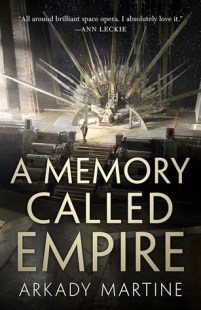 I had a pretty great January of reading because I realised I had time – and it was the time – to do some reading I’d been meaning to do, in order to nominate for the Hugo Awards. And I’d heard this hyped by a few people so I figured it needed to feature.
It was probably my favourite book published in 2019.
And it’s really hard to decide what to say about it.
It’s fitting that the cover quote is from Ann Leckie, because I was immediately put in mind of her colonial/ imperial themes from the Ancillary books when reading this – although Leckie and Martine explore quite different aspects of that troubling human experience. Here, Teixcalaan is definitely imperial, but I would argue they’re just slightly more subtle than the Raadch about it. Slightly. Both are quite convinced that their way of doing things is right, and it’s reflected in their language. What’s different though is the way the protagonist deals with this. Ambassador Mahit, whose home orbital station may be in line for being imperially expanded over, has been chosen as ambassador at least partly because of her fascination with Teixcalaan culture and society. So has she already been culturally colonised or does she know the enemy well or is it a case of appreciating beauty where one finds it? I adore the complexity of this idea.
… before you get the notion that this is an entirely cerebral book, though, don’t be fooled: there are devious plots and explosions and deceitful manoeuvrings, friends who might not be friends and behind the scenes machinations, secrets that must be kept hidden until they’re not, bonkers social manipulation, a great line in snark and discovery-of-unexpected friends.
Basically, I adored every single word.
Martine has enormous ideas and, I’m convinced, a much larger vision of the universe than readers have any notion of yet. There’s even broader problems for Texicalaan and everyone else than are directly dealt with here, and I can’t wait to see where Martine goes with it all.
And I haven’t even mentioned the secret technology that Mahit must protect, and that her predecessor possibly died doing so.
… And then I discovered that the sequel isn’t due out until early 2021, and I had to sit quietly for a while to allow myself to recover from the devastation.
Gideon the Ninth
OMG this book aaaahhhhhh how did I liiiiiive before I read it.
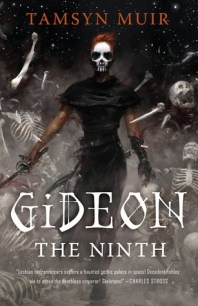 So this book, right. It’s ok.
Where to even start. How about this: Gideon hates where she lives, everyone she lives with, and her life in general. But she has plans for getting away, and it’s aaaallll going to work out… except of course it doesn’t and she ends up compelled to work with one of the people she hates the most for a chance at actually making her life better. She lives on a nothing rock a long way away from the bright centre of the universe (or solar system), which she hates.
Gideon is a fighter, and she’s cranky, and she has a great stock of lesbian porn, and a magnificent line in snark, and a heart that she tries to bluff her way out of showing anyone. I love her to pieces.
Someone mentioned the Machineries of Empire series by Yoon Ha Lee in connection with Gideon, and it made me realise all sorts of correspondences. Both have space-faring civilisations that seem to be powered by arcane things: Lee’s universe by calendar mechanics (which is still a seriously ??? moment); Muir’s is driven, in the upper echelons at least, by necromancy. Yeh, if the bones didn’t give it away: this book has, at its core, death magic. Some people die. I do not like horror and I did not find this to be horror: for me, I tend to characterise horror as when I actively feel afraid while reading, and while I was afraid for characters in this novel, I did not get that ‘oh God is there something under my couch reaching for my legs’ feeling that, say, the Doctor Who ep ‘Blink’ encouraged.
Then there’s the characters and their interactions. Frankly, they’re screwed up, in both Machineries and here. Neither main character is exactly someone you’d say was emotionally on an even keel; and neither of them have open, trusting, and healthy relationships with their closest companions. There are aspects of the key relationship here that could perhaps be seen as abuse; I have been fortunate not to experience it so certainly I’m coming from a privileged position, but somehow it didn’t read like abuse. Harrow, Gideon’s opponent/companion, definitely does some actively horrible things… perhaps part of the difference for me was in her motivation. Or maybe I’m just making excuses. The relationship really is quite destructive; and Muir never tries to paint it as anything but.
Finally, I seem to remember being a good halfway through the first Machineries book before having any real notion of what the heck was going on – and the subsequent books revealed more and more until it made that first book like one square on a chess board (maybe a 2×2 square at best). When I got to the end of Gideon, I still wasn’t entirely sure why things were happening or where the story might go next. But in both cases, I was so utterly enthralled by the writing, and so captivated by the characters and the world building, that I actually didn’t care and just threw myself along for the ride. That’s a fairly uncommon experience for me – I tend to be impatient – and it’s a giddy and joyful one when you trust an author that much.
And then I discovered that the sequel isn’t due out until June this year, and I wept.
The Light Brigade
 I’m going to make the call: this is the best Kameron Hurley book yet. And I say that as a very big fan of Nyxnissa.
This is… something else. Something outstanding as a narrative, as a commentary, as a work of art.
First let me note that this is not exactly a linear narrative, since I know that will put off some readers. It’s not exactly not linear, either… depending on what frame of reference you use. And yes, if I explain that, it will involve spoilers.
The story is set some time in the future – probably a century or so? Humans have been to Mars, and apparently we’ve also got so fed up with democracies (or been so conned) that Earth is now ruled by mega-corps, where you have to earn the right to be a citizen. And now there’s a war, and enlisting seems like a good way both to earn citizenship (Starship Troopers?) and to get back at the enemy for their atrocities. So that’s what Dietz does, and then the soldiers get broken into light in order to be transported more swiftly, and then weird things start to happen: but only to Dietz.
There’s a huge amount going on here.
There’s the relative merits of democracy, capitalist-authoritarianism, and socialism. There’s war and its impact, in sympathetic and horrific detail; the value of citizenship, the value of life, the use of propaganda and the importance of time…. For a fast-paced military SF novel, Hurley (unsurprisingly) packs a vicious amount of political (in its broadest sense) commentary in.
Plus there’s the evolving character of Dietz, as we delve deeper into back story and follow events and watch, sometimes horrified, as Dietz responds. I don’t think I necessarily like Dietz; I didn’t especially like Nyxnissa, either. But as a compelling and complex character, whose story I am compulsively drawn to understand? Dietz, and Nyxnissa, work.
On the constructed level, Hurley is playing with many “wilful homages” as she calls them in the Acknowledgements. It took me an embarrassingly long time to realise that this was basically a ‘Mars attacks’ novel, and that Hurley was playing with lots of the literary connections there. I suspected one or two other nods, early on, but wasn’t sure if they were deliberate until the James Tiptree Jr reference leapt out and smacked me on the nose. I knew that one was deliberate.
This novel is amazing.
Gender Identity and Sexuality…
 in Current Fantasy and Science Fiction.
I picked up this little anthology at Helsinki’s WorldCon, from Luna Press. I’d not heard of them before but I was and remain intrigued by their doing these non-fiction anthologies.
Yes, Helsinki was two years ago. Yes, I just got around to reading it.
As the name suggests, the essays deal with both issues of gender and of sexuality, primarily in fiction but also – and I loved it – in an analysis by Juliet E McKenna on the place of female-identifying authors across time in the publishing world. “The Myth of Meritocracy and the Reality of the Leaky Pipe and other obstacles in Science Fiction and Fantasy” made me think of Joanna Russ (as do so many of these sorts of conversations) and is well researched, persuasively argued, and did not – surprise! – leave me feeling completely hopeless. It’s a fascinating way to open the anthology.
Some of the essays meant more to me than others because in some I am familiar with the material, and with others less so. Kim Lakin-Smith’s “Doll Parts: Reflections of the Feminine Grotesque in France Hardinge’s Cuckoo Song and Neil Gaiman’s Coraline,” for instance, was truly fascinating but I couldn’t feel it as deeply as I might because I’ve not read either of the works (the Hardinge exactly because it’s billed as being horror). And it turns out I am even less up to date with fantasy than I thought, because AJ Dalton’s “Gender-identity and sexuality in current sub-genres of British fantasy literature: do we have a problem?” referenced sub-genres and authors I’ve not heard of. The essay itself was very interesting, don’t get me wrong, but I was unable to reflect on it meaningfully.
Of course, some essays I had little problem accessing. Both Jyrki Korea’s “What about Tauriel? From divine mothers to active heroines – the female roles in JRR Tolkien’s Legendarium and Peter Jackson’s movie adaptations” and Alina Hadîmbu’s “Newly added female chapters to blockbuster franchises: gender balancing in otherwise male-dominated fictional worlds or a greater purpose?” hit on issues and franchises very dear to my heart, and I greatly enjoyed reading the explorations of Tauriel and Arwen and Rey.
Let us not forget that this anthology includes an essay about Magic: The Gathering! Which is not something I would have thought was very interesting a year ago, but now I do! Rostislav Kurka (their name is meant to have a circle above the ‘u’ but my symbols don’t seem to include that one…) has helped me realise just how much more is going on in the fiction about M:TG than I realised, and how the cards’ art reflects and helps that too. So I also love that Luna Press saw M:TG as a legitimate topic for inclusion here; the essay absolutely fits the theme, and of course both the game and the fiction are a part of the speculative fiction world.
Other essays, I should point out, are more interested in a broad summary, rather than focusing on one genre or set of texts. Cheryl Morgan’s “Tipping the Fantastic: How the Transgender Tipping Point has influenced Science Fiction” was (as expected) a throughout examination of how trans characters have been presented in various stories, and what that means both for trans and cis readers and general diversity/understanding. Anna Milon’s “Bikini armour: women characters, readers and writers in male narratives” also made me think of Joanna Russ, and made me cranky, as you may imagine some of what is discussed from the title (it’s a good essay; it’s a frustrating topic).
Overall I think this is a great little anthology – and it is little, at 236 pages in about an A5 package. Obviously there is plenty more to be said, and part of me hopes that Luna does another one… although of course there are lots of other topics to cover, and they’ve got one on Evil and one on African fantasy and science fiction, so those are both excellent topics, too.
The Old Lie
I knew nothing for sure about this book, going in.
Actually, that’s not quite true. I knew it was by Claire G Coleman, so having read Terra Nullius I had a reasonable assumption that it would involve something very clever and probably heart-wrenching as a commentary on Indigenous Australians.
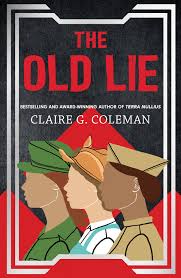 (If you haven’t read Terra Nullius yet, and you’re Australian, you really really really should.)
I also assumed that it would be a really awesome story, because it was her.
The other main assumption I made was from the title. I’m not the world’s greatest poetry reader, but I did study war poetry in Year 12 (our teacher gave us the choice of what themes to look at: we chose war and death. We were 16, what did you expect?). So I can recognise a Wilfred Owen allusion when it’s waved in my face.
Putting those two things together and I could hazard a guess at the general ideas Coleman would be broaching. And if you’ve read Terra Nullius you can guess what sort of clever things Coleman is going to do with the ideas of war, and Indigenous soldiers. If not… look, both of these are the sort of books that really reward the reader having faith in the author, and going in with as few spoilers as possible. It is incredibly worthwhile. So go away, read it (them), then come back, because there are spoilers below.
Basically, Claire Coleman has written another brilliant book for today’s Australia and compels non-Indigenous Australians to think about the past and present realities for our Indigenous sisters and brothers. Also, it’s bloody brilliant story that’s going to work as a story whether you know the history behind it all or not.

 Randomly Yours, Alex