All That We See or Seem, Ken Liu

I read this courtesy of NetGalley and the publisher. It’s out in October.
Julia had a difficult childhood, which included living on the streets and learning to be a hacker. Now, she’s making ends meet by doing pretty basic work; it’s not fulfilling but it brings in some money. Her life is thrown into turmoil when Piers turns up: he’s a stranger, looking for someone who can help him find his wife Elli. She’s a oneirofex – someone who leads others in vivid dreams – and she’s gone missing. It’s a case of pulling on a thread and the entire garment unravelling, as Piers and Julia discover unexpected things in Elli’s past that have very real consequences right now.
And then the story goes in a direction I really didn’t expect. The swerve made me quite disoriented, but eventually I could see what Liu was doing, and overall I think it works.
This is a near-future novel, and the key aspect is that it’s very clear Ken Liu has given enormous thought to the question of “AI”: what “artificial intelligence” actually means, how it might be used in future in large and and small ways, and particularly what the consequences might be. Liu is no “it’s all Skynet” doomsayer, but he’s also no “this is the answer to everything” evangelist. Julia, in particular, uses AIs in useful and creative ways. But at the same time, there is no doubt that the ubiquity of AI in this world has had some dreadful consequences: for artists, for privacy, for security, for what I would think of as ordinary life. This is a challenging novel in the best possible way: with an engaging narrative and characters that matter, Liu makes you think about things that are happening right now. It’s not didactic, but to me at least it’s pretty clear what Liu wants you to think at the end of the novel (but maybe I, as an anti-LLM person, am just reading in what I want to see).
Canterbury 2100
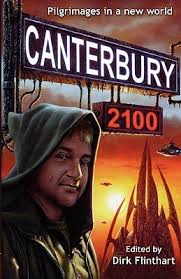
I really thought that I had reviewed this fifteen years ago when I first read it, but apparently not. How ridiculous! Anyway, I decided to reread it on a whim, and it’s still a delight.
It’s based on Chaucer’s Canterbury Tales, of course – pilgrims telling stories as they travel to Canterbury. Here, after a series of apocalyptic events only vaguely referred to, a bunch of people (mostly pilgrims) are travelling to Canterbury on a nuclear and steam-powered train. They’re delayed by rain (and worse), and start telling stories. The same sort of stories, at heart, as those told in Chaucer’s story: individuals and communities, loss and love and hope and tragedy, believable and not; all revealing tantalising glimpses about the people and their world.
There’s a great range of styles, as there should be in an anthology like this, and maybe sometimes the stories don’t seem like they’re quite coming from the same world. But honestly, would someone from Kununurra tell the same sort of story about Australia as someone from Canberra? And did you really think all of these people were telling the unvarnished truth? … all of which is to say, the collected stories feel real in a very human way.
Published in 2008, one of the fun bits is to look at the authors and see who I still know. Third up is Angela Slatter, who is still going from strength to strength; likewise Trent Jamieson, Lisa L Hannett, Kaaron Warren. There’s Martin Livings and Laura E Goodin and Grant Watson and Thoraiya Dyer… and of course it’s edited (and with connecting text) by Dirk Flinthart. Truly it’s a who’s who.
If you can still find it, this is such a fun anthology.
A Letter to the Luminous Deep, by Sylvie Cathrall
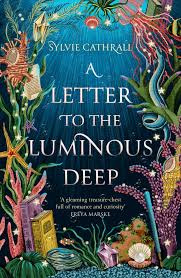
I picked this up because someone mentioned the sequel, and I thought it sounded amazing. And because it turns out I’m a bit of a sucker for the epistolary novel.
There’s a tangle of letters here. Henerey Clel and E. were writing to each other for some months… and then they disappeared, presumed drowned. Their correspondence is pieced together by Henerey’s brother and E.’s sister, some months later again, through their own correspondence. And notes from other people are also included, to flesh out various issues along the way.
Why are Henerey and E. presumed drowned? Because the world they live on has almost no land above the ocean; because E.’s house is literally underwater – and there was some sort of disaster while they were outside, near that house. The world itself is one of the most wonderful and intriguing parts about the novel; exactly how it works is gradually – very gradually – teased out over the course of the entire book, and piecing together its history is almost as much fun as learning about E. (reclusive, highly intelligent and curious, anxious, probably has OCD) and Henerey (scholar, slightly awkward, frustrated by academia, highly intelligent and curious), and of course about Sophy and Vyerin.
The language won’t work for everyone: it’s a bit on the highly-stylised end. “O dearest E.!” and so on. But for me, I felt it was done with such love – Cathrall isn’t making fun of the language, but writing it with immense enjoyment – that I was prepared to go along with it, and even enjoy it most of the time.
I must admit that I put a hold on the second book… and then let it lapse. I read the blurb, and I’m not really convinced that it sounds as compelling as the first book. At least, not enough to read it immediately. Does this first book need a sequel? I think it probably does, but also I’m willing to let the mystery just sit, at least for now.
The Greatest Fight of Sunny Granada, and other stories

This is another of the book sent by a Filipino friend. You can buy it over here.
I’d not come across Kenneth Yu’s work before, but apparently this is his second collection of short stories. There’s a really interesting variety in the stories presented here.
The eponymous story is very clearly science fiction, and told non-linearly, about a man who starts off as a boxer/MMA etc on Earth and then leaves the planet to find more career options fighting aliens in the arena. Certainly on one level it’s about fighting as a sport and sport for money, but of course it’s also about family and inheritance and Place as home.
Then there’s “Spider Hunt,” which feels more like fantasy; “The Probe” is maybe SF, maybe fantasy, and works by muddying the lines. “Beats” is also genre-defying, intriguing and mysterious.
While I can see, and appreciate, what “Operation: Bleach” is doing, I’m as white as they come; I suspect it hits far harder for folks with browner skin than mine and who live in a society that upholds my sort of skin as somehow preferable. It’s another story told inventively – a series of newspaper articles and comments – and it’s probably my favourite story of the collection.
I found “Lost for Words” a bit confusing, to be honest – it’s very short, and I don’t think entirely works as a story. Then “All That We May See” tips into horror, “One Morning at the Bank” is a superhero story, and “Blending In” feels basically like realism.
And then “For Sale: Big Ass Sword” is told entirely as an ad on Talipapa, which I understand to be an online trading site for the Philippines; the story leans into folktales/fairy tales, and is a really solid conclusion.
It was never predictable what the next story would be like, and I really enjoyed that aspect, as well as the stories themselves.
Mapping New Stars: A Sourcebook on Philippine Speculative Fiction
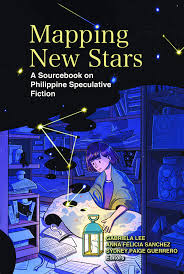
Available to buy from The University of the Philippines Press.
This is another book sent to me by the wonderful Charles Tan, who knows that I have an abiding interest in non-fiction about science fiction and fantasy…
I love that this book exists. The Philippines as a modern nation has such a fascinating (note: not necessarily a positive term!) and tumultuous modern history – the various waves of colonisation and everything that goes with them – that to begin unpicking influence and purpose and consequence is a hard thing. What I hadn’t realised and should have is that, as with so many groups (thank you, Joanna Russ and How To Suppress Women’s Writing, for always making me think about this), modern Filipino authors may not necessarily know all of the history of speculative fiction in their country, for one reason or another.
So the historian and SFF fan in me is both fascinated and thankful for the editors and authors of this book: the first half, “Reading Philippine Speculative Fiction,” is literally tracing some of the histories and places where it has developed and thrived. Two chapters in this section are in Tagalog, so I can’t speak to what they’re about; but the others were really fascinating, especially that on Komiks and the way Filipino authors have used external and local influences to create stories.
I will admit that I only flicked through the second half of the book: I don’t write fiction, so “Writing Philippine Speculative Fiction” is not for me. I do love that Emil Francis M. Flores wrote on “First World Dreams, Third World Realities: Technology and Science Fiction in the Philippines,” since this conjunction is one that I think has enormous potential for authors to explore.
This is a great book. Props to the University of the Philippines for publishing it.
Doomsday Dance Party, Nikki Alfar
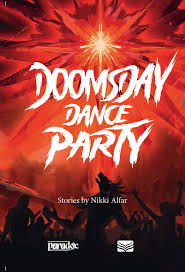
A friend in the Phillipines sent me a copy of this, thinking I would like it. They were, of course, correct; you can get it from the publisher.
I’m not sure if I’ve come across Alfar’s work before – possibly in anthologies? – so it was intriguing to see the variety of short stories she presents here. Some are realist fiction; more are science fiction or fantastical. Most have clear Filipino connections – set in the ‘real’ Philippines or an alternative version – with a couple of exceptions, most notably “The Riddle of the Great Khan’s Great-Great-Granddaughter,” which I loved and is not connected to the Philippines at all. As well, many have elements of Filipino mythology, like the tikbalang and ‘fey folk’ (in English) at the wedding in “Destination: Wedding,” which was absolutely one of my favourite stories. Sometimes, as with that one, it’s because the story is specifically about an experience in the Philippines; other times the Philippines is the setting because it’s the setting, not because Alfar is making a specifically Filipino point (I hope that makes sense). Styles changes across the stories, from relatively straightforward to the more lyrical styling of stories like “El Legado de Lana (Lana’s Legacy)”.
It’s a compact collection, at 155 pages of story. I’m glad it exists and that I got to read it: the stories are a delight and I hope Alfar gets ever more notice, both at home and abroad.
The Ministry of Time

What is there to say that hasn’t already? I read this because it’s on the Hugo shortlist this year, so that was already (likely to be) a good sign.
- Time travel done quite cleverly – excellent.
- Super slow-burn romance that basically makes sense – very nice.
- Politics that develop and get more and more tricksy as the novel progresses, in ways that I actually didn’t expect and was deeply impressed by as the book went on – magnificent.
- Pointed, thoughtful, and clever commentary about race, ethnicity, passing, immigration, assimilation – very, very nicely done.
This was another book that I had deliberately not read anything about before going in – the name told me all I needed to know, especially once it got on the Hugos list and friends started raving about having enjoyed it. So I went in with no expectations. (If you want to be like me, just stop reading now!)
I really didn’t expect that the idea was that people were being brought into the 21st century. I think the initial explanation of that is perhaps the weakest part of the story: why do this? I don’t think the “for science!” explanation is pushed enough to be convincing. And yes maybe that’s part of the point, but… on reflection, I do think that’s the one bit that’s too vague.
I really, really didn’t expect the whole explorers-lost-in-the-frozen-wilds chapters. They make a lot of sense in terms of elaborating Graham’s character. And it’s only in hindsight that I can see that they’re also doing some interesting work in terms of showing two groups, coming into contact, who find one another unintelligible.
One of the twists I picked up early – I think at the point where the author was starting to really flag it, so I won’t take any credit for being particularly clever. I did not pick up one of the other twists until it was presented to me, which was a highly enjoyable experience.
This is a debut, so I am left with “I hope Bradley has a lot more ideas left in her head.”
Bean there, Done that: The Island (2005)
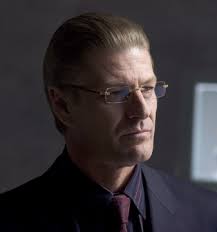
I might have seen this twice? Maybe I saw it at the cinema? I have no clear recollection. Unlike Ronin, though, I know I have seem it.
- It has such a spectacular opening: the idyllic boat ride, the terrifying maybe-drowning, waking up in the whiteness of the bed… also, Ewan and Scarlett. SO hot in 2005… and also in 2025.
- I had forgotten this was a Michael Bay! Lots of blue already.
- Michael Clarke Duncan!
- And THERE’S Bean: Dr Merrick. Maybe a psych? Certainly a top person. And Lincoln knows that needing to see him means there’s something wrong…
- I adore his office. The art, the architecture, the desk-as-screen.
- His glasses are amazing – so early 21st century: frameless, rectangular.
- Slicked back hair, short of course.
- McGregor’s accent is very confused.
- (Steve Buscemi!)
- A pod with “Merrick something” on it, with a human inside… so Dr Merrick is the person in charge then. And thus we discover that the facility is making humans, and the whole “surviving a catastrophe” thing is a lie.
- The xbox boxing arena is terrifying.
- Bean sitting in his room, alone, to watch the Lottery: fireplace, high ceilings, very different from the rest of the place.
- McGregor gets to the area he’s not meant to be in… and then Bean sees him on the security footage and loses his nut.
- Bean does coldly furious very nicely.
- Finally realised who Jones Three Echo is: Neelix, from Star Trek: Voyager.
- Bean selling his product to rich people: the ability to grow a body that will provide organs, and promising that all bodies are vegetative, rather than aware.
- But apparently without living, the organs fail. Which… seems unlikely, but it’s a good story.
- (Djimon Hounsou! Oh. Except he’s a bit evil. Well, a security consultant anyway.)
- Hearing the original Tom Lincoln with Ewan M’s actual accent is wild.
- Bean announces that because of the defect – developing curiosity – four product lines are going to be… eliminated.
- And then he shows that he has a god complex, and that he has convinced himself his ‘products’ have no souls.
- (Dijon Hounsou comes good!)
- Bean actually gets his hands dirty, going after Lincoln with a gun! Fisticuffs ensue.
- Also his hair gets mussed.
- And then he dies because their fight means he ends up hanged.
- Everyone gets out, and now there’s going to be a terrible problem with famous people having clones hanging around, plus they all need to be taught how to live in the world… but that’s not the problem of this film.
- Thing I just realised: I know it’s a completely different situation, but there’s definitely a similarity between this and Severance. Innies and outies.
Verdict: Corporate villain. Even the starting point of his journey – wanting to provide organs for rich people so they can live longer – is grotesque: there’s no suggestion that he starts from a particularly altruistic position. And then willingly keeping conscious humans in prison for his own greed? Evil.
Movies: 5. Beans dead: 4.
Esperance, by Adam Oyebanji

Read courtesy of NetGalley and the publisher. It’s out in May.
Starts as a police procedural, which is fine by me – I love them: Chicago cops turn up to investigate a death, the cause of death is very weird, and how it was managed is baffling. Cops hear about a similar murder a long way across the country…
Meanwhile, someone has just arrived in England – we don’t know where from – and talks like someone from a bad 1930s film. She meets a grifter, they fall into some trouble together, and of course their paths eventually cross the paths of the American cops. And I can’t tell you why or how without going into some of the key revelations, the discovery which was a massive part of why I enjoyed this novel so much.
I spent a lot of this novel not really sure who the traveller was, where they were from, and what their purpose would turn out to be. Sometimes this sort of suspense is really annoying, but not here: although their overall intention was mysterious, Oyebanji still managed to create a character who was fascinating and appealing enough that I wanted to keep hanging out with them. He also does some very clever things with the American cops, I think, although as a white Australian I’m really not in a position to fully comment on that.
The book is fantastic. There’s wonderful characters, excellent interactions between them, and an intriguing and compelling mystery. It covers racism, mammoth questions like what justice really is or looks like – and is a standalone story. Highly recommended.
City of Dancing Gargoyles

I read this because Ian Mond told me to. I mean, not personally or directly, but he definitely recommended it within my hearing, and I took that to heart. I am very, very glad that I did.
This is not a linear narrative. As I was reading, I was trying to figure out what it reminded me of, and I finally realised: it’s Christopher Priest’s The Islanders. It’s not identical, but there’s a similarity in the way it tells a story through vignettes and moments. It’s got a bit more traditional story-telling thrown in there than the Priest, I’ll admit, but the comparison is still valid. Especially since I loved both.
The book is set at some point in the future – not too far future, there are no galactic empires; but also not quite tomorrow (sometime early in the 2100s-ish). Something… odd… has happened in the USA (insert joke here and then move on); something alchemical, perhaps. Previously inert things have been affected – built things, and natural things. The title gives you a suggestion of one way things have been changed. There are also towns where trees shoot guns, and a city where chocolates glare at you, where books fret, where blankets cringe and candles sob. Why? Absolutely no idea. Part of the story is told in communications between Meena Gupta and Joseph Evans to their boss, Manfred Himmelblau, as they go exploring and reporting on these places. Part of it is the experience of M and E – two gargoyles searching for their place in this new world. And part of it is about Dolores and her mother Rose, who are likewise looking for safety and community.
It’s a beautiful book. It’s about identity, and dealing with change and opposition and the weird, and finding community. It’s somehow also about the things that are already remarkable in our world by imagining how things might go really (really weird). An utter delight.
You can get it from the publisher.

 Randomly Yours, Alex