Galactic Suburbia 136
 In which Alex and Tansy leap back into 2016 to talk Awards (it’s that season again!), comics, novellas, mysterious London novels and epic feminist canon.
Also, Molly Meldrum.
We’re on iTunes and over at Galactic Suburbia.
Locus Recommended Reading List.
BSFA Awards shortlist
Letters to Tiptree 99 cents! Bestseller on Amazon!
Tansy’s new podcast plug! Sheep Might Fly & Fake Geek Girl
Kickstarter for Ursula Le Guin documentary.
Nominating for Hugos (til end of March) don’t forget.
And Part 1 of the University of Oregon’s Tiptree Symposium, with Julie Phillips (Alex says: sorry not sorry, Tansy)
CULTURE CONSUMED:
Tansy: Hellcat by Kate Leth & Brittney Williams, Archie by Mark Waid & Fiona Staples, The Honey Month by Amal El-Mohtar, The Beatriceid by Kate Elliott, “Binti” by Nnedi Okorafor, “The Heart is Eaten Last” by Kameron Hurley (note: Kameron says any new Patreon subscriber automatically gets access to all the stories she has posted so far including this one – bargain at as little as $1 a month!)
Alex: Jonathan Strange and Mr Norrell, Susannah Clarke; Neverwhere, Neil Gaiman; The Just City, Jo Walton; Walk to the End of the World, Suzy McKee Charnas. MOLLY.
Skype number: 03 90164171 (within Australia) +613 90164171 (from overseas)
Please send feedback to us at galacticsuburbia@gmail.com, follow us on Twitter at @galacticsuburbs, check out Galactic Suburbia Podcast on Facebook, support us at Patreon and don’t forget to leave a review on iTunes if you love us!
Walk to the End of the World
As with Le Guin’s The Word for World is Forest, if I had not known that this was highly regarded amongst feminist sf types I would have given this book up in the first couple of pages. Charnas is utterly devastating in her representation of men and their attitudes towards one another, and their attitudes towards women – “fems” – and towards history and power. While I don’t honestly think things would go this way, it still works as a horrifying critique and savage prophecy of the outcomes of patriarchy.
Charnas writes in a post-apocalyptic world where it seems that only a tiny proportion of white men, and fewer women, have survived to try and rebuild some sort of civilisation. And we know they are all white because there is specific mention of how excellent it is that one class of unmen – the Dirties – are gone, and in case the reader was really obtuse there’s a song enumerating just who the Dirties were. I cannot imagine reading this as a non-white person, given it was hard enough as a white woman. Anyway the destruction of the world has been blamed on the unmen – beasts, Dirties, and fems. The inclusion of beasts in this list is the most bizarre bit to me, because would men really have forgotten that animals were not human and had no connection to civilisation and therefore its destruction? I guess if there were no animals left and you were creating a story to apportion blame, you might. Anyway the Dirties apparently fought against the righteous actions of the true (white) men, and fems were witches who constantly fought against men because they’re agents of chaos and the void.
Not content with this level of terrifying prediction, Charnas also suggests that patriarchy would (d)evolve into ruthless competition between, basically, sons and fathers. To the point of de-identifying familial ties so there can be no seeking out and killing progenitor/descendent; and to the point of reinterpreting Christianity as the Son defying the Father and being punished as a result. (Which is magnificent and disturbing and just whoa.)
The story revolves around the quest of a son for his father – because he’s unique in knowing this information. At heart it’s a very simple and straightforward story but the world that Charnas has created for it is anything but. Through the quest the reader sees basically the entirety of the new civilisation, as well as how the various segments of society work and all the dangerous undercurrents that are at play. The four different points of view, giving very different perspectives, all work seamlessly to develop Charnas’ vision – which is really a warning.
This book is brilliant and terrifying and not for the faint of heart not because of violence to persons but because of violence to notions of civility and humanity. Well, mine anyway; maybe I’m just a bleeding heart liberal. I can’t imagine what would happen if an MRA dude read it; I’d be rather scared they’d miss the irony.
I actually read this as the first in the Radical Utopias omnibus. The next is The Female Man, and I’m not sure my brain can handle rereading that. The third is a Delany that I’m pretty sure I haven’t read, so I will certainly get to that soon.
The Einstein Intersection
 Oh Delany. You continue to impress and stagger me. And I don’t think I got some of the more subtle stuff that was going on here.
SLIGHT spoilers. I don’t think it would compromise your enjoyment of the book.
I really enjoyed this novel. It’s got such a clash of styles – sometimes the main character, Lobey, out-innocents Garion from the Eddings’ Belgariad series, and sometimes he participates in intense discussions of genetics. It’s got remarkable meta stuff going on, with excerpts at the start of each chapter from a really broad range of sources including, apparently, the author’s own diaries (are they real? were they really written in a diary but with the intention to include it in the novel? Just how meta and sneaky can Delany b- oh wait. Pretty sure the answer to that is obvious).
Delany is doing all sorts of sneaky things here with myth and legend. The AI whose acronym spells PHAEDRA, found at the end of a labyrinth… plus Christian stuff, plus American Old West stuff, plus I suspect some other stuff that I did not pick up on. And then there’s the meta-discussion ABOUT myth and legend and their place in society and 147 pages SERIOUSLY?
I ADORED the revelation that these are non-humans literally taking on the skins and myths of humans for some unrevealed purpose. It’s almost a cliche to talk about books where you’re just dropped into the middle of a much, much bigger story but by golly that’s true here. The level of opacity is breathtaking AND YET the story is still so very compelling.
Delany. Man.
The Emperor’s Railroad
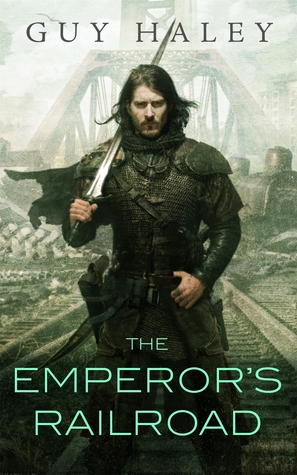 I received this from the publisher at no cost.
I’m not a huge zombie-story fan, so this story wasn’t really aimed at me. That said, turns out I can be quite a fan of your post-apocalyptic, back-to-vaguely-old-west-America stories, so that aspect was quite enjoyable. I do like the image of human creations being subsumed into nature.
Quinn, the hero of the story, is intriguing, and through him we get glimpses into the rest of the world that the story is set in. There are angels and dragons – I kept wondering whether this would turn out to be a fantasy or a science fiction story, and it’s not entirely resolved – and Quinn is a knight, commissioned by an angel but now on his own sort of quest. It’s a long time since I’ve read them but I was put in mind of the Terry Brooks Word&Void series; the child narrator, Abney, is fully aware that his world has extraordinary things in it but is still something of an innocent of the realities, while Quinn has seen too much.
Despite my not loving zombies, I did read and enjoy the whole story, so that says something for the characters and for the fairly fast-paced style.
The Just City
I hadn’t even heard of this book until Katharine mischievously sent me a copy because she wanted to know how I would feel about it. And my initial feels are: omg THERE BETTER BE A SEQUEL.
Is that what you were expecting, K?
 The premise: Athene (yes, she who sprang fully formed) wonders what would happen if humans attempted to put Plato’s Republic into action – with a little help from her, of course. So she gathers together a bunch of people from across time who have all prayed to her, perhaps inadvertently, after reading The Republic and wanting themselves to put it into practise. And they’re going to collect slave children, and they’re going to try out their city on a certain island that will eventually be destroyed by a volcano… (yes Athene is aware of how recursive this is I LOVE YOU JO WALTON).
Apollo, meanwhile, is confounded by Daphne wanting so much to get away from his tender advances that she was happy to be turned into a tree, so he decides to become mortal to explore ideas of volition and equal significance. And hanging out in the fledgling Republic of the philosopher-kings seems like an interesting and pragmatic way of doing so.
The book’s chapters switch between a few different characters. Apollo gets a few, but not most, which is good because I liked his perspective and seeing what life was like for a being with godly knowledge but human limitations, but it would have got old to have him as the focus. Instead, most of the chapters are from female perspectives. Lucia, renamed Simmea, is from what I take to be the early Christian period; she’s bought as a slave and taken to Thera, destined to be brought up in the first generation of true Republicans. Maia, originally Ethel, was born in Yorkshire in 1841. Well educated for a girl at the time she appears destined for the standard gloomy life of struggling middle class woman, until she happens to cry out to Athene… and she’s transported to Thera to act as one of the guardians, teaching the new generation how to be their best selves and eventually develop into Plato’s philosopher-kings (… well, some of them).
I’ve not read The Republic. In fact, I’ve never read anything of Plato’s in much depth or at much length (I’ve taken some Classics subjects so I must have read a bit… right?). This is not, however, a problem for reading this novel because Walton does a wonderful job of having her characters discuss the various issues and conundrums and ideas that Plato raises – all without it seeming like an info-dump. Just as setting up the city is an experiment for Athene, this book is a thought-experiment itself. This book reminded me in some ways of Ursula Le Guin’s The Dispossessed, because so much of it is conversation- and ideas-driven. There is some action, but it is not the focus – and most of the action is connected to the ideas, showing them in action in some way. And I never once found it boring.
Issues confronted:
Slavery, good or bad? And can you have the perfect society as suggested by Plato without slaves to do at least some of the jobs?
Individuals as ‘fit for purpose’: should someone else get to determine what you do for your  entire life? Should your worth be entirely determined by the work that you do?
How to be one’s best self: I could not help but think of Bill and Ted, of course. But it is also a deeply intriguing question: how do we help ourselves and those around us be excellent?
Censorship: can it be a good thing?
Who can you trust? How do you know? Are there levels of trust, or areas in which someone is trustworthy and others in which they aren’t?
There is JUST SO MUCH in this book I have only scratched the surface IT IS EXCELLENT.
Slight spoiler
The one off-note that didn’t really work for me was the rape early on of one of the guardians. While it was occasionally referenced later on and certainly had some impact on the woman involved, I didn’t really see why it needed to be a part of the narrative. And it seems weird to say that this is a minor quibble, given the topic, but overall I think it’s dealt with mostly ok; it just didn’t quite sit right with me.
Aaaaand in finding the image for this post I’ve just discovered that the second book already exists in the world AAAAAAAH *buys*. (Also buys a hard copy of The Just City, for re-reading and shoving into people’s hands. My mother MUST read this.) You can get The Just City from Fishpond.
Lament for the Afterlife
This book was sent to me by the author.
 Lament for the Afterlife is not an easy book to read. Here are some times when you should not try to read it:
- When you want a straightforward, linear narrative.
- When you want likeable characters.
- When you don’t feel like reading about war and/or death.
- When you want to read about long-term, meaningful and loving relationships.
- When you don’t want to work at reading.
- When you just want clarity.
If you don’t fall into these categories, then you may want to approach Lament. Here are some things you need to be ready for:
- A mosaic novel. Chapters do not follow one another linearly: they are more like snapshots, or vignettes, of different points in time for different characters. Overall the story follows the experiences of Peytr, a young man conscripted for war, and almost half the story I would guess is focussed specifically on him over quite a stretch of time. But other chapters are connected to Peyt only tangentially, and some not at all.
- Unhappiness. Pretty much every character is unhappy. There’s a variety of reasons, and a variety of expressions, and a variety of consequences. Not a whole lot of resolution, though.
- Death. There’s a lot. The first half or so is firmly set within the context of war – and war that civilians actually experience; this is Sarajevo or Kabul for its inhabitants, not for the foreign soldiers. And then the second half is focussed on the aftermath of war, which isn’t much more pleasant.
- Uncertainty. Every single character experiences uncertainty, to a greater or lesser extent (will my son come home? Will I die today? Will I be safe at work?), and this is shared with the reader. The reader also gets their own share of uncertainty because Hannett leaves an enormous amount out. “Our side” are fighting the greys, and have been for ages, but… why? And who even are they? Our side also have things called wordwinds, clouds of words and fragments of thought that circle individuals’ heads… somehow? and they can be physically manipulated sometimes? Those are the big questions; there’s a lot of other tantalising questions that just don’t get addressed. I don’t require spoon-feeding from my books but I did sometimes feel a bit frustrated by the opacity of the world – partly because it made me feel like I’d missed something at some point.
- Lovely language. Hannett constructs simply beautiful sentences. Her prose is elegant and evocative and creates vibrant images – some of which are unpleasant, but they’re nonetheless powerful.
Lament for the Afterlife is set in a secondary world, but you really only know this thanks to the wordwinds; it could as easily be a post-apocalyptic world, actually, where these ‘winds have somehow developed. It’s one of those stories that feels science fictional, but aside from its setting I’m not sure I can pinpoint quite how, or why. Not that it matters – this is not a novel that is bound by generic conventions, or even playing with them. It just is. It’s not an easy novel to read; it’s not a particularly nice novel to read. It’s challenging and disturbing and sad. It’s very good.
Forest of Memory
This book was provided to me by the publisher at no cost.
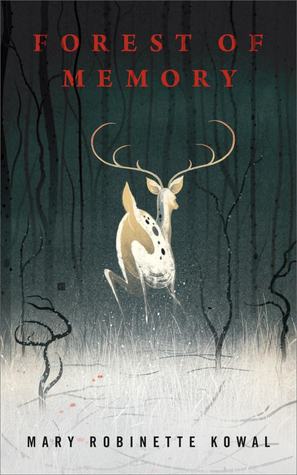 Mary Robinette Kowal takes the idea of memory and its fallibility as her central theme in this novella, and pairs it with the ever-fascinating ideas of narrative, and unreliable narrators, and their motivations.
Kowal’s narrator lives in a world of permanent connection, through her intelligent system, and a world of permanent life-casting – ideas that have a strong hold on the world of science fiction writing at the moment. I was strongly reminded of Ted Chiang’s awesome “The Truth of Fact, the Truth of Feeling.” That story is a much more rigorous exploration of the same general themes, not least because it is much longer and because it pairs those themes with ideas connecting language and meaning and memory. The two work really nicely together.
Anyway, Katya is telling a story to persons unknown who have asked for the story of three days when she was offline. (The page before the story opens has this dedication: “For Jay Lake and Ken Scholes / Who asked me to tell them a story” – which is pretty amusing in context.) She is a dealer in Authenticities, meaning old stuff with wabi-sabi (a Japanese term, she explains, of something that witnesses and records the graceful decay of life), as well as Captures on the side – that is, she sells the record of her personal experiences. The difficulty she has, of course, is that for the three days she was offline she will need to rely on her own memories, rather than asking for a replay from her i-sys. She is super aware of the possibilities here of her own unreliability, reflecting on them and looping back on herself as she considers whether or not to trust herself. It’s a wonderfully constructed piece of worry.
There’s not a whole lot of action in the story, really, and it raises enormous questions about the world in which it’s set and the reasons for why someone wants Katya’s story. I rather hope that Kowal might consider writing more stories, or a novel, set in this world and further exploring the issues raised.
The Absconded Ambassador
This novella was provided to me by the publisher at no cost.
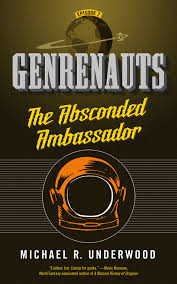 I haven’t read the first Genrenauts story, so there was a bit of a surprise in the backstory of one of the characters, but nothing game changing. Other than that, it’s a straightforward idea – especially if you’ve read the Jasper Fforde Thursday Next books, as I have (well most of them. They lost their appeal after about the fifth book): sometimes there are breaches in what’s happening in stories, or genres more broadly, and they need to be fixed before the ripples affect Earth Prime.
This story (and I think the first one too) are largely told from the point of view of a new officer – of course; it makes the storytelling so much easier. This time there’s a problem in the science fiction area, so off the crew go in the Firefly-esque mode to a Deep Space Nine-esque station, to figure out what’s going on.
I’m really happy with the theory here.
However, I wasn’t thrilled with the execution. I thought that the story forgot its genrenaut aspect too often and strayed into straight Science Fiction Action without commentary. There was some excellent commentary on the idea of the Action Hero and what that archetype is allowed to do, but that wasn’t nearly as dominant or as thoughtful as I had hoped. Additionally, it was completely unclear to me whether what was going on in the plot of the in-story story (like the play within the play) was actually a breach, and therefore a problem. This is queried once in the story itself, and I wondered whether this is an ongoing teasing thread throughout the series (there’s at least one story to come), but if that’s the case then it’s neither been set up strongly enough to be intriguing nor set up subtly enough to pack a real surprise at the eventual reveal.
For me, then, this is heavier on the promise than on the delivery.
Cibola Burn
 It’s weird. I did my mammoth James SA Corey re-read specifically in order to read this and then… it took me a while to really get into it. Partly, I think that’s because it was jarring to go from the familiar to the not but with some familiarity; it kind of threw me. And then there’s the fact that most of this book is set on, or orbiting above, a planet. I mean, there’s been bits set on Earth before, and quite a lot within the inhabited asteroids, but – a planet? as the main setting for an Expanse novel? That’s just weird.
But, eventually I got there. And of course I’m glad I did because this, really, is the conclusion to the arc that started with Leviathan Wakes (… although I’ve just bought the fifth novel and there’s a sixth due next year, so I don’t really know what’s going to happen there).
As always, there are multiple narrators. The prologue starts with Bobbie Draper, which is mean because it meant she wouldn’t feature and I really like Bobbie. Anyway. The first chapter is Basia, and it took me a little while to recognise the name (and a rather obvious hint, actually): but this is Miller’s acquaintance from Eros, the one whose little boy was kidnapped at the same time as Mai. He’s been part of the first wave of people to head out through one of the gates that’s now opened to the galaxy; basically, they’re squatters. Which is mostly fine, since their planet has a nice store of lithium for digging up and then selling – but because of that lithium, there’s a corporate ship coming with offical Earth papers that say the planet is theirs for the mining. Of course, why should an Earth piece of paper make a difference? And so Basia gets caught up with the wrong people (saboteurs) for the right reasons (family and freedom). He has many difficult decisions to make over the course of the novel.
The second narrator is Elvi, a scientist who is coming to the new planet (whose name depends on which side you’re on) with the corporate ship because heck, wouldn’t you? Chance to check out (what should be) a pristine new environment? Of course things go wrong (see previous comment on Basia’s friends), but she does at least get to do some science. I wasn’t always happy with Elvi’s narrative; I’m particularly conflicted about the romantic aspects, because while I think I understand it, it did feel a bit like “oh a lady must feel romance” and that makes me sad. She does get to be a kickass scientist though, which I guess is a consolation.
Third is Havelock, and I am so embarrassed by how long it took me to figure out who this was. It wasn’t until there were really obvious comments about being an Earther and being part of Belter security that I realised: this was Miller’s partner, back in the day. The one he warned off when things were getting difficult for Earthers. So we have a marvellous set of call-backs to the first novel, here. I mostly liked Havelock, although his tendency to just follow and mirror what his leaders are doing got pretty old. I enjoyed the perspective he allowed, though – it did add a nice rounding to the story.
And fourthly, of course, what would an Expanse novel be without James Holden? Oh Jim. Seriously. This time, he’s involved precisely because of who he is: one of the most notorious men in the solar system, renowned for a disturbing sense of decency and fierce love of truth. Who better to negotiate between Belter squatters and an Earther corporation? BAHAHA.
Also, of course, Miller is still around and being annoying in Holden’s head. In fact, the artefact gets its own occasional appearance in the narration of the story…
Not quite as enjoyable as the previous novels, but still a really solid SF story… and the epilogue makes me rather excited for the fifth.
You can get Cibola Burn from Fishpond.
Luna: New Moon
 This book was provided by the publisher at no cost.
Um. Wow.
Over on Goodreads, Jonathan Strahan describes it “basically The Moon is a Very, Very Harsh Mistress” which… yes. (Also makes me curious to back it up with the Heinlein….)
The short version: this is magnificent, occasionally vicious lunar science fiction, with a fascinating society, varied and variable characters, and unexpected plot twists. HIGHLY recommended. I want to read more like this.

 Randomly Yours, Alex