The Great Ship
 I had read a few Great Ship stories before (two of which are in here), so I was really excited about getting a collection that has almost all of them, in some sort of order.
Let me get the annoying thing out of the way first. This collection was collated by Reed himself, as far as I can tell, with a bit of additional material to bridge the stories (and adding to “the resident confusion” apparently), and some stories altered as well to better fit with the others. There are a lot of typos, and a number of problems that I would have expected proofreading to catch. This didn’t detract from my overall enjoyment of the stories, but I found it really quite frustrating. Also, rather than having headers that give the name of each story, the header is a number: so it might have “5 95” at the top of the page, which tells you you’re on p95 overall and section 5 on whichever story is on that page. But it doesn’t tell me which story! Argh. Anyway.
There’s no point in talking about every story; that would be tiresome. I realised as I read the last story that the collection as a whole rather put me in mind of Christopher Priest’s The Islanders. They have nothing in common in terms of themes or characters or setting, but there is a certain way in which their methods of connecting disparate elements feels similar. In Priest’s work, the same character might turn up on several different islands and you learn about them a little more. Here, there are a couple of characters who recur in a big way (Quee Lee especially, and Perri), and several others who appear intermittently. Additionally, the Great Ship is so very big that each story is set in a different place – and sometimes not even on the Great Ship – so that, like the Dream Archipelago for Priest, it’s the same place but very different.
The Great Ship is just that: a spaceship that is at one time described as being the size of Uranus. And there’s very few who live on the surface – which would be big, but not that impressive: rather, the entire innards of the Ship is honeycombed with a vast array of habitats, meaning that the Ship can support countless billions. For whatever reason it was launched into the universe, travelling along, and then humanity managed to board and claim it. But it’s not just a human ship; any species, as long as they’ve got the cash to pay their way, can come along for the ride. And what a ride: they’re doing the ultimate Grand Tour, around the Milky Way.
All of the stories are entirely standalone. There is no reason to read this collection in the order it’s presented. Except that Reed claims to have it in some sort of chronological order (and certainly the two bookending stories feel like a beginning and an end), and there is something very satisfying about feeling like you’re progressing through the history of the Great Ship and its passengers. And everyone is a passenger, whether they’re paying or working their way. I like that there are stories about rich folks as well as people who work on the ship; it wasn’t quite balanced, but it’s better than simply seeing the idle wealthy. There are stories of action and adventure; stories about relationships, and solitude, and time; there is death and birth and just getting on with things.
One of the odd things about these stories is the issue of time. Pretty much everyone on the Ship is functionally immortal. No diseases, no ageing; you get hurt but as long as your brain is intact it doesn’t even matter if you die. So ideas like your husband being away for a year (or ten), or a journey taking thirty years, or having to hide for centuries… those words, those time-concepts, are basically irrelevant. I didn’t end up with much of a sense of grandeur or the epic sweep of time because the numbers are so big that my mind just rebelled and basically say those as weeks, perhaps months. Which doesn’t make the stories any less interesting but perhaps is not the response Reed is hoping for.
I do intend to read the Great Ship novels… but I might go read something on a slightly smaller scale first…
The Female Factory
It took me a while to read this one. I read “Vox” and “Baggage” and then had to have a metaphorical lie down for a week, to catch my breath, then read the last two stories.
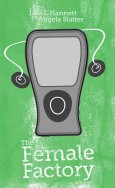 Seriously. These two ladies. THEY DO THINGS TO MY BRAIN.
The no-spoilers version is: this collection is about being a woman, and children, and social expectations, and identity.
Now go read it. No, seriously.
Spoiler-filled version:
“Vox” is incredibly chilling, probably the most of the four stories, and on two laters. Kate’s obsession with the voices of inanimate objects is kooky but not that strange; her despair at not being able to have children is a familiar one. The further despair at having to choose just one child cuts deep… but the fact of what happens to the children she doesn’t choose? I had to reread the sections about the electronics’ voices a couple of time to check whether HannSlatt really had gone there. And yes, they really really had. Plus, Kate’s attitude towards her existing child… says some hard things about maternity. Confronting, in fact.
“Baggage” is a nasty little piece of baggage, with a central character lacking pretty much any redeeming personality features and a quite unpleasant world for her to feature in. Her particular ‘gift’ is never clearly explained, which I liked, given how supremely weird it is. There are definite overtones of The Handmaid’s Tale, although obviously it’s very different, and also perhaps Children of Men? Once again with maternity, although I imagine Kate would be horrified by Robyn’s attitude towards her own fertility, and the cubs she produces.
I loved “All the Other Revivals.” Well, I… hmm. Maybe I didn’t love all of them, but it’s not to say I didn’t love the others…. Oh anyway, it was interesting to come across a male voice, after the first two strong female voices. Not that Baron would see himself as a particularly strong <i>male</i> voice, I suspect. Once again the central conceit – the car in the billabong – isn’t explained at all; it just does what it does. And Baron is who he is, whoever that is – and will be. Once again the nature of motherhood is really strong here, although in a very different way from the first two stories; this time it’s a matter of absence, and one that’s never explained. I guess the billabong can be seen as a sort of mother, too, now that I think about it.
Finally, the titular “Female Factory” – named for a real place, I discover, in Tasmania OH MY BRAIN again. Again with the absence of motherhood (so it was a wise thing to do, to read the first two together and then the second two) – this time the story is from the perspective of young children – orphans no less – influenced by daring medical science in the early nineteenth century and their proximity to two cadaver-obsessed adults. Somehow this story, while creepy, felt perhaps the most comfortable of the lot; perhaps because its ideas are a bit familiar? Which isn’t to say it’s not an excellent story, which it is.
Overall this is an excellent #11 for the Twelve Planets, and once again Lisa Hannett and Angela Slatter have well broken me. You can get it from Twelfth Planet Press.
One Small Step
Soooo this anthology came out in 2013 aaaand I’ve only just got around to reading it. Um. Oops. I have no excuse for this. It just didn’t happen.
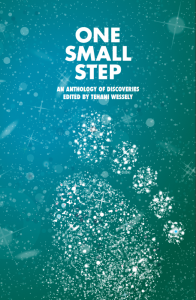 In my defence I read the whole thing last Sunday. That counts, right?
The subtitle is “An Anthology of Discoveries” and what’s really interesting is that this is such a broad anthology but yes, the theme of discovery – of place, or self, or strangers – is the unifying factor. Sometimes it’s obvious and sometimes it’s subtle; sometimes there are world-shattering consequences and sometimes not so much.
The other superbly interesting thing about this anthology is that it’s all women. From memory of Tehani discussing the process, pretty much accidentally so. And it’s not all just dresses and kissing! (Sorry; /sarcasm.) It’s basically a who’s who of established and emerging Australian writers, too, which is a total delight.
Some of these stories really, really worked for me. Michelle Marquardt’s “Always Greener” is a lovely SF story that ended up being simultaneously darker and more hopeful thanI expected (yes that’s a contradiction, too bad). And then to have it contrasted with the fantasy of Lisa Hannett and Angela Slatter’s “By Blood and Incantation” – which is not my favourite HannSlatt but is still quite good – neatly skewered expectations that it was going to be an SF anthology, pointing out that ‘discovery’ is a mighty broad concept. And then “Indigo Gold” by Deborah Biancotti! Detective Palmer!!! and !!! The Cat Sparks story is awesome (it feels like ages since I read a Cat Sparks story), Penelope Love is quietly sinister in “Original,” Faith Mudge does fairy tale things beautifully in “Winter’s Heart.” And the final story, “Morning Star” by DK Mok, is a magnificent SF bookend to match Marquardt but on a much grander, more extravagant scale.
This is a really fun anthology and I’m sorry it took me more than a year to read it. You can get it right here.
Hidden Empire
… nah.
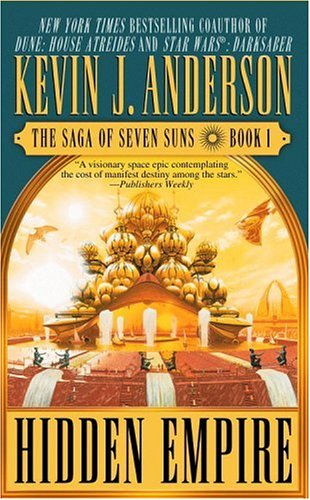 I picked this up from ibooks when they were doing a ‘get the first book in a series free’ thing. It sounded like it could be a fun epic, and it starts well enough: let’s turn a superJupiter into a star using alien tech! The first portag is a female xenoarchaeologist!
I don’t even mind multiple points of view.
But the first alien didn’t feel that alien, and was a bit too eye-rolly pompous. And the heir of the world-trees place goes to visit the alien planet – and the aliens are all very human-like – and one of the first things mentioned about the palace is that there are courtesans? And the heir of the alien planet is all ‘yeh I gotta sow mah oats real fast cos when I inherit, I get the snip’ … nah.
I liked the world-tree and their priests, but they didn’t seem as cool as the Templars in the Simmons’ Hyperion Cantos.
So unless someone can give me a really convincing reason to get back to it… nah.
TV and films of 2014
There are a lot of films in the rewatch category this year. This was seriously impacted by Project Bond, of course, but also by our decision last summer holidays to rewatch the entire Harry Potter series (we had a run of really hot days), and then the CAHRAZY idea to watch all the Fast and Furious movies (mostly again). I had forgotten about some of the films I saw for the first time this year, and I feel like we watched quite a lot of television – most of it new, though, so that’s good I think.
TV (new):
House of Cards (US) (season 1) * Game of Thrones (season 3) * Sherlock (season 3) * Fringe (season 1) * Orphan Black (season 1) * Fringe (season 2) * Fringe (season 3) * Fringe (season 4) * Agents of SHIELD (season 1) * Fringe (season 5) * Orphan Black (season 2) * The Hour (season 1) * The Hour (season 2) * House of Cards (US) (season 2) * Secret State * Alias (season 1) * Extant (season 1) * Haven (season 1) * Haven (season 2) * Haven (season 3) * Doctor Who (season 8) * Newsroom (season 2) * Homeland (season 4) *
TV (rewatch):
Battlestar Galactica (season 4) ( rewatch) * FarScape (season 2) *
Films (new):
Jonathan Creek and the Savant’s Thumb * The Desolation of Smaug * Shakespeare’s Globe: Doctor Faustus * Cabaret * Riddick * INXS: Never Tear Us Apart * Escape Plan * 2 Fast 2 Furious * Furious 6 * 2 Guns * Evil Angels * The Monuments Men * Any Given Sunday * Captain America: The Winter Soldier * American Hustle * The Man with the Golden Gun * The Three Musketeers (2011) * X-Men: Days of Future Past * Edge of Tomorrow * Europa Report * For Your Eyes Only * Jack Ryan: Shadow Recruit * Robocop (2013) * Octopussy * Maleficent * A View to a Kill * Snowpiercer * Rise of the Planet of the Apes * The Incredible Hulk * Expendables 3 * Guardians of the Galaxy * Noah * Interstellar *
Films (rewatch):
Doctor No * Harry Potter and the Philosopher’s Stone * The Expendables 2 * Harry Potter and the Chamber of Secrets * From Russia with Love * Harry Potter and the Prisoner of Azkaban * Harry Potter and the Goblet of Fire * Harry Potter and the Order of the Phoenix * Goldfinger * Bran Nue Dae * Harry Potter and the Deathly Hallows (1 and 2) * Marie Antoinette * Thunderball * Iron-Jawed Angels * The Fast and the Furious * The Fast and the Furious – Tokyo Drift * Fast and Furious * Fast 5 * You Only Live Twice * On Her Majesty’s Secret Service * Ocean’s 11 * Thor * Ocean’s 12 * Ocean’s 13 * The Matrix * The Name of the Rose * Bend it like Beckham * Live and Let Die * Evil Angels * Indiana Jones and the Last Crusade * The Spy Who Loved Me * Moonraker * The Living Daylights * Thirteen Days * Captain America: The First Avenger * License to Kill * Aladdin * GoldenEye * Fellowship of the Ring (extended) * Aliens * Iron Man 2 * Iron Man 3 * The World is Not Enough * The Bourne Supremacy * The Blues Brothers * Blues Brothers 2000 * Die Another Day * The Outsiders * The Dish * Casino Royale * The Karate Kid (original!) * Casino Royale * The Return of the King (extended edition) * Quantum of Solace * Skyfall * Mission: Impossible III * Mission Impossible: Ghost Protocol * Chronicles of Riddick *
John Kessel
 I have had this collection on my electronic TBR shelf since… well, the info at the start says it was being given away free when it first came out in 2008, so I guess for six years. And I have had no recollection as to why I might have wanted to grab it; I vaguely knew Kessel’s name but couldn’t associate anything with it. Until I got to the last story.
This is the author of “Pride and Prometheus,” which I read in 2008 (when it was published) and must absolutely have been the reason for me wanting more of his stuff. Because I really, really liked “Pride.”
The collection is an interesting assortment of stories. Some riff off others – Austen, obviously, and Orson Welles, and The Wizard of Oz, and just possibly Orson Scott Card’s Ender’s series, at least for part of one story, and maybe X-Men too. Other stories are straight “lit’ratyoor” with nary a scrap of speculative about them; “The Snake Girl” is a bittersweet undergraduate tale, for instance. Some I really didn’t connect with; “Every Angel is Terrifying” drags you in but it’s the sort of horrified fascination where you can’t look away. Others…
“The Last American” is one of those stories that is genuinely post-apocalyptic – there’s been gross climate change and massive die-offs due to disease – and dystopic; it’s the story of a man who was the president of America for 33 years, whose life spanned the 21st century. It’s told, though, as a review of someone’s new biography of the man, which has been constructed both as a sensory experience (normal) and with these odd inclusions of text – which is so not normal that you have to download a patch to allow you to experience it. This is the one with the Scott Card and X-Men resonances.
The centre of the collection (just about literally, perhaps metaphorically) is the “Lunar Quartet,” described somewhere in the opening as a ‘modern classic… about life on the moon.’ But it’s not life everywhere on the moon; it’s life in the Society of Cousins, which is run as a matriarchy. You are surnamed for your mother, fathers are largely irrelevant, men have the option of living on centrally provided subsistence which means they don’t get to vote… as a feminist I can tell you it sounds absolutely horrendous. It comes out that this is intended to curb men’s propensity for violence and domination, but it just ends up sounding like an incredibly restrictive society where you almost don’t blame some of the men for acting out. One of the stories is focussed on that, and I was also incredibly uncomfortable with the words coming out of the rebel’s mouth – it was horrid, repellant, appalling. So Kessel takes the opportunity to start a new human society and imagines its possibilities, and is pretty damned ruthless in the process. It’s almost enough to make you despair of hoping for real change. But I don’t think that’s what Kessel wants. I think he’s just being honest about how hard it’s going to be – and that crushing the spirit of half the population is never going to be the answer.
A good eclectic collection. Another one I can finally tick off my TBR list, which is very exciting, and all because I thought I was running out…
Uncanny #1
 Space unicorns, they did it! Uncanny was Kickstarted earlier this year.
The opening story is by Maria Dahvana Headley – “If You were a Tiger, I’d have to Wear White” – and I thought it was weird and clever and, indeed, uncanny while reading it and then I discovered just how much of it is true. It’s a reporter going to Jungleland (real) to interview the MGM lion (who really lived there, but probably not in a smoking jacket) and who ends up talking to Mabel Stark, the tiger tamer (real). Love and loss and memory; commercialism, culture and the crass.
Ken Liu’s “Presence” is sad and sweet and uncomfortable-making. One of those lovely sf pieces that brings together awesome tech with very real human stories.
“Late Nights at the Cape and Cane,” from Max Gladstone, isn’t really my thing. Nor was “Celia and the Conservation of Entropy” by Amelia Beamer.
Kat Howard’s “Migration” takes a quirky look at the idea of death and rebirth, while Christopher Barzak takes a Peter Pan story I had never heard of and updates it somewhat in “The Boy Who Grew Up.” And the fiction is rounded out by a reprint of a Jay Lake story, “Her Fingers like Whips, her Eyes like Razors” which also does interesting things with death – this time, challenging it, which I can’t help but imagine was inspired by Lake’s own cancer.
There are three poems included – from Neil Gaiman, Amal El-Mohtar, and Sonya Taaffe. I am not a connoisseur of poetry.
Then there’s the non-fiction. I have to say that my one disappointment with this first issue of the magazine is that there wasn’t more non-fiction, which I thought was going to be a bit of a Thing. Anyway, Sarah Kuhn talks by way of cosplaying as Sailor Mars about the reception of geeky women in fan spaces over the last few years, which felt like a round-up of some of the issues for people who haven’t been following it all closely. I did enjoy the discussion of becoming more and more involved in the Sailor fandom. Tansy Rayner Roberts’ “Does Sex mark Science Fiction ‘Soft’?” never answers its own question but does discuss the ways in which some in the sf scene have tried to banish stories with Too Much Sex/Kissing/Whatever out of sf… although they wouldn’t be accepted by romance immediately anyway. And Christopher J Garcia’s “The Ten Best Science Fiction and Fantasy Shorts on the Web” is a really great sort of article to include in a magazine like this and indeed makes its online nature an absolute positive. So too does the fact that the interview with Headley (there are interviews with Barzak and about Lake too) contains links to pictures of Stark. Overall this is a positive start to the magazine and I look forward to more.
Mitosis
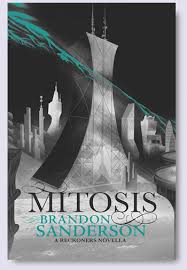 I haven’t read Steelheart so the characters and the problems in this short story didn’t mean as much to me as they would to someone who has read it. And it turns out that the story is actually half of this cute little number’s pages; the other half is a teaser for the second book in the series.
Still, I read it, and I think it does actually work as a stand-alone. There’s obviously a lot that’s gone on in the past, but that’s often true of a good short story. The one thing that could have been cleared up by a single additional sentence is the nature of the ‘Epics’, who are clearly the villains (usually) and clearly some sort of humans but… that’s all a bit obscure.
Anyway, it’s got a good pace and the setting – Newcago – is nicely set out. The narrator, David, is a bit of a nothing character to be honest; this is more about action than it is about character, but that’s not necessarily a bad thing. The villain was quite fun and I enjoyed Sanderson’s take on his particular ability.
This book was provided to me by the publisher.
Galactic Suburbia 110
In which culture, we consume it. Over at iTunes or at Galactic Suburbia.
What Culture Have we Consumed?
Alisa: Landline by Rainbow Rowell; Coode St Podcast Ep 207: Kameron Hurley; The Wheeler Centre: Books, Writing, Ideas Podcast – Quarterly Essay: On Women Freedom and Misogyny : Anna Goldsworthy; … AND PHd Check in!
Tansy: Rachel & Miles X-plain the X-Men, Battle Scars, Uncanny, Cranky Ladies, Nanowrimo
Alex: Haven seasons 1 and 2; Upgraded, ed Neil Clarke (NB available from Fishpond, for Austraian listeners!); Journeys, Jan Morris; The Book of Life, Deborah Harkness
Orphan Black cat cosplay
Anthony Mackie shouts out to little Falcons & Falconettes.
Sean Pertwee cosplays his Dad for Halloween.
Please send feedback to us at galacticsuburbia@gmail.com, follow us on Twitter at @galacticsuburbs, check out Galactic Suburbia Podcast on Facebook, support us at Patreon (http://www.patreon.com/galacticsuburbia) and don’t forget to leave a review on iTunes if you love us!
Upgrade me now

What do you do when you have a major heart attack and you’re also creator/sustainer of Clarkesworld? You decide to edit an anthology. Natch. (Read an interview with Neil Clarke here.) And you decide to make the theme of that anthology cyborgs, because you are now one yourself. Thus, Upgraded.
Now, before you go all ‘hmm, themed anthology’ side-eye on me, just steady on. In some stories, being a cyborg is the point; in others it is incidental. Sometimes being a cyborg is a good thing, a positive addition, welcomed. Others, it is something to be dreaded, confronted, Dealt With. Sometimes being a cyborg makes you better, and sometimes it seems to make you less. Cyborg-ness ranges from fully integrated and augmented body modifications to one seemingly small addition. Augmentation might be for aesthetics, or employment; for someone else’s sake or your own. It ranges from being socially acceptable to being almost beyond the pale.
Some stories happen tomorrow, here; some of them are way over there, temporally and physically. Sometimes there are aliens. Sometimes there are robots. Sometimes they are in love stories, detective stories, war stories, family stories. Not all the cyborgs are attractive characters. Sometimes they become cyborgs before our very eyes, and sometimes they’ve been cyborg so long it’s just what they are. Sometimes they were actually made that way from the start.
These stories feature men, and women, and sometimes genders are unstated. There are white characters and black characters and a variety of ethnicities. One of the central issues is that of disability, dealing with it and changing it and how those around you react to it. There’s queer and straight and none-of-your-business. Authors are from a variety of backgrounds, too.
So sure, it’s a themed anthology. But this is no Drunk Zombie Raccoons in Upstate New York. This is a vibrant, fun, intriguing and varied set of stories that have a basic concept in common.
The stories. Well, let me say upfront that I was so destroyed by Rachel Swirsky’s “Tender” that I had to put the book down and go to sleep. No more reading for me that night. As for the rest, here’s a sampler: Yoon Ha Lee’s “Always the Harvest” is creepy and disconcerting and sets a really great tone for the anthology – it’s the opening story – by being completely unlike any of the others. Ken Liu’s story is also deeply disconcerting because (very mild spoiler here) it is absolutely not the story you think it is. Alex Dally McFarlane does wonderful things with maps, while Peter Watts taps into the zeitgeist to suggest uncomfortable things about the military. And I have a feeling I know something Greg Egan might have read before writing “Seventh Sight” but I’m not going to mention it here because that would be way too much of a spoiler.
This is a really great anthology, with stories that absolutely stand as marvellous science fiction quite apart from their brethren. You can get it from Fishpond!

 Randomly Yours, Alex