Galactic Suburbia 110
In which culture, we consume it. Over at iTunes or at Galactic Suburbia.
What Culture Have we Consumed?
Alisa: Landline by Rainbow Rowell; Coode St Podcast Ep 207: Kameron Hurley; The Wheeler Centre: Books, Writing, Ideas Podcast – Quarterly Essay: On Women Freedom and Misogyny : Anna Goldsworthy; … AND PHd Check in!
Tansy: Rachel & Miles X-plain the X-Men, Battle Scars, Uncanny, Cranky Ladies, Nanowrimo
Alex: Haven seasons 1 and 2; Upgraded, ed Neil Clarke (NB available from Fishpond, for Austraian listeners!); Journeys, Jan Morris; The Book of Life, Deborah Harkness
Orphan Black cat cosplay
Anthony Mackie shouts out to little Falcons & Falconettes.
Sean Pertwee cosplays his Dad for Halloween.
Please send feedback to us at galacticsuburbia@gmail.com, follow us on Twitter at @galacticsuburbs, check out Galactic Suburbia Podcast on Facebook, support us at Patreon (http://www.patreon.com/galacticsuburbia) and don’t forget to leave a review on iTunes if you love us!
Upgrade me now

What do you do when you have a major heart attack and you’re also creator/sustainer of Clarkesworld? You decide to edit an anthology. Natch. (Read an interview with Neil Clarke here.) And you decide to make the theme of that anthology cyborgs, because you are now one yourself. Thus, Upgraded.
Now, before you go all ‘hmm, themed anthology’ side-eye on me, just steady on. In some stories, being a cyborg is the point; in others it is incidental. Sometimes being a cyborg is a good thing, a positive addition, welcomed. Others, it is something to be dreaded, confronted, Dealt With. Sometimes being a cyborg makes you better, and sometimes it seems to make you less. Cyborg-ness ranges from fully integrated and augmented body modifications to one seemingly small addition. Augmentation might be for aesthetics, or employment; for someone else’s sake or your own. It ranges from being socially acceptable to being almost beyond the pale.
Some stories happen tomorrow, here; some of them are way over there, temporally and physically. Sometimes there are aliens. Sometimes there are robots. Sometimes they are in love stories, detective stories, war stories, family stories. Not all the cyborgs are attractive characters. Sometimes they become cyborgs before our very eyes, and sometimes they’ve been cyborg so long it’s just what they are. Sometimes they were actually made that way from the start.
These stories feature men, and women, and sometimes genders are unstated. There are white characters and black characters and a variety of ethnicities. One of the central issues is that of disability, dealing with it and changing it and how those around you react to it. There’s queer and straight and none-of-your-business. Authors are from a variety of backgrounds, too.
So sure, it’s a themed anthology. But this is no Drunk Zombie Raccoons in Upstate New York. This is a vibrant, fun, intriguing and varied set of stories that have a basic concept in common.
The stories. Well, let me say upfront that I was so destroyed by Rachel Swirsky’s “Tender” that I had to put the book down and go to sleep. No more reading for me that night. As for the rest, here’s a sampler: Yoon Ha Lee’s “Always the Harvest” is creepy and disconcerting and sets a really great tone for the anthology – it’s the opening story – by being completely unlike any of the others. Ken Liu’s story is also deeply disconcerting because (very mild spoiler here) it is absolutely not the story you think it is. Alex Dally McFarlane does wonderful things with maps, while Peter Watts taps into the zeitgeist to suggest uncomfortable things about the military. And I have a feeling I know something Greg Egan might have read before writing “Seventh Sight” but I’m not going to mention it here because that would be way too much of a spoiler.
This is a really great anthology, with stories that absolutely stand as marvellous science fiction quite apart from their brethren. You can get it from Fishpond!
Galactic Suburbia 109
In which we solemnly swear we will repeat the title of our culture consumed after discussing it. Pinkie promise. You can get us from iTunes or at Galactic Suburbia.
Update on Gamergate with particular focus on Brianna Wu AKA @spacekatgal
(This episode was recorded before the Felicia Day incident)
Alisa’s con report – Conflux
Tansy’s con report – CrimesceneWA
Strange Horizons fundraising
We read and appreciate all your Twitter comments and emails, even if we don’t reply. We love your feedback!
It’s time to start thinking about the GS Award, yes already, WTF 2014 why are you moving so fast?
What Culture Have we Consumed?
Alisa: Landline, Rainbow Rowell (NB since recording, Alisa actually finished this book YES SHE DID); Night Terrace S1 1- 5
Alex: Sarkeesian’s XOXO talk; Garth Nix’s Abhorsen trilogy (Sabriel, Lirael, Abhorsen); Mothership: Tales of Afrofuturism and Beyond; Indistinguishable from Magic, Catherynne Valente; Bitterwood Bible and other Recountings, Angela Slatter; The Dish.
Tansy: Unmade, Sarah Rees Brennan; Night Terrace S1, Agents of SHIELD S1, The Flash S1 Ep 1-2
Please send feedback to us at galacticsuburbia@gmail.com, follow us on Twitter at @galacticsuburbs, check out Galactic Suburbia Podcast on Facebook, support us at Patreon (http://www.patreon.com/galacticsuburbia) and don’t forget to leave a review on iTunes if you love us!
Mothership
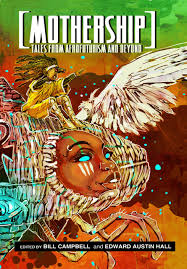 When I finished reading the first story in Mothership, a little voice in my head said “Was that really the story to start this anthology with? I mean, sure it’s got a black protagonist, but is that enough?”
And then the rest of me took a step back, looked horrified, and said: “Have you learned nothing from Pam Noles’ essay “Shame”? And from the entire Kaleidoscope project? The story has a black protagonist. That’s entirely the point.”
And then I sat, aghast at my own white ignorance, and felt ashamed.
And then I kept reading, because that’s the obvious way to combat such an attitude and is at least part of the point of this project and why I supported its production.
There’s a really wide variety of fiction in this anthology. Some skirt the edge of being ‘speculative’ (Rabih Alameddine’s “The Half-Wall”) while others hurtle over the edge and throw themselves at it. I didn’t click with every story (Greg Tate’s “Angels + Cannibals Unite” really didn’t work for me, and nor did Ran Walker’s “The Voyeur”), but many of them were absolutely breathtaking.
Nisi Shawl’s “Good Boy” – one of the only stories that really qualifies for the ‘mothership’ appellation by being set in space – is a glorious fun romp.
“The Aphotic Ghost”, by Carlos Hernandez, did not go where I was expecting and was utterly absorbing.
SP Somtow’s “The Pavilion of Frozen Women” has a wonderful line in bringing together several quite disparate cultures and tying them together into a fairly creepy thriller.
NK Jemisin does intriguing things with the notion of online communities in “Too many yesterdays, not enough tomorrows.”
“Life-Pod” is Vandana Singh’s haunting reflection on family and identity and connection.
In “Between Islands,” Jaymee Goh suggests how different things might have been for the British in colonising Melaka and surrounds with different technology…
Tenea D Johnson’s “The Taken” is a profound reflection on contemporary issues and problems stemming from the historical transportation of enslaved African to America… I don’t even inhabit the culture that’s dealing with it.
One of the intriguing things about this anthology is that it’s not focussed on African-American fiction, which I had basically expected thanks to the title’s reference to P Funk and Afrofuturism. Instead, there are stories here that draw on Egyptian, Native American, Caribbean (I think? I’m Australian, sorry!!), Japanese and Malaysian (again, I think) traditions and cultures – and those are just the ones that I (think I) could identify. There are definitely others that draw on other Asian cultures (I think there’s an Indonesian one?). The author bios don’t universally identify where the authors are from, so that doesn’t assist in figuring out what might have influenced them… which is not a complaint, by the way, because so what? (in the most prosaic ‘fiction is fiction’ sense). So it’s a really broad understanding of what falls into “Tales from Afrofuturism and beyond” – much more inclusive therefore than, for example, many anthologies of the last few years, let alone decades.
This is an good anthology, period. That it’s exploring and accomplishing a particular political aim is icing on the cake. You can get it from Fishpond!
Indistinguishable from Magic
Sometimes when people talk about an author’s work being ‘raw’, it’s as if they think words just appear on the page and there’s no mediation whatsoever. That these words, ideas, thoughts had been flying across the savannah just minutes before the author brought them down with a flying leap to serve them up still warm for the reader. I’m not silly enough to think that – and even if I were, Catherynne Valente’s excoriating essay against people who think authors are just the conduit for some muse (“she  wrote it but…”) would have made me rethink my position.
When I say that much of Valente’s work, as presented in Indistinguishable from Magic (provided to Galactic Suburbia for review by Mad Norwegian Press) is raw I mean that she has not hidden her emotions, she has not hidden herself, from the world while writing these essays.
(One presumes. It could all be a very elaborate persona, with a very detailed background and crafted voice. Y’know, I wouldn’t put that past her – she certainly has the mad writerly skillz to accomplish such a feat. And if that’s the case, well, more power to her.)
The essays collected here are variously from Valente’s blog, speeches, and a few other sources. They’re arranged into categories: pop culture and genre; writing and publishing; gender, race, and storytelling; fairy tales, myth and the future; and “Life on Earth: An Amateur’s Guide.” And they showcase the brilliant variety of Valente’s interests passions: Persephone and Doctor Who (… possibly not so much of an antithesis there…), fairy tales, equality in all manner of things, Jane Eyre (see, Tansy? she’s on MY side), poetry, and Single Male Programmer Types managing to have sex (trust me, it’s very a very funny essay).
The pop culture musings range between 2003 and 2011. Valente’s writing is beguiling enough I actually read the entirety of the first essay, which is about Buffy and Angel, despite having watched maybe three episodes of the two shows combined. Her comments on what the show meant to 20-somethings nonetheless resonated – and that pretty much set the tone for the rest of the collection. I’m also not a big Trek fan, and have watched very little DS9, but her musings on what the station would have been like with social media? Priceless. More seriously – no, it’s all serious; more academically, her essay on why World War 2 and the Nazis keeps on popping up in comics and other fantastic culture is deeply insightful.
I read about half of the essays on writing and publishing; not being in the game myself means that I don’t really have the emotional attachment to the issues necessary to connect with much of what she writes here. That said, the first essay – the one about writing actually being hard work – is a glorious piece of writing; her explanation of her love of the term metal makes me itch to use the word more; and her utter dismantling of the argument that ‘traditional publishing is dead = a good thing’ is brilliant.
Valente is wonderfully, evocatively, angry and sincere and honest and passionate and conciliatory and clinical in her essays about gender and race and why those things matter in storytelling. “The Story of Us” skewers very neatly the whole ‘but why does it matter?’ complaint – and matches nicely with Pam Noles’ “Shame,” which I read in a Tiptree Anthology. She gets dangerously personal in “Confessions of a Fat Girl” – dangerous to herself, I would guess, because of potential backlash (I really, really hope she didn’t get any); dangerous to some readers because of how it might make some squirm at their reaction; dangerous to other readers because it might just call out their own troubles, and make them confront them.
All the essays up to this point have been easy to read – delightful to read. Some have shown Valente’s academic training. With the essays on fairy tales and folklore, though, she gets her academia on. Katabasis in Alice in Wonderland, The Wizard of Oz, and The Nutcracker? Why fantasy keeps going back to the medieval (“Dragon Bad, Sword Pretty”)? The purpose of Persephone, and her multiple faces? Oh yes.
Finally, the last set are more whimsical as a group – they don’t really have a collective theme, aside from ‘some thoughts on living in the world’. Her reflections on why people love apocalyptic literature are fascinating; her frustration at being of a generation told to live as well as their parents without the means to it revealing; and her reflections on Cleveland surprisingly moving. Her essay on her love of the anchorite idea just sings, as does her discussion of “Two Kinds of Love.”
I read this not quite in a sitting, but with nothing else around it. It certainly works like that. It would also work beautifully as a collection to dip in and out of – none of the pieces are very long, after all. There is so much going for Valente’s writing – for those who are writers, for those interested in fantasy and folklore, for those interested in the world in general. And even if you’ve been a faithful reader of Valente’s blog, Rules for Anchorites, I would suggest this is still a great collection because reading these essays in this order, with essays from elsewhere to add depth and piquancy – it just works.
The Tiptree Award Anthology vol 3
 I just love these anthologies. I love what it showcases – the diversity of what the different Tiptree panels have judged as falling into the category of ‘exploring and expanding gender,’ which is the remit of the Tiptree Award each year. I love that it shows diversity within the genre, full stop. I love that the anthologies don’t just have fiction, and don’t just have fiction from one or two years, but that there’s non-fiction and older works as well. And that the introduction and sometimes the introduction to each piece are interrogating themselves, the pieces, and the scene in general.
There’s a lot to love.
I’ve had this volume waiting to be read for aaaages. I thought it appropriate to read as I rode public transport on my way to interviewing Rosaleen Love – what I’ve read of her work fits into the broader milieu of the works represented here. As I read, I couldn’t believe that I’d allowed myself to leave this book festering on the shelf for so long.
The non-fiction includes an essay of Pam Noles’, called “Shame,” which struck me very deeply: about the experience of watching and reading science fiction as a person of colour, and not seeing yourself. Her dad sounds awesome: he called the movies she was watching “Escape to a White Planet,” and “Mars Kills the White People.” There’s an enormous amount in this essay that I, as a privileged white reader (gender does not trump race – it’s not a competition) probably need to read it again. Several times. And that the editors paired it with Dorothy Allison’s essay on Octavia Butler was very nice – the latter doesn’t talk all that much about race, more about Butler’s vision of women in the future, but the two are surely entwined… perhaps not especially in Butler, but certainly in Butler. And then there’s a letter from L Timmel Duchamp to Alice Sheldon/James Tiptree Jr, which is a lovely musing on what Sheldon/Tiptree as person and as author has meant to one individual.
Geoff Ryman looks at some possible consequences of the internet arriving in an out of the way village; Nalo Hopkinson goes domestic, sinister and mythological all in one hit; Margo Lanagan does weird weird things that I’m still figuring out in “Wooden Bride” – the story that, I think, gets the shortest introduction of all, since “some stories shouldn’t be introduced” and doesn’t that just describe all of Lanagan’s work? Aimee Bender’s “Dearth” is a devastating, heart warming, bewildering story about maternity and mothering… and I’ve just realised the protagonist is never named. And isn’t that a statement in itself. All of the stories so far were new to me, and Bender was a new name. And then it gave me Ursula Le Guin’s “Mountain Ways,” one of my favourites of her short stories. I can’t possibly pick a favourite story, because that would mean choosing between Le Guin and Ted Chiang: “Liking what you see: A Documentary” is another of his glorious mucking-with-structure stories in which the question about whether you should turn off the ability to see/appreciate beauty is presented as if as a transcribed documentary. And the fact that there are no visuals to accompany this story about visuals just adds to its power and general gloriousness. And for the editors to pair this with Tiptree’s “The Girl Who Was Plugged In” – well, I’ll admit that I did not reread the Tiptree. It was just going to be too raw an experience. So too was “Litte Faces,” by Vonda McIntyre, but I didn’t know that before going in. Deeply disturbing and weird (but not entirely in an unpleasant way), as well as powerful and impressive – and so very different. So, too, the final story – different that is, slightly less weird and disturbing – is “Knapsack Poems,” from Eleanor Arnason. She uses a character who is effectively distributed over eight bodies to tell a story of travel and experience, and I couldn’t help but be reminded of Ann Leckie’s Ancillary Justice. I’m not sure the similarities are much more than superficial, but they’re intriguing anyway.
This anthology works as something read from cover to cover in a sitting or two; it could be dipped into over months; it could be hopscotched. It should be read in any way you can.
Landline: review
 This book was provided to me by the publisher.
I’ve never read anything else by Rainbow Rowell, but a lot of the Goodreads reviews talk about her style being really easy – and it is. I started reading this late one afternoon and I’d read the first 100 pages before I realised what had happened. The story is well-paced; officially it takes less than a week, although there are serious flashbacks that kinda make that a lie. The prose flows – lots of familiar-sounding dialogue, enough detail to sketch in believable places and people. I’m not great at explaining how prose works. All I know is that this was delightful to read, and partly that was the words themselves.
The premise: Georgie has the chance at a dream job – but she’ll have to work over Christmas. Husband and kids go off on their family holiday without her. Georgie discovers that the old landline at her mum’s house somehow allows her talk to her husband – but him from the past. The novel is then filled with the minutiae of daily life: work and memories and family relationships and that worrying and gnawing at problems that gets so familiar when you’re old and have lots of worrying to do.
The best thing about this story is that it’s about a woman thinking about, and worrying about, her marriage. That sounds very self-indulgent and maybe a bit dull or stupid, but bear with me. It’s refreshing to read about a woman confronting problems like this and not taking all the blame, not taking a convenient way out, and not having things magically solved. (Maybe there are lots of books like this – in fact I’m sure there are – but they’re not on my radar.) Yes, there were a few points where I got a little uncomfortable about what might almost be being suggested about her (‘letting herself go’, etc), but for me at least they never quite got to the really problematic point; they were redeemed by some thought or action that pulled it back, didn’t make her the villain for not having time to buy new bras, and so on. And I liked that the focus was on the bit after the happily-ever-after – the bit after marriage, and after kids, and things aren’t entirely wonderful but they’re also not entirely horrid, they’re just… life. But they can still be better, and yes life and marriage require work and that’s ok.
Georgie was pretty easy to identify with, and all the surrounding characters were too. At times I wondered if Rowell was trying too hard to be ‘inclusive’ – but then I realised that just maybe I was overthinking it, that actually there wasn’t a huge amount of diversity (although to be fair the cast isn’t that big), and that none of the ‘minority’ characters were such just to make a statement. (See how my brain gets me caught up in tangles?) Also, the pugs are hilarious.
Self interrogation:
I was going to start this review by saying “this isn’t the sort of book I normally read.” Which is basically true, but why start with that line? And I started thinking about the answer to that question. And then I thought about starting this review with this self interrogation… and I realised that that was still front-and-centring the issue, rather than the novel. It’s one worth talking about but it’s entirely too self-indulgent to make it the first bit. So, here it is, at the end.
This is not the sort of book I normally read. Because it is, first and foremost, a romance. And I don’t think of myself as someone who reads romance, even though actually I love ‘good’ romance in my novels and movies – by which I mean it’s realistic but/and sweet but not saccharine, and – most especially, in my head – not the focus of the story. So why was I so keen to defend myself? Because despite all the time I spend thinking about why reading SF isn’t a bad thing to do, I still automatically feel like I have to barricade myself away from that genre – the female one, the one that everyone else bashes when they’re not bashing romance – even though I am well, well aware – in my head – that oh my goodness there are so many things wrong in thinking/acting like that. And the other thing is that this is absolutely SF. If we’re happy to accept John Chu’s “The Water that Falls on you from Nowhere” as SF – and heck, we should be – then so is this. That short story is all about a romantic relationship and how it works out with the family; the SFnal element is water that, literally, falls on you from nowhere. It’s never explained. So this, a story that’s about a romantic relationship and family, where the main character has access to a phone that allows to talk to someone 15 years ago? This is absolutely SF. Was I more embarrassed because this was written by a woman, and therefore more clearly can be classified as a romance? Because it’s a novel rather than a short story from an obviously SF venue? Who knows. At any rate, I’m not embarrassed by having read it, because it’s one of the easiest – pleasant, fast, cosy – books I’ve read in ages.
Snapshot: Cat Sparks
 Cat Sparks is fiction editor of Cosmos Magazine and former manager of Agog! Press. She’s won a total of nineteen Aurealis and Ditmar awards for writing, editing and art. Over sixty of her short stories have been published since 2000. She is currently engaged in a PhD examining young adult post-disaster literature. Her collection The Bride Price, was published by Ticonderoga Publications last year. Her first novel, Blue Lotus, is finally nearing completion. @catsparx
The Aussie spec fic snapshot project is starting to take on aspects of Michael Apted’s Up documentary series — you know, the ones profiling a group of British children, revisiting them again every seven years. Snapshot comes around more frequently, but I’m starting to see distinct parallels. The Snapshot is a worthy cultural endeavor but for me, it serves to highlight how little control I have over my own career, creative development and achievements.
1. Your collection The Bride Price took out the Ditmar for Best Collection, and its story “Scarp” took out the Ditmar for Best Short Story, this year – congratulations! What was it like to put this collection together? Did it achieve what you hoped it would?
Ticonderoga’s Russell B Farr approached me three times about doing this collection. Three other publishers had previously expressed interest – in the end Russ wore me down with sheer persistence and the offer of a Canberra Natcon launch. I was worried I wasn’t ready, a pointless concern harking back to a different era. Once, authors only got collected when they’d attained a certain level of achievement. Today’s market is saturated with short story collections. I was happy to win a Ditmar for mine.
2. As well as writing, you’ve been an editor and are a designer, including designing the remarkable cover for The Bride Price. Have these skills worked together for you, or are they sometimes in tension?
The tension resulting is always about time and focus. Serious fiction takes serious slabs of time, commitment and research. The longer you’re at it, the more disassociated activities you end up having to shed. Personally I have never had more time to focus on writing than I have now, yet even writing full time isn’t enough. My output is slow, I am always behind and I never seem to achieve as much as I’d like to.
3. You’re currently working on a PhD, which is very exciting. What are you investigating, and how will this impact on your fiction?
My PhD research question is: How does real world climate change data and anxiety shape and inform post-disaster science fiction for young adults? I’m only halfway through but already my fiction has been permanently affected. I no longer believe in a non-climate changed future and expect fiction to acknowledge the dramatically altering landscape, be it science fiction, cli fi or more common garden varieties.
4. What Australian works have you loved recently?
I’ve bought so many Australian books this year but have barely had time to read them. PhD material sucks up most of my reading time. The last thing I loved to pieces was Max Barry’s Lexicon. I also really dug Andy Macrae’s Trucksong and Lara Morgan’s The Rosie Black Chronicles. I’m currently picking my way through Ben Peek’s Dead Americans, Thoraiya Dyer’s Asymmetry and Kirstyn McDermott’s Caution, Contains Small Parts. Podcast-wise, I remain a steady fan of both The Coode St Podcast and Galactic Suburbia. Artwise, I adored Nick Stathopoulos’s portrait of Robert Hoge currently hanging in Sydney’s Salon Des Refuses, as well as the short film produced by Nick and Ryan Cauchi: It Grows. (disclaimer – I appear in that movie myself, a fact that serves to enhance hilarity as I can’t act to save my life!) Trailer link here.
5. Have recent changes in the publishing industry influenced the way you work? What do you think you will be writing in five years from now?
I have zero interest in self-publishing or becoming a relentless self-promotion machine. I write what I’m interested in writing, study the form, work hard to lift my game. That’s what being an author means to me.
Right now, I’m two weeks off finishing a novel and delivering it to my agent. This novel in various forms and guises has been weighing heavily on my shoulders for a very long time. If I’m still working on the same book five years from now, do me a favour, please take me out and shoot me.
This interview was conducted as part of the 2014 Snapshot of Australian Speculative Fiction. We’ll be blogging interviews from 28 July to 10 August and archiving them at SF Signal. You can read interviews at:
Snapshot: Alisa Krasnostein
Alisa Krasnostein is editor and publisher at Australian specialty press Twelfth Planet Press, a creative publishing PhD student and recently retired environmental engineer. In 2011, she won the World Fantasy Award for her work at Twelfth Planet Press. She was the executive editor and founder of the review website Aussie Specfic in Focus! from 2004 to 2012. In her spare time she is a critic, reader, reviewer, podcaster, environmentalist, knitter, quilter and puppy lover. And new mum.
1. You’re just about to launch the anthology Kaleidoscope, which you’ve coedited with Julia Rios and funded via crowdfunding. How has the experience of creating this anthology been different from previous ones you’ve done? And has it lived up to your hopes of being a political and diverse set of stories?
With every project I’m always evolving and learning. For a long time I’ve wanted to be able to pay pro rates so with the advent of crowdfunding platforms, I was able to explore that business model for this project (SFWA raised the pro rates after we ran our campaign which was bad timing!). Crowdfunding is a fascinating and time consuming business model and we learned a lot about the maths behind them and also the amount of marketing and promotion required. It definitely helped keep my mind off my delivery date of my baby!
Kaleidoscope has definitely lived up to my hopes of a political and diverse set of stories. I felt a lot of pressure to do that – when you are given the money up front. The editing process was also a fascinating one. It challenged a lot of my own ideas about creating a good book and in the way I acquire stories. It’s markedly changed the way I approach and read fiction. I’m still processing a lot of my thoughts about it. Which is lucky because that gives me food for the thesis! Kaleidoscope is filled with a really diverse array of stories and protagonists – straight, queer, of colour, disabled – we hope there is a story in there for every reader to identify with.
2. Another project that you’re still working on, which is now well on its way to finishing, is the Twelve Planets series wherein you decided to publish collections of short stories by Australian women. I know originally the plan was to publish these over a year, or a bit more, which I’m sure in hindsight seems crazy! What impact has the process of developing the Twelve Planets had on you as an editor and publisher, and has it met your expectations?
In hindsight, I’m not sure it was every feasible to publish the Twelve Planets across a year – it’s actually a very tall order to ask writers to produce 4 outstanding stories on so tight a turnaround! Most authors ended up submitting more than that before we got to their final collection of 4. I think I’ve grown a lot as an editor through these collections – both in terms of my editing ability and in the mechanics of how collections work. At times, choosing to do shorter collections was really challenging because you can’t get away with things that maybe you might in a longer collection – you can’t hide a bad story amongst three others. Which I guess has made me much less compromising as an editor – if I wouldn’t buy a story for a collection where I can’t hide it, why should I buy it ever?
As a publisher, the Twelve Planets taught me a lot about branding and the effectiveness of a series for promotion and marketing.
The Twelve Planets was conceived back in 2009 as a response to the lack of female authors on awards shortlists. I’m very proud of the work that’s been published in this series. I think it shows the outstanding quality of short stories being written by Australian female writers. The series has more than met my expectations and I can’t wait to see the full project sitting on my bookshelf!
3. You always seem to have a lot of projects on the go, and more bubbling to the surface all the time. Do you imagine that the next five years will see Twelfth Planet Press branching out into other areas, or strengthening the areas you already do well?
Publishing tends to work on a three to five year timeframe. The more books I publish, the more I am understanding that it really does take 2 to 3 years for a book to properly come to fruition, especially if you’re working on developing projects rather than just buying out of an open submissions process. That’s a long way around saying I have a lot of the next 3 years’ projects already in progress. And if I could source funding, a few more beyond that! I think the next 5 years will see us strengthening areas like novels, our crime line and young adult fiction. But yes, I have a view to branch out further. 🙂
4. What Australian works have you loved recently?
I’m currently enthralled by Sean Williams’ Twinmaker – I kind of want to read his PhD thesis after I finish with all his fiction related to matter transmitters. Twinmaker is a fast paced YA thriller and I can’t put it down.
5. Have recent changes in the publishing industry influenced the way you work? What do you think you will be publishing in five years from now?
Yes. How can they not? Adapt or die. I have absolutely no idea what the industry will look like in 5 years time. I know we’ll do our best to try and ride the wave but I suspect that what will be *it* in 5 years hasn’t even really begun to be a thing yet. Recent changes have had us learning how to make good quality, flexible ebooks and to do our best to bring release all formats in tandem. We’re now looking at keeping up with the ever expanding distribution channels for ebooks and wondering about the longterm viability of print book distribution. Bookstores keep closing even though readers still buy print books.
Snapshot: Max Barry
Max Barry is the author of five novels, including “Lexicon,” the New York Times Notable Book “Jennifer Government” and “Syrup,” now a film starring Amber Heard. He is also the creator of the online political simulation game “NationStates.” He lives in Melbourne with his wife and two daughters.
1. Your novel Lexicon won the Aurealis Award for Best SF Novel this year – congratulations! The novel’s plot revolves around the power of words, which isn’t in theory a new concept but you take it in a really remarkable direction. Did the plot and the SF aspect emerge separately or together? And were you pleased with the result?
Thank you! I was very happy with how that book came out. The SF angle… I never think of my stories as science fiction or anything else until my agent or publisher starts talking about how to sell them. I have three or four novels now that could be correctly classified as science-fiction, in the sense that they deal with ideas and a slightly modified world, but to me they’re just stories. They’re about people in a particular situation. The characters don’t think they’re in a science fiction book so I don’t either.
2. An earlier novel, Machine Man, was adapted from an online serial that you started in March 2009 and continued for nine months. What was it like to have the deadline of completing a page a day? And was the process of turning it into a novel easier or harder than writing one from scratch?
The serial was a brave experiment in writing with people looking over my shoulder. It was amazing to have that immediate feedback, posting a little page and seeing people react to it and comment the same day, so different to novel-writing, where I find out whether anyone likes what I’m writing two years later. It was terrifying, and raw and rough because I couldn’t take my time to build the story. It was just: Go!
Turning it into a novel was challenging because the serial was in bite-sized pieces, which doesn’t really work for a reader who wants to sit down for an hour and be immersed. I had to retell the whole story for the new medium. But I had a big first draft that I wrote quickly because I had to, so that was helpful. It made for a different kind of book, in the end; I think I mostly hid its roots but they’re still there.
3. On your blog you note that you’re working on “too many books.” Do you tend to work on more than one project at a time? Are the ideas all pushing impatiently to get out?
It’s easy to lose perspective on a story when you work on it every day for months. You forget how to see the book through the eyes of a reader. So it’s valuable to take a break, go do something else, and come back a few days or even weeks later. When I do that, I see its strengths and weaknesses far more clearly.
But the drawback is, yeah, too many books. I get immersed in the thing that’s meant to be a temporary distraction and suddenly a month has gone by.
4. What Australian works have you loved recently?
“Splitsville” by Sean Condon. I had always really enjoyed Sean’s books but recently I got to hear him read some of one and it elevated the whole thing to a new level. Because Sean is not some writer sitting back cleverly constructing bitter, intricate, insane, gallows-humor fiction; he is actually intricate and bitter and insane. So it’s even funnier. You have to read his books slowly, and normally I hate that, writers being tricky with sentence structure, because I just want the story, but Sean is so hilarious he breaks the rule.
5. Have recent changes in the publishing industry influenced the way you work? What do you think you will be writing in five years from now?
The industry is undergoing change, for sure, but I don’t feel affected that much. It makes a difference to the finances and mechanics of how I publish books but in the end almost all of what I do that matters is between me and the reader. How I get words to them, exactly, is not that big a deal. Not compared to how important it is to make sure they’re the right words.
This interview was conducted as part of the 2014 Snapshot of Australian Speculative Fiction. We’ll be blogging interviews from 28 July to 10 August and archiving them at SF Signal. You can read interviews at:

 Randomly Yours, Alex