Hav
 I have never, in my life, read a book two times in a row. Until I read Hav. This was possible because Hav is not a novel in the ordinary sense. It’s a travel memoir to a fictional place that could easily exist; it’s a meditation on East meeting West, on history and culture and modernity; it’s about being a stranger in somewhere simultaneously familiar and alien. And it has some of the most wonderful prose I’ve come across.
This section from Hav illuminates many of the aspects that make the book so wonderful.
[The boats] often use their sails, and when one comes into the harbour on a southern wind, canvas bulging, flag streaming, keeling gloriously with a slap-slap of waves on its prow and its bare brown-torsoed Greeks exuberantly laughing and shouting to each other, it is as though young navigators have found their way to Hav out of the bright heroic past. (p66)
This. It’s beautiful, for a start. It suggests that conjunction of somewhere existing both in the present and, somehow, in the past that makes Hav so intriguing. And it’s quoted back at its author in the second part of the book, as an indication of her own understanding of Hav.
(We’re all about the meta.)
Two thirds of the book was written and published in the 1980s. According to Ursula le Guin, who wrote the introduction, it led to people going to their travel agents looking to book a ticket to Hav because it was so convincing. Now, it really is convincing, but at the same time there are aspects that make it quite clear that Hav is a fiction. Like the fact that you’ve never seen it on a map, maybe? I was confused by that until I look Jan Morris up, and discovered that she has written many actual travel books (under that name and as James Morris). So I concede that perhaps if you knew her earlier work, you could be forgiven for some confusion if not quite that much. Anyway, the last third was written in the early 21st century, and sees Morris going back to Hav after the Intervention – which was just starting as she left last time. And this allows Morris to explore a whole other aspect of culture and development.
“Last Letters from Hav” are entries written between March and August, with Morris arriving in Hav at the start and being bustled out as trouble brews at the end. In between, she does what any travel writer does: she stays in interesting places, she visits the important and not-so-important places in the city, she talks to people, she reminisces about what other people have said about the place. I’ve been having a great deal of difficulty writing this review because the books is absolutely busting at the scenes with themes, with commentary, with historical (a)musings. There’s multiculturalism and colonialism and identity – the losing and finding and historical nature of and doubt around. There’s appropriation on a massive scale – see previous note – and getting on with the business of life. There’s ordinary mystery and profound mystery, religion and politics and architecture and this book had me in RAPTURES. Can you tell?
Hav is a city-state in a world that really doesn’t have them any more. It’s got an uneasy relationship with Turkey, its only (?) land neighbour, but a seemingly thriving one with certain Arab nations and perhaps the Chinese. It’s basically meant to be somewhere like the Dardanelles – although the geography isn’t quite right – because it’s a big deal that this was where Achilles and his Myrmidons came ashore. And the Spartans too, apparently. And, later, Arab merchants, and Venetian merchants, and it’s one of very few venerable Chinese merchant settlements outside of Asia. See how Morris twists history and makes it just believable? There really were moments where I could believe this was real. Because her discussion of history is modern, too: the Brits wanted to colonise it; Hav was shared by France, Italy and Germany under a League of Nations mandate; Hitler might have visited, and Hemingway did. Morris talks to people who are flotsam from this era; and also to a man claiming to be the 125th Caliph. Also a casino manager, members of the ‘troglodyte’ race who live in the nearby mountains, the local philosophers, and some bureaucrats. She visits odd monuments, the Conveyor Bridge (I admit I had to ask someone whether that was actually possible, because I was teetering on the edge of What Do I Believe?), and the Electric Ferry. I don’t believe that this book could have been written by anyone other than an established travel writer, because her eye and ear for (even imaginary) detail is breathtaking.
The second section is much shorter and deals with only a week or so, some two decades later when Morris is invited back to Hav after the Intervention. “Hav of the Myrmidons” does all of the same things as “Last Letters,” with additional meditation on the nature of change and tourism and the impossibility of an outsider ever really understanding the internal workings of a foreign city. There’s also the inevitable nature of change, and the sinister side of globalisation with imported labour and native populations made to relocate – which, intriguingly, is given a possibly positive spin. Morris’ books is either revered or believed to be banned in Hav, depending on who she speaks to (it’s one of the bureaucrats who reveres it that quotes the passage above at her, as part of the reason for why she was asked back). But things have changed. Most of the glorious many-centuries-in-one-place nature of former Hav is gone, replaced with new and forbidding and disorienting architecture. Like the massive Myrmidon tower, surmounted by an M – but no one really knows who or what the Myrmidons are, or meant to be, in this context. Some things of old Hav have been retained, but sanitised, bent to a new understanding of the world. Tourists are allowed, but only in a defined space – which leads to another bit I wanted to quote, because I think it’s an indication of a travel writer’s despair:
“The thing is… one feels so safe here. The security’s really marvellous, it’s all so clean and friendly, and, well, everything we’re used to really. We’ve met several old friends here, and just feel comfortable in this environment. We shall certainly be coming again, won’t we darling?” “Oh, a hundred percent. I think it’s bloody marvellous what they’ve achieved, when you remember what happened here.” (p196)
Thus spake an older English couple with no intention of leaving the resort.
Hav puts me in mind of China Mieville’s The City and the City, and Christopher Priest’s The Islanders, both of which do a similar thing with inventing places that ring so amazingly true. The Priest is clearly fictional but written as a travel book; the Mieville is a fiction but set in a city that purports to be real. I guess Hav conflates the two.
This review gets nowhere near what I really want to say about Hav. I am so glad that it exists, and that I have read it. And now I will force it into the hands of anybody I possibly can… although I admit to some trepidation that maybe other people won’t like it as much as I do. (I haven’t been able to look at any Goodreads reviews for that reason.) I may have used the word intriguing too many times, and I may have given in to hyperbole, but I don’t care. I love this book and want to hold it to my heart FOREVER.
(Another of the books that has been languishing on my shelves for far too long, unread. WHAT OTHER GEMS ARE WAITING FOR ME??)
You can get Hav from Fishpond.
Black Ice
It’s the exacting details in this book that means it has dated so dreadfully that for all it’s an interesting enough story, I just can’t imagine anyone born after about 1980 enjoying it. Except possibly for its historical value.
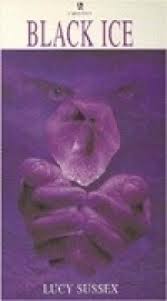 There are two plots entwined here: a ghost story, and a technology story. And they’re packaged with a family drama, just to give the main character another headache.
The ghost story aspect holds up, as one would expect, in that it’s not context-reliant; you could have the same story set in 1850 or 2050. Syb’s new house is always cold, and the new housekeeper Hille starts talking spooky things as soon as she moves in. Hille wears an amethyst and claims to see ghosts, or spirits, all over the place. Syb is dubious, but….
The technology aspect, though – oh, I giggled. This was published in 1997. Syb is really lucky because she has an email address and can dial up the internet with her modem any time she likes. She wins a competition and gets an internet camera. People are able to get hold of each other’s email addresses quite easily, there’s only a few websites to search for on any one topic, and hacking is a breeze. I have no doubt that Sussex was going for close-to-bleeding-edge experience with this story, and going for serious verisimilitude with the intricate details. But all of that means that it really hasn’t travelled well. Which is a shame, because Sussex does write well and engagingly.
The inside cover calls it a Children’s Book; it’s what I would consider the younger end of YA. Syb’s parents are going through a rough patch, and this is dealt with brusquely but (and?) sensibly. It’s a “this is not the end of the world” attitude, but not “this doesn’t matter.” Intriguingly given how many such novels get rid of the parents completely, Sussex does it a bit differently: the mum goes away but stays in contact via email; the dad is always a bit absent in his attitude but is always present and still relevant. Also, the romance interests are just barely present but more usually as an irritant than anything else.
This book was read as part of my read-all-the-books-I-own-but-haven’t-read effort, and conveniently also contributes to the Australian Women Writers challenge for 2014.
Galactic Suburbia
Galactic Suburbia the John Campbell Memorial not a Hugo Episode
In which we do discuss the Hugo shortlists both Retro and Current, but this is not an episode. Not at all. For… administrative reasons. We’re on iTunes or over at Galactic Suburbia.
Brandon Sanderson says interesting things about fandom groups, and the Wheel of Time nomination.
Some gender notes on the Hugo shortlist
Tansy’s Hugo links post
Tansy & John DeNardo of SF Signal discuss the shortlist on Coode Street Podcast
THANK YOU EVERYONE WHO NOMINATED GALACTIC SUBURBIA FOR BEST FANCAST, WE LOVE YOU TOO. WE LOVE YOU SO MUCH WE WOULD GIVE YOU FIVE STARS ON ITUNES.
Galactic Suburbia 98
In which we approach Fringe from multiple sides, rant about Game of Thrones, muse about cake lit and Alisa is a PhD student again! Bonus supplemental awards chat (but not in depth about the Hugos because we recorded before the shortlist went public) and an invitation to CAKE OUT for our 100th. See you there…
You can get us from iTunes or over at the Podbean site. I should warn you that I felt entirely off my game for this ep, but Tansy and Alisa keep the ball rolling very nicely.
Culture Consumed:
Alex: Fringe season 1; A Million Suns, Beth Revis; The Crooked Letter, Sean Williams;
Tansy: Game of Thrones rant, Jenny Colgan novels, Jago & Litefoot 7, Yonderland!
Alisa: Game of Thrones; Generation Cryo; The Cuckoo by Sean Williams, Clarkesworld Issue 91; the PhD Report
Aurealis Awards were awarded.
(sidetracked: Before the Internet from XKCD)
Hugo nomination (!! third time running!!)
CAKE COMPETITION! For our 100th episode, we would like to have a new logo. On a cake. Designed by you. Send a picture of your creation and you could win… something… and you can eat the cake, too. (This is episode 98, so you’ve got 4 or 5 weeks to plan your creation.)
Please send feedback to us at galacticsuburbia@gmail.com, follow us on Twitter at @galacticsuburbs, check out Galactic Suburbia Podcast on Facebook and don’t forget to leave a review on iTunes if you love us!
River of Gods
 One of the central yet peripheral things in many characters’ lives in this remarkable novel is the ‘soapi’ Town and Country. It’s the Indian version of Neighbours, or Eastenders. And in some senses this show – banal and humdrum, focussed on banal and humdrum activities, just like those shows that have enormous and devoted followings today – is emblematic of River of Gods itself. It is neither banal, nor humdrum; but much of it is concerned with surprisingly mundane and domestic issues, which become absorbing and riveting partly because of the skill of the author, partly because of the allure of the exotic: the exotic of the future, and the exotic of a country other than my own.
(Is it wrong to be enchanted by the exotic? And by exotic I simply mean other-than-my-familiar… which is, surely, an inherent part of the appeal of much fantasy and science fiction. Perhaps Other would be a less loaded term than exotic, at that. Hmm.)
River of Gods is set in 2047; the cover proclaims “Happy birthday, India.” Which becomes rather ironic, and somewhat sad, when it turns out that India as it exists in the early 21st century doesn’t exist in McDonald’s vision of its future: it has fractured into several, often rival, states. The political aspect is rarely front and centre in the novel; although it consumes at least one of the characters, McDonald focusses on his larger life, rather than simply making him a political animal.
See how I’m struggling to get on with this review? It’s hard to figure out where to start, what to say. Perhaps I should begin with “I adored this novel,” and attempt to explain why…
I adored this novel. You can stop reading now if you like.
Structure
The novel itself is split into five parts, each of them named for some aspect of Hindu mythology. It’s entirely possible that I have missed some deeper meaning here that relates to the novel’s structure, but I didn’t have much access to the internet while I was reading it so I wasn’t able to chase up meanings. The first part sets up the rest of the novel, introducing all but one of the main characters. Each of them gets their own chapter (in the third person), and the issues set up here continue across the novel with occasional intersections with other characters or their issues. Shiv is a crook, involved in various nefarious deals; Mr Nandha is a Krishna Cop, concerned with the regulation of aeais (AIs). Shaheen Badoor Khan is deep in the political regime of Bharat, Najia an ambitious journalist, and Lisa is a polymath scientist concerned with alternate versions of Earth’s development. Add to that a dropout scientist, a set designer for Town and Country, and a wannabe stand-up comic forced to go home to the family business. Parvati, married to Mr Nandha, is introduced later. Through their individual experiences, the novel tells the story of the world over a couple of weeks in 2047, with India as the focus.
Plot
Family trouble, political intrigue, criminals to chase, and AIs to try and understand. Also an alien artefact.
Each of the characters has a story. For some of them, the novel encompasses crisis and resolution. For others, we’re brought in halfway through, while for yet others we’re made to leave before the resolution. Some of these stories are exactly the sorts of domestic stories that are the fundamentals of soapies today: love and family and betrayal. (Please note I am in no way using ‘domestic’ in a derogatory sense here. Domestic stories are different from, for example, politically-focussed stories: Much Ado about Nothing is domestic, Macbeth – despite some domestic scenes – is not.) Other aspects are more detective story or political thriller. It does need a bit of adjustment to jump between them, but each chapter heading clearly tells you who the focus is, so it’s not that hard.
Language
McDonald uses Indian slang and terms throughout the novel. I didn’t realise until I was a third or so in that there’s a Glossary at the back (it is mentioned in the contents pages, but who reads the contents pages of a novel?), but even then not all of the words are explained. Most of the time the words – especially the slang – are understandable within context; I don’t need the exact translation to understand when someone is using profanity. Now, I have absolutely no idea whether McDonald is using the slang and other terms in appropriate ways. I’m willing to assume that he hasn’t made too many stupid and insensitive mistakes because he’s seemed to do well in the other, non-Western, novels of his that I’ve read – but if I’m completely wrong here I would like to know, so drop me a line if I need to be put right.
I loved the language. It was a little bit like reading a Greg Egan novel; if you’re put off by not being able to understand absolutely everything, this is not the novel for you (and I’m sad for you). And McDonald writes in an utterly captivating manner that meant putting this novel down was occasionally painful.
Characters As mentioned above, the novel focusses on a great range of people (and it passes the Bechdel test, if not spectacularly), which is a fine way to demonstrate the depth of the world-building. I’m not in love with how some of the female characters were portrayed (and some of the sex scenes seemed out of character with the rest of the novel), but other women were presented realistically. The men and women were just as likely to be competent or not, ruthless or not, etc. There’s only one main character who stays at home, with no job, and she’s female – but this makes sense in the context of 2047 India: there’s more men than women (one to five), so those women who want to work have trouble doing so because the men are favoured.
One of the most intriguing characters, both for who yt is and for yts storyline, is Tal. See that “yt”? Tal is a nute, surgically altered to have no genitals and psychologically/mentally altered to change the neurological aspects of yts previous gender. How Tal comes to physically be thus is briefly discussed, but why is not – so private a decision that the reader isn’t invited in. I have no idea how a reader who identifies non-cis would read Tal and those like yt. As an outsider looking in, I thought yt was treated like every other character and while yts nature was absolutely necessary for elements of the plot, it didn’t feel like a MacGuffin. While yt is treated as a freak by some, this is never (I think) portrayed as an acceptable attitude; and yt’s treated as an ordinary co-worker or neighbour by others. Yts other-ness isn’t treated as something added in just to add spice to the narrative, but as a genuine choice that ought to be available to people who so choose to change their own bodies. A minority, and one occasionally feared and derided, but legitimate.
Issues and themes
There are many. The place of women, as mentioned briefly above. The place of AIs – how do you legislate against them, how do you police that, and what are likely to be the ramifications? Climate change is a major factor, looming large in the background, because the monsoon hasn’t come to India in quite a while and this is, of course, disastrous. The development of new technology features. How to exist as a minority, and how to live as a fish out of water.
Overall, this is another great novel by Ian McDonald and I’m looking forward to reading Cyberabad, his set of short stories set in the same universe. You can buy it from Fishpond.
Fringe: season 1
Tansy and Alisa have been raving about Fringe for I don’t know how long. I tried the first episode ages ago and wasn’t that grabbed by it, but listening to those two – and hearing them agree that it was great – piqued my interest. So I bought the boxed set.
This is not a review, just some rambling thoughts and questions about the series. It does contain spoilers. And if you comment with spoilers about the next four seasons, I will track you down and cry at you.
 Characters: eeeee I love Olivia. I remember I think Alisa saying that she’s the gun-drawing violent one in comparison to Peter’s more cautious character, and there really are some nice stereotyped gender-swapped moments. But Olivia overall is awesome. I love that they give her such a good relationship with her sister and niece without it compromising her job (even though it puts the niece in danger once, which was unpleasant). I do think she accepts the weird stuff a bit faster than I would have expected… but perhaps that can be explained by her both experiencing the weird stuff first hand, and her being driven enough to use any means necessary to catch the villains. And she sometimes ties back her hair before going off to chase villains!
I love Peter. I am not coming from a Dawson’s Creek background, so there is no residual Pacey affection clouding my thoughts. But Peter – he’s marvellously complicated. I love the exploration of his relationship with Walter, I love his shady past and the way he’s really quite open about it and uses it for good. It’s a bit problematic to see just how quickly he appears to have turned to the Bright Side, but I think that can be explained by the Bright Side finally giving him enough of a challenge that he doesn’t need to evil to be amused anymore. There’s clearly a lot more to be found out about Peter’s background – I don’t think they’ve adequately resolved the whole ‘people are after him’ thing, so I expect that to keep recurring, which is so fine.
Walter is… well. Brilliantly acted. John Noble portrays driven, and confused, and childlike, and distressed magnificently. Snapping between his different mental states is done to great effect, and I love that his attitude isn’t always in keeping with everyone else’s; he’s so clearly on a completely different plane from those around him. While Olivia and Peter are great, and drive the plot forward, I don’t think the show would work without Walter. And I don’t mean because he’s the brains and clearly partly (if not mostly) the reason for the weirdness going on – I mean because his offbeat character is what makes this more than just an X Files remake.
And then there’s my one frustration: Astrid. We know a little about even Broyles’ home life, by the end of the season, but Astrid? Nada. We know she’s got a linguistics and computer science background, but only because it was relevant to the plot at one stage. If I don’t get some more background on her in the next season, I am going to be very cranky indeed. My darling is convinced she’s going to end up being evil…
The plot: I like the alternate reality thing. I still don’t really see how or why the nasty events to this point contribute to anything to do with the alternate reality – because I assume that’s what will be revealed – but I’m willing to go along with it. There were a few episodes that threatened to slide into just-another-monster-of-the-week, but mostly the writers rescued them with some line about the Pattern, or more often linking it back yet again to Massive Dynamic. I adore the fact that Massive Dynamic is slip-sliding between Good and Bad, just like William Bell and Walter himself.
Yes, I had absolutely guessed the truth about Peter before that last reveal at the end of the last episode. Walter had been dropping some pretty major hints, after all.
Questions: when will Peter find out about the truth of where he’s from? Is Nena Sharpe evil? Is Astrid evil? Did Walter write the manifesto? How bad can things get from here? Will Olivia and Peter get together? How much more Leonard Nimoy can I have?
Yeh, totally hooked.
Greg Egan: Quarantine
I think – in all my vast understanding of the world – that one of the things that really sets Greg Egan apart is his willingness to drive real physics to its ruthless end.
This is not to say anything against his plots or his characters. On the contrary, I think Egan does utterly absorbing plots and some remarkable characters. But so do other SF writers. There are few others, though, who combine this with a determination to take real-world physics and drive them a long, long way.
 Quarantine is a case in point. Take the idea that quantum mechanics suggests, that of collapsing probabilities as a wave function and the role of the observer in doing so. (Dear scientists, if I have just or am about to claim the equivalent of the Dark Ages being a real thing, please let me know and forgive me at the same time.) This leads to the many-worlds theory, whereby every action spawns alternate worlds where that action was done differently.
Now extrapolate to its ruthless conclusion.
Now add a detective thriller plot.
Now add a world in which there are no stars – they went out some decades ago.
Add the ability to mod your brain (turn off boredom, modulate emotions, change memories and attachments).
Add a world where Arnhem Land has become an autonomous nation and offered part of its land to become New Hong Kong.
… and you begin to get an idea of what Quarantine is like. Seriously, just a few of those things could make for a great novel. But they’re all there. Some are just part of the world-building, some are fundamental to the plot, all work cohesively together to produce a book that I read in a day (it’s only 250 pages, ok? And there are no formulae in this one, unlike the Orthogonal books).
I am never bored by Greg Egan, I am never impatient with Greg Egan, I am consistently surprised by Greg Egan. This is another good one.
You can get Quarantine from Fishpond.
Midnight and Moonshine
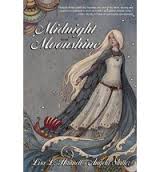
This book. Oh, this book.
It took me a few months to read this collection, this mosaic novel. This is no reflection on the quality of the book. Well, actually it is, but not the way you might think. See, I’d read a story, and then I’d be forced to close the book, sigh, and stare into space in order to wallow in the beauty of the prose. And then I’d have to go read something else, because (like with me and Gwyneth Jones’ Bold as Love series) sometimes too much beauty is painful and you need a break.
First off, look at that cover. Is she not glorious? are the colours not soothing and enticing? Created by the awesome Kathleen Jennings (who chronicles the saga of its production on her blog), I would absolutely have this on my wall. LOVE.
Angela Slatter and Lisa L Hannett created the contents. Writers who collaborate are even more of a mystery to me than authors who work alone, and to produce this sort of magic has to be just that – occult somehow. And they haven’t been content to just a straightforward story. Instead, as suggested above, this could be seen as a collection or a mosaic novel. A collection because it is made up of short stories that can basically stand by themselves. You could take one and put it in an anthology and it would still work ok. However – and here’s a metaphor I’m very pleased with – that’s like taking a candle out of a chandelier. Yes, it still sheds light. But when you put it with its fellow candles and they’re ringed with crystal, the whole effect is so much more just a few candles in one place. These thirteen stories, read together and in sequence (and wrapped in that art), are far more than the sum of their parts. Together, they create a history of an entire people: their origins, their interactions with humanity, their crises and triumphs, and the ongoing impact of a few families and their heirlooms. Thus, a mosaic novel – there is continuity, but it’s thematic and genetic; there’s only one character appears in or influences lots of the stories. I couldn’t help but be reminded of Edward Rutherford (London, Sarum) and James A Michener (The Source) following multiple generations in one place in order to fictively illustrate local history. Slatter and Hannett do just that… with magic. And Norse gods. Same amount of revenge though.
The premise, as set out in “Seeds,” is of Odin’s raven Munin (memory, here called Mymnir) surviving Ragnarok and setting out for Vinland (thought to be somewhere on the north-eastern corner of North America) with a few followers. Once she gets there, she creates an enclave and peoples it with servants, and sets out to rule it I guess like she learned from the Aesir she’s observed for however many centuries. Of course this does not go entirely well either for her or for her people. There’s love and betrayal, selflessness and vindictiveness; people get beaten up, rescued, married off, wooed… and some people even manage to make their own destinies. My estimate is that the stories take place over roughly a millennium, but that’s based entirely on the fact that that’s about how long ago it’s posited that Vikings did historically head off for Vinland and settle for a short span. The early stories take place in a sort of timeless, medieval-ish zone; from memory there are no dates in the first seven stories, and it feels like that sort of myth/fantasy where time itself is important but recording it is less so. Then, with “Midnight,” suddenly the external world exists and thrusts itself onto this dreamy place. From then on, time is relentless, and within 5 or 6 stories it’s the modern world. This development works mostly because although the stories do stand alone, there is continuity within families. Sometimes the names give them away, sometimes it’s an heirloom appearing, occasionally a reference to a past event. This often means that rather than having to struggle for a new emotional connection every time, the reader can build on the investment already made in the character’s family, from an earlier story. It’s the same reason Rutherford and Michener’s works can be successful.
And on top of all of this, the sheer beauty of the prose. I do not have the words to explain how delightful the words in this book are. It just all works.
Did I mention it’s an Australian production? Produced by Ticonderoga, in Perth.
You can get Midnight and Moonshine over at Fishpond. (Although it does ship from a US supplier.)
Riddick
Some people will probably find this unbelievable, but I was disappointed by Riddick, the third in the Richard B. Riddick series.
Did Diesel and Twohy realise that Riddick was going to be such a badass when they named him Richard B. Riddick? It makes him sound like a cartoon character.
There are spoilers below, if you care.
I was disappointed to be disappointed, because I really like the first two films. I am so not the target audience of Pitch Black; I do not like horror, I do not tend to like creature features, I do not enjoy being scared. But Pitch Black… well, it has Claudia Black and Radha Mitchell, which helps. The planet and its creepy inhabitants are just so crazy that I liked them, and I found the interaction between the different sorts of characters – the scared, competent pilot; the wine snob; the drug-addicted cop; the imam; and the Riddick – quite enthralling. As for Chronicles of Riddick, I’m only a little embarrassed to say that I love this insane b-grade dystopic over-the-top sf action film. Hell, it has Karl Urban in awesome makeup, and it has mad sets, and Crematoria is spectacularly nuts as a planet. So going into Riddick, I thought – well, how bad can it be? From the ads it was clear they were taking the franchise back to the Pitch Black model, which is fine; I was expecting some equivalent fight scenes against humans and weird aliens, some snappy dialogue, maybe a plot. Also Katee Sackhoff!!
There were some entertaining bits, I’ll admit. That Riddick is now so notorious that mercenaries know his name, and the smart ones know to be terrified, allowed for some pretty amusing scenes. The aliens were indeed as weird and unlikely as I expected. There was a brief shot of Karl Urban in his eyeliner. Sackhoff (whose character is Dahl, which is a very unfortunate name) is kickass with a sniper’s rifle. That one of the mercenaries was actually there in order to get information about the drugged-up Johns from Pitch Black gave it something of a Die Hard 3 feel, which I really liked, and meant that it did actually tie into both parts of Riddick’s past. I was intrigued by the back-to-basics appearance of the film, back to the first appearance of Riddick; it seems to suggest that Riddick makes more sense in a mostly-fighting-animals world, rather than even pretending to fit in, or interact, with humanity like in the second. And that’s an idea worth exploring.
But.
Oh, but. The first third or so of the film is basically Riddick-as-Robinson Crusoe, which was weird. Especially the bit where he domesticates a canine because… does that kind of make the dog a replacement for Jack/Kyra? Also, Riddick with a dog? That he feeds and cares for? ?!?!? That was all a bit odd. And then the movie proceeds to the fighting-the-mercenaries bit, which is where the vague plot actually starts. And Dahl arrives. In a very tight outfit, with belts and straps that emphasise her bust even more. And half the time when the dialogue involved her, it was someone being sleazy. Even Riddick himself gets in on it, which shocked me enormously. The merc on the other team – fine, I understand, he’s a douche; that’s been established already, he doesn’t like a woman being in authority over him, and she can deal with him. It’s not nice, but the writers seem to think that that helps to establish him as being Super Bad. However, I honestly don’t remember Riddick being sleazy or misogynist in the other films. Did I miss something? He’s totally big-brother to Jack/Kyra – actually, not even that to Jack, he’s completely dispassionate. Maybe there’s a moment of maybe-electricity with the pilot, Fry, but no suggestion that they make out, as far as I recall. The comment that Riddick makes towards Dahl is just so crude that I was disgusted. Over at The Mary Sue, the argument is that Dahl – established as lesbian early on, in a moment that impressed me – uses her last line as a come-on to Riddick. I actually didn’t read it this way; for me, it seemed to reflect the situation they were in (a very intimate embrace on a rope hanging from a plane). Maybe I’m just in denial.
I am glad I did not pay to see this, but got to see it at a friend’s house. That said, Diesel has just announced the fourth movie… which makes my prediction of Riddick: the Search for Furya (based on the final 60 secs of this film) all the more likely. If they can get Karl Urban back into his eyeliner, I probably will go and see it. Because I am weak like that.
The Dream Archipelago

This collection of stories is characterised by non-completion. By ellipses, gaps, loss of memory, tantalising hints of more, general incompleteness. In the stories themselves, in the people, in the world.
This turned out not to be the book I thought I was reading. Having adored The Islanders, I thought I was getting an earlier novel set in the same place. Uh, no. This is a set of short stories (including a couple of novellas): some set in the Dream Archipelago, some just referencing it. So I was quite discontent when I read the first ‘chapter’ – The Equatorial Moment – and accepted it as setting the premise for the book… and then realised that The Negation was quite separate, although with strong links. Don’t worry; I got over my disappointment.
“The Equatorial Moment” is not a story. It’s a vignette, explaining the very odd thing about this world: that there is a time vortex, which means it’s the same time everywhere on the world at the same time. It also means that flying somewhere is a rather difficult business. It also sets up that this world is experiencing a war, which – far more than issues to do with time – informs the entirety of this collection. “The Trace of Him” is also a vignette, of a lover and a funeral, that doesn’t really seem to fit the rest of the collection. It’s set in the Dream Archipelago, but that’s all.
Some of these stories are directly about the war, and its impact on soldiers and civilians. “The Negation” is framed around a draftee and his experiences, but also around an author whose art might be subverted by the war. (Its connection to the Dream Archipelago is tenuous – the novel that the soldier loves is set there.) This story was the first taste of incompleteness that flavours the rest, as Priest suggests and hints but does not fulfil. It’s marvellous. “Whores,” too, examines soldiers and civilians, through a different lens. This time the soldier has been granted leave due to sickness which manifests as synaesthesia; the civilians are women who have become whores because of the exigencies of war. This aspect, that the women are not simply whores but that they became such for real, usually economic reasons, and that they might also have other concerns, was a delight. Too often whores (and slaves) just exist in the same way that horses or dogs do, with no reference to what came before. So that worked. And there’s a tantalising question over whether the soldier in these two stories is the same man or not. The last story in the collection, “The Discharge,” also brings together art and war and ellipses. It’s the fullest exploration of the war that’s been affecting this world for a ridiculous amount of time, and makes it clear that ridiculous is exactly what it is. But then the narrator ends up in the Dream Archipelago, and starts exploring art… a type of art that has a genuinely visceral impact on its viewer by messing with the hypothalamus. And the story takes on a whole other layer and attacks a whole other idea. It’s maddening and glorious and a bit creepy.
You know that thing where you’re reading along, and you’ve been assuming something about the race, gender, location or attitude of a character and then something happens and you have to go back and read everything again to see whether you were stupid and made a mistake, or whether the author has been deliberately messing with you? That was “The Miraculous Cairn” for me. And I’m pretty sure the answer is the latter. It’s set half on the mainland and half on an island; half in the present and half in the past; and it’s a horror story. One of those slow, creeping horror stories that might not be a horror story but probably is. Gave me the shivers, anyway, and is the exemplar of non-completion. It has nothing to do with the war. Neither does “The Cremation,” which is set more fully in the Archipelago and whose horror aspects stem directly from that fear of not knowing the local traditions and attitudes and behaviours. It works all too well. Also largely separate from the war is “The Watched,” whose horrific nature really only comes through in the last few pages. Before that, it definitely has its creepy elements but they’re not the focus (although on reflection perhaps that ought to have made it more creepy…). The tantalising gaps in this story are the sort of thing that in another author’s hands would just indicate a lack of imagination, or pages where they’ve simply deleted “MUST ADD MORE INFO HERE”. Instead, the reader is left just as much in the dark as Ordier about the society of the Qataari, his object of frustrated fascination. What makes the novella really work is that this fascination, while at the heart of the story, is not its sole preoccupation. Ordier – living in the Dream Archipelago but not a native, having left the mainland and his war-related work – lives a relatively ordinary life with a girlfriend whose job is demanding and disappointing, and we get many pages of relatively ordinary life along with Ordier’s growing obsession. This adds to the creepiness but it’s not just there as filler; actually I would have been happy reading about Ordier and Jenessa and their experiences, they’re so intriguing. Which is why it works as a novella.
Are they SF? Is this fantasy? No. The collection is set on a different world, yes; but there’s no exceptional technology – it would be easy to read much of it as set in a generic olde worlde rural setting until you get references to planes, grenade launchers and microwaves. There’s also no magic; the time vortex just exists, and except for stuffing around with air travel doesn’t actually impact on life. The people are human, with nothing special about them. This is just… a world. But I would still argue that it counts as speculative fiction, because I am contrary like that.
This is not the sort of collection I can imagine reading again. The stories are demanding, they’re frustrating, and I think they may only work once. But that once was pretty glorious.

 Randomly Yours, Alex