Tusks of Extinction, Ray Nayler
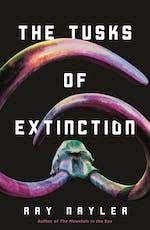
Read courtesy of NetGalley and the publisher, Tordotcom. It’s out in January 2024.
I had read and loved Nayler’s The Mountain in the Sea, so it was a no-brainer that I should want to read this novella. There are some similarities between the two, and a whole lot of differences.
Most importantly, it’s fantastic.
I hadn’t read the blurb before diving in – why would I, when I had high expectations? I assumed it was going to be about elephants, or maybe mammoths, and honestly that was enough. So yes, it’s about mammoths – although not quite as I expected. Nayler dives into the thorny questions around what it might mean, and require to bring mammoths back from extinction: in terms of science (although it’s not overly science-heavy; it’s only novella-length, after all), in terms of mammoths learning how to BE mammoths, and in terms of the human reaction as well. In particular, the focus is on poachers, beginning with elephant poachers and the people attempting to thwart them in various parts of Africa.
There’s a lot of humanity, there’s a lot of animal conservation, there’s a lot of scientific consideration. It’s provocative in the best way – no devil’s advocate crap, but raising important issues that don’t have simple answers. Well-written and engaging, this is a further evidence that Nayler is someone to keep watching out for.
Ares Express, by Ian McDonald

When I read Desolation Road I had no idea that I was reading a companion novel to Ares Express. Happily, it doesn’t matter what order you read them in – there’s no spoilers, and only one character in common… who is fairly central to the plot of both, but in ways that work separately for each novel.
Every time I read a new McDonald novel I’m reminded of just how awesome a creator he is. Here, the focus is a young woman born to a train family – they drive trains around Mars, and everything about the family is focused on the train. It’s a weird mix of a society, because it’s clearly technologically advanced – or at least, there are aspects of that, since they’re living on a terraformed planet and they have various tech things that don’t exist for us. At the same time, though, there are archaic aspects to the human side, including, sometimes, arranged marriage. Such is the future looming for Sweetness Octave Glorious-Honeybun Asiim 12th, and she is not having it. And so begins an adventure across Mars that will eventually have enormous repercussions.
The way McDonald gradually reveals his vision of this future world is masterful. There’s enough, early on, to understand the basics of society… and then slowly, slowly, enough of the history of the place is revealed that the reader’s vision is broadened. It’s looking through a keyhole vs eventually looking through a door. But not stepping through that door – there are still lots of tantalising bits that aren’t fully explained, which just makes it all the richer.
Sweetness is a great focal character: young, impetuous, smart, unafraid of challenges and usually willing to admit when she needs help. I would have been happy with an entire novel focused on her. But McDonald adds Grandmother Taal, and I love her to bits. Old ladies being feisty, taking up the slack when the younger generation is being a bit useless, fearless and clever and willing to meddle: she’s everything I love.
One of the great things about writing a middle-future novel where there’s been some loss of tech for whatever reason is that, despite being over 20 years old now, it still gets to feel vital and believable and not at all outdated. Ares Express is magnificent.
Tomorrow’s Parties (anthology)
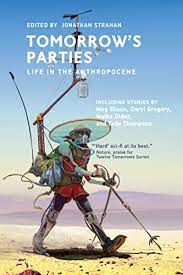
I really have to be in a particular frame of mind to read anthologies, which is why I read several in a row recently – including this one. It’s not that I thought I wouldn’t enjoy them – they’re Strahan anthologies, I’ve never not enjoyed one. It’s just a particular reading experience.
Anyway! Now I have read this awesome anthology and it was as stunning as I expected. As the subtitle suggests, the loose theme is “life in the Anthropocene”, and the authors largely took a similar-ish attitude towards what that means; there’s a lot of climate change-related stories, as is appropriate, and / but all of the authors took quite different approaches to what that might mean.
Every single one of these stories is amazing. I’m intrigued that Strahan chose to open the anthology with a conversation between James Bradley and Kim Stanley Robinson – it’s the sort of thing that I tend to expect at the end of the anthology – and maybe that’s part of the reason for it to be up front: to encourage readers to actually read it. It also sets up the climate change issues that are so front and centre through the rest of the book; the title is “It’s Science over Capitalism: Kim Stanley Robinson and the Imperative of Hope,” which itself speaks volumes.
The ten stories in this anthology are all exceptional.
Meg Elison, “Drone Pirates of Silicon Valley”: the future of online shopping and delivery, yes, but also rich vs poor, and the future of capitalism.
Tade Thompson, “Down and Out in Exile Park”: how communities might live differently, and how that challenges the status quo.
Daryl Gregory, “Once Upon a Future in the West”: multiple perspectives, and quite creepy at times. So many issues – the (negative) future of telehealth appointments, autonomous vehicles, bushfires…
Greg Egan, “Crisis Actors”: a very disturbing story that explores some of the consequences of living in a “post-truth society”. I always adore Egan’s short work.
Sarah Gailey, “When the Tide Rises”: another story that confronts capitalism head-on, bringing back the idea of the ‘company town’ as well as poking at the idea of companies making money from finally doing good for the planet. Brilliant.
Justina Robson, “I give you the moon”: one of my favourites, and not just because it’s one of the most hopeful of the stories. This is post-climate crisis, when humans have figured out how to live in more balance with the rest of the world (her vision is marvellous). Rather than focusing on how we get there, this story is about family dynamics, and ambition. It’s gentle and wonderful.
Chen Qiufan (trans. Emily Jin), “Do you have the Fungi sing?”: the consequences of a hyper-connected world, what happens if an area doesn’t want to participate – and possible alternatives.
Malka Older, “Legion”: completely and utterly different from all of the others, this is the story that’s going to stay with me the longest. Chilling, confronting, challenging… I had to stop reading when I finished this story and take a breath. It takes place over a short period of time – maybe an hour? – in the prep for, and during, an interview on a talk show. The host, Brayse, is interviewing a woman representing Legion, a group who have just won a Nobel Peace Prize. The reader is in Brayse’s head, which starts off as a reasonable experience and then gets… less so. Legion, as the name suggests, are not just one or a small group; they are everywhere, always watching through wearable cameras, and able to call out – or respond to – what they see: micro- and macro-aggressions, and all the ways in which some people are made to feel less comfortable right up to actual harm. Older nails the unfolding of this story perfectly.
Saad Z. Hossain, “The Ferryman”: another incisive take on the consequences of late-stage capitalism, this time how people will respond to death when, for the ‘haves’, death doesn’t need to exist.
James Bradley, “After the Storm”: being a child growing up in the ravages of climate change is likely to suck; at the same time, children do tend to be resilient and make their way within the world that they know. Bradley focuses on teenagers and their experiences – rather than the adults who know how things have changed – and captures the cruelty as well as the love of adolescents beautifully.
All in all, an excellent addition to the literature around ‘what next’.
Someone in Time (anthology)
I am late to the party… however, not SO late, because this just won the British Fantasy Award! Which it absolutely deserves.
I’m sure there are some readers who would avoid this because “they don’t read romance” (hi, I used to be one of those). The reality though is that you do; there’s almost no story – written or visual – that doesn’t include romance somewhere in its plot. What I have learned about myself is that I rarely enjoy what I think of as “straight romance” – that is, stories where the romance is the be-all of the plot; they just don’t work for me, as a rule. What I love, though, is when the romance is absolutely integral to the story and there’s a really fascinating plot around it. Every single one of these stories does that.
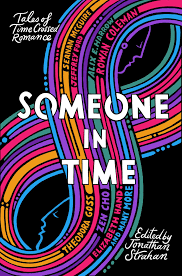
As the name suggests, this is set of stories involving romance and some sort of time travel. It’s a rich vein to mine, and every single one of these stories is completely different. Sometimes the time travelling is deliberate, sometimes not; sometimes the ending is happy, other times not; some are straight, some are queer; some pay little real heed to potentially disrupting the historical status quo; some have easy time travel while others do so accidentally; sometimes the time travel happens to save the world, and sometimes it’s about saving a single person. Sarah Gailey, Rowan Coleman, Margo Lanagan, Carrie Vaughn and Ellen Klages (a reprint) wrote my favourite stories.
And then there’s Catherynne M Valente’s piece. I did love every single story in this anthology; Valente’s story is breathtakingly different in its approach to both structure – eschewing linearity – and theme: the romance is between a human woman and the embodied space/time continuum. Hence the lack of linearity. It’s a poignant romance and sometimes painful romance; it also confronts the bitterness of dreams lost, the confusion of family relationships, the beauty of everyday life, and the ways in which even ordinary people don’t really live life in a straight line, given the ways our memories work (Proust, madeleines, etc). This is a story that will stay with me for a long, long time.
Divinity 36, Gail Carriger
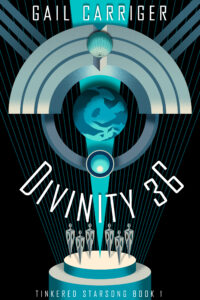
Sooo I missed this when it first came out – but it turns out I’m not too far behind the times as I read this first one (in a day…), went to look for the second one, and turns out it came out the next day (which is today, as I write). And the third comes out in October, so actually I’m doing just fine.
If you just want to buy it, or read what Carriger has to say: https://gailcarriger.com/books/d36/
So there’s many different aliens, pretty much all interacting companionably. One particular species, the Dyesi, search the galaxy for sentients who can sing or dance and then put them through rigourous training and bring them together as pantheons, because at that point those artists are gods. Yes, it’s a bit “The Voice” – or, more accurately, “Idol” where the prize is to ACTUALLY be an idol. And their performances get broadcast across the galaxy, and people literally identify as worshippers and send in votives and so on.
The focus of this series is a refugee who has a lot of trouble with ordinary emotional interactions thanks to childhood trauma. Brought together with new people and compelled to live and work with them, this is inherently a story about found family and in that it is simply lovely. There’s also, of course, music and art, and – amusingly – food and cooking.
This is a very cosy story, as should be no surprise to readers of Carriger’s work: that is, there is real and important trauma in various backgrounds but (so far) little immediate or overwhelming danger to our heroes; there’s a lot of focus on friendship and figuring out how all of that works, with a sense that obstacles can and will be overcome (not in a cheesy way). It’s a generally upbeat, inclusive, humorous, joyful story – and honestly who doesn’t need that in their lives sometimes? If you haven’t read any Carriger but you loved Legends and Lattes, I suspect this will work for you.
Desolation Road, by Ian McDonald

This book should not work.
The first few chapters are “and then this person arrived in this place that has no right to exist”. Sometimes the person or family group have some explanation about who they are or why they’re travelling; sometimes their background is incredibly vague. There are hints and vague hand-wavings at what might be coming in the future because of a particular character, and then it takes a hundred pages for anything like that to happen. There are possibly-magical occurrences, there are references that make it sound like you’ve missed the first two books in the trilogy (Our Lady of Tharsis…) and it takes FOREVER until there is something resembling a narrative.
This book absolutely works. And I don’t know why.
Well, I do: it’s because McDonald is an astonishing storyteller, and all of those things that seem wrong just become utterly intriguing and compelling. Someone who manages to make a time machine because a green person pops up at their camp as they travel across the desert? OK. Triplets who may or may not be clones; twins who split the rational and the mystical between them; someone who has an uncanny way with machines… yep, fine. I’ll read it. People are adults at 10 years old? Oh right, it’s Mars, and the Martian year is 2/3 longer again than an Earth year. So yes, actually, that’s fine.
Imagine writing this, and selling this, as one of your first books.
A Deepness in the Sky
Read via NetGalley and the publisher, Tor. This is a reprint so you might be able to get earlier printings, or this one is out in October 2023.

Where do I even begin?
I have never read a Vernor Vinge story before. According to Jo Walton’s introduction to this one, this and The Fire in the Deep are basically the culmination of his lifetime’s work.
Reading this (admittedly quite long) novel is like reading a trilogy that’s been refined down to just one volume. There is SO MUCH GOING ON – and it all works, and it draws you inexorably on. It’s not particular frenetic in pace – I didn’t feel like I was reeling from one explosion to another – but it’s relentless. It’s like an avalanche.
Partly this is because although the story takes place over decades, there are several well-placed time jumps. I think this is part of where the ‘trilogy refined to one book’ feeling comes from. There’s nothing extraneous. There are moments of people just being people – being in relationship, having families, relaxing – but they don’t feel like padding. It’s all adding together to make these characters intensely real.
There are three strands. Two are human: the Qeng Ho, a loosely connected and enormous group of people whose aim is trade; they travel between planets to sell whatever is needed, and call people on planets Customers – not in a taking-advantage kind of way, but in a ‘this is what we do’ way. Then there’s the people known as Emergents, and I wondered about this name for a long time… before I discovered it was because their society is the Emergency, named for a particularly dramatic time in their political history which has had cascading effects on their political and social structures (to become far more authoritarian than the Qeng Ho countenance) and honestly the name tells you a lot about them. These two groups of humans end up working together – much to the dismay and distrust of both sides – as they go to explore an astronomical anomaly. The third strand is the aliens who live on the planet around that astronomical anomaly, who are not bipeds and whose planetary and biological experience has led them to develop in some very different ways from humans… and yet, they are intelligent, and Vinge suggests convergent evolution in a lot of scientific and technological ways.
As I said, there is A LOT in this novel. Love and betrayal and family and war and technology… and then Jo Walton’s foreword tells me that if I read The Fire in the Deep it may completely change the way I understand this novel? I’m a bit sad that it took me until now to read this, AND YET reading it at this age was actually excellent.
I’m so glad Tor is reprinting this and I hope it gets a lot of love.
The Far Reaches: an anthology
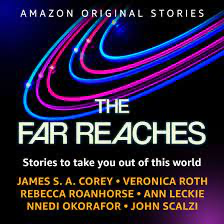
Read courtesy of NetGalley. It’s out now.
Honestly you just look at this list of authors and you can’t help but be impressed, right? I don’t love the Behemoth but this is a pretty amazing anthology.
James SA Corey gives a non-Expanse short story where the goal is humanity populating the galaxy. Which isn’t necessarily a goal I can subscribe to, but the method proposed here is an ingenious one. Clearly the distances are too great to send actual humans; generation ships are deeply problematic. So instead, Corey invents “slow light” that (don’t ask questions) allows for duplication of… stuff. So you can scan people and things and beam it out into the void – and ta dah! Humans colonising worlds that may or may not actually support them. Unsurprisingly, there’s not a lot of focus on the science; instead, this is all about the people. Because it’s the same people going to each of the maybe-settlements, and they can communicate with each other – albeit only at the speed of light. I loved this a lot.
I’ve never read anything by Veronica Roth! But I was fairly impressed by “Void”, which takes a completely different spin from the Corey: while it’s not quite a generation ship, the Redundancy moves people between our solar system and that of Centauri – so the crew lives on ship time, speeding along, while history goes on around them. Again, this is not a story of war or empire or politics of any sort; it’s human relationships and failings and friendships. It’s nicely done, and is exactly the sort of story that works well in the short format.
Ann Leckie, though! A new Ann Leckie story is always to be celebrated! And this is a super weird one from her. Humanity is not at the centre; instead it’s an alien whose planet has been discovered and settled by humans. This particular alien has the uncommon ability to look to the future, and organise its people to make its plans reality – partly inspired by the humans, and partly through its own intuition. So it’s a story of bootstrapping, and of individual genius and shortcomings, as well as the functions of society. It’s enthralling.
Then Rebecca Roanhorse, whom I have also never read. And “Falling Bodies” is heartbreaking. Ira, newly arrived at the space station Long Reach (which is, I’m sure, unintentionally hilarious to the Australian reader), is hoping for a fresh start. He’s human but hasn’t grown up with a human family; he’s got a new name and identity to live on this station, rather than spending however many years in prison; and he’s not sure how to fit in, and whether it will all last. The fitting in bit won’t be unfamiliar to anyone who’s gone away to uni, or moved towns in general; Ira’s particular circumstances just make it that much harder. Set more against a political background than most of the other stories, this one is still intensely personal.
And THEN there’s Nnedi Okorafor’s “Just Out of Jupiter’s Reach”. Seven people in all the world are chosen not at random or for skills but because of their genetics – the fact they happen to match with a genetically bio-engineered creature/machine, in partnership with which they must go exploring the solar system. As with the other stories, the main character, Tornado, isn’t anyone special – she says so herself – and so it’s a story of solitude and companionship, resilience or not… it’s beautifully written, and it’s hopeful and heartbreaking, and I loved it.
Finally, John Scalzi’s “Slow Time between the Stars” is another non-human story. In this case, the narrator is an AI: a ship, for want of a better word, launched by humans, containing the “Alexandria Module” – a repository of all human knowledge – and the task of finding a human-habitable planet and then creating those humans and whatever they required to survive. But of course, sentient beings often end up with their own intentions and goals, and so here. It’s a story of becoming, more than anything – learning about self, and figuring out what to do with it.
The unifying theme here is that these are individual stories. For all the title is “Far Reaches”, these stories are intensely personal. They’re not even really ABOUT exploration or anything else on the grand side of things. They’re about people, and much more about internal discovery and knowledge than external. These stories are fantastic.
Re-reading the Culture: The Player of Games
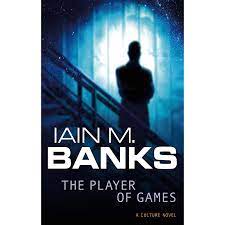
Again, it’s been a super long time since I read this. I had a vague memory of one of the twists, but basically it was like reading it for the first time. And it’s astonishing.
Gurgeh is a games player. He lives in the Culture, so all of his basic needs are taken care of; he has no concern for shelter, food, medical treatment, or anything else at all. There Culture isn’t a monetary society, so he can be or do anything at all. And what Gurgeh does is play games. All and any games. And he is one of the greatest games players the Culture has ever known. Probably not the greatest at any one game – but that’s because he’s good at all of them.
So eventually, Special Circumstances comes knocking. Contact are the group responsible for dealing with interactions with new alien species that the Culture comes across, and SC are… well, they’re basically the secret services branch. Because what the Culture doesn’t really like to advertise, or even admit to themselves, is that they are inveterate meddlers. They believe they have the right way of doing things, and that places like the Empire of Azad who are still that – an empire, although multi-planet – are desperately backward. SC recruit who they need, and Gurgeh is needed because the Empire of Azad is functionally ruled through the playing of a game that’s so intrinsic to the society that it gives it its name. Gurgeh has two years – the travel time to reach Azad – to learn how to play…
I’m pretty sure when I first read the Culture novels that I basically accepted the Culture as what they would say about themselves; helping other societies to better themselves, which may sometimes require breaking eggs for omelettes, etc. I wasn’t quite so naive that I didn’t see it as problematic, but I think I assumed I was meant to be entirely on the Culture’s side. I have, happily, become a more nuanced reader since then. As a post-scarcity society where anything and everything is available, accessible, and largely permissible, living in the Culture is indeed a wonderful thing. The problem comes when it assumes that everyone else must want, and need, to be like them. When you’re inside that society, of course this makes sense! Why would you not want people to be able to express themselves as fully as possible? And when the realities of Azad society are shown, aren’t there indeed issues that should and could be dealt with? Of course! … and yet… colonialism, imperialism, external imposition of outsider norms…
The Player of Games is fantastic. Banks’ exploration of societies and politics and individual mentalities, the influence of context on behaviour, the extreme but logical consequence of actions: they’re all nuanced and precise. And devastating. It’s never particularly easy to read a Banks novel. Worth it, though.
Re-reading the Culture: Use of Weapons

I read read a lot of Iain M Banks’ novels, but apparently the only ones I’ve properly reviewed here is Player of Games and Surface Detail. So that’s a bit weird; maybe I always felt like I didn’t have the words for it. I must have mentioned them on Galactic Suburbia, so maybe that got it out of my system.
My review for Player tells me that I read my first Culture novel, Consider Phlebas, while visiting the UK for the first time over Christmas 2006. So that’s a mighty long time ago, now, but I still remember the bit from Phlebas that freaked me out quite considerably and made me reluctant to trust Banks at all. Clearly I got over that, but I’m honestly reluctant to go back and read it because of those couple of pages. I will, at some point… because I think I might do a complete re-read of the Culture. Not in any order, since that’s one of the great advantages of these novels – they’re all standalone, like Reed’s Great Ship series. It does amuse me that the books got fatter and fatter over time, so I might pick based on what other reading deadlines I might have.
So! Use of Weapons. I love it. I love the structure, although it also drives me completely wild trying to figure out WHEN the different chapters for together, not to mention which of the characters in the various timelines are actually the same people. I’m always fascinated by how people write non-linear stories: did Banks write two stories and then cut and paste the various chapters? Did they just come out in this order, and he always knew what Zakalwe was up to? Who knows! And in the first few chapters, the reader has basically no idea what’s going on and or how any of it will fit together. But there’s something about Banks’ writing – something in his style, in his easy-to-read and yet challenging prose, that just… makes you keep reading.
One of the things I keep realising about Banks is how easily he sucks you in – look! this society is great; look! these political ideas are straightforward; look! the drone will always make sensible decisions – and then whoosh the carpet is pulled out from under your feet and you’re left unbalanced, bewildered, not really sure what’s going on except realising that things have changed just enough that the world is unmoored. And still you keep reading.
We see very little of the Culture itself, in this relatively early novel. We learn that they have a penchant for interfering in other people’s business; that they take their ideas of morality very seriously, but also that they’re ruthless in ‘the needs of the many’ or ‘the greatest good’; and, of course, that their technology is stupendous: the machine intelligence that is Skaffen-Amtiskaw, the ships that traverse phenomenal distances, and so on.
For all of that, this is still a very human story. Revenge, justice, forgiveness, family, shame – these are the driving factors. It’s horrific, and brutal; it’s also compassionate, in a weird way. Is it hopeful because of its suggestion that tech and galaxy-spanning empires will not change humanity all that much? I’m really not sure.

 Randomly Yours, Alex