Cryoburn, or The End of Bujold… so far
Tehani and I conclude our conversational reviews of Lois McMaster Bujold’s Vorkosigan series. There are LOTS of spoilers! (The rest can be read here.)
ALEX:
Well Tehani, I guess we actually have to bite the bullet and admit that we have come to the end of the Vorkosigan saga, as fas as has been published so far anyway.
TEHANI:
*sniff* I think we might have put this last review off a little, cos it’s THE END (so far, we can only hope!).
ALEX:
I KNOW I was putting this off! I have read somewhere that she is working on ANOTHER one, but given it took a decade to get from Diplomatic Immunity to this, there will be no holding of breath.
I’ll start off by sacrificing my reputation and saying that this is definitely not my favourite story – I would not want to come to Miles with this book, because I think that the first couple of chapters might have really turned me off! In fact for the first third or so I wasn’t overly impressed at all. It was a very abrupt beginning, the whole wandering-through-the-tunnels thing; being suddenly on a world that we’ve never experienced before, AND minus Ekaterin – to whom I had become so accustomed over the last few books – was quite disorienting. I had to keep reminding myself that I trusted Bujold’s story-telling and character-development skills in order to keep going.
TEHANI:
The beginning is a bit off-putting, for sure. There is precedent though, as it uses the same technique as in “Borders of Infinity”, dropping us into the middle of action we know nothing about. I thought it was very effective, especially given most people reading the book WILL know the characters, so you’re not coming into it blind. Having said that, you’re right in that if this was your first Miles book it would be a shock!
ALEX:
You’re right that it’s similar to “Borders.” Somehow though, that felt more… familiar maybe? Because Miles had been having similar-ish experiences. This time, though, it’s quite different from the last couple of books.
Anyway, as Bujold has started to implement over the last few books, we have multiple perspectives again in this novel; the other main one presented is that of the young boy, Jin, whom Miles befriends – or is befriended by, really. This was interesting and different for the Miles books, since previously it’s been the perspective of people we already know, or Ekaterin. It did make me like the young characters a bit more, and it was a different and otherwise impossible view of the world itself.
TEHANI:
And don’t forget Roic! The stoic armsman has a bigger role here, foreshadowed in his point of view narration of “Winterfair Gifts”. It’s interesting, because the first time I read Cryoburn, I absolutely raced through it, and was left with the impression when I talked about it later that it was Miles and Roic narrating, and that I hadn’t liked it. That first time, it felt like the two voices were too similar and there didn’t seem to be a purpose to the dual narrative perspective. THIS time though, I had a completely different opinion! I’d forgotten about Jin, and yes, I think that works really well – particularly interesting in that Miles is now a REAL DADDY and has a much better understanding of kids! But even the Roic POV worked better for me, and I think it was well done.
ALEX:
I do love me some Roic, I’ll admit. I like the adult-but-not-military-male point of view. And he’s a maybe a little less in awe of Miles, maybe? You’re right that Miles’ attitude towards Jin and his sister is maybe a bit more understanding than it was before, although he dealt with Nicky fairly well.
The plot is, on the surface, a standard investigative one – is a cryogenic company doing, or going to do, something dodgy on Komarr?
TEHANI:
Yep, but we don’t find this out until quite a long way into the book! For a goodly while, we’re really not certain what the heck Miles has been sent to do – doesn’t help that he finds himself an even more interesting mystery while on the planet, which occupies much of the storytelling 🙂
ALEX:
Oh that’s right! I forgot that – it just gets all so tied together in the end 🙂
Miles is sent to find out, on the pretence of attending a cryogenics conference – which also allows us to be reconnected with Raven, the very young clone who helped Miles a bit way back in Memory. Of course, this being Miles, the whole thing develops into something even more unsavoury. As with his meddling on Cetaganda, Miles ends up helping another planet discover something rather wrong at the heart of their system. In this case, on a world where cryogenic storage is close to being the accepted norm for every person (at least those who can afford it…), it turns out that a few decades ago the preserving fluid was faulty, so the people preserved then are actually, genuinely dead. This is bad enough, but is made worse – and far worse, perhaps, from the companies’ perspective – because in storing those bodies, the companies get the rights to the frozen people’s votes. So they are in effect exercising the rights of people who are dead. The whole situation on this planet is gerontocracy taken to a bizarre degree. Miles doesn’t exactly end this, but he certainly helps the world out. And foils the dastardly plans of the cryogenics corp, Chrysanthemum, to do the same on Komarr.
The story is made the more interesting with Mark and Kareen turning up to make a business investment, meaning we get to see the brothers interacting outside of the family sphere and with their respective businesses potentially either colliding or colluding.
TEHANI:
And I’d forgotten this entirely! That Mark and Kareen have a part (and quite an important one!) in the story. Was most odd rereading – almost like I hadn’t read it before at all!
ALEX:
That’s a good thing!
And then Mark and Miles travel together most of the way to Barrayar and… well, then we get to the bit where I cried just a little. Because after an entire book about death, and with Miles earlier brooding over what it would be like when he was finally told that his father had died, that’s exactly what happens. He is greeted by those three little words: “Count Vorkosigan, sir?” For me, this was a fairly heart-rending moment. When I read it, it had only been 7 weeks since I first met Aral, as he was capturing and falling in love with Cordelia. For him to them up and DIE so soon was… hard. And poor, poor Miles. I really appreciated the way Bujold then told the end of the story, in five discreet ‘drabbles’ – stories of exactly 100 words each. The different perspectives on Aral’s death and its aftermath were very compelling. I had more tears, actually, when it got to Gregor’s perspective, and his insistence that he be a pall-bearer because “the man has carried me since I was five years old … it’s my turn.” SO SAD.
TEHANI:
And I teared up even just reading THAT! Hits me every time. Even though Aral hasn’t played a huge role in the actual storytelling for most of the books, he always loomed so large in Miles’ life, in so many of his decisions (particularly to do with honour, and what it means to be a hero), that he seemed to be hugely present in every book. And how masterful is Bujold. Just three words reduce me to floods of tears – the connotation of what it means for Miles to be addressed that way is something only a seasoned campaigner in the Vorkosigan universe would be so affected by and it’s Bujold’s nod to the intelligence of her fans that she could end the chapter that way, knowing that we would KNOW what it meant. In some ways, I would have preferred the book without the drabbles, although they are indeed heartrending – but for me, I think they are there for the newbie reader, not us.
ALEX:
I thought the drabbles were the perfect conclusion, actually. It saved Bujold from the potential to be all saccharine and unbelievable by trying to do the funeral etc from Miles’ perspective, and allows us an insight into the other characters that we love.
TEHANI:
So where could it possibly go from here? What will happen to Cordelia, adrift in Barrayaran society as a widow? How will Miles handle life as the Count? Will Bujold write more novels? Should she? Who should they focus on?? Of all the threads Bujold has woven in her Vorkosigan tapestry, are there still some unfinished? (I think Ivan’s story isn’t yet done, myself, and maybe Mark and Kareen? And then there’s the children…). Do we WANT more?
ALEX:
A large part of me of course wants more, but… like you say, where would it go? I don’t know whether I want to know about Miles the Father and the stinky nappies, or Miles the Count and the Disappearing Money. I really don’t think I like Ivan enough to want an entire book about him, but I know you disagree rather violently! And if the focus were not Miles… well. That’s not really a Vorkosigan novel, is it? I can’t imagine another Cordelia novel, but I’d sure as hell read the heck out of it.
14 Vorkosigan novels in 7 weeks. I think I am officially an addict.
TEHANI:
YAY!
Galactic Suburbia 38
In which none of your fearless podcasters are impregnated by mysterious aliens for the duration of a single episode, nor do any of us experience a rapidly accelerated pregnancy or give birth to an otherworldly demon/alien/vampire. Also: Batgirl, Bujold and a cranky feminist rant or two. You can get us from iTunes or from Galactic Suburbia.
Cordwainer Smith Rediscovery Award – fascinating idea – given to a living writer for the first time, Katherine MacLean.
World Fantasy nominations, of course!
The Mystical Pregnancy trope – torture porn? Reproductive terrorism, exploiting women for being female. Violent degradation of women’s bodies for plot.
Vote For Top-100 Science Fiction, Fantasy Titles; Swedish Writing Fairy crunches the numbers.
Andromeda’s Offering Issue 1 – new fanzine to “open up new female voices in SF, raise the awareness of female SF writers and share ideas.”
(you can find them on Facebook)
Where are the women in the new DC Comics? Newsy; interview with Batgirl cosplayer.
SF Signal Episode 70 – 6 men talk about their favourite podcasts and illustrate what we mean by gender disparity in SF gatekeeping; Alisa makes reference to a recent Mind Meld.
What Culture Have we Consumed?
Alisa: Passage by Connie Willis; Red Glove by Holly Black; The Lifecycle of Software Objects by Ted Chiang.
Alex: Diplomatic Immunity and Cryoburn, Bujold; Chicks Dig Time Lords, ed. Lynne Thomas; The Sparrow, Mary Doria Russell; Shades of Milk and Honey, Mary Robinette Kowal; Songs of the Earth, Elspeth Cooper (abandoned). SF Squeecast.
Tansy Glenda Larke – Stormlord Rising; Malinda Lo – Huntress; Penni Russon – Only, Ever, Always
Feedback
We get to be Friday Hoydens!
Please send feedback to us at galacticsuburbia@gmail.com, follow us on Twitter at @galacticsuburbs, check out Galactic Suburbia Podcast on Facebook and don’t forget to leave a review on iTunes if you love us!
The Sparrow: a tale of religion and aliens

This book was recommended to me I think when I was lamenting the lack of religion in modern SF on Galactic Suburbia, and then also somewhat at random by my school librarian. Who then proceeded to buy it for school… but put it on my desk before putting it on the shelf. Truly I am looked after.
The premise behind it is one that, once stated, makes an enormous amount of sense when you consider the history of colonisation and exploration from a European perspective. Which group of people have, historically, often been the first into new, uncharted-by-white-folks areas? That would be the Jesuits. Of course. So, in 2019 when a signal is received from another planet, it is the Jesuits who finance and send the first interplanetary mission. As the history of Earth’s colonisation would also suggest, it is not an easy mission, and fraught with all sorts of difficulties – physical, emotional, mental, and spiritual.
The narrative follows two timelines: one from the time of the discovery of the radio signal, and the subsequent preparations to go to the new planet; the other, some 40 years later, with the one returnee being… interviewed… by his Jesuit brethren about what happened there. This is a difficult process for a variety of reasons: some pertaining to the priest (Emilio) himself, some to the interviewers, and others to the way the situation has been handled and reported. This second timeline is the most difficult to read, obviously, but in turn it has a big impact on the way in which the first has to be read. In the first, Emilio is not the man he has become in the second, so reading the two congruently gives the reader quite a sense of dissonance – which of course makes sense and adds to the experience of understanding just how this man changed, and why.
Did I mention it’s not an easy book to read?
Most of the characters are compelling, and usually in a good way. Emilio is probably the most enigmatic of them, right from the start. The rest of the crew who head off to the alien planet are more accessible, to a greater or lesser degree; most of the Jesuit investigators likewise, although we get to know them to a much lesser extent. There is a nice variety of character – different religious backgrounds being the greatest and most important example of diversity, given the book’s premise. I found most of the characters intensely believable, too, with one exception – and that exception I can’t really talk about without giving spoilers. Suffice to say, I hope, that I didn’t find that this took away from the book in the slightest.
In some ways this book can be seen as a meditation on the impact of European contact and colonisation on the rest of the world in the so-called Age of Discovery. Interestingly, and intriguingly, it looks at the impact on both the subject and the colonisers, which is I think something often missing from the literature (Heart of Darkness being an obvious parallel here). Connected to this, and really really interestingly from my perspective, is the fact that the impact of such an experience – right from the discovery of aliens to contact and the end result of that – on religious people is also front and centre. And taken seriously, and described in ways that I, as a Christian, found quite profound and… accessible, I guess. (The author discusses her own religiosity in an afterword, saying that she was a lapsed Catholic until she had children, at which point she started thinking about religion again and converted to Judaism.) I appreciated this attempt to grapple with what I think are incredibly important issues, and that are often overlooked in the genre.
There is a sequel, apparently, and I’m not sure what I think about that; it stands so starkly and brilliantly by itself that I would be reluctant to add to the ‘afterwards’. That said, this book is so beautifully written that I’m a bit in love with Russell’s prose and I think I could read every other bit of fiction that she’s put out there, so I guess I’ll be reading the sequel.
Diplomatic Immunity: Miles really needs it
Tehani and I approach the end of our mammoth Bujold re/read with the (currently) penultimate novel in the Miles universe. Many many spoilers for this one and all the preceding! The others can be found here.
TEHANI:
This is a fantastic book because it brings together a whole heap of elements from books gone by. It’s a very nostalgic read, while still being centred very much on Miles in the “present”, learning to be a husband (and father-to-be!) and an Imperial Auditor. It’s got lots of Ekaterin, which is great, but we also get Bel Thorne! And Cetaganda! And quaddies! And of course, mystery, misdirection, action and danger. All par for the course in a Vorkosigan adventure!
ALEX:
If anything could be said to be a ‘standard’ Miles adventure, this probably comes close. It includes many aspects of previous adventures, as you mention, and it’s definitely a Miles-solves-the-mystery-and-saves-the-day. And it doesn’t have the excruciating embarrassment that A Civil Campaign sometimes offered! ‘Nostalgic’ is indeed the word I am searching for here. 😀
Adding to the nostalgia, and something that I loved, is the fact that we are brought back Miles’ own birth in many ways with Miles and Ekaterin waiting for their babies to be born… from their uterine replicators. While they are in a tizz about getting home at the right time, the reality is that missing the birth would be sad but not actually tragic – and how weird to think that this applies to both father and mother! That it’s not the end of the world for, ostensibly, a pregnant woman to be off having adventures! (Makes me think of Gail Carriger’s latest Alexia Tarabotti novel, Heartless, where her heroine is seven or eight months pregnant, and still running – or waddling at least – around.) This compares directly with Cordelia and Aral’s immense worry over Miles – that he had two births! – and of course with Count Piotr’s immense distaste for the very procedure that Miles now sees as, if not routine, then not abnormal. (Also? I’m quite sure every mother reading this either fainted in horror or hilarity at the suggestion that if they wanted to have four children, they should just get them all out of the way at the same time…. I’m not a mother, and even I couldn’t decide between my reactions, and feel sympathy for Ekaterin for having to deal with such a manic as Miles.)
TEHANI:
I hadn’t even thought of the parallels to Miles’ own birth, but you’re completely right. The bit where Ekaterin and Miles are jaunting off round the solar galaxy while officially eight months pregnant? FRUSTRATING! *I* want that!! 🙂 And yeah, twins is enough work I reckon, although people do have more at once even NATURALLY, so I guess it could happen – but four lots of baby Miles? Eep.
ALEX:
Plus: Bel Thorne! Not forgotten! Hooray!
TEHANI:
One of the best elements of the Vorkosigan Saga is that Bujold builds on what has gone before, allowing growth and change in her world but still giving the reader familiar elements to cozy up to. The use of Cetaganda in Diplomatic Immunity is far better here than the match up between Ethan of Athos and the book Cetaganda – Bujold played to the strengths of the better worldbuilding this time, ensuring continuity.
ALEX:
Yes, I was very pleased that Cetaganda made a comeback; they seem like far too important a part of Barrayar’s universe to not interrupt Miles’ life again. (I loved that the Emperor sent a delegation to Gregor’s wedding, as of course he had to, in ACC – and Miles’ interaction with Benin and the haut Pel.)
TEHANI:
There’s only one tiny point where this falters, and that is easily explained. Diplomatic Immunity was published before “Winterfair Gifts” was written. In “Winterfair Gifts”, Roic has an interlude with Sergeant Taura, which would be a pretty important memory to him, and Ekaterin is nearly poisoned by a wedding gift. However, when Taura’s visit and the wedding are mentioned in Diplomatic Immunity, there’s no note of this (understandably, as Bujold probably hadn’t conceived of it at that point!). What grated though, was the reference to Ekaterin’s “tense, distraught state the night before the wedding” which “reminded Miles forcibly of a particular species of precombat nerves he’d seen in troops facing, not their first, but their second battle. The night after the wedding, now – that had gone much better, thank God.” Having just read “Winterfair Gifts”, this jars significantly because Ekaterin’s “nerves” or behaviour had nothing to do with worry about her first marriage or what lay in store for her in her second. But we have to allow for these little issues, I guess!
ALEX:
As someone reading these now, in internally chronological order, it still weirds me out to see these inconsistencies because overall, the series is so consistent – for something not written thus!
TEHANI:
Other than that, this is a brilliant book. Miles is learning to rely not just on his on manic wits, but on Ekaterin’s thoughtful observations as well (and his own reliance on her to moderate him and calm him is becoming very sweet). The extra element of needing to be back on Barrayar to open the uterine replicators for the birth of their first children gives a very important deadline to wrap up the case, which naturally means the case gets more and more complex! The actual plot of this one is nicely twisty, and it’s the sort of mystery that ONLY Miles, with his rather varied background, could have solved, at least without a major interplanetary incident.
ALEX:
I really liked Miles’ comment on basically wanting to use Ekaterin to help his investigation – recognising that some people would be more willing to talk to her about things, in order to relay information. Of course this only works because Ekaterin is herself more than willing to be involved, at least to some degree, and readily acknowledges that she does indeed have talents and uses that Miles just doesn’t. They are delightfully complementary.
I was bemused at the start as to how all of the various skeins would end up tying together – because I knew that they would. I certainly didn’t expect the ‘herm’ to actually be a ba! And a renegade ba at that! The tie back to Cetaganda was very neatly accomplished, I thought, and of course Miles’ dealing with the whole thing was perfect.
TEHANI:
Was very cleverly put together indeed – Bujold working her magic as usual!
Great to see Nicol back, and with Bel – so sweet. Bel’s departure from the Dendarii was a bit heartbreaking, so it’s really good to see what happened to it, and where it ended up.
ALEX:
So SWEET!!
TEHANI:
It was also interesting to see how other places react to Barrayaran ships and their crews at a local level – we know that Barrayarans are generally regarded as fairly brutish by civilised races, but this is drawn more explicitly in Diplomatic Immunity. It’s particularly interesting given that we’ve seen such a lot of gentility on Barrayar more recently, as well as the brutality (particularly towards mutants), and could have been fooled into thinking this perception may have changed.
ALEX:
I was intrigued by the idea of a Barrayaran having deserted in order to be with a ‘mutie’ – one of the quaddies – and then of course his shipmates’ responses to this. I can’t help but see it as a comment on responses to mixed-race couples, personally.
TEHANI:
In all, it’s a great book. But so sad because we’re getting so close to the end…!
ALEX:
ONE MORE! Well… one more published so far, anyway… oh my, I’ve joined the ranks of Bujold fanatics rather hard…
This chick digs time lords… although maybe not as much as them
 I got sick, realised that I had this to read thanks to the Hugo voters’ pack, and read it in a day. Well, there were a couple of entries that I skipped over a bit because they weren’t that engaging for me and my experiences, but I swear I read almost all of it.
I love Doctor Who, but I do not LOVE it. I am a fan, but I am not a FAN. I don’t think I ever realised the difference between the two before meeting people like Tansy and other serious, mad FANS (in much the same way that I didn’t really know about or understand about SF fandom before attending conventions). That is, I will watch Doctor Who anytime it is on TV, and go out of my way to do so, but I don’t own any DVDs, and I’ve never read the books; I’ve not watched the entire history, although I watched a fair chunk of the First Doctor when the ABC put him on a few years ago. So… love, but not obsession, perhaps?
This book was written largely by women who are closer to the obsessed end of the spectrum. I don’t imagine that I would ever attend a Doctor Who convention, but it seems most of the women here have done so. That’s ok, though; I certainly don’t think any less of them for it! In fact it was really fascinating to see what it would be like to be fully in a fandom on which I am at best on the periphery. What many of the writers were writing about, at heart, was the sense of community that being in Who fandom allowed them to experience: the cosplay, the acceptance of a child with special needs, people who shared a wider range of interests than Who but which converged on that central point. The fact that frequently, the cast and crew of Doctor Who featured in these reminiscences adds to their overall appeal, too. (The fact that I too have been on the receiving end of the warmth of Rob Shearman’s generosity and boundless nuttiness made it all the more amusing.)
When they weren’t writing about that community aspect, writers tended to be dissecting aspects of the Who universe and their own love of it, despite its flaws: the role of companions was a particular topic. I remember one of my university tutors remarking once that there are some loves that can withstand ruthless and relentless examination, and that others just can’t (her example for the latter, I recall, was Home and Away…). Who clearly falls into the former category for these authors, and it was with great joy that I read critical (in the best sense) examinations of Donna, Martha, and Rose – often different from person to person.
The thing that I haven’t mentioned yet about this anthology, of course, is that it was entirely written by women. Not being a part of Who fandom either during the Wilderness Years or even with New Who, it had never really occurred to me to consider whether it was a boy thing or not; I guess I’ve always just read and watched whatever and not been fussed by it – and been lucky enough not to be told not to by anyone I met. So it was also very interesting to read a little about how female fans have been treated, and also about how people (especially women) coming to Who lately have been treated by old-school fans (badly, often). I am led to wonder just how different this book would be were it written by men. I think it probably exists, but honestly I have little interest in seeking it out. I may be wrong, but I harbour a suspicion that it would be more hung up on internal consistency (or lack thereof), and lavishing attention on gizmos. This is probably a dreadful generalisation, and I apologise to male fans to whom this is insulting, but….
Miles in luuuuurve
Tehani and I continue our voyage into Lois McMaster Bujold’s Miles-land, in a conversational review utterly replete with spoilers. Other reviews can be found here.
TEHANI:
It seemed logical to do the whole omnibus at once this time. We had both raced ahead of ourselves, more interested in reading the books than reporting on them, and before we knew it, Komarr, A Civil Campaign and “Winterfair Gifts” were all done! These three works are very strongly tied though, with the arc of the love story between Miles and Ekaterin, so it makes sense to talk about them as a whole.
ALEX:
Yes, absolutely. Reading them in the omnibus, I just… kept right on reading…
Komarr
TEHANI:
Now an official Imperial Auditor, Miles tags along with Imperial Auditor Vorthys to investigate an incident on the Barrayaran colony world Komarr, and finds himself imposing on the hospitality of Vorthys’ niece, Ekaterin Vorsoisson, and her husband and young son. The Vorsoisson household is not a happy one, with Ekaterin’s husband Tien hiding a secret. Miles finds himself drawn to Ekaterin, although his honour forbids him ever to act upon this, and Ekaterin, miserably trapped in a marriage she long grew out of, can only dream of a happier life. Despite his change in status, trouble still follows Miles wherever he goes, and the Komarr situation is no different. Balancing a diplomatic disaster in the making with the mystery of the solar mirror accidents, Miles, as always, finds more problems than he bargained for.
ALEX:
And it’s not like Miles doesn’t half COURT danger, let’s be honest. Nosey little git is a NICE way to describe him, most of the time! Anyway, there are indeed two narratives going on her. First, the detective business that the Auditors essentially find themselves in and bring them to Komarr, figuring out what happened to the soletta – deliberate or accidental damage? – which in turn leads to a much bigger issue: someone trying to close Barrayar’s wormhole permanently. I really enjoyed the investigative aspects of the story, and the way in which Miles used and explored his new Auditor powers. Pairing him with Vorthys, much older and much wiser, with different skills and a more relaxed take on life, was clever from the Emperor and from Bujold – it sets Miles up nicely to work the way he works best, as well to continue growing as a character. And I really really liked that the issues at stake got so much bigger from something quite small; it developed over the course of the novel very smoothly.
The second narrative, of course, if Miles falling in luuuurve with Ekaterin – already married, and then widowed, partly through Miles’ own negligence. And doesn’t that play on his conscience…
TEHANI:
One very interesting aspect of this book is that it’s the first time we get another point of view character for a big chunk of a Miles story. And this in itself is a dead giveaway as to Ekaterin’s importance to the world. Elli Quinn and Elena Bothari-Jesek were never given the narrative. Obviously things were a bit different in Mirror Dance, when Miles was dead or missing for much of the book, but in this case, it is as much Ekaterin’s story as it is Miles’, if not more, and this is very telling.
ALEX:
I loved that we got Ekaterin’s perspective! I’ll admit that I had accidentally looked over a chronology of Miles’ life and saw “Miles and Ekaterin on honeymoon”, so there was no surprise for me in their relationship developing – although I did wonder what we were going to do with Tien! – which I was a bit cranky about. As you say, that she gets so much personal airtime in the book is indeed a giveaway. The insight into the more domestic side of things, and how Miles impacts on people, was a fascinating one.
TEHANI:
I didn’t feel like Komarr was the most engaging of the newer books, but really, that’s a comparative issue – when the two books that precede it are Memory and Mirror Dance, it’s a challenge to stand up and be equal or better! It’s still absolutely solid storytelling, giving us action, drama and mystery, with a little glimpse of love thrown in.
ALEX:
I really enjoyed it! It’s a very different book from either Mirror Dance or Memory, and it benefited from that. There’s a bit less introspection from Miles, and a bit more action, which helps to distance it from Memory in particular. It’s a nice change of pace, given we still get to keep Miles being Miles.
TEHANI:
I’m really glad Bujold didn’t leave poor Miles in the lurch again here. It’s really been so unfair that all the women in his life are not interested in being Barrayaran wives, and while of course, happy ever after is not where we leave the book, at least we know the possibility is now open.
Ekaterin herself plays an important role in Komarr. She’s not there to be Miles’ love interest or complication, although there is that aspect. She plays a big part in the plot as well, but I think the most interesting aspect is her insight into what it means to be a Vor woman. We’ve seen a bit of this with Ivan’s mother and some others, but here, Ekaterin is in the spotlight and she is true Vor. Miles has been our benchmark of Vor, supplemented by Ivan, Aral and many other MEN. now we get the other perspective, one that Cordelia, being Betan, could never offer – that of what it’s like to grow up, and live, as a Vor woman.
ALEX:
The insight into being a Vor woman was utterly captivating – as you say, Cordelia is so totally off the map for Barrayar that she can’t offer this sort of perspective. My heart ached to see Ekaterin’s personal life… and realise that actually Bujold is talking about the experiences of many women today. Her relationship with her son Nikki was interesting too, for being (it seems to me) very real. I was so pleased that she got an action part to play, too – although I will admit that when she and her aunt got nabbed at the station, I had to put the book down and walk away for a little while, because Bujold just KEEPS DOING NASTY THINGS TO HER CHARACTERS. I was fairly sure she’s be ok, but the stress was no good for me. And then Ekaterin destroyed the weapon and it was all ok. Thankfully. Also, I really really liked Aunt and Uncle Vorthys and their relationship – which is developed much more in the next book – that they both have successful, professional careers and have a good marriage says that the Vor aren’t completely and totally useless.
A Civil Campaign
TEHANI:
THIS BOOK IS SO. MUCH. FUN!
ALEX:
Hell yes!!
TEHANI:
I adore this from beginning to end. Bujold once again demonstrates her incredible ability to cross genres, writing a marvellous romantic comedy with intrigue and gender bending and politics and Miles bumbling about! There’s a name for that, right?
ALEX:
Awesome?
TEHANI:
There are lots of plot threads crisscrossing this book. Underpinning it all is Miles’s attempts to woo Ekaterin, now living back on Barrayar with her aunt and uncle Vorthys (side note: I ADORE Ekaterin’s aunt – she’s up there with Cordelia for awesome) and Nikki, her young son. We know how well Miles does in the romance stakes, so his concerted efforts go rather awry – he really must get used to the fact that his vision is not always the same as the vision of those around him!
ALEX:
Oh heck, that dinner party!! That was another moment when I just wanted to crawl under the carpet on behalf of Miles and his shame. But honestly, why the hell did he go around talking about her?? I guess I understood, a bit – hard to keep your trap shut about being in love – but at the same time, he was telling himself so firmly that he had to WAIT… and then it got out of hand… and then it all came good! Hurrah! I think this is one reason why I don’t tend to read or watch romantic comedies, actually; I do not enjoy other people’s embarrassment; I feel it too keenly myself.
Once again I enjoyed Ekaterin’s perspective – that she is coming to understand herself so much more, in particular with how she treats her would-be suitors and her relatives. That she is still trapped to an extent in Barrayar legalities and expectations is excruciating. I also really enjoyed her love of gardening – it’s nice to have at least one person expressing an appreciation of the native flora, rather than just wanting to totally terraform the place. On the Miles front, being privy to her turmoil in thinking about him was very cleverly done. Also, it ends up giving us a whole new insight into Miles himself – and finally a proper tour of Vorkosigan House!
TEHANI:
But the side plots are such fun. The butter bugs, brought to Vorkosigan house by Mark, under the erstwhile care of the mad professor (that’s totally what he was, right?), and Mark’s own love affair with the wonderful Kareen Koudelka gives us a madcap zaniness, which while often under the surface in the Vorkosigan saga, is rarely so overt. And seeing Mark really becoming a person, with a girlfriend and a business, is just lovely. Lady Alys is still organising that darn imperial wedding, keeping everyone, particularly Ivan, hopping. And poor Ivan, now left on the shelf, thinking he might have a chance with a three-time widow who goes and has a sex change in order to take legitimate success of a District … well, that’s just typical for Ivan, isn’t it? I do love that Ivan gets a chance to be a hero here though – without him, the outcome of the meeting of the counts would have been rather different. And you know I’ve always had a soft spot for Ivan 🙂
ALEX:
BUTTER BUGS!! So gross. And Mark turns up, hurrah! I like Mark – the sub-plot with him and Kareen was also a very interesting one, with Kareen paralleling Ekaterin in some ways, with her trying to figure out how to be herself with her parents as well as with Mark. I love Mark for his love of her – and I really love the way Cordelia deals with Kou and Drou, dragging that couch out of the attic!! Ivan… see, Ivan lost some of my goodwill, for trying to be nasty to Miles in upsetting the Ekaterin applecart somewhat. Grrr.
TEHANI:
This book shows Barrayar itself growing up too. The count with the replicators, the one who finds he has Cetagandan heritage, and the Donna/Dono subplots demonstrate ways in which Barrayar is becoming more galactic, and how well her people are, or are not, dealing with this change. I think it’s a very important change Bujold is making here, because while Barrayar has been so set in its cultural ways for many generations, things HAD to change (and it’s a nice tip of the hat to Aral and Cordelia’s own efforts to bring about change).
ALEX:
The Donna/Dono plot was AWESOME. I had so not expected that, and it was a marvellous challenge to the stuffy Counts! I did get a giggle out of the fact that they were, in the end, more scandalised that one of their own could attempt an assault – and worse, fail – than by the sex-change. Additionally, Gregor and Laisa finally get married (with almost no problems!), which provides a nice bit of development/improvement for Barrayar as a planet too; ties to a colonial possession at a very personal level certainly help.
TEHANI:
This book is full of misunderstandings, miscommunications, missed opportunities and mischance. It’s surprisingly long, but is the most amazingly quick read. The characters are so dryly funny, even in their utter despair, and the story absolutely belts along in pace, weaving the myriad plot threads into a gorgeously fun tapestry of a book. I think this has to be my favourite book, for the sheer fun of it (with its underlying serious elements), despite my adoration of Memory and Mirror Dance. I can’t imagine being like Tansy and STARTING with this book, because the back story adds so much more depth, but I can see how it would provide a brilliant introduction to the madness of Miles!
ALEX:
The idea of starting with this book makes my head HURT. This is indeed a whole lot of fun, but it can’t rate as my favourite, I’m afraid; there were too many cringe-moments!
“Winterfair Gifts”
TEHANI:
While not next in the publishing schedule, “Winterfair Gifts” is a neat little tie up of the events of A Civil Campaign. Miles and Ekaterin are finally getting married, and this sweet little tale tells that story. Again we switch point of view, this time to the young armsman Roic, who gives us a fresh perspective into what being around the Vorkosigans is like. Naturally, nothing is easy on Barrayar. Sergeant Taura comes to the wedding, shocking Barrayar with her fearsome appearance (but the Lady Alys handily takes her under her wing and helps Taura understand her own beauty) and uncovering a nasty plot that would destroy not only the wedding, but Miles himself, by killing Ekaterin. In a fairly short piece, all is resolved and tied up in a bow of the beautiful winter wedding.
ALEX:
It was nice to have this next in the omnibus – although I did wonder at Ekaterin’s nerves and whether Bujold was going to actually make Miles WORK in this one! It was awesome to get Roic’s point of view, this time – his discomfort at not being from the military was sweet, and his reaction to Taura was awesome – as was Taura’s reaction to Lady Alys! But, a winter wedding in the garden? The man is crazy.
TEHANI:
If I have one disappointment it was that we didn’t see any more than a brief glimpse of Elena and Baz and their baby, and more of Ekaterin than as a plot device here. That said, Taura and Roic were lovely, if sad, and I liked that it showed the backwater boy learning to understand a bit more that looking different doesn’t mean being different. I don’t know that we had to have “Winterfair Gifts” to complete the Miles/Ekaterin love story, but it’s a nice touch.
ALEX:
True. I was a bit sad Quinn wasn’t there, but I guess having one old flame and one old lover in the place for the wedding was enough for Miles’ potential discomfort…
TEHANI:
Onwards, to Diplomatic Immunity where Ekaterin once again gets to demonstrate why she really is a great match for Miles and we run across some old friends!
Galactic Suburbia, #37
News
The Locus Awards
Prometheus Award winners
Sturgeon and Campbell Awards
Shirley Jackson
Recent announcement – Gollancz announces the SF Gateway, huge project to digitise & make available thousands of SF classics as ebooks.
Linda Nagata on ‘What’s in a Name’ and her career trajectory as a female writer of hard SF
Chris Moriarty on label in the women & SF conversation
via Thoraiya Dyer, women and the chilly climate
Liz Williams at the Guardian on the way science fiction reflects human belief
Alastair Reynolds to write Doctor Who novel: Tansy and Alex’s obsessions in one package!
What Culture Have we Consumed?
Alisa: Maureen Johnson on www.whyy.org/podcast; Twin Peaks; Mercy (not genre but interesting feminism);
Alex: sooo much Bujold (3rd, 4th and 5th omnibi, and Memory); lots of books, because of holidays! But particularly Heartless, Gail Carriger; Blackout, Connie Willis; Hundred Thousand Kingdoms, NK Jemisin… also Harry Potter 7 and Transformers 3.
Tansy: The Demon’s Surrender, The Holy Terror & Robophobia (Big Finish), Subterranean’s YA Issue
Pet Subject: Feedback from our Joanna Russ episode
Please send feedback to us at galacticsuburbia@gmail.com, follow us on Twitter at @galacticsuburbs, check out Galactic Suburbia Podcast on Facebook and don’t forget to leave a review on iTunes if you love us!
Hugo (re)reading: Troika
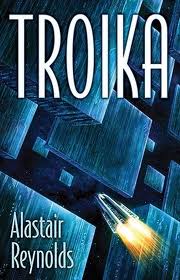
 I read this novella in my lovely hardback version of Godlike Machines. It’s a re-read, since I read it last year for Last Short Story and had to re-read it now to reassure myself that it really was as good as I thought it was in the lead-up to the all-important Voting In The Hugos. And yes, it still really really is.
What’s often awesome about novellas is that they give a certain amount of tantalising world-building, but leave a lot to the reader’s imagination. Reynolds does that here; it’s maybe 40 years from now, set in the Second Soviet of Russia. There’s all sorts of wildly interesting stuff hinted at, about Russia and the rest of the world, but it takes a back seat to the plot. And it’s a marvellous story. A trio of cosmonauts were sent out to rendezvous with a mysterious artefact on its third go-around of a 12-year elliptical orbit… and things proceed. More than ‘just’ a first-contact story (or is it?), though, the story is told some years later as one of the cosmonauts visits an astronomer whose outlandish theories about the artefact – the Matryoshka – had been derided.
So there’s fascinating world-building, a really cool story, and intriguing character development too. I loved this story originally, and I still do.
Memories and Miles
Tehani and I continue our read of the Miles Vorkosigan series. This review contains lots and lots of spoilers! (Previous conversational reviews here.)
TEHANI:
Well, where to start? I think this is one of the most powerful of the Vorkosigan books, for so many reasons. Having said that, it’s probably one that suffers for being read in chronological order, because it follows Mirror Dance, which is just brilliant and so emotionally draining!
ALEX:
I finally feel, with Mirror Dance and Memory, that here are books that I could really imagine reading again. I mean, I loved Cordelia’s books a LOT, and can imagine re-reading the entire series over the years, but these two felt like a massive step up in… complexity, I guess? In narrative depth, maybe. I’m quite sure that I have missed some of the subtleties going on, which I will enjoy on a second read. I quite liked this after Mirror Dance, because while it’s emotional and fraught it’s quite different – and this is another demonstration of Bujold’s complexity as an author, which I keep being impressed by.
TEHANI:
Memory is very confronting in its own way, where Miles deals with the fallout of having died, and the long-term consequences of
this. It leads him to not only bring about his own downfall, but brings about a massive life change, leaving us, the reader, to come to terms with what could Miles possibly DO after having lived such a wild ride to date. No way could he sit at home just being Count’s heir!
ALEX:
Oh yes, I knew that no way was he going to end up being the lad-about-town with Ivan.
You know, when I said I thought Miles would take Illyan’s job, I didn’t want him to actually leave the job…
TEHANI:
I know! Illyan has been such a staple of Miles’ (and Aral and Cordelia’s) life, it’s hard to imagine how the Empire will run without him!
Fortunately, Bujold doesn’t leave Miles on the shelf, and so he embarks on a new vocation, one which gives him even MORE power and authority than he had before, more than even he could have imagined. It’s a very sweet scene when he steels himself to beg Gregor for a post-discharge promotion to captain, and is given an Imperial Auditorship! Not thinking big enough for once!
ALEX:
I realised when he was granted those powers that of course, this was really the first book in which Auditor powers had been explained at all… but I never thought, from the conversation at the ballroom, that Miles would end up having those powers, even temporarily! I loved the scene with Miles putting ALL of his medals on, including the Cetagandan one – and that it made Miles Vorkosigan feel like he actually had some worth, apart from Miles Naismith. I think this has been the most intriguing part of Miles’ character arc so far: that he has genuinely divorced Naismith and Vorgkosigan in his head, that the latter is jealous of the former… exactly how that would impact on someone of barely thirty is a bit horrifying, actually.
TEHANI:
That’s such a good point – Cordelia mentioned in an earlier book that she worried for Miles’ sanity if he ever had to give up the little
Admiral. Here, we have to worry too, because it’s not something he copes with immediately (and I love that Ivan, poor Ivan, has to deal with this).
Memory gives us a chance to see more of some backstory characters – Miles comes home to Barrayar and this means we get to play with Ivan, Lady Alys, Gregor and of course, Illyan. I love how Bujold draws her people together, and how we learn more about them over time. Lady Alys starts out as a young wife way back in Barrayar, and look how far she’s come (and still further to go!) past the overbearing mother/aunt of Ivan and Miles’ early life.
ALEX:
I like that she keeps the supporting cast so consistent, with new people only brought in when necessary and quite appropriately. Also, I just knew where things were heading as soon as Illyan described Lady Alys as a reliable woman. Ha! Old people making out! Hilarious. Bujold likes pairing off her minor characters, which makes Ivan and Miles look very left out! I mean I know Miles Naismith is ‘with’ Elli, but it’s clearly not going to be a permanent relationship, which Miles certainly longs for and even Ivan may be sort of interested in…. Also, POOR GALENI. Having your ladylove stolen by the Emperor has gotta hurt. I was pleased that they made Gregor and Laisa’s relationship gooey but also sensible – and that both Galeni and Gregor came out well, which sometimes doesn’t happen when there are love triangles.
TEHANI:
It’s also fun to see Miles assemble his own household. It really is the first time Miles has had to be a grownup, running a house, dealing with cooks, cleaners and all the daily minutae of this. He is, as always, very clever at getting good people, recognising in others what they may not have seen in themselves, and I think this is lovely to see in a domestic setting.
ALEX:
Domestic Miles! I loved it! And the fight to keep Ma Koti was a really awesome little side-play.
TEHANI:
The plot in Memory is a twisty mystery, with the usual red herrings and wrong turns, which forms the backbone of this change of life story (not just for Miles, for Illyan as well, and to a lesser extent, the Dendaari and Elli Quinn). Bujold again demonstrates her mastery of writing in yet another form.
ALEX:
For me it was one of the classic “I bet it was him ooh no he’s let off the hook ooh maybe it WAS him!” mysteries, and cleverly done too. I was VERY sad about what happened to Illyan.
TEHANI:
I love this book, which lays Miles bare, to possibly his lowest point, and forces him to reinvent himself. A definite favourite!
ALEX:
yup, it’s ranking up there for me too.
Tiptree book club: With Delicate Mad Hands
Welcome to July’s Tiptree Book Club story-discussion-thing, which I have inherited from TJ on the closing down of Dreams and Speculation. This month we’re looking at “With Delicate Mad Hands,” which marks the halfway point in the anthology Her Smoke Rose Up Forever. (A note on the next few months – I’ve changed it around a little so that we’re reading kinda-sorta the same number of pages each month: August will be “A Momentary Taste of Being;” September “We Who Stole the Dream;” and “Her Smoke Rose up Forever;” October “Love is the Plan the Plan is Death” and “On the Last Afternoon;” November “She Waits for All Men Born” and “And So On, and So On;” December “Slow Music” (yes those last two are not in the order given in the anthology).)
This discussion is completely riddled with spoilers, so don’t read on if you’d like the joy of discovery all for yourself!
It’s worth saying up front that this story did not go in any of the directions I had expected, which shouldn’t have surprised me with Tiptree. That a story could go from a discussion of how awful a girl’s life was because she had a squashed nose to her being the first human on a extra-solar planet, beloved by an alien and bequeathing an enormous amount of new knowledge… yeh, that’s pretty awesome.
Of course, to get to the awesome you have to struggle through some quite awful stuff. CP’s life is horrid right from the start – and I hope I’m not the only one slightly frustrated by the tantalising looks into this ?post-apocalyptic world offered by Tiptree, where you can rarely see the sky and Managers are the be-all and end-all. CP’s drive to get into Basic Space Crew Training eventually gets her there, and while I was initially impressed with a society that eventually lets girls in, that was rapidly quashed: she has to pay for her own sterilisation, which was awful on numerous levels, and, along with her other duties, she has to allow the men onboard to use her as a sexual ‘waste can’. My horror knows no limits…
The events on the ship, with CP eventually getting rid of the men and taking off towards Galactic North, I found surprising and I’m not sure why. Perhaps because of the no-nonsense way it was all described; and perhaps because CP’s preparedness for just this eventuality is chilling. I did, though, really enjoy her enjoyment of solitude, and finally doing just what she wants; that she went around and pulled off all the blinds to be able to see out felt so familiar that I think at this point I was able to identify with CP, just a bit. And then to have her find a roving planet… as I said, it was unexpected, and utterly utterly intriguing. That life could grow somewhere like this! That radiation could have a positive impact on life… that telepathy etc would develop, and the different ways that can be found to do science… Tiptree had a seriously amazing imagination. (Also, did anyone else feel like she might have been a little influenced by Yoda, in characterising some of her little aliens?? This story came out in 1981, so it’s just feasible….) The poignancy of discovering that yes, there really had been a voice in her head all that time, and that she was and had been loved, was a wonderfully touching conclusion.
Some questions to get discussion going:
How did you feel about CP, and did this change over the story?
Did the story develop as you were expecting?
What did you think of Auln, the alien world?

 Randomly Yours, Alex