Galactic Suburbia 22
You can download or stream the episode from Galactic Suburbia, or get us from iTunes.
In which we have run out of our supply of feminist ire for 2010 and are reduced to being happy bunnies with rainbows and vanilla sprinkles. Also, we discuss re-reading, re-watching, and our (apparently unhealthy) emotional attachment to beloved books. With zombies. BONUS: see if you can pick how many times yours truly screwed up the recording because my stooopid Skype crashed. Is fixed now.
News
Black Quill nominations.
Best of 2010 Tables of Contents, Rich Horton & Jonathan Strahan (Niall Harrison tweeted about online percentage, 14/29 stories in Strahan – and 16/28 in Horton. Last year JS had 4/29 and Rich had 7/30).
Torque Control’s Week of Women & SF (also here).
Swancon invited guests announced.
Pet Subject
On re-reading. Did you re-read books as a teen? Do you re-read now, or would you if you had the time and the publishing industry stopped for a year (or three)? Why/not… (on re-reading The Belgariad).
What Culture Have we Consumed?
Alisa – Fringe Season 1 and half of Season 2
Tansy – Feed, by Mira Grant, The Five Doctors easter egg commentary
Alex – Quantum Thief (Hannu Rajaniemi), Zima Blue (Alastair Reynolds)
Please send feedback to us at galacticsuburbia@gmail.com, follow us on Twitter at @galacticsuburbs, check out Galactic Suburbia Podcast on Facebook and don’t forget to leave a review on iTunes if you love us!
Zima Blue
 Published in the UK in I think 2009, this is a collection of some of Alastair Reynolds’ short stories from 1991 through to 2007. I’d read a couple, but not many, so I enjoyed it immensely, even though there were a few stories that didn’t really rock my world. I won’t give a complete review here; suffice to say that I don’t think there are any Revelation Space stories here; there are some very near-future as well as some awesomely far-distant future stories; and mostly they’re great. Three stories in particular caught my attention, not least because they revolve around the same character: Merlin.
The stories are (in narrative chronological order) “Hideaway,” “Minla’s Flowers,” and “Merlin’s Gun.” I’d read the second, because it was written for Jonathan Strahan and Gardner Dozois’ most awesome anthology The New Space Opera. It remains my favourite; having the additional background provided by “Hideaway” makes it all the more fascinating. The sequence is one of Reynolds’ very, very far future histories. It begins with a group of humans in an enormous spaceship attempting to escape the Huskers, who have been systematically wiping humans from the galaxy. The group ends up hiding in a solar system, making various discoveries, and ultimately taking a drastic decision to escape annihilation. All except Merlin, who goes on and – in “Minla’s Flowers” – lands on a planet divided between two factions, and whose sun is (cosmologically speaking) going to be blown up any moment. Merlin gets involved, and the story follows the consequences of that. Finally, in “Merlin’s Gun,” Merlin finds the weapon he’s been seeking that will allow the humans to combat the Huskers, hopefully stopping the genocide. Of course, things are never quite that simple, and all sorts of interesting things are revealed.
I love the plots of these three stories, and my precis here does not do them justice. However, more than just the plots, it’s the ideas that I was intrigued by. Firstly, the vision Reynolds presents of galactic civilisation is a fascinating one. There are any number of far-future stories that imagine a basically unbroken chain of human existence, where humans just keep on building on what they already know, with few hiccups along the way. More rarely, someone writes of a pangalactic spread of humanity that hasn’t managed that continuity – as suggested by Isaac Asimov in Foundation, for example. In those sorts of stories, humans sometimes have an understanding of what they’ve lost, and sometimes not. The former is the case here, and is most vividly demonstrated by the fact that Merlin and his companions have no idea how to use the Waynet: a system of nearly-faster than light tunnels traversing the galaxy. This suggestion of galactic ups and downs is a really fascinating one. (Taken to extremes you get cargo-cult stories, which can be well done or can be painful.) I think it’s the most likely outcome, really. It does suggest a pessimism about human nature, of course, because usually the ‘downs’ are caused by wars.
Secondly, “Minla’s Flowers” deals really interestingly with issues of colonialism and the oft-accompanying attitude of paternalism. Merlin has a century to get Minla’s people up to speed on how to escape their doomed planet. But he doesn’t make them anything, or even give them all the answers. He provides what were probably intensely annoying, vague suggestions that lead to the development of atomic power. Merlin sleeps away most of the time, waking every couple of decades to provide further tidbits of information. Now, partly he acts this way because he himself doesn’t understand all of the technology he uses, for the reason outlined above. But partly he does it because he thinks that the people ought to do things for themselves. In general I’m in favour of that idea, I think, although it’s problematic when it would be easy enough to simply provide technology and supplies and instantly make things better. Both approaches have their problems, of course.
Finally, the character of Minla is a fascinating study in power. Meeting Merlin as a young girl, over the years she becomes the leader of her people and is shown as responsible for the actions they undertake. In the author notes, Reynolds says he was inspired in writing her by “a certain grocer’s daughter with ambitions to high office,” and it’s clear he had things like the Falklands War in mind when writing about her. The decisions she takes, particularly in relation to how the opposing faction is dealt with, are never suggested to be inevitable. Rather, they are precisely that: decisions, made deliberately, not forced by circumstances. I like that sort of dedication to your character, and I like that although she started off admirably she went downhill terribly – yet with a sort of terrible dignity.
The anthology in general is awesome. These stories are in the middle, and form a nice centrepiece.
The Quantum Thief
Sensory deprivation tanks are weird things. They remove all sensory inputs from the inhabitant, who is left just… floating… presumably so that they can concentrate on just thinking.

The first couple of chapters of The Quantum Thief (by Hannu Rajaniemi) are the complete opposite of a sensory deprivation tank. Within just a few pages, the narrator dies and comes back to life, confronts a copy of himself, bemoans being in prison, is rescued by a woman having hallucinations, and discovers that he has been rescued in order to do what he does best: steal something. Descriptions are vivid, and I had the feeling of being swept along – like there was no time to lose, everything has to happen fast so get on with it! – an effect that never let up over the whole 330 pages.
The book switches perspective several times, which adds to the hectic feel. The main narrator – the only character whose perspective we actually share – is Jean le Flambeur, master thief. After being rescued by Miele (whose story is quite hazy, one of my few issues with the book as a whole) to undertake a theft, they travel to Mars, where Jean begins to remember things long forgotten that threaten to undermine… everything. I quite liked Jean; he’s from the urbane, amusing thief mould, with enough complexity that he never feels like a stereotype. In Jean’s story there are elements of the classic caper, like The Italian Job: we like the thief, and although we know stealing is wrong we’re still basically cheering him on. I enjoyed finding out more of his back-story, which deepened his complexity without changing the basics of who he is.
The other perspective that dominates the book is that of Isidore, a student moonlighting as a detective. His sections of the book have a detective noir feel that nicely complements Jean’s story. Isidore is commissioned to investigate a crime that hasn’t happened yet, which brings him into contact with all sorts of interesting people. And along with his semi-professional life, the reader is also brought into his personal life, made particularly difficult by the fact that he is dating a girl from the zoku colony – and zoku don’t usually mix with native Martians. Difficulties, of course, ensue. Again, I really liked Isidore. I was a bit concerned that he would turn out to be a naïve boy-wonder, but thankfully he’s a much better constructed character than that.
As a native of Mars, the reader gets a more intimate understanding of the place through Isidore than is possible from Jean’s (and Miele’s) tourist perspective; and a weird place it is, too. Isidore lives in a city floating above the surface of the planet; a city where rather than money, the inhabitants trade in time. (Gives a whole new meaning to the phrase time-poor.) Once your time is up, you become a Quiet for some unexplained period of time: physically changed into whatever sort of machine is required for the city’s maintenance, from an Atlas supporting the whole place to merely a personal servant. And then you get changed back, but of course the experience can’t help but have altered you. The other fascinating feature of Martian society is the privacy aspect. Everyone has a gevulot: essentially a privacy screen with different levels, allowing you to do everything from be visible to absolutely everyone, to completely invisible, with shades in between. In light of current concerns over personal privacy, this is an intriguing idea – as is the idea of choosing how much of your information is available to the people you meet. Quite the reverse of Facebook then.
The plot, essentially, revolves around the theft that Jean is to undertake, which isn’t actually revealed for quite some time. Weaved through this, though, are at least two love stories, a political discussion, several explorations of the self, and a bucketload of really cool and mind-blowing technology. So it’s not a simple caper-on-Mars story. In fact it’s not a simple anything; this is definitely not the book to give someone who has never read any science fiction. There is a lot of science in this book; it expects at least a passing knowledge of quantum mechanics and entanglement theory, as well as other bits and pieces. And it’s one of those books where many disparate parts only come together at the end – if you’re not aware of how that style works, this could be a very annoying book.
Rajaniemi has had numerous short stories published, but this is his debut novel. There has been a lot of hype about it being the best debut of 2010, and indeed one of the best science fiction books of 2010, period. For a debut, it is fantastic, but I am not convinced about it being one of the best books of the year. It’s certainly very good: the characters are mostly multi-faceted and well-developed, the plot is well-paced, and his vision of Mars is wonderfully imaginative. However, as I said before, I was disappointed that Miele is not more fully explained – there are tantalising hints about her background, but not enough to really come to grips with her motivations. Given that she is a fairly major character, this is a flaw. My other problem is with the conclusion. It bugged me. A lot. I felt that it came out of nowhere, and that it did not add to the plot. It was a disappointing note on which to end. As is this.
Bold as Love
It’s Women in SF week over at Torque Control, and they’re posting the top ten SF books written by women over the last decade. Coming in at #10 is Bold as Love, by Gwyneth Jones, which I read a few weeks ago and have been meaning to blog about… so it seems an opportune time.
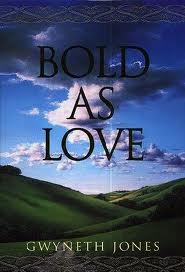
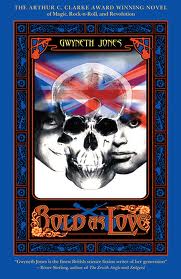
This is the book that, infamously, Tansy threw across the room when she got to the end and discovered it wasn’t a standalone novel. And I can understand that; I was halfway through it before she told me it was this one, and I too had just assumed it would stand alone. Truthfully, I think it could: there’s a huge messy pile of unresolved issues by the end of the book, but it’s done in such a way that actually I don’t feel a burning need to go find the next FOUR BOOKS. Well… that’s kind of a lie. I really really want to know what happens to my guys, but it’s a delicious sense of anticipation, not a burning MUST HAVE RESOLUTION NOW GETOUTOFMYWAY feeling.
Anyway. I was amazed to discover the book was only written in 2001; I thought it would prove to be much older. As Torque Control point out, it feels like it’s rooted in 1971 – the music, the festivals, etc. At the same time there are definite aspects that make it very modern – and those are mostly the same aspects which, when I thought about them carefully, contribute to the science fictional feel. (More on that later.) So it’s set at some time in the near future when the United Kingdom is splintering into separate countries, and a music festival has been organised to mark Dissolution. From this, essentially, come the main players in the novel – all musicians of one stripe or another – who end up being involved in politics. This seemingly-natural transition was, for me, the one aspect that didn’t sit comfortably. Perhaps it’s because I’m not very aware of the counter-culture movement in the UK (or Australia for that matter), and maybe they have, or could be imagined in the near future to have, this sort of political clout. It’s a minor quibble, though; after all, it’s sf/fantasy, and sometimes they require a bit of a leap.
Sf/fantasy? Well. Yes. When Tansy mentioned that it’s part of a series, she also mentioned that the fantastic elements become more pronounced over the series, and I can already see areas in which that can happen. But it is also definitely science fictional: there’s advanced technology in some areas, for example, and anyway it’s set in the future. I know that’s not a hard&fast guarantee of sf – just look at Michael Chadbourn – but it’s still there. In fact I think it’s one of the most fascinating meta-aspects of the book: it’s so genre, but… why does it have that feel? I don’t know, and I’m slowly coming to the realisation that actually, I don’t care about classifications so much. It’s a GOOD BOOK.
The plot, then, revolves around what happens to England (mostly) after Dissolution. There are social issues – such as the impact of a large Muslim minority; environmental issues – mostly around sustainability – which also tie into technological ideas; political issues – exactly what would happen if you put a bunch of counter-cultural musicians in a position of power? – and lots&lots of personal issues. After all, even when society is collapsing around you, in reality the thing that’s most likely to concern individuals is Does s/he like me? Who are my friends? What’s going to happen to me?
This is actually the first Gwyneth Jones book I’ve managed to get through, of two attempted: I gave up on Escape Plans pretty early on. And she is nasty to her characters! I don’t think there’s a single undamaged person in the entire ensemble. Thing is, the damage doesn’t make you want to cry for them, usually; instead, it turns them into quite hard characters, who would be utterly contemptuous of anyone even thinking of being sympathetic. Fiorinda is the sort of woman (girl, really, she’s a teenager – at least in years) who would fascinate me in real life but probably repel at the same time: she’s cynical and hard, and I’d be way too soft for her. She makes for an intriguing, and contradictory, main character. The main two male characters essentially revolve around her. I love Sage: he’s totally anarchic and narcissistic, while also being tender and considerate and generally awesome – plus his stage shows sound like they’d blow your head off. And Ax… well. He’s Mick Jagger and Jim Morrisson and David Bowie. And Bono and Bob Geldof too. I really really liked him, but I think Sage is still my favourite because he’s a bit more… human. And he’d hate me for saying it.
It’s a marvellous book. It deals with gender issues, social issues, and political issues. It wraps all of those things into the equivalent of the most awesome three-day music festival in the mud; you can’t let go, you can’t go home, you have to see it through. I have two copies (by accident) and I’m seriously thinking about keeping both of them.
Brightness Falls from the Air
One of the most interesting things about this book as an object is that nowhere (that I could find) does it mention that James Tiptree Jr is actually Alice Sheldon. Neither, though, is there any personal pronoun used for the author. This is really only interesting when you know something about the history of Tiptree, I guess, but it is revealing. It came out in 1985, which puts it only a couple of years before Tiptree’s death and several after s/he had been ‘outed’ as Alice Sheldon. So was the publisher trying to cash in on the Tiptree name and people now knowing the ‘truth’? Was it Sheldon/Tiptree’s decision? I’d be fascinated to know.
Going in, I thought this would have some of the terribly interesting gender discussions that many of Tiptree’s short stories have, and that – combined of course with the reality of Tiptree’s life – led to the Wiscon award for gender-bending in SF/fantasy being named after her. However, it’s not there. This isn’t to say anything against the story itself, which I’ll get to, but it was something of a surprise for me. There are awesome female characters; a female in command of a base, who is never questioned by the males under her, and a bunch of other women playing vastly different roles from one another – very few of the female characters or their dialogue had me cringing, which is laudable. There’s a homosexual relationship that’s neither more nor less obvious than the hetero ones… and everyone is referred to by the same honorific…. hmm. Ok. Maybe it actually is quite gender-subversive, or at least was for 1985.
Mild spoilers
There is a certain attitude in books and films that I – no doubt derivatively – refer to as the Agatha Christie Vibe. A group of people get together somewhere nice, mostly unknown to each other, and you just know that something very bad is going to happen. Brightness Falls from the Air, by James Tiptree Jr, is strong in that vibe. A planet where few humans live in order to monitor (in a good way) the indigenous sentients is about to experience a phenomenal cosmic event, and a select few tourists get to land for the show. Hello, sinister vibe.
I’ll admit, somewhat guiltily now, that I went into this book not entirely sure that I was going to enjoy it, but figuring it would be worthwhile because yo, it’s Tiptree, right? Yes, well. This is one of the best action-SF books I’ve read in a long, long time. The characters are awesome, the plot is skilfully drawn and brilliantly brought together, the worldbuilding is exquisite, and the issues it addresses – because there are some – are relevant and not overdone. Also, the writing: I could Not. Put. It. Down.
Whoever would have thought that a book which includes kiddie p0rn could have me waxing so lyrical?
Yeh. Kiddie p0rn. When I realised what was going on I was initially horrified – and, honestly, still am. It’s not a major focus of the book, but I have to put it out there, as I imagine it was picked up by contemporary reviewers. So: there’s a group of four teenagers who, with their manager, are among the tourists who arrive on the planet. It’s clear from the outset that they are TV-equivalent stars. But it’s only maybe a third of the way through that you discover there’s a sexual element to their stardom, and that there has been for a number of years. There are a number of fascinating things about this element, which account for why it didn’t immediately make me want to throw the book across the room. For a start, the manager is not the one exploiting them – he’s sympathetic, and looks after them as well as he can. For another, they’re mostly doing p0rn with each other; there’s a vague suggestion that they have been in such situations with adults, but it’s unclear. The main thing that makes this… not acceptable, because it is still horrendous, and Tiptree never suggests that it’s a good thing, but… easier to read about, is the adolescents themselves. They don’t suggest it’s a wonderful life; they’re pragmatic about their careers; and it’s never actually a central element of the story. I don’t think I’ve explained this at all well, to be honest, but all I can say is: despite its presence, I am not hesitating to recommend the book.
So, the characters. They’re marvellously entertaining. There’s an aloof one, a slightly crazy one, the teens, an on-the-surface pleasant one, sensible and earnest ones – and all of them, basically, are given interesting backgrounds, sound motives for all of their actions, complex and intriguing interactions with everyone else, and individuality. Seriously, Tiptree was a master at characterisation. There’s maybe one character who doesn’t get much explanation overall, but that’s not bad in such a large ensemble.
The plot? As I said, there’s an Agatha Christie vibe: something is clearly going to go disastrously wrong. And it does… in fact, several things do. I anticipated one of them, but the other major plot point was totally unexpected – in a good way: it made perfect sense, and upon revelation I could see where Tiptree had been leading up to it by stealth. And the two disasters weave around one another, without tripping the other up. One is an intensely personal disaster, while the other is on a more mercenary level, which is really nice; they deal with different issues and allow Tiptree to explore different reactions, emotions, and all that stuff.
Finally, there’s a really interesting element of, essentially, post-colonial critique, particularly at the very end. I have no idea whether Tiptree was into literary theory – I should hurry up and read that bio I guess – but I know post-colonialism was starting to be discussed at around the time the book was published. There are aliens on this planet, and they were terribly abused by humans in the past. Now, humans have taken it on themselves to try and rectify that… but of course, that’s still a colonial, paternalistic attitude, assuming the aliens are completely incapable of looking after themselves. Towards the end, then, there’s a suggestion of how this could change. It’s neat.
It should be clear that I adored this book, of course. It’s brilliantly paced, full of awesome characters, deals with meaty issues without getting moralistic, ponderous, or annoying, and the plot is just wonderful.
Writing masculinity
What better anthology to read at a largely testosterone-fuelled event like a 24 hour bike race than one intending to discuss masculinity? And so it was that I read c0ck, edited by Keith Stevenson and Andrew Macrae.
ETA: I have been reminded that the best way to pronounce the title is with a Scottish accent – “cawwwk” – and then it doesn’t sound nearly so rude.
I got into the Australian sf scene just after this anthology came out in 2006, and despite hearing good things about it and seeing it for sale at numerous cos, I only got around to buying it at WorldCon this year. I feel that I am now a bona fide member of the scene. I read it in a day – it’s only 130-odd pages long, and I’d already read the longest piece in it earlier in the week. Lying in my sleeping bag, my brain started analysing my reactions, and I couldn’t go to sleep until I wrote this:
Taken individually, many of these stories are just sf/f/horrow; quite good, mostly, but not necessarily exceptional in the issues of ideologies they present. However, being collected in this anthology – with such a provocative title – means they create something of a gestalt: they become a sum greater than their parts, forcing the reader to acknowledge and consider the particular modes and methods of characterisation utilised (if, that is, you follow the type of reading suggested by the editors). As a collection, these stories interrogate ways of being male (and, conversely, female) that are possible, acceptable, or viable. The very idea of what it means to be a man is questioned and investigated. In 137 pages, these authors use sf in particular in ways that to me are exactly what the genre should be about: they tell engaging, sometimes creepy, stories, all with quite different characters, and they suggest ways of thinking about ourselves and society that might, hopefully, lead to change in those ways of thinking.
Yes, I get a bit pompous late at night. Anyway, I primarily bought the anthology because of Paul Haines’ Ditmar-winning “The Devil in Mr Pussy (or How I Found God inside my Wife),” which was exactly as creepy and shudder-inducing and brilliantly written as I have come to expect from the man. One of the things I really like about Haines is he in some ways so domestic a writer – most of the stuff I’ve read is set in suburbia, with normal people as the characters – that it is intensely believable and, therefore, intensely horrific. In this case, a couple move into a new house and are trying to have a baby. He’s also trying to write, and ends up taking the cat’s antidepressants. Weird, weird things happen. This was a well-deserved Ditmar win.
I liked most of the other stories in the anthology. Cat Sparks’ “The Jarrah Run” was another favourite, set on an alien world, and kinda interrogating the idea of the knight errant, and “Honeymoon” by Adam Browne and John Dixon was also excellent, with a clever take on suitors fighting for the hand of the maiden. All up, I think the collection basically succeeds in its aims. If nothing else, I was forced to ask of each story what it was saying about masculinity, whether that was realistic or stereotypical, whether I subscribed to that idea or not, and the implications of all of those. There’s violence, and control issues, and sex (lots of sex), helplessness, frustration, and a variety of relationships with women and other men. I’m pleased to have finally read it; I think it’s a really interesting part of the Aussie spec fic scene of the last few years.
Episode 21 of Galactic Suburbia
You can get us from iTunes, or download from Galactic Suburbia.
In which we work, play, shake up our format a little (gasp!) and cover the life & death of magazines, the changing face of the industry, respect for non fiction, sexual harassment, rants, reboots and as usual, books, books and more books. Also a few sneaky clues about what Twelfth Planet Press is publishing next year!
News
Realms of Fantasy is back, again…
Escape Pod expands: “We have been pushing to expand what Escape Pod does, adding an SF blog and distributing our stories via magazine format. We’re also becoming a pro market, and hope to keep paying our authors pro rates well into 2011 if the donations make it possible.”
Cheryl Morgan talks about paying for reviews as semipro.
On the Cooks Source scandal and seeing stuff on the internet as ‘public domain’.
Jim C Hines on reporting sexual harassment in SF/F.
Old men complaining? When you get old, do you by consequence lose your sense of wonder? Just simply because you’ve read everything? And is/should all SF be aimed/written for the 60 year old man? And Jason Sanford responds
New Buffy Reboot
New Friend of the Podcast: The Writer & the Critic (Mondy & Kirstyn).
Chat, rants and backpedalling…
What Culture have we Consumed?
Alex: Blameless, Gail Carriger; “The Devil in Mr Pussy,” Paul Haines; Women of Other Worlds, ed. Helen Merrick and Tess Williams; Bold as Love, Gwyneth Jones; Day of the Triffids (2009 BBC production)
Alisa: works too hard, and also Fringe.
Tansy: To Write Like a Woman, Joanna Russ; Marianne, the Magus & the Manticore by Sheri S Tepper; Sourdough & Other Stories, Angela Slatter; China Mountain Zhang, Maureen McHugh, Mists of Avalon movie
Please send feedback to us at galacticsuburbia@gmail.com, follow us on Twitter at @galacticsuburbs, check out Galactic Suburbia on Facebook and don’t forget to leave a review on iTunes if you love us!
The Evolution of Ellen Ripley, take 2
I have no idea what happened last time I tried to post this – only half my post appeared! So hopefully my memory is good enough to remember what I wrote…
I love Aliens. I love the action, the characters, and the look. We recently bought the the Alien Anthology, complete with 3D facehugger:

Gross, eh?
So, we watched Alien, and J is convinced he’s never seen it before. Side note here (with spoiler): we met a guy in the UK who had a friend working as Ridley Scott’s PA while this was being shot. Apparently, That Scene where the alien bursts out of Hurt’s chest? No one knew that was going to happen. And I mean no one: not the cameramen, not the actors, not even Hurt himself apparently. They were all told that if they stuffed it up, they’d be looking for new jobs…
Anyway. We re-watched Aliens, and then skipped to Alien Resurrection, having seen Alien3 not so long ago on TV. And it got me thinking about Ripley.
I’d forgotten that, in the first movie, she’s nothing special. That is, she’s a competent third officer, and although Parker and Brett give her crap they still do what she says. But there’s nothing about her that stands out, and watching the movie for the first time I reckon you’d be hard pressed to guess who might survive (except for Lambert. No way was she going to live).
I love Ripley in Aliens the most, perhaps because I’ve seen it so often. She’s a complete wreck at the start, and the loss of her daughter is gut-wrenching. But she hardens up out of compassion for the colonists, and a conviction that she has to destroy the alien, and goes back to the source of her nightmares. There, of course, she adopts Newt, a daughter-substitute, and discovers the alien queen, having children of her own. I don’t remember where, but I read a really interesting analysis once talking about visions of motherhood in this movie – and the fact that Ripley becomes a monstrous mother, like the queen, in defending her daughter-substitute. She becomes a technological monster – a cyborg – so it’s something of a culture/nature clash. She ends the movie having found some semblance of peace, and you’re left believing that perhaps she can have something of a life, now.
Alien3 is, therefore, a gut-wrenchingly awful movie. That they killed Newt (and Hicks! poor Hicks!), and that Ripley then had to an autopsy – so destructive to Ripley’s soul. I enjoyed it enough when I saw it, but listening to Grant’s Bad Film Diaries made me appreciate it all the more; he devoted an entire episode to the movie. It was interesting that in this movie Ripley got to have a ‘love interest’ (she came close, I think, with Hicks, since she was basically Sarah Connor and he Kyle Reese). Not that it’s exactly a loveydovey romance; it’s mutually beneficial, and mutually agreed on, as a comfort. So she’s never distracted from the main task at hand. And then she’s called on to make that ultimate sacrifice, going out in a rather Terminator-esque blaze of glory… and it makes sense; it almost feels right that this should be the culmination of Ripley’s journey.
Except, of course, that it’s not. And bizarrely, the creation that is Ripley in Alien Resurrection feels even more right, in a twisted sort of way. She becomes part of what she fears and hates most, with the memories of that fear and hate. Perhaps the most poignant and chilling moment in the whole film is when she identifies herself as the monster’s mother: after the angst of losing one and saving another, she ‘gives birth’ to a final, loathsome daughter. Ripley herself has actually become a monster, unwillingly, unlike when she took on cyborg monstrosity for just a limited time in Aliens. But ultimately she uses that monstrosity for good… well, we hope so, anyway. I don’t really know what to think about the end of this film. Staring out over the ruins of Paris with Call doesn’t feel like a satisfying conclusion to Ripley’s saga.
The one thing I think could have made the development of Ripley as a character more interesting would have been an ongoing relationship, that adapts and changes with Ripley’s development as a person. I guess she sort of has this with the androids: working well with Ash and then getting shafted by him; fearing Bishop and then appreciating him, before getting shafted by Bishop#2, and then finally making peace with Call. But it’s not the same as watching one relationship change over time. And I don’t count Ripley’s relationship with the aliens here, either, because that’s really always based on hate.
So. I like Ripley. I like that we get the story of a woman in four films, over 18 years. I like that she changes and develops and evolves, that she was one of the early role models of kick-ass women that seem to have proliferated recently (maybe someone should write a comparative essay on Ripley, Sarah Connor, and River Tam? Probably it’s been done). I really like that although in the popular consciousness she might be defined by the action – and especially “get away from her you bitch” – there is more depth to her than that.
She is so very awesome.
Women of Other Worlds
Helen Merrick and Tess Williams had the chance to attend WisCon 20 in 1996. This book, which they co-edited, sprang directly from that experience. It’s a thick book – well over 400 pages – filled with fiction, poetry, and a variety of non-fiction pieces: some critical essays on authors or particular works, some collected correspondence, a few along the lines of memoirs. I haven’t read the whole lot yet, but the pieces I haven’t read are those that relate to work I’m unfamiliar with. So there are a couple relating to Lois McMaster Bujold, for example, which I’ll read when I’ve finally caught up with the world and read her stuff.
A complete review of the book would be… extensive, to say the least. But there are a few pieces that especially made me think. For a start, there were a few pieces of fiction that I didn’t really like. That’s an odd place to start a discussion of the collection, perhaps, but it was an important thing for me to realise and come to grips with. Part of me expects to always like everything in a particular set: all feminist SF, for example, or everything by Ursula le Guin… even everything SF, period. (This account for my dismay at not enjoying Terminal World by Alastair Reynolds as much as I had hoped, given my love of everything else he’s written.) So to discover that I didn’t like everything chosen by Merrick and Williams for inclusion was interesting, and gave me pause, and was ultimately quite useful in helping me think through my attitudes. There was much fiction I did like, of course, and one of those in particular was “Home by the Sea,” by Elisabeth Vonarburg. It’s a marvellous tale about struggling with identity, and family, and personal history, in the context of a vague environmental disaster. Kelley Eskridge’s “And Salome Danced” is also a brilliant piece, creepy and lush and subtle. Showing just how useful the internet has become in facilitating criticism, it’s followed by a essay comprising email correspondence from the Fem-SF list about that story, allowing for all sorts of interesting comparison and discussion.
As an anthology relating to WisCon, there are of course a couple of pieces relating to James Tiptree Jr, although – not unexpectedly – they’re neither straight biography nor criticism. There’s an excerpt from one of the cookbooks put out to raise money for the eponymous award, which is hilarious and sounds delicious and makes me want to buy the book, and Pat Murphy’s reminiscences about how the award got started. And Justine Larbalestier contributes an essay on “Alice James Raccoona Tiptree Davey Hastings Bradley Sheldon Jr”, and the stories told about that collection of identities, that makes me itch to go read the bio sitting on my shelf.
Judith Merrill, to whom the anthology is dedicated, finishes the anthology, with an excerpt from her memoirs, and a reflection on the compiling of the same. She had been a Guest of Honour at the con, and died before the anthology was completed. It’s another bio that I really must get my hands on, because she sounds like a most amazing woman, especially in the context of her time but really for all time. I’ve read hardly any of her work, and I’ve tried looking for one of her novels (Shadow on the Hearth), but she seems to be totally out print, which is tragic.
What Merrick and Williams show in this book is how different sorts of writing can work together to give an impression of a community, all its different aspects and ways of relating and divergences. It’s my sort of book; good fiction, good criticism, humour and an attempt to understand the world, or bits of it anyway.
An open letter
Dear Joanna
– do you mind if you call you Joanna? I’m not going to pretend like I know you from your writing, but Ms Russ feels rather distant and Professor Russ is rather intimidating. I do kinda get the feeling, from your work, that should I meet you in a social setting, after I recovered from my awkward fangirl-induced silence and/or hysteria, you would be Joanna. Thus –
Dear Joanna
I’m 31. That means all of your novels were written before I was born. Much of your short fiction was, too, and almost all of your reviews. (Happily you’ve kept writing essays and the like, so I’ve got heaps still to read – not that I’m even through your fiction yet.) Despite being an historian myself, and one obsessed by the ancient and medieval worlds at that, there is a small part of me that is still somewhat amazed that work from before my birth can have an impact on me. Although I quite like Ancient Greek tragedy, for example, medieval literature rarely affects me on a visceral level; it’s too foreign; I mostly like the ancient tragedies because they’ve become so wrapped up in Western European culture.
The point is, your fiction does affect me. I’m only a child of the ’70s by the grace of three months, and I grew up in Australia, so I don’t really understand the anti-feminist rhetoric that so clearly affected The Female Man, for example. I sometimes get made fun of for identifying as a feminist, which is insulting and horrible and all those sorts of things, but it’s never turned actively nasty, actively hostile – which I know is a blessing. Reading The Female Man, especially the section where you anticipate reviewers’ reactions? Well. It was like a punch to the guts to realise that you expected that sort of reaction. And it makes me admire you fiercely for being willing to put your work out there and endure that sort of reaction because you believed in your work, and in what you were saying.
(All of this may make me sound naive and innocent. I’m not, really. It’s just that my understanding of second-wave feminists’ experiences has often been a bit academic, I guess. Hostile critical reviews, especially when they’ve already been actively anticipated and lampooned, are not academic.)
The first of your work that I read was “When it Changed,” and I had the advantage of reading it without already knowing the reality of life on Whileaway. When I gave a copy of that story and The Female Man to a friend of mine entering law school (she has a Masters in Philosophy as well, don’t worry), I had to scribble out the intro to “When it Changed” because it revealed who the narrator was, which is of course most of the fun. Since then, I’ve read one of your Alyx stories, The Two of Them, “Souls” (which I was overwhelmingly excited to see as a double with a Tiptree story!), and To Write like a Woman. I really enjoyed that collection of your non-fiction, by the way, and I’m dead keen to get the others. You have such an incisive mind, and such a delightful turn of phrase. I especially enjoyed your essays on “What can a Heroine do? or why Women can’t Write,” and “Somebody’s Trying to Kill me and I think it’s My Husband: the Modern Gothic.” You maintain an inspiring balance between humour, and compassion, and cutting criticism that makes your work wonderful to read. So, thank you for that. You have indeed inspired me.
My one issue I wanted to mention is your early dismissal of stories you said you were set in “galactic suburbia.” Admittedly I only know about this from Lisa Yaszek’s book of that same name. I quite enjoy the (well-written) stories set there, and I’m wondering whether you have changed your mind since your discussion of them. If you haven’t, that’s fine… I guess I wonder if, with distance between then and now, things have changed. And at the heart of that wonder is the question of whether you think things actually have changed enough for it to be worth changing your mind. This is getting convoluted; let me explain my (now admittedly naive) thought process. I am presuming that part of your dismissal stemmed from the idea that those stories weren’t feminist enough, and that female authors ought to be writing more challenging, more overtly feminist, work. Maybe I’m wrong; maybe you just didn’t like them. Fair enough. But if my assumption has any truth, do you now think that there can be a place for more domestically-oriented texts? Hmm… it may well be that I am just digging myself in deeper now, and this is making me sound totally unreconstructed.
The reality is, this is fanmail. I love your work. I love that you write/wrote fiction and non-fiction, that you are an academic who is passionate about science fiction, that you are a passionate feminist, and – what spins me out – that you have been those things for so long (sorry, I don’t mean to imply that I think you are old…). You are an inspiration to me.
With deep regards and immense gratitude
Alex

 Randomly Yours, Alex